

Slovenian theatre is going through a period of transition, beset by changes in artistic leadership, threats of funding cuts and creeping conservatism. Karolina Bugajak asks if the country’s cultural institutions can remain spaces of resistance and experimentation?
The last theatre season in Slovenia was marked mostly by word – change. Much of it was institutional, though, unfortunately, not formal. Leadership changed at Mladinsko Theatre and at SNG Drama. The way the theatre programme at Stara Elektrarna operates also has shifted and it is still awaiting the government’s decision on whether Bunker will continue to manage it. Perhaps most significantly, however, Slovenia has a new government – a political change that is likely to reshape the country’s theatre landscape and determine which projects receive public funding in the coming years. Independent artists and non-governmental organisations may find themselves in a particularly difficult position. At a time when smaller players in the cultural landscape are struggling, cultural institutions could have a crucial role to play in resisting the growing conservative backlash and driving positive change, particularly as the government shifts further to the right. With this in mind, I would like to take a closer look at these institutional changes and explore whether cultural institutions are capable of leading such a transformation. I also want to examine what new developments these changes have already brought about, and what they might mean for the future.
Let’s start with Mladinsko Theatre, which is currently led by artistic director Marko Bratuš and director Inga Remeta. At the start of the previous season an exhibition organised to mark the theatre’s 70th anniversary was presented in Tivoli Park alongside a discussion with former directors Goran Injac and Tibor Mihelič Syed, as well as the graphic designers behind the theatre’s distinctive visual identity. The meeting took place at the Museum of Contemporary History, in a large, ornate hall. I do not know whether this was intentional, but, combined with the retrospective exhibition that preceded the discussion, the whole event served as a symbolic gesture telling us – the Mladinsko of Injac/ Mihelič Syed duo is now a thing of history, as are all the projects they spoke about during the meeting. The new director was not included in the discussion, which meant it was purely a look back at the archives without any sense that we were looking towards the future. Instead, a sense of nostalgia and sadness for Mladinsko’s fading glory.
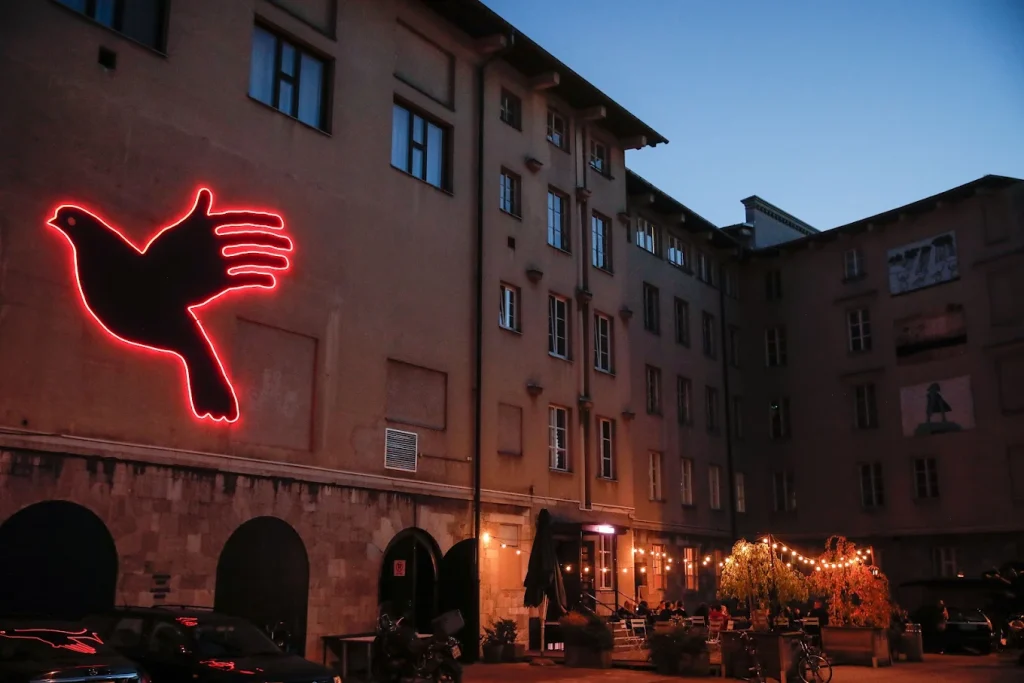
Mladinsko Theatre
A director’s first season is a transitional one, which is why it is usually the most timid and the most difficult. This, one hopes, is why there were very few interesting premieres. The productions were in no way engaged with the themes and forms that had previously been important to Mladinsko. Most of them touched upon themes such as environment or feminism at a very basic and superficial level, some of them even could even be described as problematic in respect of the way they represented of fragile topics. The most interesting work was connected to Tomi Janežič’s Dodekalogija project, but this was not initiated by Mladinsko, rather it is a larger project by the director created as part of the European Capital of Culture.
In previous seasons, Injac’s approach to programming was to build each season around a specific theme. For example, one season focused on love, which could be understood in different ways, such as queer love or love for one’s homeland. This year, the theme of the programme is “unusual.” And no, this does not refer to non-normative people or stories, but rather is an umbrella term that can cover many different performances. Of course, this may be a certain kind of strategy if there is no specific vision for the development of the theatre behind the programme, but it left the question of what kind of theatre Mladinsko should be unanswered.
The programme includes Sebastijan Horvat’s Osem ur ni ves dan based on Rainer Werner Fassbinder’s TV show (a coproduction with Prešernovo gledališče Kranj, Slovensko mladinsko gledališče, Mestno gledališče Ptuj and the Croatian National Theatre in Zagreb); a lecture/performance Three-sided chess made by Dario Varga, and a performance on militarisation by renowned director Janez Janša. There is a diversity of themes, but it is difficult to identify a clear curatorial idea. The most interesting programme – both thematically and formally – is the one selected through the Mladinsko Lab open call, to which younger theatre-makers applied. It is precisely these projects that seem to have the potential to continue the tradition of the former Mladinsko and its experimental space, Nova pošta, however they are not the director’s curatorial choices, so it is difficult to treat them as an expression of a coherent artistic vision of the new management.
During the two terms of Goran Injac and Tibor Mihelič Syed, Mladinsko became a European theatre – open to experiments, new themes, aesthetics and strategies. Its international character seems particularly important, especially in the context of Slovenia. Of course, Injac himself is not Slovenian, but this also refers to collaborations with directors from abroad, including Poland and Germany. Thanks to his many years of experience working abroad, Injac also brought a different perspective on theatre and how it functions. At present, the only international production is supposed to be a performance prepared in cooperation with a Croatian theatre, which itself comes from a theatrical tradition similar to that of Slovenia.
As a result, we may see Mladinsko once again closing itself off within its local bubble. Slovenia, like many other countries, has its own specific school of directing and narrative-building. The existence of such a tradition is, of course, perfectly natural, but limiting collaborations exclusively to directors from the region may mean fewer experiments and new experiences for the actors. Mladinsko, also thanks to the many years of work of its predecessors, became a theatre recognised beyond the country’s borders. It was able to travel to international festivals and represent Slovenia on the international stage. Today, from what we saw last season – I see fewer opportunities. It is because of the themes and forms of the proposed productions, which may be less attractive to international audiences and festivals. However, what I believe was the most important characteristic of Mladinsko under its previous leaders was the theatre’s particular political and social engagement, with its curatorial programme responding to existing inequalities. In current programme we can find some singular accompanying events that resist questionable political decisions such as Palestinci so tvoje oči, however it’s difficult to call it theatre’s strategy. Politically and socially engaged theatre is particularly needed at a time when right wing parties are gaining strength. In 2026, a right-wing government led by Janez Janša took power in Slovenia. In this context, the absence of a theatre with a strong curatorial programme and a clear artistic vision, one that could address pressing social issues, engage in dialogue with current events and confront dominant political narratives, is a significant loss for Slovenia’s cultural community.
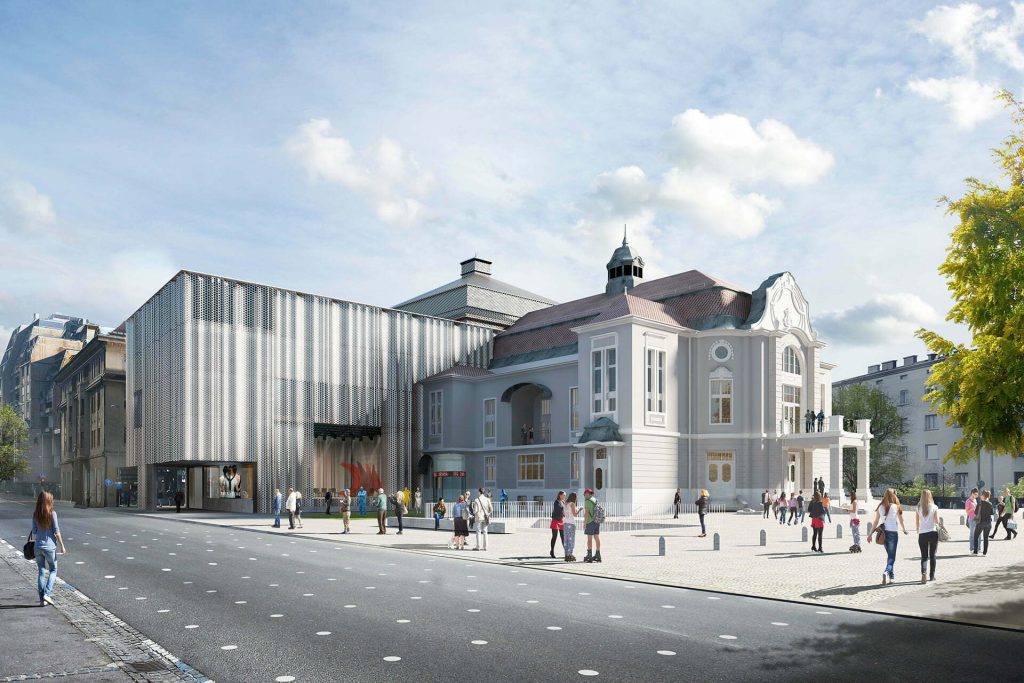
Architectural plan for SNG Drama
On a more positive note, SNG Drama, under the leadership of Ivana Djilas, is showing great commitment to social issues and theatre life. Although Drama’s current programme still largely curated by the previous management’s team, the new director has already organised a series of accompanying events that may indicate the kind of theatre the Drama could become under her leadership. The start of her term coincided with events in Serbia – the cancellation of the Belgrade International Theatre Festival (Bitef) and the organisation of a new, guerrilla-style alternative, ne:Bitef. Djilas made a gesture of solidarity at the time; not only did she publicly support the Serbian students’ protests, but she also organised a screening of Milo Rau’s The Pelicot Trial, staged as part of ne:Bitef, at Drama. In doing so, she outlined a vision of a theatre of solidarity, activism and social engagement, one that responds to current events and does not remain indifferent to what is happening beyond its walls. Thanks to these initiatives, Drama has also gained greater media visibility as one of the supporting theatres. – not only in Slovenia, but also beyond its borders.
The theatre’s original building is still falling apart, overgrown with weeds and standing forgotten in the centre of the city. This is the result of long negotiations over the renovation of the building. However, due to ongoing archaeological work, the project is paused, while politicians seem to have little interest in it. As a result, Drama has gained a modern building located in an industrial area far from the city centre, with poor public transport connections. The national theatre has therefore been pushed out of the centre and now resides in a grey, deserted part of the city. Symbolically, this is of course a significant change, and Djilas is aware of it. While politicians are celebrating the new building and the awards won for the renovation of the former industrial warehouses, Djilas is not giving up and continues to emphasise his desire to return to the city centre.
First, in June, she organised a site-specific performance there, which was open to everyone. As the actors were unable to perform in the old building, the performance took place in the courtyard in front of the theatre. The next event was Djilas’s recent appearance, together with the cast and other Drama staff, in front of the theatre building to clear away the rubbish lying there, clear the walkways of debris and pull up the weeds. As the director herself said, it was sad to see Drama falling into disrepair and being left to deteriorate. That is why those to whom the theatre belongs – its staff – decided to do something about it. This is a remarkable act of commitment, but also a way of putting pressure on politicians to take further action regarding the building. And it seems to have worked, as a visualisation of the planned renovation has finally been released.
In many countries, national institutions are characterised by stagnation and a tradition of silence. Djilas is trying to change this perception of the national theatre as a static, inaccessible institution by showing that it can also be an active, vibrant participant in social life. So, interestingly, this major national institution seems to be more lively than many others at the moment, and this is largely due to the clear and strong vision of its leadership.
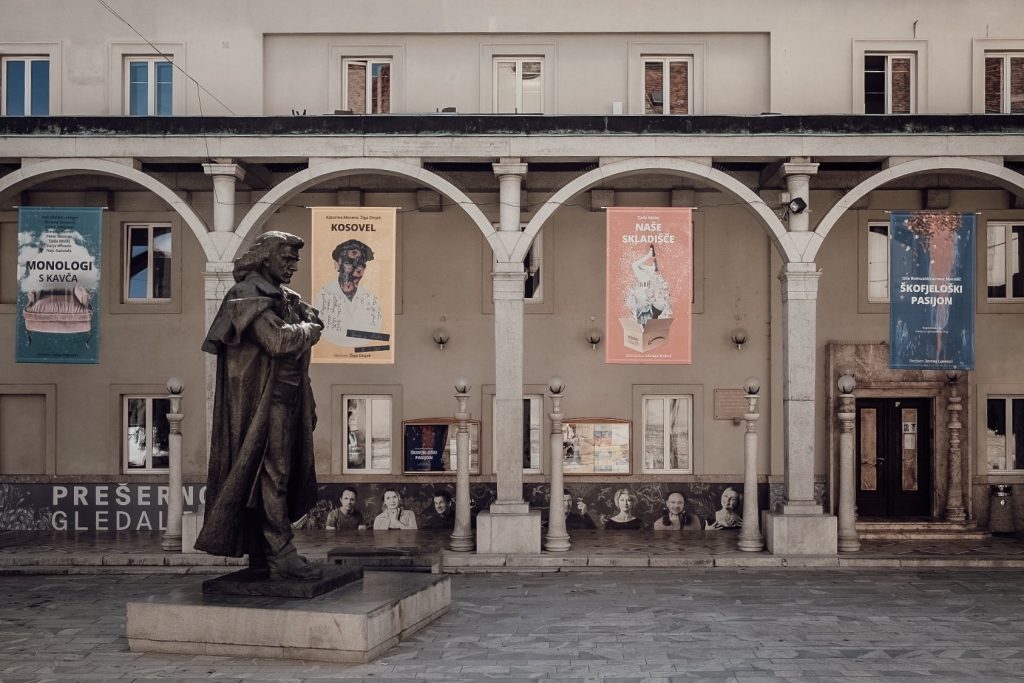
Prešernovo gledališče Kranj
There is, of course, an abundance of theatre happening outside Ljubljana. Theatres in Kranj and Nova Gorica are increasingly surprising audiences with interesting approaches. Particular attention should be paid to Prešernovo gledališče Kranj, whose director, Rok Bozovičar, took up the position in 2025. The theatre in Kranj is part of the Drama of Smaller European Languages network and also organises the Week of Slovenian Drama festival. This year’s edition was particularly interesting because of its selection of productions. Bozovičar invited theatre critic and scholar Zala Dobovšek to serve as the festival selector, giving the festival a clearer thematic profile. As Dobovšek herself pointed out, in making her selection she focused primarily on politically engaged theatre – both in terms of its themes and its formal approach. The programme included productions addressing topics such as sex workers, ecology, and feminist theatre in the broadest sense. The main award for best play went to Anhovo by Žiga Divjak and Katarina Morano, directed by Divjak – a production addressing the problem of environmental pollution in the town of Anhovo resulting from industrial activity. One of the festival premieres was Tekst telesa by the young director Tjaša Črnigoj, based on a text by Anja Novak and dealing with eating disorder – an issue that is still relatively rarely addressed on theatre stages.
It seems that PGK has a clear vision of the kind of theatre it wants to be – one focused on contemporary, often young Slovenian drama and its promotion abroad. As part of the DoSEL project, Slovenian plays are translated and presented to a wider, international audience. Meanwhile, the inclusion of plays by young playwrights in the programme of the festival organised by the theatre in Kranj further strengthens its position and points the way forward for its development. Bozovičar also endeavours to involve local residents in the theatre’s activities. In the new season, entitled Paths of Closeness in a World of Distances, a production focusing on the learning of the Slovenian language by foreigners was staged. This is an important topic for Kranj, given the significant Albanian community living in the town. The choice of this theme demonstrates that the theatre is seeking to respond to the local community.
Since we are talking about engagement with local issues, the theatre in Nova Gorica also has an interesting approach. It is an example of a theatre that, once it firmly establishes its own direction, could become an interesting point on the theatrical map. While PGK focuses on dramatic texts and promoting them abroad, SNG Nova Gorica seems to be much more deeply rooted in the identity of the region. The theatre’s current artistic director is Neda Rusjan Bric, a Slovenian actress and director known for productions dealing with Nova Gorica and its surrounding area. Among other things, she created a trilogy devoted to the aleksandrinke, or the Rusjan brothers imported for the region.
The theatre stages both classical and contemporary productions. Its interest in local history was explored particularly extensively as part of GO! 2025 – European Capital of Culture, which, among other things, led to Tomi Janežič’s Dodekalogija, a cycle of twelve performances telling the stories of people from the region. SNG NG also tries to invite young artists and address contemporary issues. One example is last year’s queer production The end of an era, directed by the young Jaka Smerkolj Simoneti. Presenting productions dealing with queer themes and based on the work of a young playwright is particularly important outside the capital, where such subjects may find it harder to gain support. The theatre in Nova Gorica does not have a clearly defined programme profile built strongly around one particular theme yet. It could, however, be argued that its distinctive feature is its local focus and its interest in the history, memory and identity of the region, as well as its creation of space for artists connected to the area.
Slovenian theatre is currently shaken by changes, threats of funding cuts for culture, and rising conservatism. Despite this, what gives me the most hope, is the artists of the younger generation – millennials and members of Gen Z – who do not seek to imitate the big names of the Slovenian stage, but rather strive to experiment, find their own voice and explore new theatrical forms. More importantly, they tackle contemporary themes with which the audience can identify. It is in this generation that I see hope that theatre will remain a space of resistance against growing conservative tendencies. Young artists also seem particularly attuned to the themes present in contemporary theatrical discourse. They explore feminist and class issues, as well as those related to capitalism, social inequalities and violence. In doing so, they are opening up space within Slovenian theatre for themes that were previously addressed less frequently or remained on the margins of artistic debate. This generation therefore has the opportunity not only to explore contemporary issues, but also to broaden the scope of what and how is discussed on Slovenian stages, especially when given opportunities to enter institutional theatres.
Tjaša Črnigoj deserves special mention. Her project Sex Education II and later productions tackling feminist themes – including the rarely explored subject of abortion – demonstrate the consistency of her artistic exploration and establish her as one of the key figures amongst the young generation of Slovenian female directors. Her works have also gained international visibility and have been presented at festivals abroad, demonstrating that the themes addressed by the young Slovenian theatre scene can resonate with audiences beyond the country’s borders. Her theatre is a meticulously constructed form of documentary theatre that unfolds herstories and focuses on transforming the way in which the history of Slovenia and the entire region is told. Črnigoj draws on stories that were previously marginalised or overlooked (particularly the experiences of women ) and uses theatre as a tool to reclaim them and incorporate them into the broader collective memory.
Another artist worth noting is Varja Hrvatin. She has already created the feminist performance Sukeban, which addresses violence against women and the Japanese gangs that combat it. Her next interesting project was Stampedo, which tackled the issue of the irresponsibility of the authorities and local politicians in the face of the tragedy that occurred at a Slovenian nightclub in the early 2000s. Hrvatin readily draws on internet aesthetics, often incorporating elements of kitsch and camp. Her productions not only tackle contemporary issues but also seek out appropriate and relevant theatrical and aesthetic forms through which to explore them.
Živa Bizovičar is also a director from the younger generation who is well worth keeping an eye on. Bizovičar skilfully employs the visual language of theatre to create dynamic scenes, while at the same time making deliberate use of set design and costumes, which makes her productions visually interesting. Her production Boško in Admira, which also marked her directorial debut at Mladinsko and tells the story of the war in the Balkans, was, in my opinion, the best production of the season 2024/25. Bizovičar is currently working on Sabat at Cankarjev Dom, a production about witches – a feminist and very timely subject in today’s theatre debate.
Bora Ravbar’s career is also developing in an interesting direction, as his performances often address questions of class and social inequality. Particularly noteworthy is the site-specific Kje mi živimo, which focuses on the housing situation and the crisis of housing affordability. Ravbar also explores class issues and the subject of precarity in the performance deklici, based on a text by young playwright Nina Kuclar Stiković and focusing on the financial situation of artists.
An important performance from the previous season was Now, Suddenly, I Was a Creature of Vice, directed by Lučko Nežа Peterlin – a documentary performance based on conversations with sex workers. Peterlin neither judges nor moralizes, but instead gives them a voice, creating an honest and nuanced picture of the conditions of sex work. She does so on her own terms, using the form of documentary theatre
At a time of political uncertainty and changes in theatre leadership, the future of Slovenian theatre depends on whether cultural institutions can preserve their critical role and create space for a new generation of artists. To answer the question of whether cultural institutions can remain spaces of resistance, experimentation and social change, I deeply believe that they can, and some of them are already proving it. Especially with the support of younger generations of artists who are not afraid to tackle taboo subjects, even when doing so might put them in a difficult position, this approach to leading theatre is possible. I really hope it is, because particularly today, we need distinctive and independent voices that can make audiences uncomfortable, challenge dominant narratives and provoke discussion, both through the subjects they address and the theatrical forms they explore.
However, it is important to emphasise that these voices should not be left isolated from the beliefs of cultural institutions. As public spaces, cultural institutions should not merely produce performances, but also foster critical discourse. They have the potential to become much more powerful when they move beyond presenting individual productions that primarily reflect the personal artistic vision of a single director. Instead, they could focus on developing coherent programmes that encourage collective thinking, foster dialogue and engage with pressing social and political issues. In this way, theatre can become a space where public opinion is shaped, dominant narratives are questioned and alternative ways of understanding the world are collectively imagined.
I can only hope that the structural and financial problems caused by the new authorities will not prevent institutions to fight, and young theatre artists from developing their careers.
Further reading: Tjaša Črnigoj: “Women’s sexual pleasure is still taboo in our society”
Further reading: Living Conditions: Staging Slovenia’s housing crisis.

Karolina Bugajak is a theater critic from Poland, currently living in Ljubljana. She studied culture and contemporary art at the University of Lodz. The title of her master's thesis was "Theatricality and Exaggeration. Camp aesthetics as a strategy for creating new identities in the plays of Grzegorz Jaremko". Her main theatrical interests include topics such as institutional criticism, the representation of marginalized groups in plays, and most recently the theater of the former Yugoslav states.