The 59th official edition of Bitef took place this year, but the spirit of the festival – and much of its audience – were missing. Andrej Čanji looks back on the events that prompted this year’s ne:Bitef and asks what all this means for the festival’s future.
On paper, the 59th edition of the Belgrade International Theatre Festival (Bitef) went ahead this year as planned. Productions were invited. Performances were staged. The reality was somewhat different. Many of the originally programmed artists withdrew and the festival was boycotted by part of its regular audience. A parallel, self-organized ne:Bitef, the second iteration of a guerrilla festival created as a consequence of last year’s censorship, took place at the same time.
Problems with this year’s Bitef emerged even before the selection of the 59th Bitef was announced on June 26. The first signs that things were falling apart appeared as early as May, when Sebastijan Horvat and Milan Ramšak Marković turned down the invitation to present their piece The Conqueror at Bitef. They were soon followed by the British-German group Gob Squad, whose refusal was confirmed by the organizers at a press conference on June 23. As soon as the selection of seven productions was officially announced on June 26, the formal withdrawals began. On July 3, Portugal’s Teatro Praga pulled out, with its production Audition; Žiga Divjak subsequently announced that he would not attend, prompting the Slovene National Theatre Nova Gorica to withdraw his play Anhovo.
The exodus only accelerated from there. On July 21, the Italian company Motus withdrew its production Frankenstein_Diptych (Love Story + History of Hate); on July 30, Lebanese artist Ali Chahrour pulled out of When I Saw the Sea; and on August 2, Argentine artist Marina Otero withdrew her project Kill Me. Finally, on August 19, The Medea Case by Diego de Brea, produced by the Montenegrin National Theatre, also dropped out. This left only one production from the original seven: Black Gold, produced by Belgrade Drama Theatre and directed by Oliver Frljić, although Frljić himself had already stated on July 8 that performing it would amount to normalizing censorship. For most of them, the reason was essentially the same. The artists refused to legitimize last year’s censorship and the authorities’ pressure on culture by taking part, and chose instead to stand in solidarity with their Serbian colleagues, who had kept them informed about the circumstances surrounding this year’s festival.
To understand what prompted the artists to withdraw we need to go back to the opening of the 58th Bitef in 2024. The festival’s then-selector, Nikita Milivojević, invited Antigone in the Amazon by Swiss director Milo Rau, who was also given the honour of making the festival’s opening address. At the height of the protests against Rio Tinto, the company that planned to extract lithium from one of Serbia’s most fertile regions, Rau criticized such plans from an environmental perspective.
Several months later, Milivojević, who had brought Rau to the festival, was not given another term. In public discourse, the decision was linked to political pressure on the festival. At the same time, Bitef’s budget was cut. Yet there were still several clear-headed people in positions of responsibility who proposed the director Miloš Lolić as the new selector. It took some time before Lolić’s acceptance of the offer was confirmed. We soon learned that theatre scholar Ana Vujanović and dramaturg and critic Borisav Matić would also join his selection team. Their selection for the 59th edition of Bitef included Milo Rau’s The Pelicot Trial.

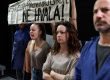
The ne:BITEF performance of The Pelicot Trial
According to reports, Nataša Mihailović Vacić, then Belgrade City Secretary for Culture, and several members of Bitef’s Board discussed the selection, resulting in the program being rejected twice, precisely because it included Rau’s work. According to the testimony of Lolić and Matić, the Board members who voted against it did not discuss the production itself, but its director. Actor Svetozar Cvetković, then chairman of the Board and the only member to vote in favour of the program, later described the decision as “censorship of a name.” Miloš Lolić and Borisav Matić went public and announced that Bitef had been censored. The official Bitef was therefore not held. Instead, in response, ne:Bitef emerged as a self-organised guerrilla festival of Belgrade’s cultural community, with Rau himself joining in solidarity with his production as its central event. It was precisely this sequence of events that became the context in which artists from across the world declined the invitation to participate in a prestigious international festival.
This year, a new edition of the official Bitef was announced by Jelena Medaković, the new Belgrade City Secretary for Culture. A new selector was chosen: Spasoje Ž. Milovanović, whose appointment represents a radical break from the succession of competent and principled figures who previously held this position. Given that no official apology for last year’s censorship has been issued by any authority, the official Bitef lacked the essential spirit of Bitef. For that reason, the official Bitef came to be seen as an anomaly in relation to the festival’s tradition, which has historically been seen as pushing the boundaries of artistic form and freedom. It became important that another Ne:Bitef be held this year and every year until the essential spirit of Bitef is regained.
The official Bitef, however, rejected this contunuity. Spasoje Ž. Milovanović argued that this year’s festival cannot be viewed through the lens of last year’s events because the City Secretary for Culture, the Board, its president, the selector, and the program have all changed since then. His central argument is that Bitef is a public institution founded by the City of Belgrade, and that it is precisely institutional continuity that determines which event can bear its name. According to this interpretation, ne:Bitef may be a legitimate parallel cultural event, but it cannot assume the identity of the official festival.
Milovanović further argued that the creation of parallel events, however legitimate as an expression of disagreement, leads to a division of the cultural sphere rather than resolving disputes within institutions. Jelena Medaković went a step further, calling for last year’s events to be treated as an incident that should be left behind, and for Bitef not to be “vulgarized” or “politicized.” In this way, Bitef’s officials attempted to frame the dispute over the festival as a question of its future, while obscuring the question of responsibility for last year’s decisions, the distortion of the festival’s long-held values, and the cultural resistance that is active in Serbia.
The officials’ arguments remain abstract in nature. They avoid specific events, overlook facts, or simply ignore them. A change of a few people, for example, does not mean a break in the institutional continuity of responsibility, particularly since two members who were involved in last year’s decision still sit on the Board. The City may be Bitef’s formal founder, but that does not make it the owner of its cultural identity, because the city government is subject to change and does not represent the will of the city as a community, but rather the political structures in power at any given moment. This is precisely why ne:Bitef is guided by the slogan that Bitef is the people who create it, and that it is wherever we gather. The parallel festival did not, of course, divide the cultural community; it emerged in response to a decision to invite Milo Rau again, a move those in power did not approve of. That is the reason that community was excluded from having a say in the festival. Ultimately, last year’s “incident” cannot simply be left behind by passed over it without an apology, accountability, and a clear repudiation of the decision that produced it.
After the majority of artists on his first selection withdrew, Spasoje Ž. Milovanović quietly put together a new one. There was a sense that the authorities wanted, with parliamentary elections coming up, to preserve the appearance of normality at all costs and avoid calling into question the survival of a major cultural event with an international reputation. The new programme was announced only a few weeks before the start of the festival, giving the impression that its publication was delayed until the last possible moment. Everything was done quickly and behind closed doors, leaving a strong impression that the aim was to minimise the possibility of further withdrawals. It is possible that this is also why, unlike the failed selection, which gravitated toward the West, the new selection turned toward the East, where Serbian artists have fewer contacts and fewer opportunities to inform their colleagues abroad about the circumstances surrounding their participation.
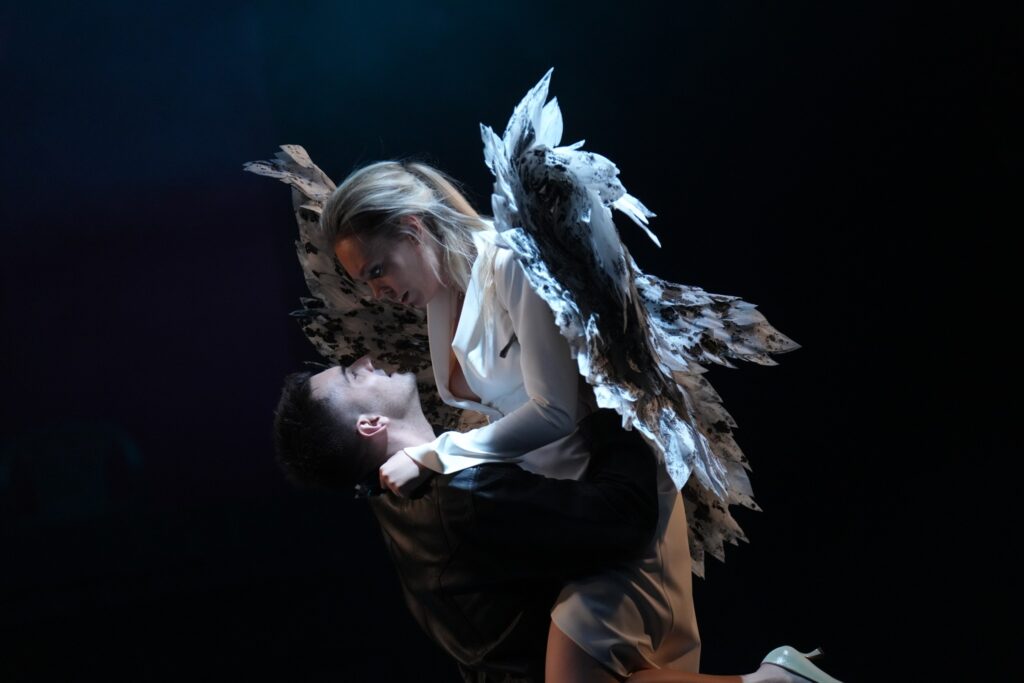
The second selection for the 59th Bitef comprised eight productions: The Merchant of Venice by William Shakespeare, directed by Strahinja Padežanin and produced by KPGT in Belgrade; Albion by British writer Mike Bartlett, directed by Zafir Radjab and produced by the Youth Theatre “Nikolay Binev” in Sofia; Russian Blues, choreographed by Sofia Gorlova and Anton Shmakov and produced by Metr Dance Company in Yekaterinburg; Chișinău by Night by Mihai Fusu, produced by Teatrul Fără Nume (Nameless Theatre) in Chișinău; Stalker by Avtandil Varsimashvili, produced by Liberty Theatre in Tbilisi; Black Gold by Dejan Dukovski, directed by Oliver Frljić and produced by Belgrade Drama Theatre; Antigone by Sophocles, directed by Hakan Alkan and produced by Karma Sahne in Samsun; and The Runaways by Wafa Taboubi, produced by the Tunisian National Theatre and Fabula Production. Of the productions in the original selection, only Black Gold remained in the final programme. Its performance was ultimately cancelled, officially because an actress had fallen ill, but also directly after Frljić once again publicly objected to his production being staged during Bitef.
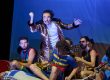
Black Gold, Belgrade Drama Theatre
The slogan of Bitef’s second selection remained the same as that of the first. “Dare to Find Out,” a slogan uttered by those unwilling even to hear a word of criticism, was now being used for two entirely different selections. This alone shows that Bitef is being approached mechanically, without an idea or any sense of value. The slogan is cynical because it embodies a fundamental paradox: an injunction to broaden the horizons of knowledge is being voiced by a selector who came to head the festival through a sequence of events stemming from censorship, and who then refuses to acknowledge the obvious fact that at a festival of freedom, he is cultivating a spirit of prohibition.
The anomaly has affected the audience as well. Part of Bitef’s regular audience decided to boycott this edition and symbolically create a parallel version of it in an attempt to preserve its values. On the official social media accounts, during the first days of the festival, the half-empty halls were noticeable, and subsequent photographs were taken in ways that made it difficult to establish the actual turnout. They stopped posting photos if audiences inside the theatres.
During the festival, Spasoje Ž. Milovanović used his social media accounts to publish cynical spin pieces in which he boasted that his selections were good enough for two theatre festivals, since almost all the participants in the first failed selection had supported ne:Bitef by attending in person or joining via video link. Milovanović went on to suggest that the “parallel festival” owed him an honorarium because his selection had effectively provided the content for both festivals. Although he was denied the financial reward from what he calls “a gathering of frustrated, socially engaged activists of whatever, hungry for attention,” Spasoje Ž. Milovanović managed to do the job he was hired to do, and in doing so permanently marked the continuity of the celebrated festival with vulgar cynicism.
Bitef, however, was from the very beginning much more than a festival of contemporary theatre. It was founded in 1967, at a time when Yugoslavia was rapidly opening up to the world, and when the liberalisation of society, the internationalisation of culture, and the affirmation of the Non-Aligned Movement were becoming important features of its domestic and foreign policy. Emerging from the artistic and intellectual circles around Atelje 212, Bitef was at once an expression of the artistic modernisation of the period and a product of cultural diplomacy. Its international orientation corresponded to Yugoslavia’s position between East and West, while bringing the most radical theatrical tendencies of the time to Belgrade represented one of the most visible forms of the country’s cultural opening. Bitef became one of the most important cultural events to survive the breakup of Yugoslavia, wars, sanctions, international isolation, and the NATO bombing, as well as the continued fragmentation of the state in which it was founded. Social systems, state borders, and political contexts changed, but despite all the crises it went through, the festival managed to preserve its continuity and its place in the country’s cultural life.
From a recent perspective, the history of Bitef becomes a story of an inverse process. The movement is going in the opposite direction, from the opening of the boundaries of what was permissible toward their gradual narrowing. The festival emerged on a wave of social and cultural liberalisation within a one-party system, in a society that, despite the repressive mechanisms of its political order, was willing to open its borders to the world, contemporary art, and new forms of thought. Today, however, it is facing, for the first time, a serious assault precisely from a political system that nominally bases its legitimacy on democratic principles. Bitef’s continuity was first called into question by last year’s censorship and the cancellation of the festival, and then by this year’s refusal to reconsider and rectify that decision. Nothing of the kind had happened even as a result of wars, sanctions, bombing, or the breakup of the state. As long as Bitef remains under the rule of a government of this kind, only ne:Bitef will be the real Bitef.
This week’s historic parliamentary elections have brought a change of government, and with it, for the first time in years, a real possibility of autonomous decision-making in culture. The new authorities now have the opportunity to do what their predecessors refused to do. They can publicly acknowledge that censorship did take place, restore the festival’s independence, and return Bitef to the people who create it. If that happens, the 60th Bitef could potentially be the moment when the official Bitef and ne:Bitef become one.

Andrej Čanji is a theatre critic and theatrologist based in Belgrade.