Chamber Theatre 55, Sarajevo, premiere 20 October 2026
All that Sarajevo truly needs right now is Wet Cats. That is, strictly theatrically speaking. In a city whose water supplies have come under severe strain and whose winter air regularly reaches hazardous levels, the conditions of everyday life can no longer be taken for granted. What such a place needs, then, is a reminder that life, if you let it, can be a laughing matter. As the 2026/27 theatre season gets under way, Realstage in co production with Kamerni Teatar 55, presents an absurdist comedy-drama written, directed and performed by Bosnian actresses Tatjana Šojić and Džana Pinjo.
In Wet Cats, an aunt and her niece find themselves in each other’s company following the passing of the niece’s mother. When the niece Še discovers that her aunt Te, too, is ill, the two women find themselves caught between two deaths: one that has already occurred, the other drawing closer. But life, a series of moments, doesn’t puss out just because death is around the corner. It unfolds in what we might mistake for a mere interval, an in-between phase, a state of limbo. Or, as the aunt puts it: “Being comes in three stages: to be born, to live and to die. You have only so much control over the second. So… what ya gonna do with it?”
What follows is a reckoning with mortality that leaves the audience in tears and prompts one of the quickest standing ovations Sarajevo has seen in recent memory.
“Well, at least momma’s got to have her new curtains every single year.” — “Curtains are important. So nobody can see you.”
All there is onstage are two wooden chairs, a black plastic box holding three kilograms of juicy oranges, a clothing rack pushed to the side, and white, luminous, muslin-like curtains to complete the setting. The curtains double as a projection screen, dividing the performance into non-linear chapters, starting off with #16 Diving.
The two women enter the stage in diving suits, completely drenched, with flippers on their hands and diving goggles dangling loosely. What follows is a minutes-long cacophony of mutual incomprehension, a chaotic opening sequence that establishes the two relatives as polar opposites. One is outrageously courageous, the other sensibly sensitive to the unpredictabilities of the world beyond her four walls. It all begins with Te’s attempt to introduce Še to a new hobby, pushing her hyperventilating niece well beyond her comfort zone. And so begins a bumpy ride in which the boundaries between mentor and mentee, encouragement and intrusion, are continually put to the test.
In many ways, Wet Cats resembles a road movie stripped of its roads. Just like Thelma and Louise, the drama centres on two women whose time together becomes an inviting journey towards self-discovery. More so for one than for the other. However — where the road movie usually promises movement through space, this journey unfolds within the multimedial confines of a chamber theatre. What emerges is a timeless two-hander about the uneasy business of living: learning to venture into the unknown, to accommodate another person’s fears, and to recognise that courage does not necessarily mean being unafraid.
“Are we rolling?” — “Oh, we’re rolling!”
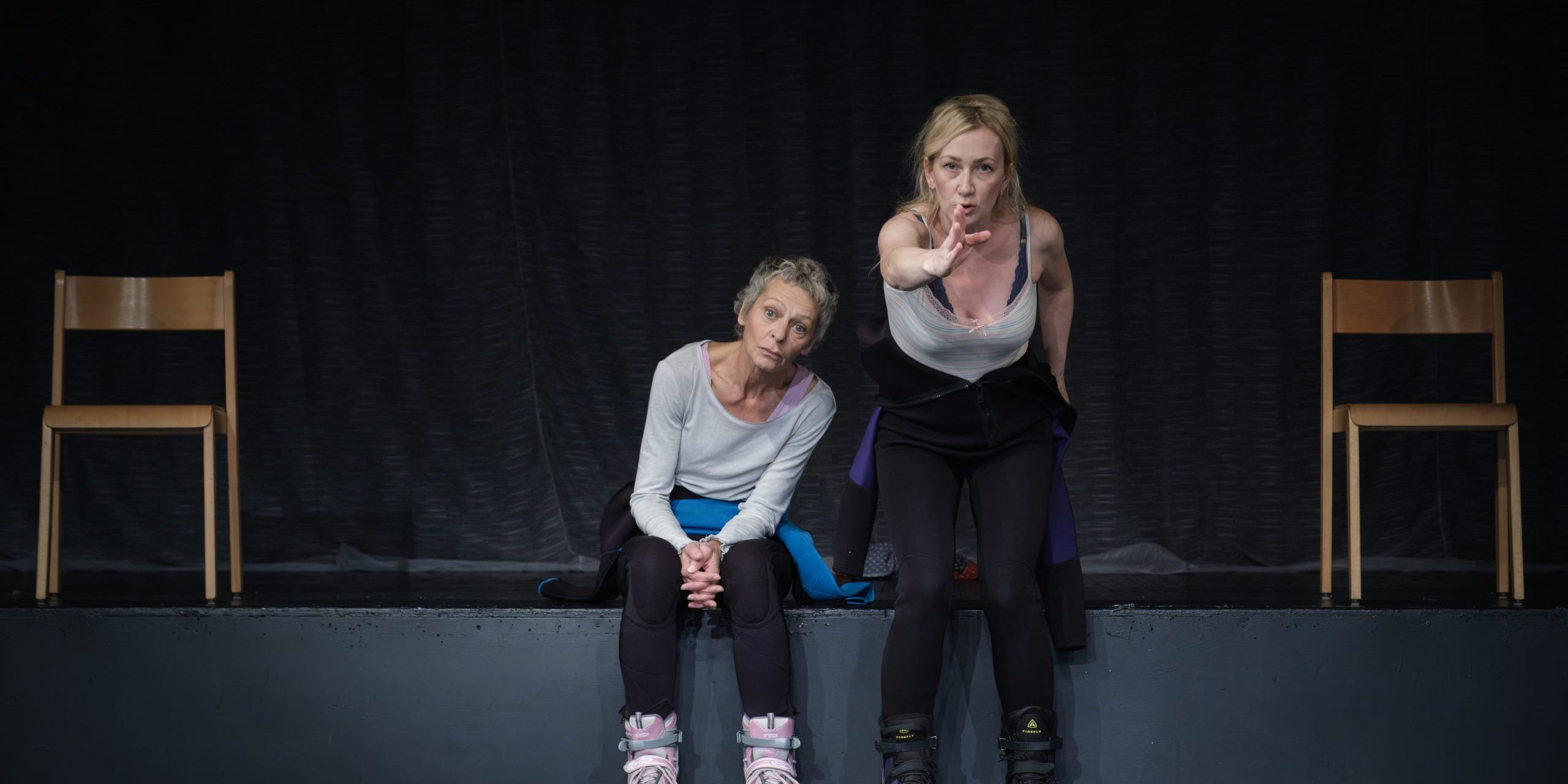
Within its colourfully fragmented patchwork dramaturgy, Wet Cats takes its characters through a series of pastimes, most of them refreshingly absurd. Some unfold on video, others live onstage: the two women practise laughter yoga, bake an orange cake, roller-skate, drill a hole into Zaima Šarca Street — and dance the Lambada like two little kittens, swirling around in their polka-dot petticoats, kicking up the dust until their lungs are full of shimmering particles.
There is something disarmingly truthful about these moments, something that cuts straight to the heart and makes you forget, for a moment, that none of this is real. Or is it? I could watch Pinjo dance to Kaoma’s “Lambada” or Šojić lip-sync Janis Joplin’s “Me and Bobby McGee” for hours. Their performances are so ridiculously liberating that watching them feels almost therapeutic. Again and again, the two actresses generate moments of catharsis, carried along by the momentum of their fast-paced theatrical duet. There is no time for overthinking, let alone cynicism. And none of it feels tacky or corny. Their self-irony is always present, gently nudging the audience until laughter ripples through the space. This is especially apparent in a seemingly simple exchange: ‘Are we rolling?’ — ‘We’re rolling’, which earns spontaneous applause.
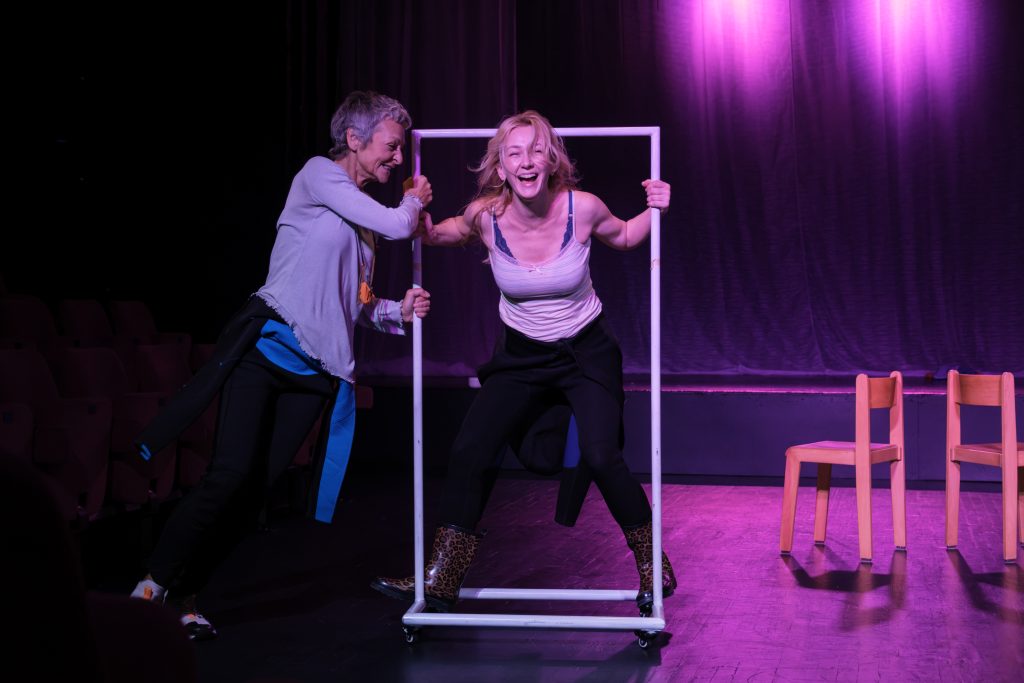
Wet Cats. Chamber Theatre 55. Photos: Dženat Dreković
“Love is love. Even if it’s between you and a dolphin.”
None of this would work without the sincerity of its performers. Tatjana Šojić, a veteran of the Chamber Theatre 55 ensemble, plays as if drunk — not on alcohol, but on life itself. Every word sets her entire body in motion. Before a declaration can leave her lips, her spine curves forward, her head juts out, her arms begin to bounce, and, for reasons known only to her, so do her legs. Then, just as the physical build-up reaches its peak, the words burst forth. Her deep voice, with its buoyant, up-and-down intonation, adds another layer to the comedy. Even in the brief moments when she does nothing but listen to Pinjo, allowing her partner to take centre stage, Šojić’s posture and facial expressions reveal an exceptional instinct for slapstick.
Pinjo, by contrast, works through restraint. Vulnerability seems to emanate from every pore of her porcelain skin, revealing a woman on the verge of a nervous breakdown. Breathing her way through panic attacks, she evokes a Pierrot clown: melancholy, fragile and quietly, irresistibly comic. Where Šojić embraces the exuberance of the jester, Pinjo finds humour in Še’s frailty. Yet, unlike Pepa in Almodóvar’s Women on the Verge of a Nervous Breakdown, her character never plunges into eccentricity. Her aunt wouldn’t let her. And the niece, in turn, will make sure that her aunt’s lessons do not fall into oblivion.
Together, they form a study in opposites: night and day, blue and yellow, push and pull. Their differences generate friction in almost every scene, supplying the drama the play needs without tipping into mélo or pathos. Wet Cats is all symbiosis, no ego.
“Tomorrow is today. If something fails, you go ahead and try again.”
To stage a memento mori play that is, paradoxically, so affirmative of life feels particularly urgent in Sarajevo. Its inhabitants are made to confront their own mortality in ways that extend far beyond the theatre. It is easy enough to surrender to the accumulated weight of bad news, to let the world shrink to the dimensions of everything that is going wrong.
And yet, here are Šojić and Pinjo, Te and Še, doing so much with so little. Two actresses, a handful of objects, and an unwavering commitment to their craft: in a theatrical landscape often preoccupied with spectacle, such simplicity feels like a precious rarity. They lean into every word, every gesture, every mistake, and begin again. The result is a lively ninety-minute performance that can bring an audience to tears one moment and send it dancing to “Lambada” the next, as if laughter and grief were never all that far apart. There is something profoundly truthful about Wet Cats: it doesn’t deny the inevitability of death, but insists that the time before it belongs to us. So… what ya gonna do with it?
Credits
Writers and directors: Tatjana Šojić & Džana Pinjo/ Dramaturgy associate: Emina Kovačević-Podgorčević/ Stage & Costume Design: Adisa Vatreš Selimović// Video: Almir Đikoli and Tarik Bičo/ Producers: Merjema Đipa and Ishak Jalimam/ Stage manager: Senad Bešić
Cast: Tatjana Šojić & Džana Pinjo
Producers: Realstage and Chamber Theatre 55

Berina Musa is a writer, dramaturg, and critic based in Sarajevo and Freiburg. She studied German linguistics, literary studies, and art history at the University of Freiburg and is currently completing a second degree in dramaturgy at the Academy of Performing Arts in Sarajevo. Her plays and short films have been presented at the Bosnian National Theatre Zenica, MESS, the Sarajevo Film Festival, and the Mostra Internazionale del Nuovo Cinema di Pesaro.