National Experimental Theatre “Kujtim Spahivogli”, Tirana
At a time when Albanian society is in a state of crisis and has been for nearly six months, it was perhaps unsurprising that a production of George Orwell’s 1984 would prove popular. The Flamingo Revolution, and subsequent student boycott and uprising, has escalated into a more violent protest that is still ongoing. A politically charged production, adapted for the stage by Jeton Neziraj and directed by Dino Mustafić, offered a possibility of catharsis. Clearly, contextualizing 1984 in relation to the situation unfolding in the streets would be both a challenge – and a responsibility.
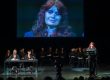
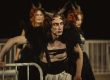
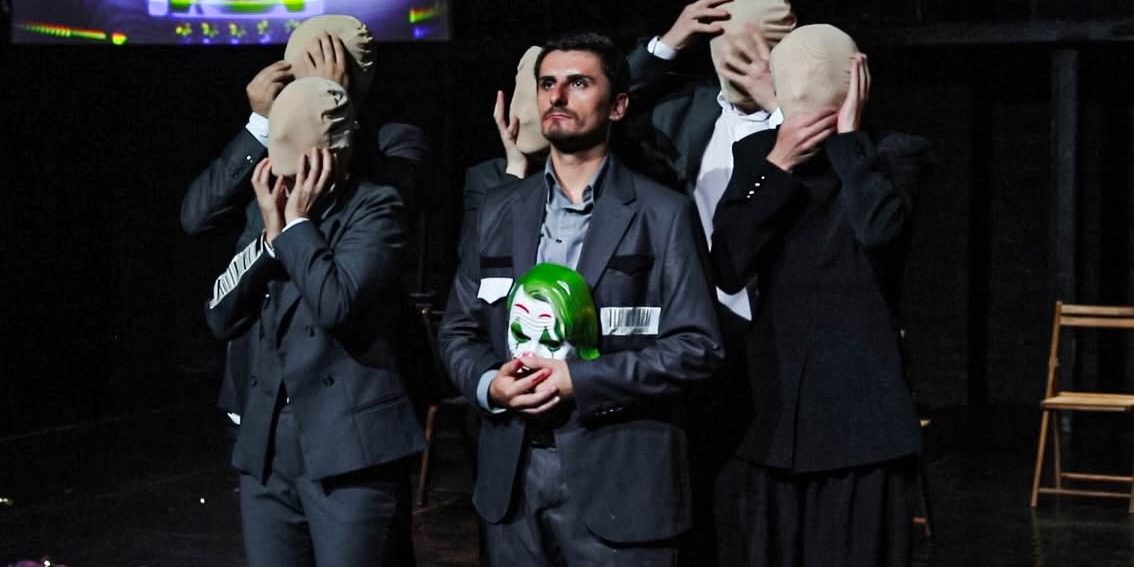
Dino Mustafić does a remarkable job of constructing the overall atmosphere and visual aesthetic of the production. The elements come together like the pieces of a puzzle, creating a tableau that draws the audience into the dystopian world of the play. The symbolic imagery, including snippets of video depicting human suffering under the regime, as well choreography and other audio-visual effects, all contribute to the visual language of the piece. In this respect, the production succeeds in creating an interesting visual representation of the symbols and concepts explored by Orwell’s work.
Although the production successfully establishes the central concepts of Orwell’s work in this way, it ultimately remains confined to presenting them rather than fully engaging with their political implications. Through strong directorial and acting choices, it brings to the stage some of the novel’s most powerful themes: the regime, Big Brother, brainwashing, torture, propaganda, and the conflict between the working class and the Party. Yet, despite its artistic achievements, the production fails to establish a deeper connection with both Albania’s political reality in 2026 and its political past.
There are several attempts to bridge this gap, including references to the communist internment camps, the demolition of the National Theatre, and O’Brien’s invitation to engage Winston in a so-called “dialogue” during his torture, which clearly echo Prime Minister Edi Rama’s approach over the past few months. However, the question remains: are these references, in themselves, conceptually strong enough to constitute the kind of artistic stance of exposure and denunciation that Orwell’s work invites?
At one point during the performance, the auditorium lights come on and the assistant director walks onto the stage with a microphone, delivering a short speech in which, among other things, he calls for a new government. He then leaves, and the production resumes its dystopian narrative. This felt like clumsy attempt to justify the production’s forced effort to contextualize itself within the country’s current political situation. While this poorly integrated scene ultimately functions as a gesture of solidarity with the protesters, solidarity and contextualization are not the same thing. The theatre’s stance in support of a democratic state facing such a profound political crisis, in which citizens have lost faith in its institutions, is and should be a given. The problem lies precisely in the production’s failure to move beyond the boundaries of its own aesthetic framework. The production’s dystopian impact is lessened, when, beyond the stage, reality itself has already become a reflection of that dystopia, yet this reality was addressed only at a conceptual level.
1984, National Experimental Theatre “Kujtim Spahivogli”, Tirana
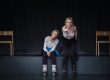
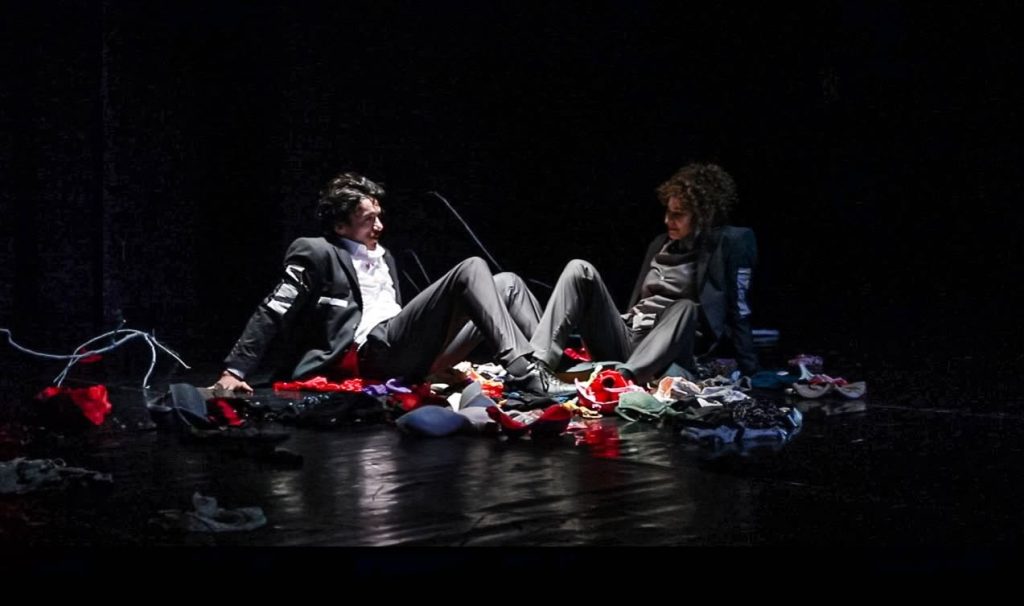
While Rafael Hoxhaj delivers a powerful performance as Winston, his strongest moment coming during the torture scene involving the rats, when he begs for Julia to be subjected to torture instead of him, choosing to betray their relationship to save himself, Julia, as portrayed by Eva Gjika, is fragmented to such a degree that it feels like she is only there to serve the story, primarily as Winston’s love interest.
Considering that Julia is 26 years old in the original – equivalent to Gen Z – it’s a shame her character wasn’t given greater significance, given how younger people are driving this current wave of protests, not only in Albania but across Europe. The production sticks closely to the structure of the original and the relationship between Winston and Julia ultimately feels artificial.
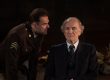
The production’s strongest statement is its emphasis on the fact that the regime does not seek to eliminate its enemies, but rather to convert them, pursuing this transformation down to the very cells of thought. The Thought Police are presented as an institution responsible for maintaining the ideology of Oceania and Big Brother. Ema Andrea, in the role of O’Brien, brings an extraordinary energy to the stage, particularly in the way she establishes relationships with the other characters and with herself when it came to the question of power. She shifts between the role of the narrator and that of O’Brien, making it difficult to distinguish when she is speaking as the narrator and when she has stepped into the role of the manipulator. From both a dramaturgical perspective and a directorial one, this idea is integrated in such a way that it functions as the production’s anti-ideological backbone, one of its most essential elements.
Through Mustafić’s approach to Brechtian and post-dramatic aesthetics, the production acquires multiple dimensions in conveying the larger ideas raised by Orwell’s work. The abridgement of the dictionary by the invisible force of Big Brother remains one of the most fundamental parallels for expressing a rebellion that can no longer be articulated. Much of the production reinforced this interpretation, with the allegory most notably marked by the demolition of the National Theatre in 2020, whose image appears on Big Brother’s screen, while the propaganda machinery of the ministries distorts history and narratives. It is clear that the destruction of the National Theatre is more than merely literal.
Credits: