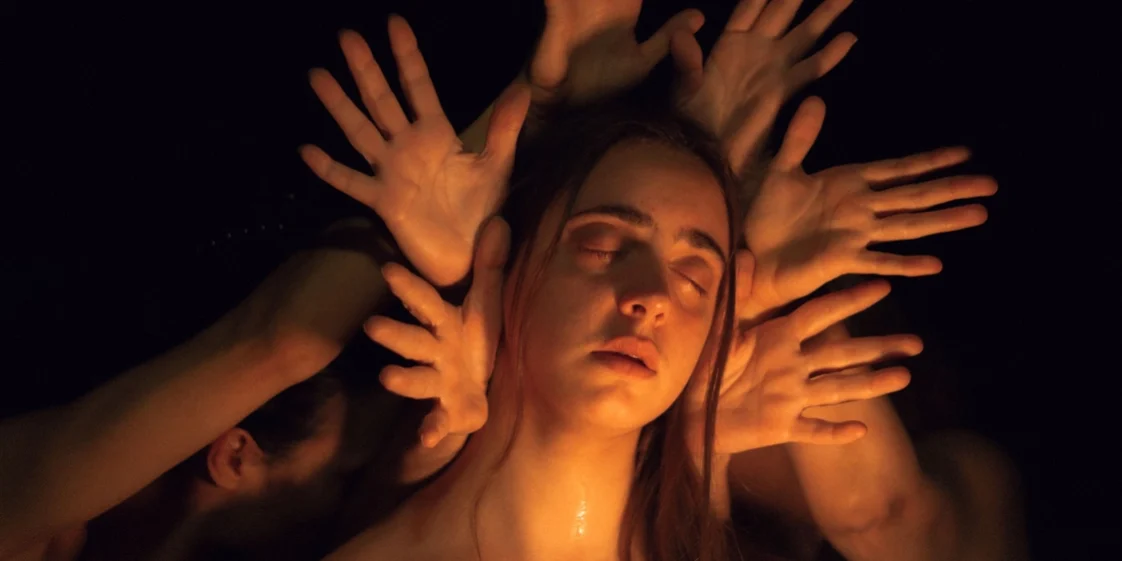
Palace of Youth, Prishtina, 24 October 2026
Greek-Albanian director Mario Banushi’s Taverna Miresia – Mario, Bella, Anastasia was presented to Albanian-speaking audiences for the first time as part of the inaugural edition of the “LA RREMË” International Theatre Festival. It’s a festival with grand ambitions to offer the city and beyond a glimpse of what is happening in contemporary European theatre today.
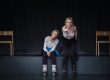
The Red Hall of the Palace of Youth – the temporary home of the National Theater of Kosovo until the theatre building’s reconstruction is completed (a process that has been dragging on) – is an enclosed room in which we are confronted with another enclosed room, a white-tiled bathroom. In the show’s opening moments Banushi emerges from the shower, dries himself, and gets dressed for a funeral.
Banushi’s Taverna Miresia is a semi-biographical piece about the death of his father. Taverna Miresia is the name of the tavern his father owned, and Mario, Bella, and Anastasia are his children. From the very beginning, death is present. And a jacket pulled from the earth paves the way for the grief that will pass through us, its witnesses. We do not know what death is, but we know what it leaves behind.
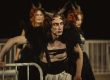
Four women sit on chairs around what appears to be a grave. From the first scene, you can clearly distinguish the different ways they experience grief, even in their postures. One tilts her head to the side, another gazes into the distance, and another curls inward. Grief unites them, but the experience is personal. Banushi explores the aftermath of death and the grief it leaves behind in the living. He takes this personal encounter with death and brings it to us in a performance that is distinctly intimate and yet also at times extreme in its depiction of grief.
Actress Savina Yannatou, with her wonderful voice, laments as she pulls away from the other women, crawling towards the tap on the other side of the stage. A little water is what will soothe her pain, if only slightly. She is the matriarch of the family and the mourner who seems to be weeping for her son.
While one woman feeds the other, the other throws the food in her face. The act is repeated over and over until the plate is empty. One patiently waits for the other to release her grief. Grief takes different forms, whether in the explosive act of throwing food in someone’s face or in the violent rocking of a chair. All the characters have their own episodes of experiencing grief, different and similar at the same time. Some lash out at others, while others tremble within themselves. The actors’ performances and their ability to convey emotion are one of the great strengths of the performance, though it also relies heavily on visual and audio-visual elements.
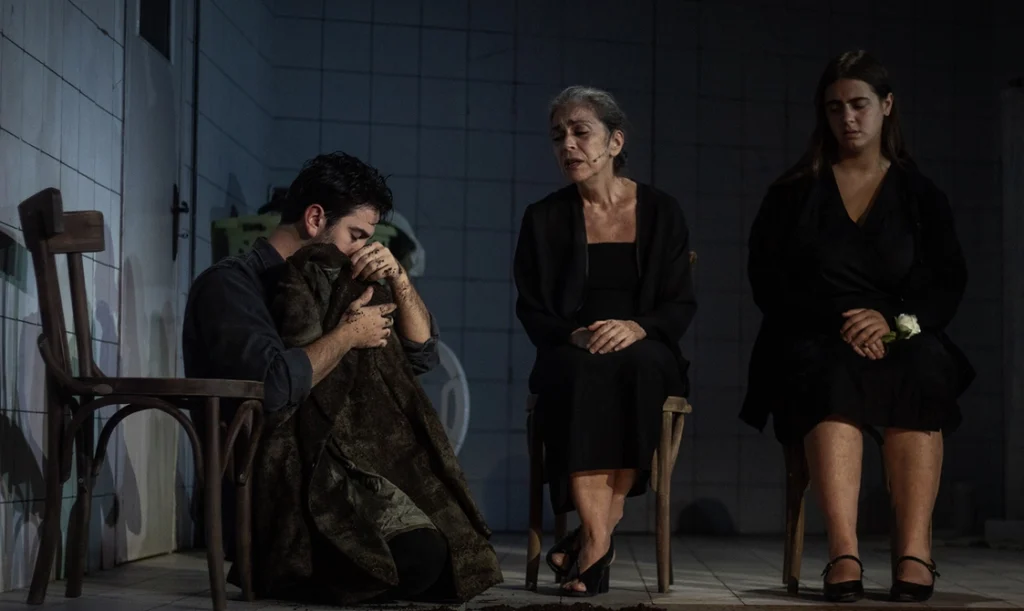
Taverna-Miresia. Photo: Theofilos Tsimas
While it has a slow beginning, the production contains several powerful outbursts of intense grief. Yet, amid the overwhelming sense of death, Banushi also makes room for moments that are less emotionally charged. The woman who appears to represent an intermediate generation between the matriarch and the younger women experiences grief more lightly. Her actions are less ritualistic: whether discarding an eggshell and attempting to use the toilet, he presence eases the tension, offering a counterweight to the intensity and allowing it to become something lighter, more fluid.
Taverna Miresia is bold in the way it defies the conventions of traditional performance. If you surrender yourself to it, the experience is truly extraordinary, but it also carries the risk of rejection. However Banushi’s success so far suggests it strikes a chord with many.
A stain on the wall, earth taken from the grave, is another powerful image that lingers in memory. Taverna Miresia is a mosaic of finely composed, slow, dreamlike scenes that resemble paintings, shifting from bluish tones to yellow, from cold to warm, as if seeking to evoke a sense of purification or healing. Death rituals in the Balkans and beyond serve precisely this purpose: to allow us to experience grief, to channel it, to let it flow so that it does not become trapped within us. Banushi draws on these rituals of death to convey the experience of grief. The channels through which grief flows fill to the brim, and Banushi knows how to pace these moments, how to navigate the stages of this process.
Thus, in the final act, the open grave, filled with soil, becomes overgrown with dry vegetation, suggesting the passage of time. Banushi returns to grief, revisiting it as though to bid it farewell. Here, grief becomes more rhythmic, more spiritual, and perhaps more healing. He brings everyone onstage for one final encounter with grief, while the arched windows, through which a yellow-orange light pours in, transform the stage into a temple of ritual.
The performance lasts about an hour, but you hardly notice the passage of time. Inside that room, time stands still. Banushi is not afraid to push boundaries, both in the themes he explores and in the way he approaches them. This requires him to be meticulous with his images, the primary means of expression in his theatrical language, and words are not needed. Yet the images in Banushi’s compositions are not new. You have seen it all before; everything feels like a revisiting of something familiar, maybe like a dream.
While Taverna Miresia is a lament for death, Mami – which I saw last year at Onassis Stegi – is more of a hymn to motherhood, womanhood, and life itself, even though death remains present there too. In Mami, Banushi steps outside the room, beyond the enclosed space. He has described this as an attempt to move away from the theme of death, from darkness towards light. He seeks an opening into something larger in scale, more complex and multifaceted. This transition towards the light seems to be what we can expect to see in the future work of this young artist who, with just four productions created in four years, has become the fastest-rising talent in European theatre.
Credits:
Savina Yannatou//Dramaturgy Collaboration: Aspasia-Maria Alexiou4
Cast: Mario Banushi, Katerina Kristo, Rita Lytou, Eftychia Stefanou, Savina Yannatou
Further reading: Review of Mami at Onassis Stegi
Further reading: Mario Banushi: “The Balkans aren’t just one thing; they’re many things.”

Flamur Dardeshi is a freelance writer based in Tirana. He has contributed in the areas of translation, analysis, and poetry. His main fields of interest are literature, cinematography, and theatre.