Last week was an eventful one in Serbian politics as the candidates for Serbia’s Student List were sworn in and the new speaker was elected. Duška Radosavljević explores the overlap between parliamentary session and durational performance.
Three days of Serbia’s constitutive parliamentary session came to an end around midnight on Thursday, 19th November 2026. By then, the new parliamentary chair (or speaker) and his vice chairs were finally elected to jubilations from the remaining MPs, mostly members of the Student List, as those on the other side had demonstratively left the building at the point of voting. Outside, people waited to greet the MPs and filmed their exit. Someone began a song associated with Aleksandar Čupić, the newly elected chair, and the MPs sang together on the Parliament steps.
Parallels between theatre and parliament are by no means incidental. Both are the traditional sites of public gathering, deliberation, and rhetorical display. Both are also the sites of collective imagination, contestation and, at times, endurance. Since 1990, when the multiparty system was brought back into the Serbian parliament, theatre professionals too entered the parliamentary fray – most famously actors because their popularity could help with gaining votes, but also some directors and dramaturgs. Theatre director Ljubiša Ristić led the notorious political Party JUL for seven years in the late 1990s. Actor Branislav Lečić has had a particularly long career in Serbian politics having served as Minister of Culture under the democratic government 2001-2004; then following his #MeToo demise, he has just returned as an MP under Aleksandar Vučić’s Serbian Progressive Party (SNS) list in 2026. The current Serbian parliament actually has seven actors, one opera singer and a playwright. But in watching this constitutive session I finally realized why some cultures have also successfully produced the profile of a theatre critic-cum-parliamentary political correspondent (exemplified by Quentin Letts and Joyce McMillan in the UK and Fintan O’Toole in Ireland).
Despite (or maybe because of) memories of some captivating parliamentary proceedings from 1990s Serbia and 2019 Britain, this has been the first time I watched the sitting of any parliament for multiple hours at a time. And I must say there was quite a bit of high drama and quality theatre in the three days’ proceedings. The chamber has its rituals, entrances, exits and a rulebook too – which is intermittently invoked due to a skillful stretching of the rules and sliding through its loopholes. Its popularity has risen so much since last week’s session that its pdf has since started circulating online.
The yoghurt incident
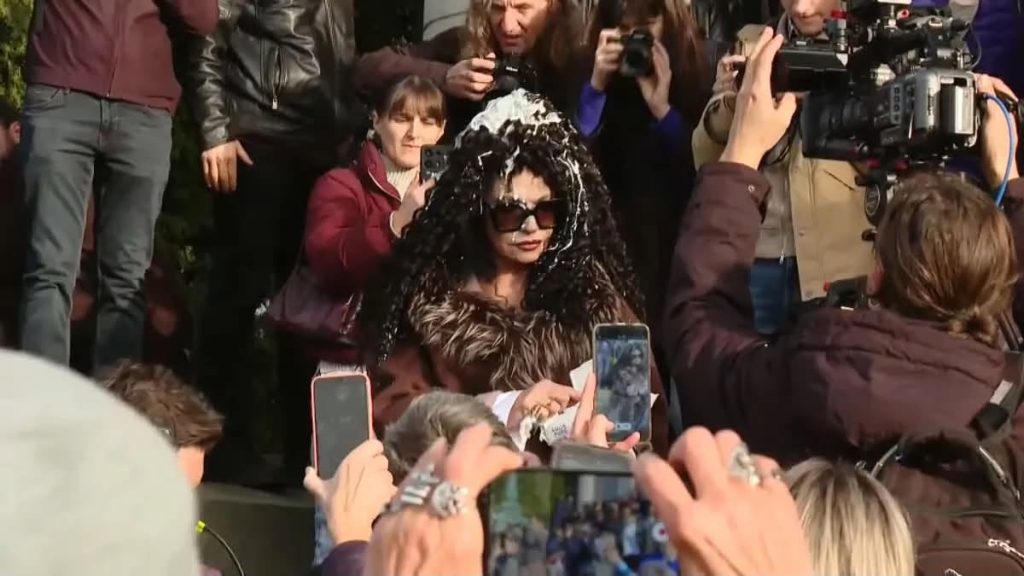
On Day One, of the constitutive session, the historic Tuesday 17th November 2026, the drama had actually started already on the MPs’ way into the parliament building with the pouring of yoghurt on the iconic coiffure of the faded actress Lidija Vukićević, recently re-elected as an SNS MP. The Student Movement had requested for a group of their representatives to be permitted to watch the inaugural session from a gallery, but this request was denied. As was its custom during two years of protest, the students then invited members of the public through their social media to gather peacefully outside the parliament to greet the new MPs as they arrived. Most of the Student List members were greeted with cheers. Most of Vučić’s party entered the building using other routes.
The actress, Lidija Vukićević, famous for a few minor B movie roles from the 1980s, entered through the crowd. The woman bystander who had disposed of her breakfast in this unceremonious way immediately took responsibility for her actions and spoke to the press about her outrage and loss of self-control. Vučić wasted no time to call an impromptu press conference about the incident before the sitting began. A statement was made, tears were reportedly shed behind dark sunglasses. The Student Movement condemned the action through social media, which were also flooded with speculations that the incident had been staged or provoked. Vučić naturally seized it as pretext for shaming and taunting the other side for their ‘uncivilised’ behaviour.
The session began with due formalities: the anthem, the confirmation and swearing in of the MPs: seven mostly familiar faces from five of the traditional ethnic minority parties (the Hungarians, the Albanians, the Sandžak Bosniaks), 103 from Vučić’s SNS party, and 140 completely fresh faces vetted by the students from all around the country on behalf of the Student List.
In the absence of an elected chair, the oldest MP, SNS’s 78-year-old mathematics professor Stojan Radenovic, presided. Fifteen minutes into the proceedings, he called the first break, lasting a full hour! A second break followed soon after, for lunch, and lasted two hours. It quickly became obvious the suspense was part of the SNS tactics to delay the election of the new leadership.
After lunch, Vučić took the floor. A former president and prime minister, now just an MP and leader of his parliamentary party, he nominated his party’s candidate for the chair of parliament. The nominator formally has limitless time, so this one spoke for an hour and forty minutes in his first address. Only two or three of those minutes were about his candidate, septuagenarian Stojan (currently in the seat). The rest was a sustained attack on the other side.
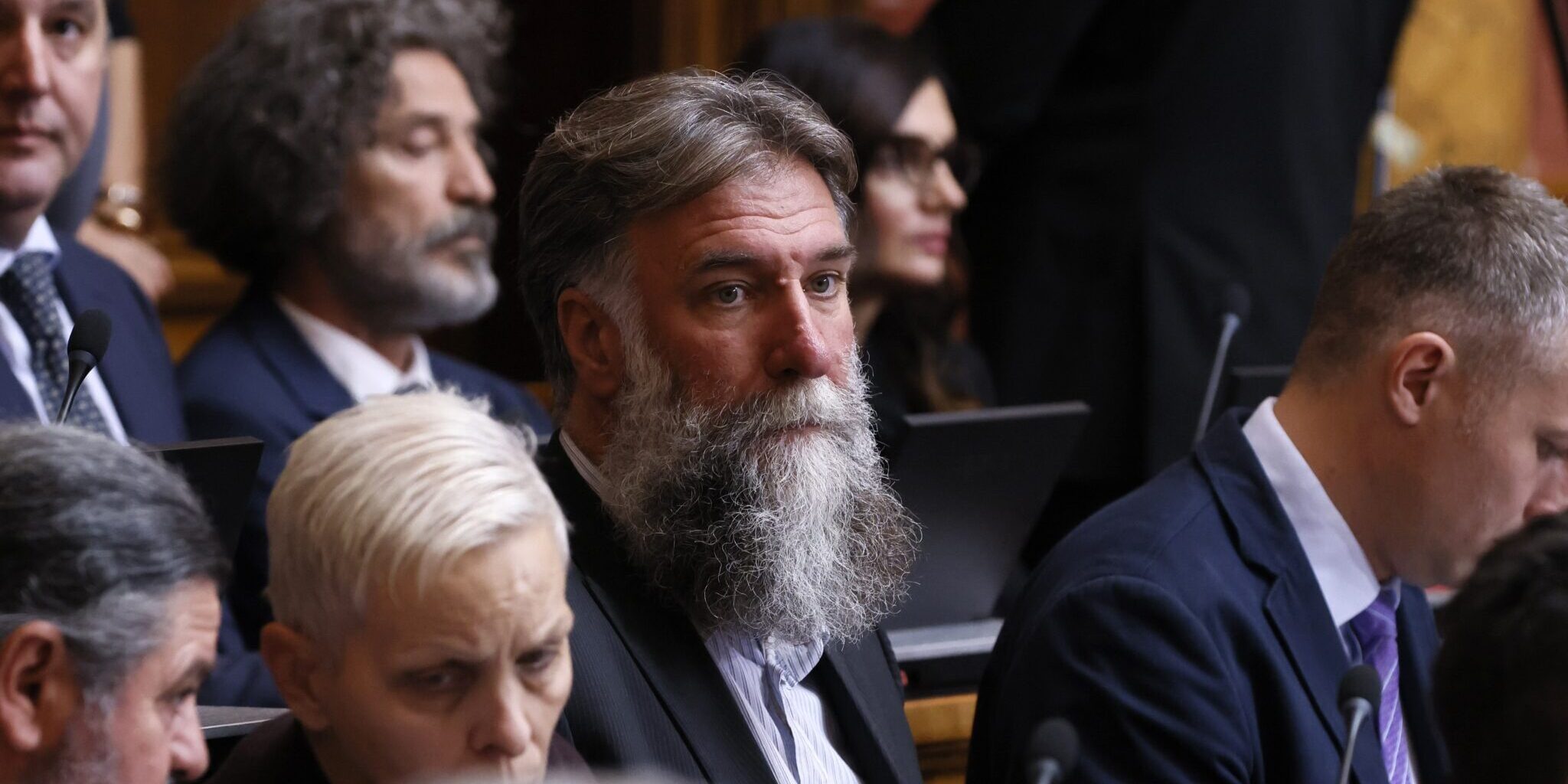
Members of the Student List sat there patiently, in a dignified silence, occasionally lodging objections about transgressions against the protocol, waiting for their turn, for nearly three days.
Septuagenarian Stojan put in a performance of bamboozled benevolence. Feigning good intentions and desire to impart wisdom, but essentially delaying any meaningful action and heaping up seemingly incidental praise on the outgoing regime, he gradually revealed himself as a kind of Gargamel, who apparently also has a history of fudging the number of his academic citations.
At the end of day one, all members of the Student List had spoken for the total of 25 minutes, while over two days Vučić spoke for over seven hours. This was peppered with dramatic pauses, direct stares, and confrontational asides: ‘What is funny?’, ‘You still haven’t apologised for the yoghurt incident, you philistines’, ‘Do not come to the parliament in trainers!’, ‘You know nothing about any of this, but you will learn’, ‘You will destroy this country!’, ‘Don’t block my oxygen’, ‘Give me water’, ‘Stop coughing’, ‘Let me speak!’ One social media user summarised his speeches as a three part routine: ‘insult – unsolicited advice – pleading’. Another created a Chrome browser extension that could automatically silence a chosen speaker in a live broadcast.
There were valiant attempts at parliamentary rhetoric on both sides, some cute evocations of declamatory style we learnt at school, but little by little multiple days essentially merged into one long waiting act. Some members of the Student List took to colouring books to still the nerves. Dramaturg Željko Hubač at one point jokingly appeared to cast a Harry Potter-style magic spell against an accusatory finger pointed from the other side. When farmer and eco warrior Zlatko Kokanović from the Student List jovially sent Vučić a kiss in response to his insult, the gesture seemed to enrage the macho former leader.
Ana Brnabić approaches the bench.
Finally some breakthroughs arrived on Day Three. I happened to miss sociology professor Jovo Bakić’s impassioned and eventually triumphant speech, which finally gained some moral satisfaction on behalf of the heavily insulted Student List by turning the tables on Vučić’s side, deflecting some of their baseless accusations, and surfacing their documented links to the mafia.
Visibly annoyed, Vučić finished his last speech before the vote for the chair was due to take place, received the applause from his supporters, and left the room. Voting took about an hour. Each MP cast a verbal vote. Those from Vučić’s side left the room one by one after voting, leaving their candidate largely alone in the auditorium to acknowledge defeat. Of the seven representatives from the national minorities parties, most voted for the Student List candidate, Aleksandar Čupić, a professor of traffic engineering, farmer, and father of six.
Čupić walked to the chair with serenity and composure, shook hands with some from the opposite side, and made a dignified speech in which he promised to be ‘strict and fair’ – strict with himself, fair to others. In a statesmanlike way, he also condemned the yoghurt incident on behalf of the Student List. In the interim, before the presidential elections are held in the coming months, he also stands in for the President of the Republic, according to the Serbian constitution.
In a striking contrast to his predecessor, Čupić began his term trying to practice what he preached – observing the protocol very closely and far more proactively. In roughly one hour, he issued around seven penalties, mostly for derogatory or accusatory remarks. Each penalty carries a 10% deduction from the salary. A person who has received two penalties can be ejected from the proceedings in the next step and lose 50% of their salary.
The afternoon’s main agenda topic was the election of the vice chairs of the parliament. The contentious issue was the Student List’s exclusive nomination of its own members to these positions. Vučić’s party counter-proposed their own six candidates. One was the faded actress Lidija Vukićević. In the discussion it was pointed out by the SL nominator Aleksandra Štimac that Vukićević’s formally submitted biography for this purpose characterised her as a ‘henchwoman of Aleksandar Vučić’. As a woman and politician, Štimac now demanded that SNS should apologise to their colleague, and questioned whether the actress knew about this description? The actress refused to comment. Another one of Vučić’s ‘henchmen’ – Milenko Jovanov – replied on her behalf by saying ‘Well done on reading the documents closely; you’re obviously inexperienced so you do not know that it is common to sometimes resort to tactics designed to provoke the other side’. Štimac then retorted with ‘Oh, and we thought this was only because you used ChatGPT, but thanks for admitting that you resort to frame-ups, which is something we suspected anyway’…
Aleksandar Vučić adjusting well to his new role.
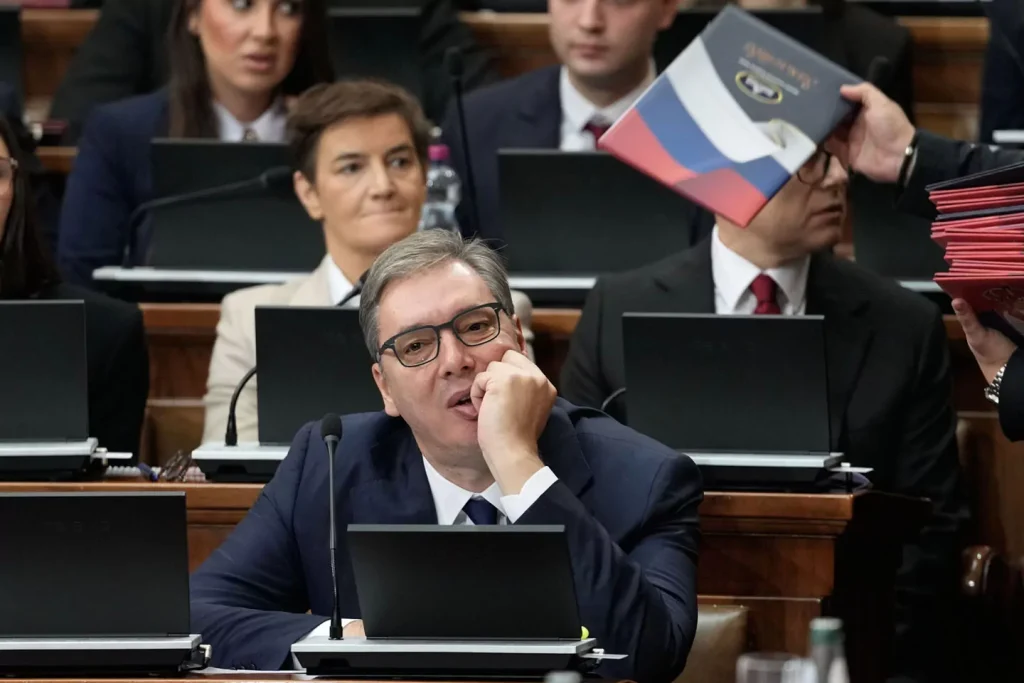
Aleksandar Vučić arrived late into the debating chamber after lunch, clearly aware of what had happened in the meantime. He had more to say, of course, also, in amongst other things, about how Radio Television Serbia was filming the session, accusing them of acting as ‘turncoats’. This was an involuntary admission that the state TV station was never in fact as objective as it purported to be. Čupić now pleaded with Vučić to stay on topic and modify his language. Vučić had made a dig at his nemesis, farmer Kokanović, saying that his education only included ‘recess at school’, implying he was underqualified for an MP. When Čupić rightly classified this as an insult, Vučić denied that he had said anything offensive. He continued with personal comments directed at Čupić, alleging he had falsely presented himself as a more moral person than he was – a point which resulted in a penalty for Vučić.
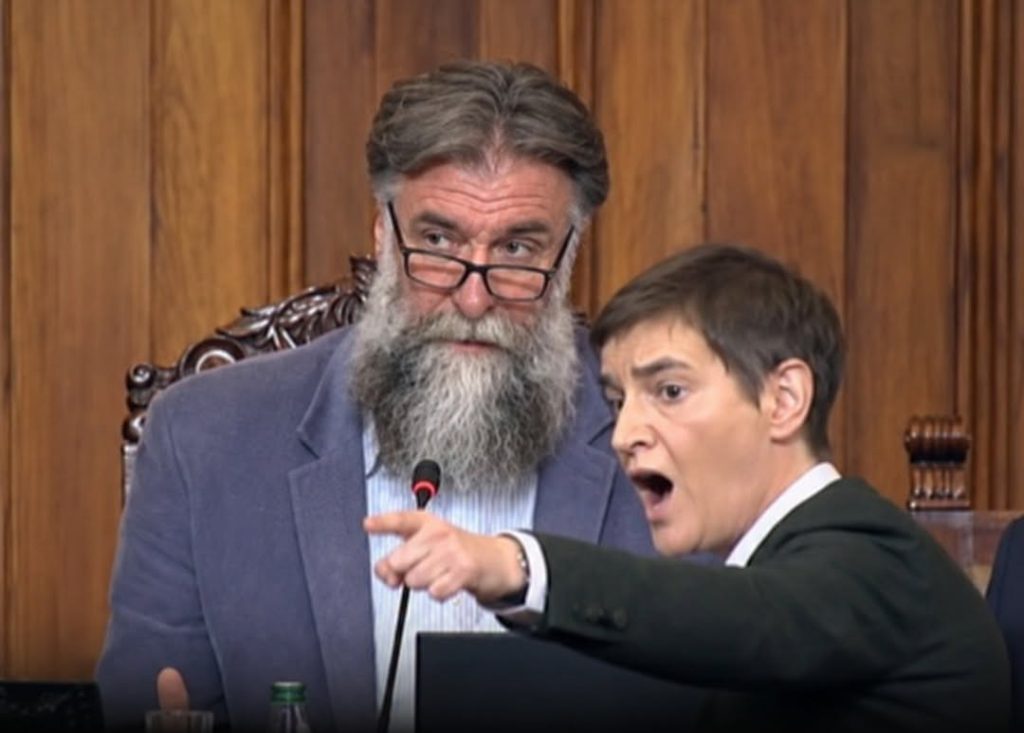
At this moment, all hell broke loose! A hundred and forty MPs jumped up into a rapturous applause. Another hundred jumped up to protest. Vučić stood alone with a cynical smile, the hand of the concerned actress Lidija Vukićević resting protectively on his shoulder. Former acting president, Ana Brnabić ran towards the chair’s bench and was quickly accompanied by henchman Jovanov. Clearly hoping to provoke Čupić to break the rules, she challenged him to throw her out. But Brnabić and Jovanov only received a penalty each, as per the rulebook, for approaching the chair unsummoned. Then Čupić, unfazed, called a break.
At this point I had to stop watching in order to feed my family, but the saga continued until midnight with just the 140 members of the SL the only MPs still standing in the end… A phrase associated with the Student Movement’s darkest moments resurfaced online: ‘We are not tired, we don’t know what tiredness is’.
Like in real theatre, the drama was not all about hustle and bustle. I subsequently caught up on a poignant scene involving opera singer Nataša Tasić Knežević, the only Roma representative in the parliament, standing before Vučić’s party, who addressed the chamber in order to present her case for inclusion of ethnic minorities in among the vice chairs. Even though the Student List had made sure their nominations were fully ethnically diverse, for reasons of caution, distrust and a desire to fully reboot the Serbian institutions, they did not wish to include any of the already well known MPs from other parties among their nominees. This was understandably perceived as undemocratic and was pointed out as such multiple times in the afternoon, but Tasić Knežević took a slightly different route. As the only Roma person in the room she invoked Roma values of love and understanding, trying to appeal to a shared sense of humanity and advocate for collaboration beyond party divisions in order to address concrete sociological problems. She appeared to be reading her speech and did so in a thoughtful but expressive and effective manner which moved the entire chamber to heartfelt applause and a few tears too. Playwright Željko Hubač wanted to reply straightaway, but because he did not have a right to do so according to the protocol he made up some grounds for an ‘objection’ in order to be given the word. He was lightly disciplined for this and took his warning on the chin, but still proceeded with his reply in which, speaking as a neighbour of Roma people, he pledged to want to work together with Tasić Knežević on the problems of this community. In the aftermath of the moment itself, the online public has been somewhat divided on the sincerity of Tasić Knežević’s motives, but nevertheless this will go down in memory as one of the finer moments of genuine pathos on this parliamentary stage.
Last image: one by one, members of the Student List in winter coats, some with suitcases in tow, roll out of the main entrance to the Parliament building in the middle of the night. By comparison to their journey in, they look a bit dishevelled, but satisfied, and now also surprised as they get stopped in their tracks. It is a fitting curtain call that seems as if it was both perfectly staged and completely unplanned. Members of the public are gathered outside, waiting with their phones raised in the air. Then someone starts a familiar song which distinguished Aleksandar Čupić as an eager singer during the election campaign. They all stand together on the stairs of the Parliament, singing.
Further reading: Boycotts, censorship and controversy: In search of the spirit of BITEF

Duška Radosavljević Krojer is a writer, dramaturg and academic. She is the author of award-winning academic monograph Theatre-Making: Interplay Between Text and Performance in the 21st Century (2013) and editor of Theatre Criticism: Changing Landscapes (2016) and the Contemporary Ensemble: Interviews with Theatre-Makers (2013). Her work has been funded by the Arts and Humanities Research Council in the UK multiple times including for www.auralia.space (2020-21) and The Mums and Babies Ensemble (2015). She is a regular contributor to The Stage, Exeunt and The Theatre Times.