Over recent years, several key cultural institutions in Kosovo have been closed for renovation with more planned to follow. Nick Awde reports on what happens to a country’s theatre scene when there are increasingly few spaces in which to stage work.
Culture needs a home, and caring for that home is a societal duty. In Kosovo where most cultural buildings belong to the state and the economy is one of the poorest in Europe, it follows that most of that caring needs to come from the state (and possibly its big business friends). But over the past four years, Kosovo’s government has launched an unprecedented cultural reform programme at local and national level that has turned out to be as much an act of artistic suffocation as it is institutional rescue.
The problem is that the country has seen a staggering eighty per cent of its cultural spaces go dark as they undergo or are about to undergo renovation – in the process not only disrupting careers in the sector but also separating artists from their audiences. Key institutions such as the National Theatre and National Museum – both legally protected monuments – head a list that includes the Oda Theatre in Pristina, the theatres in Peja and Ferizaj, and the Lumbardhi Cinema in Prizren. Works are planned soon for the Gjilan Theatre and the Prison of Ideals Museum, while the newly restored National Gallery reopened in July, and now the Ministry of Culture plans to start on the restoration of the National Library.
“The theatre scene in the capital has been almost completely paralysed,” says Jeton Neziraj, director of Qendra Multimedia. “Now we have one semi-functional theatre, the Dodona Theatre for Children and Young People – but it is, in turn, non-functional because of certain bureaucratic procedures imposed on it by the Municipality of Prishtina.”
This snatching away of functional cultural spaces is an infrastructural quagmire that directly affects human careers. As director, filmmaker and writer Besim Ugzmajli points out: “As is often the case in our country, things are not planned or thought through to the end. Renovating cultural venues without first securing alternative spaces has been devastating for artistic and cultural life in Kosovo. Imagine renovating hospitals without providing alternative facilities for patients and doctors. Artists will lose their rhythm, their creative condition and their motivation.”
The drive for a lasting cultural reality has created a parallel reality of constantly shifting completion dates and a resulting artistic limbo. “There is a common cliché that ‘the artist has no age’, but in reality artistic development is profoundly tied to specific periods of life,” says Adrian Morina, artistic director of Prizren Fest. “How can an actor perform Hamlet if, between the ages of 20 and 30 – the most vital years for exploration and growth – the theatres are closed for reconstruction? How can you become Juliet in your 40s? Who has the luxury of waiting long enough to play King Lear? I once joked that we might move our performances to the Prison Museum stage, only to be told that even that space is planned for renovation next year. It raises the troubling question: is this a cultural scene under reconstruction or one that is effectively closed? The consequences are the same.”
Unsurprisingly the few alternative spaces that exist are massively overbooked. The Oda theatre, for example, was closed for renovation, meaning that the two independent theatre companies based there have to use the facilities of the National Theatre, which itself is being renovated and has been temporarily relocated to a small amphitheatre in the Palace of Youth and Sports… which also serves as the stage for the National Ballet. The National Theatre is still waiting for a completion date for the works on their building which began nearly five years ago.
“Imagine how a space which at best could serve as a venue for a student production is now hosting productions by four companies,” says arts journalist Shaban Maxharraj. “There is zero capacity for large-scale performances, so ideas have shrunk to fit the size of the venue. At this point, careers are no longer being developed, they are merely surviving.”
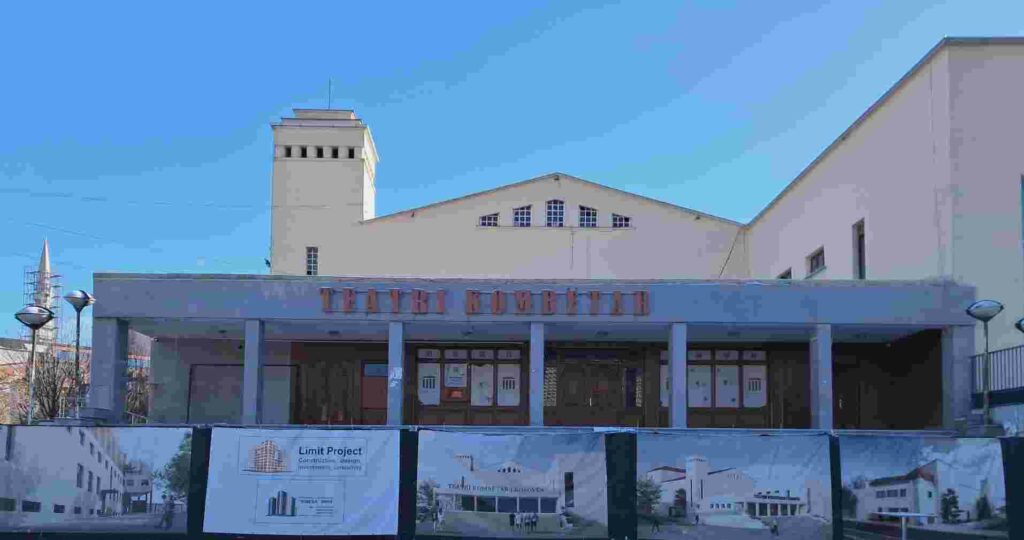
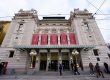
The National Theatre of Kosovo, under renovation
Qendra Multimedia, one of the companies using the Oda Theatre, was given ten days after works began to remove their sets and costumes from the premises. Some of it was taken to members’ private homes, from which they have to organise the transportation for shows.
Of course no one can argue against the renovation and reform of cultural infrastructure and providing dignified working conditions. But provision for alternative workspaces should have been made, and this simply did not happen – and so artists have been stripped of the opportunity to practise their profession and given no plan of how to proceed, which has already impacted the development of careers, particularly for young theatre-makers.
“We urgently need alternative venues, even if they are far from ideal,” says Ugzmajli. “While these spaces cannot provide the same artistic and aesthetic quality that a proper theatre offers, they are still far better than allowing Kosovo’s cultural scene to come to a complete standstill.”
Artists in Kosovo have always shown resilience, but resilience should not be mistaken for sustainability, adds Morina. “Many of us have been forced to adapt by creating alternative and open-air spaces, but transforming an open space into a fully functioning theatre stage requires immense effort and resources: building stage constructions from zero, installing lighting, sound and video systems, ensuring technical safety. It is more fragile, especially under unpredictable weather conditions like rain.”
What should be creative choices therefore become infrastructural obligations. “People are faced with just the one choice, ensuring that the country does not remain without artistic productions,” Shaban points out. “In Kosovo, for example, we have no proper concert hall. There have been two attempts: one failed after more than one million euros were spent, while the other is still ongoing, but there is nothing concrete yet. This month, we had a premiere of the Kosovo Opera which, together with one additional performance, cost 400,000 euros. According to the organisers, half of that amount was spent on just creating an improvised opera stage in a private venue.”
But spaces in general are not readily available in Prishtina where real estate is at a premium and almost everywhere suitable has been taken over by media oligarchs and businesspeople. A bigger issue is the amount of time these renovations are taking and the deadlines often not being met – where a theatre renovation that requires two years is not completed even after four years – and perhaps it will be impossible to fully recover the resulting loss of creative momentum and audience engagement. Additionally, there is a growing understanding that many of these projects are being carried out superficially without the involvement of experts in theatre architecture, acoustics or stage design.
“We have to ask ourselves a fundamental question: how many theatres have we built since the Second World War?“ says Morina. “The answer is none. Zero. So on what tradition are we relying when we speak about reconstruction? If there is no continuous practice, no accumulated expertise, then reconstruction risks becoming guesswork. Theatre is not just a building, it is a highly complex organism. What about acoustics? What about stage mechanics, audience visibility, sound isolation? Who are the experts ensuring that these elements meet professional standards? I fear that even after these reconstructions are completed, we may still not have truly functional theatres. We risk ending up with spaces that look new but do not serve the real needs of artists or audiences.”
Kosovo has already seen declining theatre audiences, especially since Covid, and this new period without regular productions risks distancing audiences from theatre even further. Bringing them back to the theatre will be a huge challenge, just as it will be hard for artists to bring back their own enthusiasm and passion.
“It is difficult to understand why this dilemma was not analysed more carefully by those responsible for these investments,” says Ugzmajli. “Especially the municipalities, who knew at least two years in advance that these renovations were coming, yet still failed to find the vision and commitment to create or adapt alternative performance spaces.”
Neziraj sees the situation making more sense when viewed through a political lens: “Our profession has been called into question because of the state’s irresponsibility. The state is responsible for this crisis, it has backed us into a corner. Our prime minister never misses an opportunity to talk about film and culture whenever and wherever he gets the chance, while the cultural scene of the state he leads has been cast aside and attacked so primitively by the state itself.”
A notable visible expression of Kosovo’s cultural power is the development of international collaborations – taking work abroad and bringing work into the country – and yet this is another case of no provision planned by the authorities.
“The impact is enormous,” says Ugzmajli. “Here in Ferizaj, we are already facing serious difficulties in organising the 56th edition of our theatre festival. We have no suitable venue for the competition performances, so we are forced to improvise. We also lack spaces for workshops and masterclasses, making it much more difficult to invite international artists to collaborate.”
Even when festivals like Prizren Fest manage to host international productions, it requires superhuman effort to create temporary stages and basic technical set-ups from nothing. And around the country international collaborations have been cancelled due to the lack of alternative spaces, while a major international co-production that Qendra Multimedia is producing this year with theatres from Georgia, Ukraine and Sweden has now moved production from Prishtina to Skopje in neighbouring Macedonia.
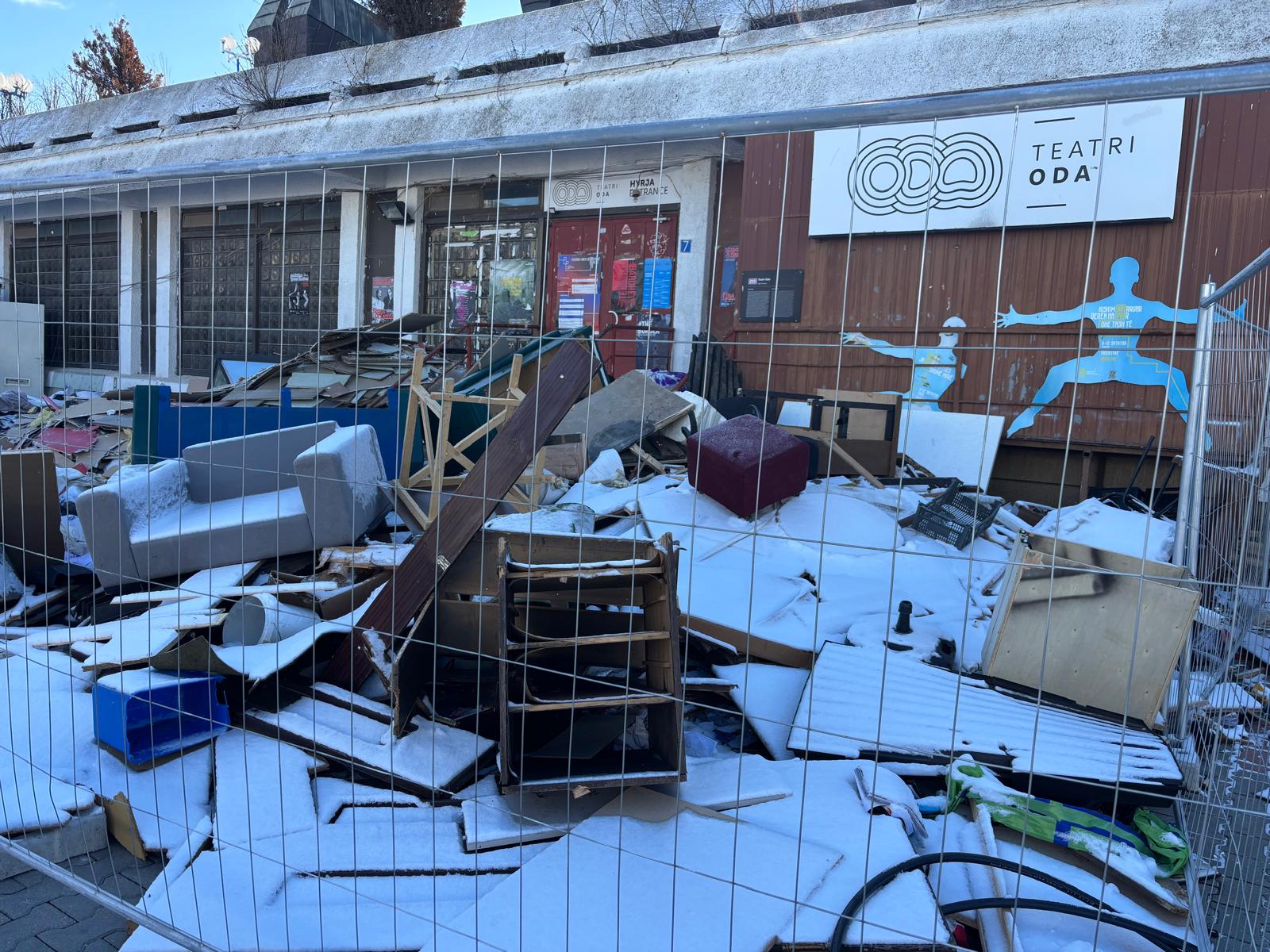
Teatri Oda, under renovation
“Cultural exchange is not only about artistic ideas, it is also about trust, reliability, and infrastructure,” observes Morina. “When partners from abroad consider bringing their work to Kosovo, one of the first questions is where will the performance take place and under what conditions? It forces us into a position where we either compromise on artistic and technical standards or risk losing collaborations altogether.”
Taking work abroad suffers in a similar way. It’s not hard to see that if a production is developed without access to proper rehearsal spaces, technical equipment and stage continuity then quality is impacted, which in turn negatively affects how the work is received internationally. Artists are placed in a constant state of improvisation, where the energy is spent on overcoming limitations rather than artistic expression.
“No institution in Kosovo can host an event that goes beyond the limits of the venues we have – which are, in reality, among the weakest in the region,” says Maxharraj, who however can see a positive side for the future: “We have the Kosovo Philharmonic, which was established in 2000 and has never performed in a proper concert hall in Prishtina. This means that the local audiences still do not know how the orchestra or the choir truly sounds like. New infrastructure would provide tremendous support for artists like this.”
When (if) the spaces open again, it would be a crime if there was not a clear structured recovery plan, backed by funding and institutions who recognise their responsibility, that prioritises artists whose careers have been disrupted by the closures and that supports those who have not been able to start their careers. This means opening spaces not only physically but in terms of programming that proactively creates opportunities for productions, residencies, commissions and long-term engagements, allowing artistic careers to rebuild. Young and emerging artists who have not yet had the chance to step onto a professional stage should be given priority access, mentorship and support.
But, asks Neziraj, will anyone in power think in such terms when it comes to people’s careers? “People will simply rush to occupy and use those spaces without thinking much about the impact that such a prolonged closure has had on this generation of young artists. I am afraid we will suffer the consequences without even being aware of them. We are not talking about concepts, ideas, development or international exchanges, instead we are having to talk about spaces where we can practise our profession. And even this has been denied to us. Twenty-seven years after the end of the war, we still have to fight for basic working conditions, we remain barricaded behind governmental stupidity, trapped in the government’s inability to address and resolve such a basic problem.”
Further reading: Kosovo’s new Arts Council sparks political concerns

Nick Awde is a journalist, playwright, editor, critic and producer. Based in the UK, he is co-director of Morecambe's Alhambra Theatre. Books include Equal Stages (diversity and inclusion in theatre), Mellotron, Women In Islam, and translations of plays by other writers. Much of his work focuses on ethnoconflict and language/cultural genocide.