In theatre the most straightforward of items can be made to have meaning. At this year’s Sarajevo Theatre Showcase, Vedrana Bogdanović explores the different ways in which that most simple of things – a clothing rack – was used in three very different productions.
A clothes rack is a portable or freestanding frame used to hang and store garments when closet space is limited.
In theatre everything has a purpose. No element of the scenography is there by accident. Everything has a deeper symbolical meaning: even a clothing rack.
Almost every performance I watched during the Sarajevo Theatre Showcase featured a clothing rack on a stage. At first I don’t take much notice but gradually I start to realize that this common object is not there just as a decorative element, nor is its presence purely functional – it carries a meaning. The way in which the clothing rack is used in each piece is an essential element of how the storytelling is structured and the message the production wants to spread.
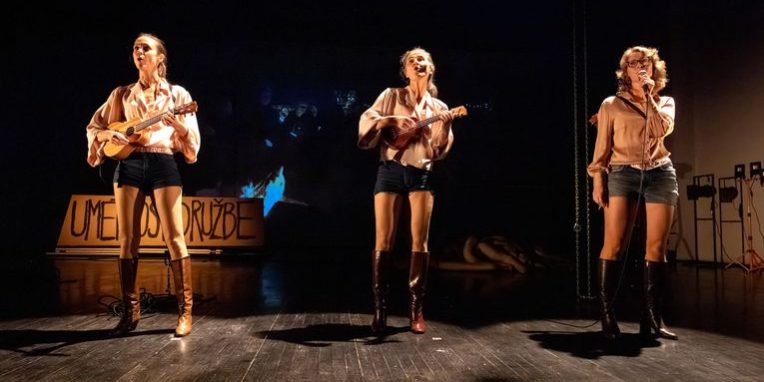
In The Art of Living: The Act of Killing, co-produced by Slovenia’s Mladinsko Theatre, Rizoma Institute and City of Women, Barbara Katovec, Katarina Stegnar and Urška Brodar – performing as the Bukovec sisters – try to make feministic art more familiar to housewives living in a small village in Slovenia. However, we only see this later. Initially the production seems more like a light-hearted comedy about a girl who escaped life in the countryside. The show opens with pile of women’s bodies in the middle of the stage. We can hear the performers’ voices but still not fully see them among the pile of dolls. They talk to each other, getting in sort of a quirky quarrel over who is going to get up first and speak to the audience. At moments different parts of their bodies appear briefly and then disappear again. At this point the performance resembles a kind of puppetry more than anything else. When the trio suddenly rise up from this pile, we are introduced to Barbara, who tells us a story about her own life, focusing on a defining moment for her – leaving her home village and escaping to the city of Ljubljana.
This is the same moment in which the clothing rack appears on the stage as a part of the set design but, more importantly, as a symbol of her new “style”. This escape, naturally, made her change her way of dressing but also her way of behaving – it changed her art of living. A clothing rack here represents putting on a new guise that contains more self and world awareness, more knowledge, more intellectualism, more people, more art, more elitism, fashion and culture; more life. It is not just about getting a new physical look and wearing shiny sequins, it is about revamping her previous, more conservative self, and emphasizing that on the outside, in order for others who did the same to be able to recognize that she is one of us now.
While putting on new extravagant accessories, Barbara recounts how after Ljubljana – the city which once seemed so huge and full of opportunities – became just a tiny province to her, she moved to London, once again putting on a new guise. In the UK capital she became not just a student at Goldsmiths but a citizen of the world learning new artistic contemporary practices and learning for first time about mainly feminist oriented, avant-garde performances. However, this clothing rack travels all the way back from the UK’s urban metropolis to rural village in Slovenia where Barbara was born. Now she is the one creating performances, not on streets of big cities, not in famous galleries, not at rich people’s parties but there in the place she once despised and wished to run away from. Her runway now is in the houses of this province, the space that once limited her; the same closet she was trapped in before.
Like the Three Graces, the three performers gather around crates of beer, sitting on them as Slavic men do, on the streets, in front of markets, on basketball courts, while wearing denim shorts, corsets and long brown cowboy boots. Later in the play, they change outfits, from shorts to jeans, from corsets to classic short-sleeved white shirts, a one could connect with the image of a typical Balkan man – an image once can associate with violence – but also from wider popular culture. Think of Lana Del Rey’s famous lines “Blue jeans, white shirt/walked into the room/you know you made my eyes burn…” in her 2012 hit Blue Jeans in which she explores her toxic relationship with her problematic ex-boyfriend.
There’s another potential pop culture reference in the final scene. The three performers wear glamorous shiny long dresses, evoking the iconic moment of Marilyn Monroe singing Happy Birthday to President John F. Kennedy, something later reenacted in Lana Del Rey’s music video for the song National Anthem. Our trio sing Stand by Your Man by country singer Tammy Wynette, pointing out the concerning way that domestic violence is often romanticized through the music that surrounds us in our daily lives, with songs like Everybody Dies by Billie Elish drawing attention to the number of femicides, which is often the consequence of being in this kind of relationship.
The three performers change outfits plenty of times during the duration of the performance but remain on Meta Grgurevič and Olja Grubić’s set at all times. They never leave the sight of the audience. As a result the clothing rack fulfils a triple purpose: visual, practical and symbolic.
I, David
I, David is the graduate performance of Gabrijel Lazić, produced as part of his MA in Theatre Directing at the Academy of Theatre, Radio, Film and Television (AGRFT), University of Ljubljana. It’s inspired by the true life story of David Reimer, who was born in Winnipeg, Canada, in 1965 as one of two twin brothers. Not long afterwards, however, the twins Brian and Bruce are diagnosed with phimosis which requires surgery. Bruce’s procedure takes place first, but the operation goes horribly wrong and Bruce loses his penis. The once happy family slowly sink into desperation after the accident until they come across a TV talk-show featuring the sexologist, John Money. Convinced their son’s physical defect is going to stand in the way of his happiness, they seek help from Money who advises them to raise their son as a girl.
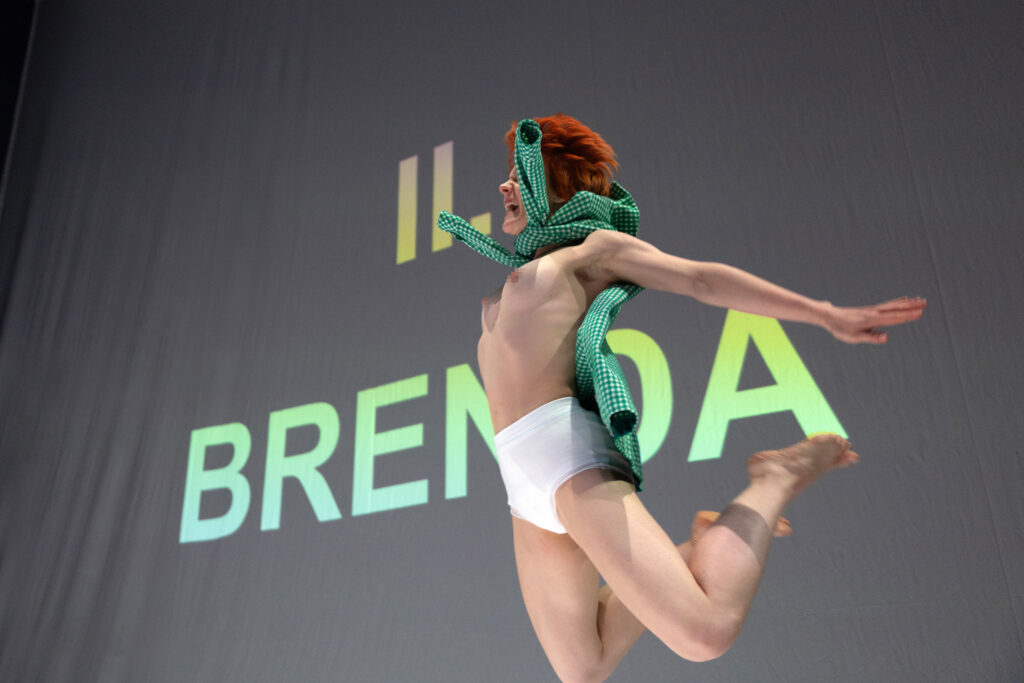
Money sees this as an opportunity to study both the children and strongly advises the parents not to talk with Bruce about his past, claiming that children are very able to adapt. In his opinion, gender is something we are not born with; it is something we can learn. At this point in the story a green dress is put on the actor playing Bruce by his parents,sybolising that he is not a he anymore, but a she. The performance is divided into three sections and the second section is titled I, Brenda, after Bruce’s new female name.
The set design by Lovro Ivančić is minimalistic. It contains a couple of tables that appear and disappear when needed, and a clothing rack. Here, the clothing rack serves not just a practical purpose (considering the characters’ constant changing of clothes) but an allegorical one. It helps us develop a deeper understanding of socially acceptable gender roles; it underlines the distinction between Bruce and Brenda but also highlights Bruce’s resistance to behave in accordance with those made-up rules. On this clothing rack hang “girly” clothes: pink and yellow-coloured skirts, dresses, ribbons – everything society is trying to frame him into.
When Brenda has a mental breakdown, it is portrayed by the same clothing rack falling on her, crushing her body. Brenda then, through her own strong inner desire, transforms one more time, turning male once again, becoming David. This transformation is initially shown by her getting up after the clothing rack falls on her, a literal “coming out of the closet,” the term widely used to describe the process of publicly revealing or acknowledging one’s sexual orientation or gender identity. In this sense, the clothing rack emphasizes the constructed norms of society that are being refused; it is a form of fighting against the stereotypical gender segregation; a sort of resistance.
In the final act the only person on the stage is David standing on the table next to the clothing rack that now holds just a single brown suit – the other metal hangers that once held dresses are empty now. David uses these metal hangers, one by one, not to hang a girl’s clothing on them, but to remodel his naked body (which has female characteristics due the hormones he was forced to take) back to his desired masculine form. Having finished this reshaping, David takes the brown suit from the clothing rack and puts it on, over the metal hangers, which he has slowly wrapped around himself – the clothing rack remains empty, waiting patiently for other clothes to fill it that fit the traditional definitions of gender roles – but which also allow another person to break the norms of gender as a cultural construct.
Sounds Like Pepper
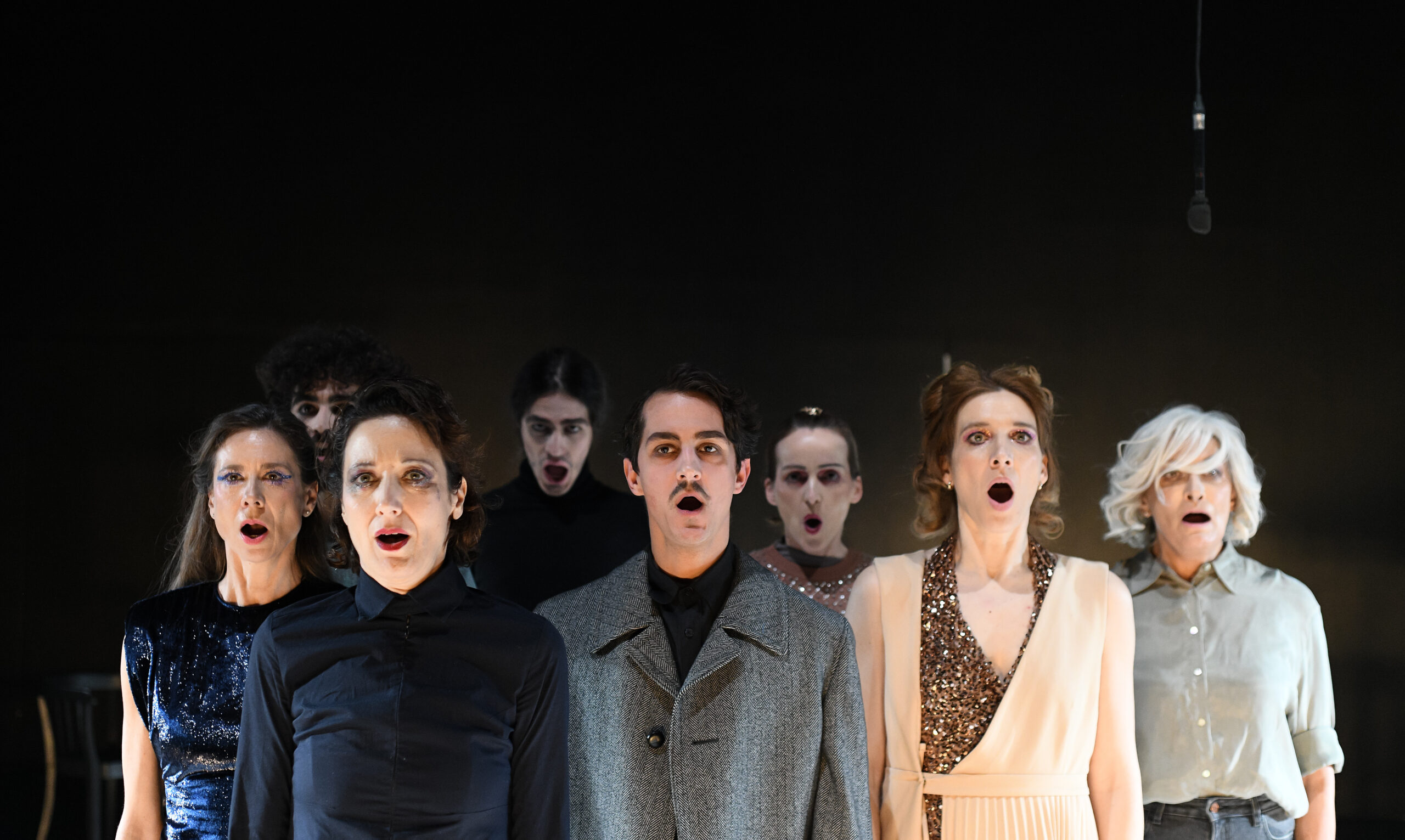
A clothing rack also features in the Croatian experimental performance Sounds Like Pepper, directed by Marina Petković Liker for Četveroruka with set design and costumes by Ana Paulić. This piece is harder to write about since it is mostly based on senses – sound as the main one: screams, onomatopoeia, cries and whispers (as in Ingmar Bergman’s cinematic masterpiece). This clothing rack adds to the performance’s horror-like atmosphere. The story (if there is even one) is situated in a space that resembles a mental asylum, madhouse or amusement park complete with freak shows. The Lynchian atmosphere is enhanced by the lighting which is mostly dark, leaving us in total blackness at times, able to rely only on our hearing.
Here, the clothing rack is not a metaphor as it was in the last two performances but rather a living creature that hypnotizes our protagonists and the audience along with them. This is a haunted-house world full of “clothing” ghosts. A woman dressed in a shiny royal blue dress, taken from the clothing rack, escapes from what seems like a coat-ghost. She traps herself in it, rapidly switching the play’s tone from hysterical but mystical, to dark-hued absurdity.
All three, used this seemingly unimportant stage prop as a strong tool for spreading their ideas – from moving locations to changing personalities to creating a haunted ambience.
It reminded me again to a well-known Chekhov’s gun principle emphasizing that every element in a story should be necessary – if there is a pistol it should be fired. In theatre everything is something, even the tiniest thing that sometimes can look insignificant, or decorative, or even invisible. Every single thing should bring meaning to the piece as a whole.
According to Google’s definition of the term, we use a clothing rack when the closet space is limited. In these performances it was used for the same reason – a hometown that suppressed self-expression, a society that shut down an individual’s own desires, limiting him, a “closet” that felt claustrophobic. Sometimes a set does not to be spectacular or elaborate to say something, sometimes a variety of messages can be sent through a simple clothing rack – the same one that we, by definition, require when “the closet space is limited.”

Vedrana Bogdanović is a writer, journalist, art historian, performer, and film and theatre critic based in Belgrade, Serbia. She has collaborated on various regional and international projects related to writing, theatre, cinema, and circus, as well as on festivals. Her articles have been published in several cultural outlets and publications, both locally and internationally, including Serbia’s only media platform dedicated exclusively to theatre —Hoću u pozorište. In addition to writing, she is engaged in devised theatre, circus, and performing arts. As a co-author and performer, she has participated in the creation of several plays. She has her own poetic-essay travel column “Deflated Balloon: Postcards from.” As a journalist and writer, she is a member of a few editorial boards dedicated to culture and art, such as Mingl BOS.