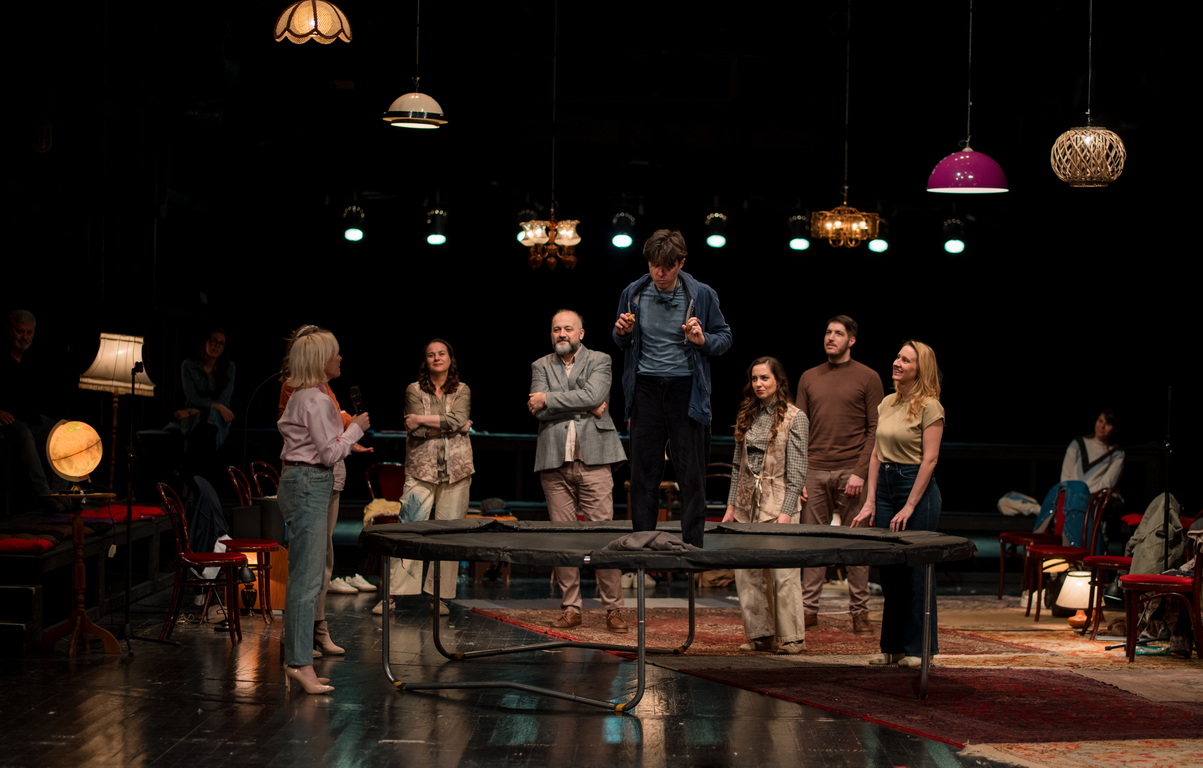
Following the premiere of Qëndrim Rijani’s production Othello at the National Theatre of Albania, our critics discuss the questions it raises around race, otherness, power and identity, as well as wider issues within the Albanian theatre scene.
The final production of the year at Albania’s National Theatre was William Shakespeare’s Othello, directed by Qëndrim Rijani. We approach this production through a dialogue because it drew our attention in different ways and opened questions that invite further discussion. What follows is not an attempt to reach one final judgment, but to think through the ideas, images, and topics brought into view by the staging.
What is Rijani’s approach to Othello?
Flamur Dardeshi: The production is presented to the public as a modernization of Shakespeare, but for me it is difficult to see where that modernity actually lies. The opening scene introduces a man boxing a BOB (Body Opponent Bag) and a motorcycle, and this is used as a sign of the production’s contemporary setting. Still, this modernisation remains on the surface; the staging retains the play’s traditional structure and does not substantially reframe its conflicts for a contemporary Albanian context. Othello is still a Venetian general, Desdemona is still caught between her father and her husband, and Iago’s betrayal remains the central engine of the story.
Katerina Markoska: The production does not go in the direction of fully transferring the plot into a contemporary Albanian context. Instead, it opens with recognizable contemporary signs, just enough to create a passage through which today’s audience can enter the tragedy. The opening images establish a world in which power appears weakened, masculine frustration is already present, and old hierarchies continue to function.
From there, the staging gradually moves toward a Venetian and Shakespearean atmosphere. That movement is important because it suggests that the mechanisms of the tragedy are not closed in the past. Patriarchy, hierarchy, possession, honour, violence, political order, and the mistrust of the one marked as different still belong to the present. The production feels contemporary not because it changes who Othello, Desdemona, or Iago are, but because it makes the old structures painfully readable again.
Its modernity lies in the theatrical language: in rhythm, scenography, music, choreography, physical intensity, and images that reveal how Shakespeare’s old mechanisms still operate today. Here, Josif Papagjoni’s reading offers an important critical frame. He locates the production’s shift in the transformation of the theatrical treatment of the text, describing it as a stylistic and semantic movement from the classical dramaturgical model toward a contemporary, modernist stage language.[1]
Belkisa Zhelegu: For me, Rijani’s modernity lies in the complexity of his treatment of the play’s central themes, rather than simply in its contemporary setting. The production moves between recognisable contemporary images and Shakespearean time, using music, costumes and scenography to create a world that is both historically specific and metaphorically timeless. The set by Valentin Svetozarev is particularly important in this transition: its metallic, constantly present structure creates a barracks-like environment in which the characters are physically close but rarely intimate, reinforcing the sense of a world organised around hierarchy, control and separation. The movement between temporalities therefore does more than update the visual language; it makes the structures of Othello – power, possession, exclusion and violence – feel continuously present.
This complexity is also evident in the way Rijani constructs a theatrical mechanism through the relationships between the characters, rather than confronting the play’s ideologies directly. The parallel between Othello and Desdemona and the relationship between Bianca and Cassio creates two opposing models of love: one shaped by social structures, expectations and prejudice, and another that exists outside them. Through these relationships, the production allows its wider themes to emerge organically, while the final image of Cassio washing himself with Iago’s heart and returning to Bianca reinforces this contrast. In his Othello, it is not love that triumphs over moral structures of society, but love without prejudice that triumphs over every structure.
Othello at the National Theatre, of Albania
How does the Albanian translation and stage history shape Othello’s difference?
Katerina: This question is important because Rijani’s production does not appear in an empty space. Albanian Othello already has a history in which race, ethnicity, foreignness, Turkishness, Muslim identity, and blackness overlap. Marinela Golemi shows that Fan Noli’s translation presents Othello as an “exceptional Turk,” while the Albanianized Othello simultaneously carries the identity of a Turkish other, a Black foreigner, and a Muslim man.[2]
Seen from that perspective, the emphasis on “the different one” does not come from nowhere. It has roots in the Albanian reception of the play, where Othello’s otherness was not understood only through skin colour, but also through ethnicity, religion, migration, and the experience of being placed outside full belonging. Rijani’s production seems to continue this line by shifting the visible marker of difference away from Blackness and toward a broader question of conditional belonging.
This history makes Rijani’s choice both logical and complicated, because the absence of visible Blackness in this production can be read as continuing a longer history of displacement.
Flamur: For context, we should mention the fact that Othello, translated by Noli in 1916, was staged at the People’s Theatre (now the National Theatre) in 1953 and ran until 1964. A. J. Ricko directed Othello using Noli’s translation, with Loro Kovaçi playing Othello. The production was performed 40 times. Sources also document the use of blackface makeup.
An interesting fact is that Othello was staged by the Vatra Society in Boston, USA. On 4 July 1923, Faik Konica directed Othello, using Noli’s translation. Konica himself played the Duke of Venice.
In his translation, Noli, who is considered one of the best Albanian translators and at the same time also a translator who treats the original text as flour for bread, not always remaining faithful to it, often removing or adding things and contexts so that the translation is adapted to the new reality in which it comes, translates the English word Moor as “Arap,” which in Albanian means a person with distinctly dark skin or darker than others, the other- a person who is different and distinguishable by the colour of their skin. In other nuances, the word also phonetically resembles Arab and is thought to come from Turkish (arab–arap). Through Noli’s use of the word Arap , Othello’s character simultaneously embodies the identities of a Turkish outsider, a Black foreigner, and a Muslim man, folding geographic, ethnic, and religious differences into one figure.
Noli’s translation matters, not because it is beyond question or not open to further dialogue, but because of the time and place in which it was produced. He translated Othello while living in the United States, where he encountered racial discrimination against Black people firsthand. As an Albanian Orthodox priest living abroad, as Marinela Golemi explains Noli’s choice to present Othello as an “exceptional Turk” can also be read as a way of reflecting on the experience of Albanian immigrants and the forms of racial and cultural othering they encountered outside Albania.
Belkisa: What contextualises Rijani’s Othello for an Albanian audience, for me, is precisely its psychological dimension: the way Othello internalises the idea of being a foreigner. This also resonates with the history of Othello in Albania, where the character has been shaped through overlapping ideas of race, ethnicity, religion and foreignness. As Katerina and Flamur point out, Noli’s translation presents Othello as an “exceptional Turk,” while his use of the word “Arap” brings together Blackness, Turkishness and the idea of the foreigner. The history of the play’s staging in Albania, including the use of blackface in the 1953 production, further shows how differently Othello’s difference has been constructed across contexts. Yet I think the production moves beyond these historical markers by focusing on something more subjective: the way discrimination and the feeling of not belonging are experienced by the individual. The form that exclusion takes may change from one context to another, but the psychological experience of being made to feel different, and the suffering that results from it, remains deeply personal and valid. This is what makes Othello so adaptable to different contexts: not because every audience shares the same history of discrimination, but because the experience of internalising exclusion can be understood beyond the specific circumstances that produce it.
How is Othello’s difference defined in the production? Can a production of Othello move race into the background without making race disappear?
Flamur: I feel like one of the main elements of the tragedy has been removed from Othello: the racial element, the fact that he was Black and a Moor, an element that Shakespeare seems to have considered important from the very creation of Othello, from the fact that he actually took the plot for Othello from Un Capitano Moro by Cinthio, and that Othello is often called by epithets rather than by his name.
That choice not to represent Othello as Black could be understandable, particularly in a context where there may not have been a Black actor available, or you may not have the possibility or desire to deal with such a theme, even though it would be interesting to address it within the Albanian or Balkan environment or context.
In Albania and the Balkans, there is a considerable Roma population, which remains underrepresented and stigmatized.
Another question is what replaces that aspect of his identity. If racial difference is removed, we need to understand what makes Othello an outsider instead. The production tells us that he is different, but it never really names or defines what that difference is.
Othello’s otherness could have been framed in many ways: he could be Roma, he could be an Albanian emigrant in Italy, a foreigner living in Albania, someone culturally or linguistically displaced, or even someone whose difference is defined through another aspect of identity.
Instead, the production makes him a foreigner without naming his foreignness. His outsider status is present, but it remains vague. As a result, one of the central elements of the tragedy becomes weakened: we are told that Othello is different, but we are never given a clear sense of what that difference means or how it shapes the way others see him and the way he sees himself.
So the issue is not necessarily that Othello is not Black. The issue is that his racial identity is removed without being replaced by another clearly articulated form of otherness. This leaves us with an Othello whose difference is acknowledged but not fully explored.
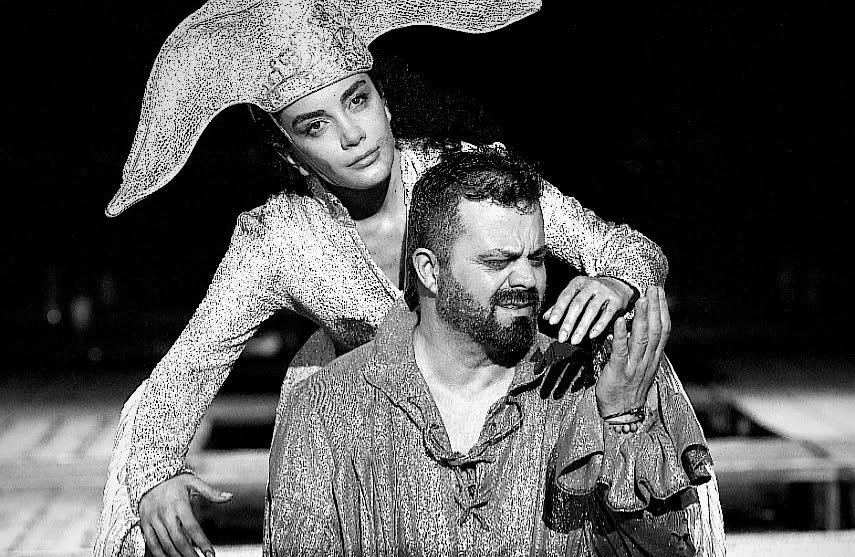
Katerina: This is one of the questions raised by the production. When Othello is not visually marked as Black, something central is inevitably displaced. Still, I do not think Rijani’s production removes Othello’s otherness completely. It relocates it. Arben Derhemi’s Othello is separated from the surrounding world through authority, severity, costume, posture, and the fragile way in which he belongs.
For me, the production opens Othello through difference, foreignness, and conditional belonging. It asks what happens to a man admired for his victories, yet still vulnerable to the suspicion that he does not truly belong and is not accepted as equal. This question also has to be placed within the material conditions of theatre-making in Albania, where the availability of a Black actor within the institutional theatre context may itself be a real limitation. In that sense, the choice of a white Othello is not directly comparable to contexts where Black actors are present but excluded from the role.
But this practical condition does not make the question disappear. Othello cannot be treated only as a neutral tragedy of jealousy, because race is already present in the play’s language, in the history of the role, and in the ways Othello’s body has been translated, marked, or visually constructed on stage.
This is why a colour-blind or race-neutral reading is never fully neutral. At the same time, this question becomes more complex in Europe, and especially in the Balkans, where difference is often read through foreignness, ethnicity, religion, geography, or national belonging rather than only through skin colour. Galland writes about Europe’s self-image as a “colour-blind continent,” while Golemi shows that in the Albanian context race and ethnicity are often intertwined. [2,3]
For me, Rijani’s production neither erases race nor resolves it. It makes otherness visible through belonging, power, and exclusion, while leaving the racial dimension of that otherness unresolved.
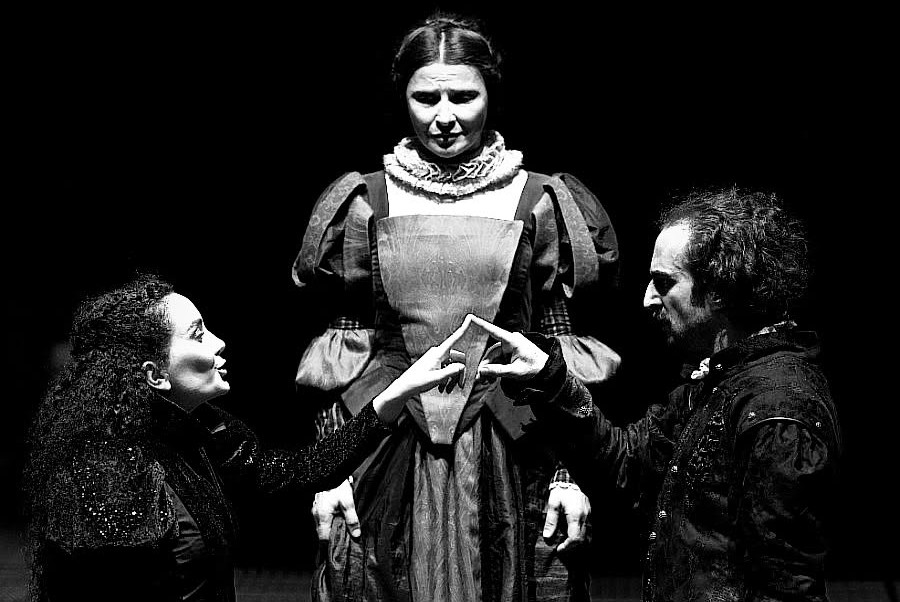
Belkisa: What happens to Othello when a production removes the visible sign of race but keeps the psychological mechanism of racial othering? In my interpretation, Rijani creates a subtle dramaturgical trap. Direct racial terms used by Iago and Brabantio intentionally are removed from the dialogue, shifting the focus away from explicit racial discrimination toward the clearer framing of “the concept of the foreigner.” Othello is thus positioned as excluded, and this exclusion becomes central. At first, the production even plays with the assumption that Othello is perceived as racially unmarked or “white” in appearance, inviting the audience to read him primarily as a universal outsider rather than a specifically racialized figure. This assumption proves to be a subtle narrative trap that is only deconstructed later in the performance.
Among the most important modern readings is the idea of internalized racism: Othello gradually begins to see himself through the racist gaze of others. In anti-apartheid interpretations, this was understood as the psychological effect of racial oppression. Rijani develops precisely this shift in perspective, moving questions of race into the background and shifting focus from the social structures of discrimination to Othello’s subjective experience. The production’s central concern is not racism as a social condition alone, but the psychological mechanism through which racism becomes part of Othello’s consciousness. Exclusion becomes the core of the drama as he gradually learns to perceive himself through the logic of his own marginalization, a process that remains central throughout his denial of inferiority.
Othello at the National Theatre of Albania
What meanings are produced by the use of dirt or blackening on Othello’s body?
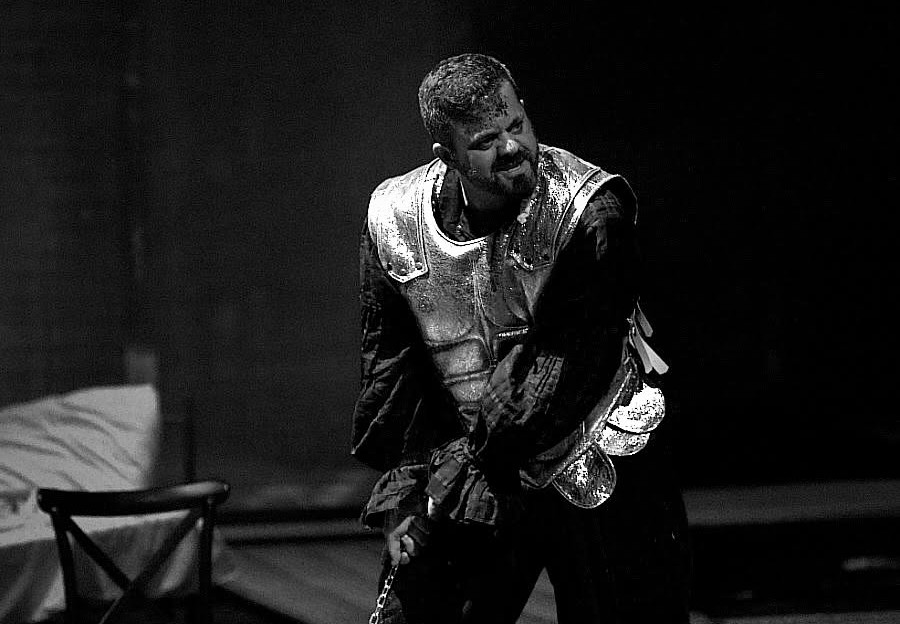
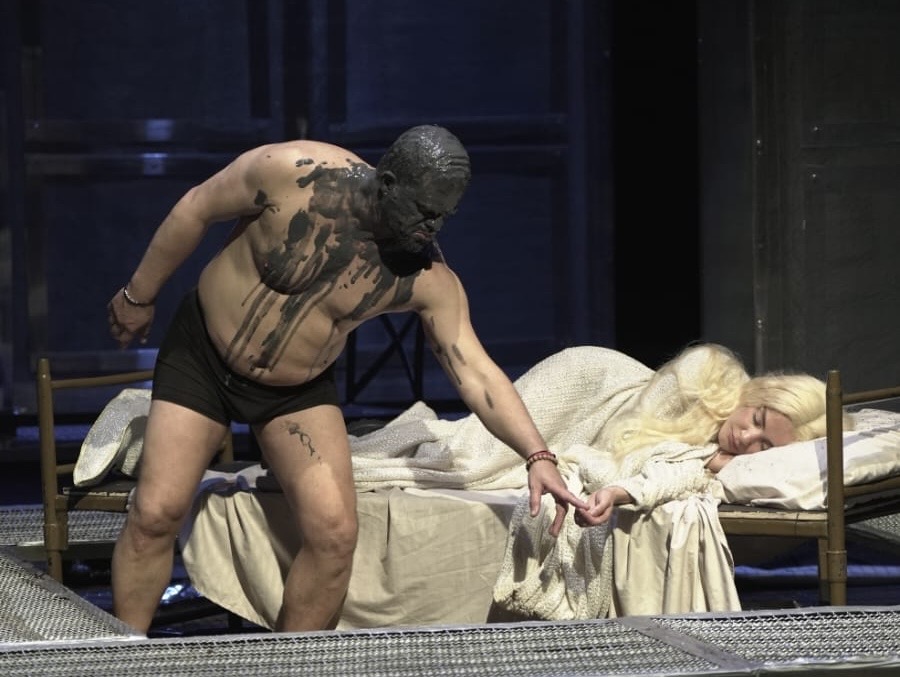
Flamur: At the moment of the murder of Desdemona, Othello’s upper body is covered in black paint or mud. After the killing, he retreats to the side of the stage and takes a shower, washing the black substance from his skin.
For me, this is the oddest part of the production. The metaphor of covering him in dirt through Iago’s manipulation seems difficult to digest, both because this covering happens suddenly rather than progressively, and because immediately after the murder he is cleaned with a “cathartic” shower. Ηere it seems that the spectacle takes up more space than the meaning and, given the racial dimension of Othello, covering him in black paint during the murder scene may add one problem on top of another, revealing a certain lack of sensitivity.
From the audience’s seat, this scene made me uncomfortable.
Katerina: The image had a strong theatrical effect for me. I read the dirt on Othello’s face and body as the material form of jealousy, as if the thought planted by Iago had entered him so deeply that it darkened his mind, covered his eyes, and destroyed his ability to see clearly. In that sense, it belongs to the emotional and visual logic of Rijani’s production. Jealousy is no longer only an inner state. It becomes visible, physical, almost impossible to remove.
Papagjoni’s review is important here because it shows how this stage image was read within the local critical reception. He understands the mud through slander, crime, vice, paranoia, the “black trap,” and catharsis. This confirms how legible the gesture is within the moral and emotional logic of the performance. [1]
But because this is Othello, the image cannot remain only a metaphor. When darkness appears on the body, it inevitably touches a much older symbolic and racial history. This is where Thomas Ostermeier’s 2010 Othello at Schaubühne Berlin becomes a useful point of comparison. In that production, Desdemona painted Othello’s white body with a black, mud-like substance, and the image also provoked questions about theatrical intention, racialization, and the material presence of Blackness on stage. [3]
The two productions do not use the same strategy, but both place darkness onto Othello’s body. Because of the history of Othello, that darkness cannot be read only as a private or psychological sign. It also enters the wider history of how Blackness has been represented on stage. This does not cancel the power of Rijani’s scene, but raises the question of whether the production is fully aware of the meanings produced by that gesture.
Belkisa: The final blackening first asks us to reconsider what lies behind Othello’s exclusion. If what we have understood as “foreignness” may also conceal race, then what does this change about our understanding of Othello? Does it make him less responsible for what he does? Does it turn him into a victim? Does it somehow diminish his responsibility as Desdemona’s murderer? This shift functions as a kind of ringing bell: it allows us to understand the circumstances that shape Othello without confusing them with the choices for which he remains responsible. However deeply an individual internalises exclusion, the way they respond to it ultimately remains subjective.
This is why the blackening is important as a theatrical action. I do not read it simply as jealousy made visible or as moral degradation, but as the materialisation of an identity that Othello has gradually internalised. The paradox is that when Desdemona sees him covered in the substance, she does not see him as transformed. The transformation exists entirely within Othello himself. He has internalised the experience of not belonging so deeply that he has incorporated it into his own sense of identity, almost into his very being. The image therefore does not show us how others see Othello, but how Othello has learned to see himself.
At the same time, because this is Othello, the image inevitably recalls the racial history of the play and the history of Blackface. But this paradox is precisely what prevents the scene from being reduced to a simple repetition of that history: the substance may recall how Blackness has been constructed and perceived on stage, yet within the scene itself, Othello is the one who perceives himself as transformed, while Desdemona does not. The gesture therefore brings race back to the surface while simultaneously showing that the deepest transformation has taken place within Othello’s own perception. This makes the image uncomfortable, but also theatrically productive: it forces us to reconsider both the origins of his suffering and the responsibility he retains for what he does.
Othello at the National Theatre of Albania
What kind of critical conversation does this production invite?
Flamur: Rijani creates an atmospheric, epic-like show (similar to what I have seen in other productions of his as well); it focuses on creating an epic atmosphere that carries through from start to end. At the centre of the tragedy, remains Iago’s betrayal and deception: the story of a good man whose friend turns against him because he is resentful that Othello has promoted Cassio instead of him.
From this perspective, the discussion could also move toward the way Othello and the tragedy itself are represented in the production: the human capacity for manipulation and deception in pursuit of personal interest, and the role of jealousy, betrayal and self-interest.
Katerina: For me, this is exactly why the production invites critical conversation. It is not a performance that can be reduced to one problem, one image, or one final judgment. Rijani’s Othello opens many questions at once: about jealousy, exclusion, conditional belonging, violence, and the position of the one marked as different.
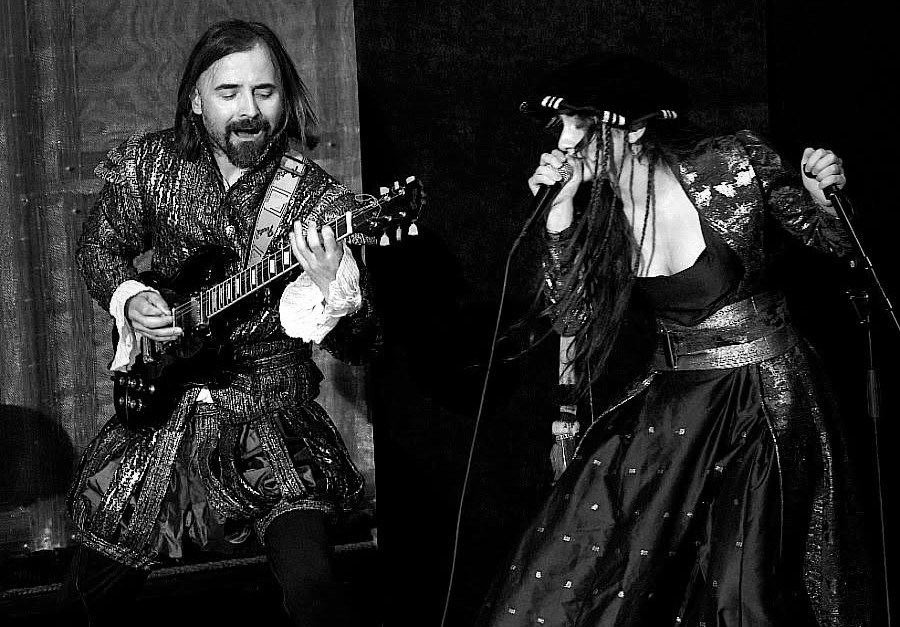
The strongest moments of the production move beyond plot and psychology. They are built through rhythm, scenography, music, choreography, ensemble work, and a series of images that remain in the mind. Rijani also thinks through Shakespeare beyond Othello itself, allowing echoes of Hamlet, Macbeth, The Merchant of Venice, and Julius Caesar to enter the performance and widen its world of power, guilt, blood, justice, and political order.
At the same time, the fact that the production is visually and emotionally powerful does not mean that every image should be accepted without questioning. The use of darkening on Othello’s body is one of the points where the performance opens a more difficult conversation. It works theatrically within the logic of jealousy and blindness, but it also carries meanings that cannot be controlled only by directorial intention.
That is why criticism should not flatten the production into either admiration or rejection. Its value lies also in the fact that it provokes discussion. The most interesting space is precisely between its theatrical power and the questions it leaves open.
Belkisa: In my opinion, the most interesting critical conversation the production invites begins with a contradiction: can racism itself be used as a way of criticising racism? And if it can, what happens when a theatrical image carries meanings that go beyond what the director intended?
This question becomes especially important in Rijani’s Othello, because the production constantly moves between the social circumstances that shape Othello and his own responsibility as an individual. We are given many reasons to understand him: his position as a foreigner, his conditional belonging, the insecurities that Iago manipulates, and the way exclusion gradually becomes part of his perception of himself. But the production does not, for me, allow these circumstances to completely explain or excuse what he does.
This is what connects the different questions raised by the production for me. Race, foreignness, love, jealousy and exclusion ultimately lead back to the individual: what happens when we internalise the way others see us, and what responsibility do we retain for the way we respond to it? The production does not give us an easy answer, and I think that is precisely why it remains open to critical discussion.
Its strongest images do not necessarily resolve the questions they raise; they make them more difficult. The blackening of Othello is a good example. It can be read within the psychological logic of the production, but it also inevitably recalls the history of Blackface and theatrical representations of Blackness. That tension cannot simply be resolved by referring to directorial intention.
For me, this is where the critical value of the production lies: it gives us enough to understand Othello, but not enough to stop questioning him. Its theatrical power and its problematic or unresolved images can exist at the same time, and criticism should remain in that space rather than reducing the production to either admiration or rejection.
Othello at the National Theatre of Albania
How was the production framed in public and media discourse?
Flamur: It is not easy to understand the audience’s reaction to theatre performances in Albania. It often appears blurred and contradictory. Nevertheless, for as long as it was on, the show was sold out, but this is already happening with every production at the National Theatre, perhaps because there are so few productions. In any case, in Albania, a full house is by no means a criterion for evaluation.
With the closure of the programme Artes on RTSH, which gives considerable attention to theatre in Albania, there is tendency to settle for simply announcing performances and inviting the director and actors of the show onto afternoon television programmes to discuss them. Often the interviewing journalist has either not seen the performance and promises to go and see it, or simply talks about how moved and amazed they were by theatre. Usually, on these programmes (and not only on these), theatre is treated as an El Dorado, or as some other wondrous place where simply passing through is enough for your soul to immediately experience catharsis. In terms of actual criticism, however, a review of this production, by the 76-year-old critic Josif Papagjoni, praises the director, the actors, and the show.
Katerina: From my position outside the Albanian context, I would be careful not to judge the audience response too directly. A sold-out theatre always means something, even if it cannot be taken as an objective criterion for artistic value. It shows that the production attracted attention and created a public effect.
That kind of visibility is valuable, especially when compared with contexts like North Macedonia, where theatre is often almost invisible in the wider media space. But visibility and strong audience response are not the same as criticism. Promotion, admiration, and television appearances can bring a production closer to the public, but they do not replace the slower work of considering its theatrical value, its choices, its structure, and the questions it opens.
Still, the public reactions I read were largely positive and often framed the production as a major artistic event, a powerful stage experience, and a successful contemporary encounter with Shakespeare.
Belkisa: I think it is difficult to speak about a real dialogue between audiences and theatre in Albania, simply because there are so few productions, and an even smaller number that invite this level of discussion. In that sense, the fact that Othello was sold out and received a largely positive response is significant: the production clearly attracted public attention and connected with its audience.
But there is a difference between being well received and generating deeper critical engagement. Othello raises questions about race, foreignness, exclusion, love, violence and individual responsibility that go beyond whether the audience found the performance powerful or moving. The media also plays a role here, because theatre is very often covered as a promotional event rather than as a subject for serious discussion. There is very little media space (or not at all) for questioning a production, examining its choices, or creating a wider critical discourse around it. This makes it much harder for a performance to move beyond its immediate reception and become part of a larger cultural conversation.
Is there a dialogue between theater and public life? What is the position of the theater in the city?
Flamur: The protest six years ago to save the National Theatre building could have opened an extraordinary discussion about freedom, culture, and the role of theatre in public life. But that conversation never really took place.
Instead, we moved from the withdrawal of many of those who had protested to the silence that followed the demolition of the building at four in the morning, a silence that continues to this day; From the “tourist” visits to the construction site led by the mayor, who is now in prison; to one dismissed director and another appointed temporarily; from a troupe waiting for their salaries to a theatre struggling with chronic underfunding; from gold-covered El Dorados to performances that often struggle to connect with the public(which public?). Taken together, this makes the theatre seem less like a living institution engaged with its society and more like a numb organism, one that has lost its sensitivity to what is happening around it.
For two months now, as the sun colours Dajti mountain in pink, the mountain that gives meaning to the city, and the main boulevard is likewise coloured pink by citizens protesting with flamingos in their hands, because it seems they have understood something that the theatre in Albania has still not understood: that freedom is won only by defending the other, a migratory bird in this case, or public land, or even a fellow citizen from a corrupt and authoritarian government.
References:
- Josif Papagjoni, “Shakespeare with Another Language and Theatre Code,” ExLibris newspaper.
- Marinela Golemi, “Othello in the Balkans: Performing Race Rhetoric on the Albanian Stage.”
- Nora Galland, “German Hermeneutics of Racecraft in Thomas Ostermeier’s Othello (2010).”

Flamur Dardeshi is a freelance writer based in Tirana. He has contributed in the areas of translation, analysis, and poetry. His main fields of interest are literature, cinematography, and theatre.

Katerina Markoska is a translator, theatre critic, and emerging author from North Macedonia, living between Skopje and Sofia. She is currently completing a master’s
degree in Theatre Arts and Dramaturgy at the National Academy for Theatre and Film Arts “Kr. Sarafov” in Sofia. Her translations of contemporary drama have been
recognized by Eurodram, and her creative texts have been published in collective books in Bulgaria.