Novi Teatar at ICIKUM, Sarajevo, premiere 5 September 2026
As they drift through Sarajevo’s September skies, their cries carrying over the murky waters of Miljacka River, one pauses for an instant to wonder: what is a seagull doing in a valley city, 518 metres above sea level and even further from the coast? For Nina and Kostja, the young artists at the heart of Chekhov’s play, the answer may be a six-letter acronym: ICIKUM — and, perhaps… supposedly… hopefully… for a whole generation of aspiring artists, too, a new nesting place from which to attempt a flight of their own.
Selma Spahić’s The Seagull (Galeb) was the inaugural performance at the Novi Teatar within the International Center for Play, Culture, Arts and Youth — better known as ICIKUM, in the borough of Grbavica. A newly opened cultural institution, founded by Dino Mustafić, whose programmes are designed to connect the local community and young audiences in particular with contemporary cultural trends through artistic production, education and international cooperation.
In that regard, The Seagull seems an apt, if not programmatic choice for an inauguration piece, as the Chekhovian drama itself is about the desire to reinvent theatre. The generational and aesthetic conflict between the established actress Irina Arkadina (Ejla Bavčić-Tarakčija) and her aspiring playwright son Kostja (Josip Stipić) turns the question of new versus conventional forms into a palpable culture war that, in terms of specific arguments, ultimately flounders on slippery ground.
However much the production is concerned with a semi-critical cultural-political debate between the old and the new, at its core it deals with themes of vulnerability, (un-) happiness and aspiration. In this spirit, the show is steeped in hopeful, childlike glee, the imaginative pleasure of make-believe and, therefore, a gullible faith in theatre as a necessity — perhaps even as a means for its characters to make sense of their own misfortune. Or, as the evening’s catchphrase has it: “One cannot do without theatre.”
The Seagull
That being said, some roles seem to be reversed along the way. It’s firstly the grown-ups who act recklessly, forcing the young adults to take responsibility for decisions made by their caretakers — decisions they had no part in making, yet are left to bear the consequences of. Spahić emphasises this inversion by shifting not only generational but also gender dynamics, both between and within her characters, portrayed by a star-studded, light-footed cast whose joy in playing is ever so visible.
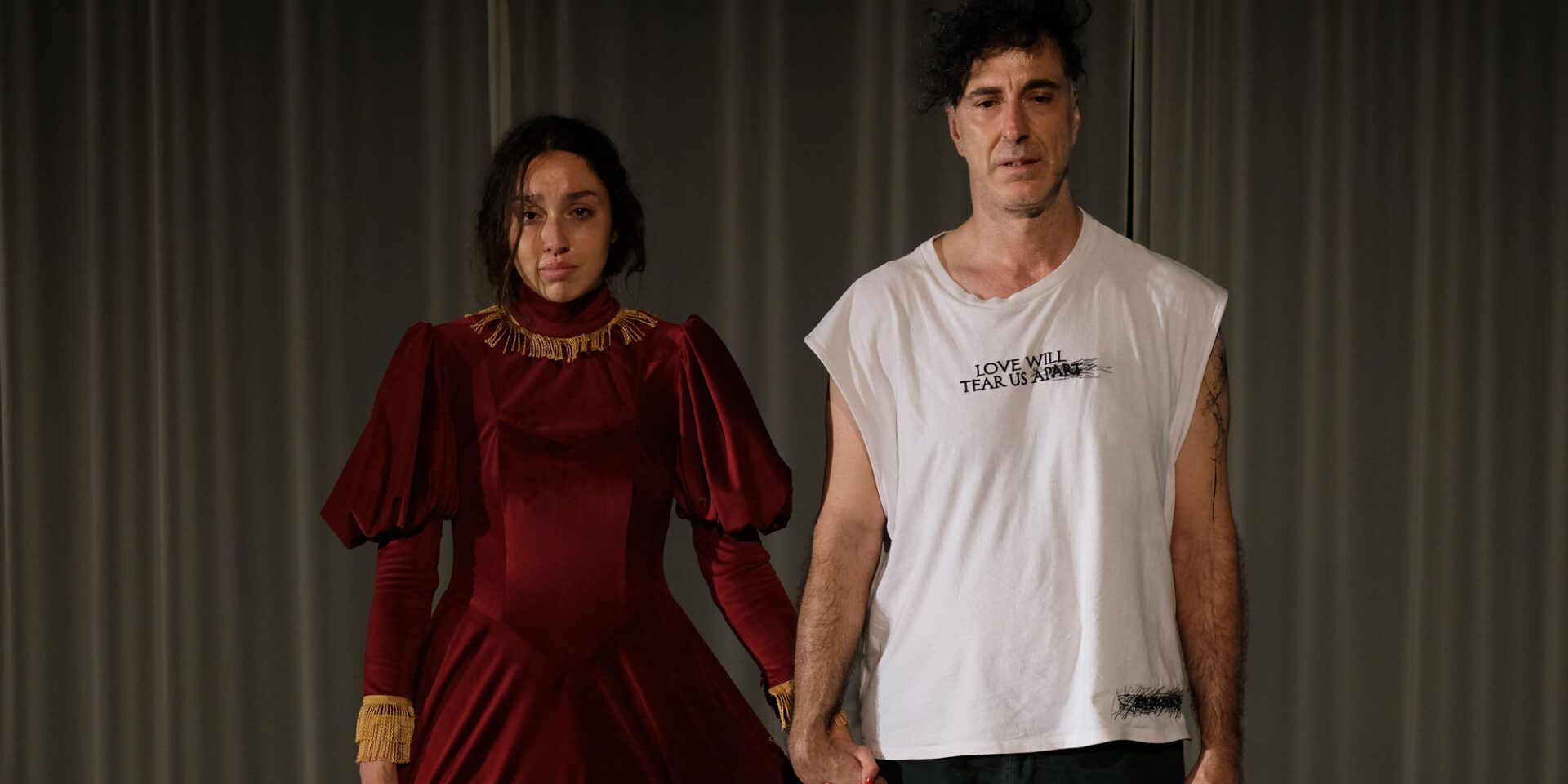
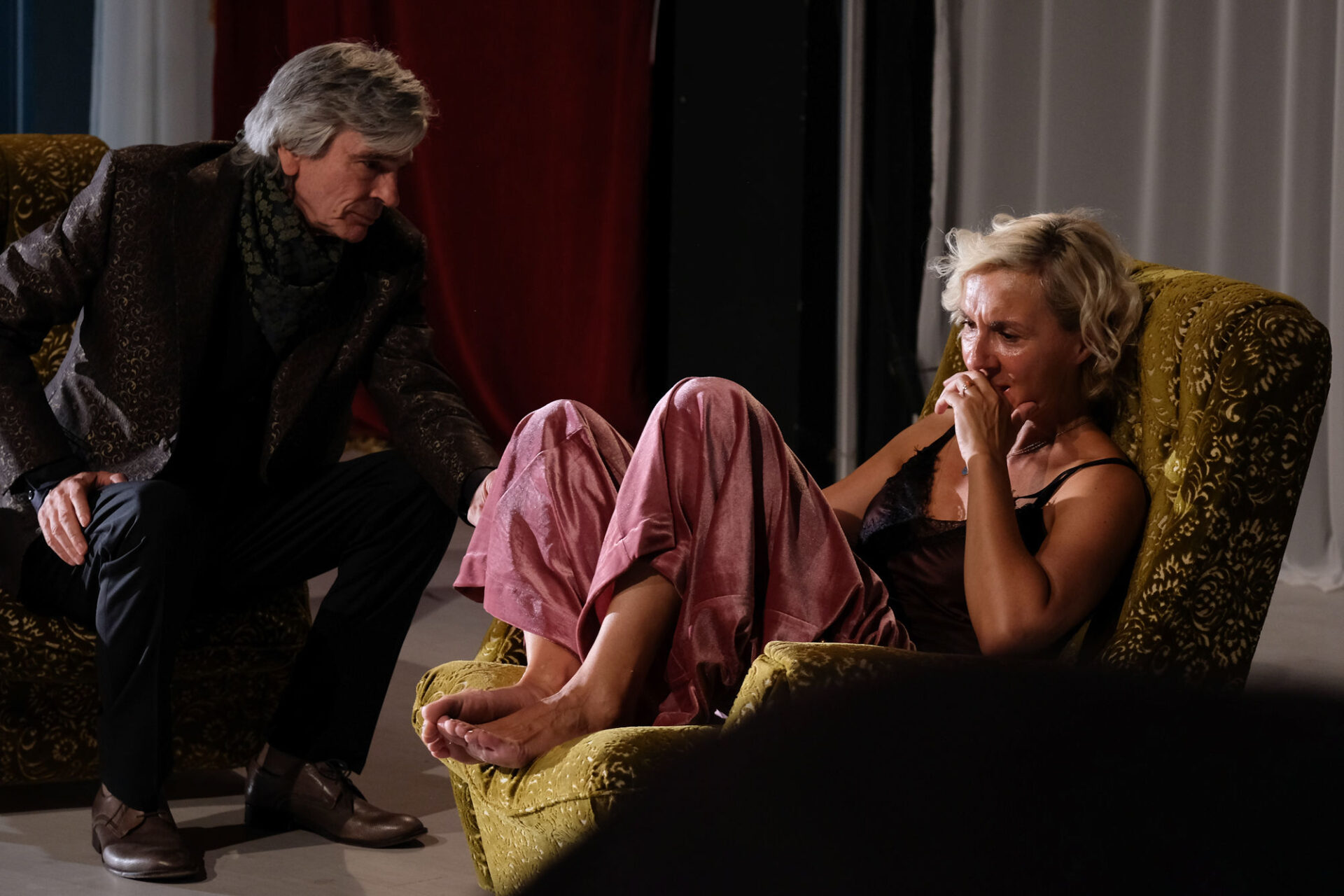
This becomes most prominent in the relationship between celebrated writer Trepljev (Ermin Bravo) and aspiring actress Nina (Iva Prgić). What is usually presented as an arrogant, vampiric, life-sucking artist, Bravo unexpectedly and wholeheartedly embodies as a vulnerable, bashful wallflower, hesitant even to flirt with Nina, let alone touch her. She, on the other hand, takes his timid blushing as an invitation to play out her fantasy of him — as if he were the one truly in love, while she projects onto him her own ambitions of fame. Prgić and Bravo play out this emotional tango on equal footing and with flying colours.
It has to be added, though, that while this critical reinterpretation of their relationship feels exciting and contemporary in its reversal, it lacks a convincing dramaturgical resolution in the fourth act, which, in general, feels somewhat rushed.
Side-eying their love affair from a safe distance, the enfant terrible Kostja, played by wunderkind Josip Stapić, is left to watch his nemesis pursue Nina, the woman he is notoriously in love with, while struggling to become a writer himself, just like Trepljev. This being Stapić’s second collaboration with Spahić, following Softness, which premiered earlier this year at the Istrian National Theatre Pula and the Sarajevo War Theatre, puts the leap from an acting student to professional on full display — his charm, eagerness and collaborative spirit seem to spring from a burning desire to play.
Equally blazing brightly is the joy of legendary actor Senad Bašić, whose embodiment of Sorin is all warmth, mischief and rose-tinted childlike wonder. His personal bliss in being onstage turns Sorin’s longing for a life that might still have been different into something tender rather than merely melancholic. In a similar vein, Ejla Bavčić-Tarakčija shines brilliantly as Arkadina, whose presence brings a sharper, more seasoned theatrical energy to the ensemble. She gives Arkadina the vanity, authority and vulnerability of a woman who has spent her life being observed — and has no intention of surrendering the stage now. The rest of the cast follows suit, contributing to an ensemble whose greatest strength is precisely its infectious delight in playing together, whether with one another or with the audience.
Even though her directional style is marked by an actor-centred approach, Spahić’s version of The Seagull positions Chekhov not as the origin of psychological realism, but as an avant-garde experimentalist, a reading that becomes apparent in her formalistic use of dialogue and space. She developed a new stage adaptation together with emerging dramaturg Adna Dautović, drawing on translations by Kirill Taranovsky, Laurence Senelick and Tom Stoppard, as well as the Russian original. Additional lines were generated through improvisations with the ensemble, giving this version a playful looseness that feels genuinely claimed by the performers, even if the adaptation ultimately leaves the contours of Chekhov’s original largely intact.
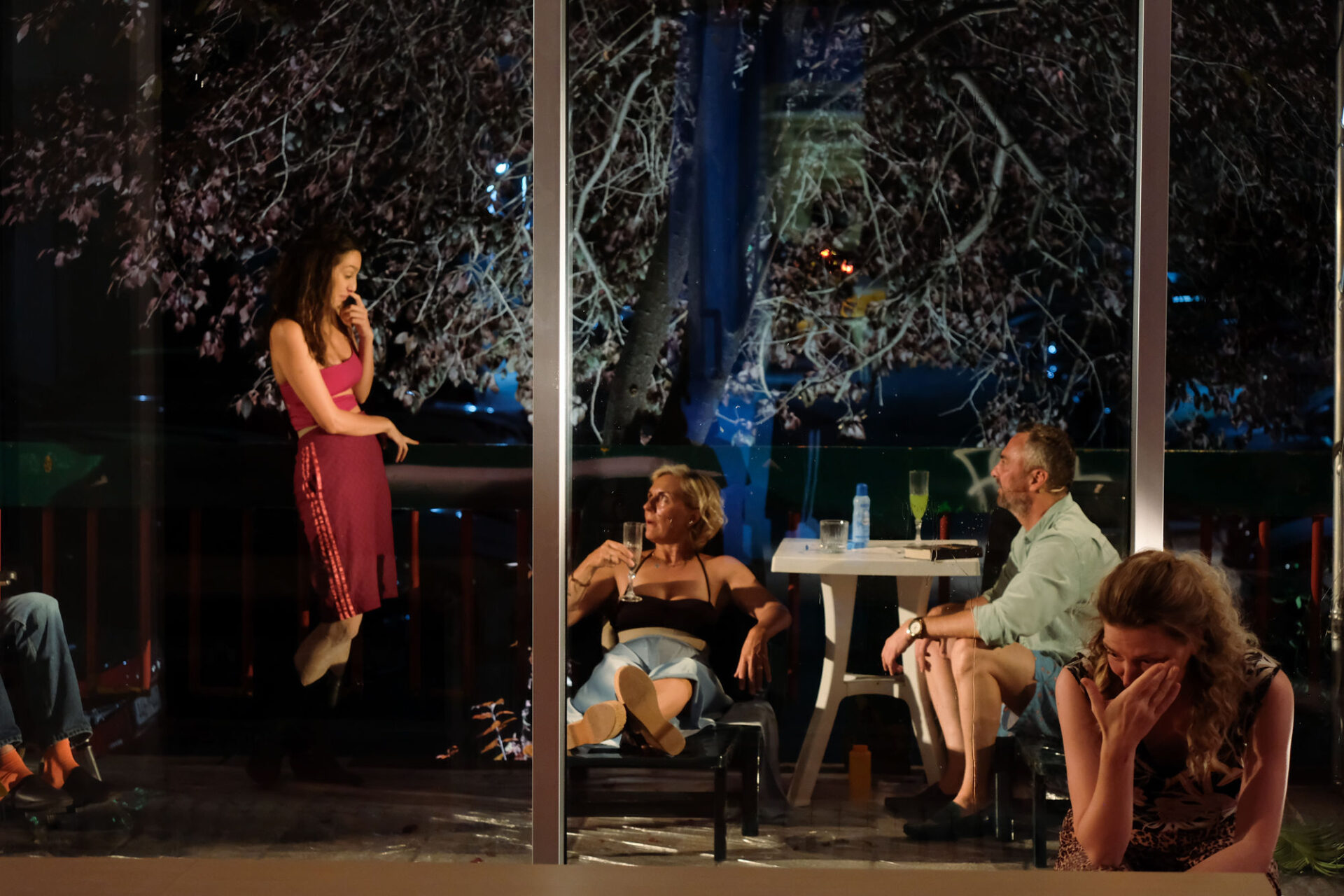
Instead of imposing the established Stanislavsky method on her cast, Spahić projects its interplay of inner and outer onto the surroundings of ICIKUM, turning its architectural framework into a symbolically charged emotional scaffold. In this sense, the building itself becomes a kind of external nervous system for the production. It begins in the Grbavica amphitheatre outside the main building on a crisp autumn evening beneath the chestnut trees — evoking the huge plane tree designed by Jan Pappelbaum for Thomas Ostermeier’s 2023 The Seagull at Schaubühne Berlin — before moving through three different chambers of the interior. By orchestrating the character’s entries and exits in a way that the voice of a performer often precedes their body, Spahić creates an astonishing metaphysical effect: disembodied voices travel independently through the ether, as if their souls were extracted from their earthly physicality.
The Seagull
Praise belongs not only to the artistic team, but also to the production department. Coordinating the logistics of the actors’ movements across the building was no small feat, but some members of the technical crew also stepped into the play themselves. Stage manager Senad Bešić and sound engineer Mladen Maroje Dolić both give formidable performances as caretaker Ilija and worker Jakov, moving through the production with ease and confidence.
And perhaps this is where Spahić’s The Seagull ultimately finds its most convincing answer to Kostja’s perennial question of how theatre might be revolutionized. It does not reinvent Chekhov so much as it reinvents the conditions in which he can be encountered, showcasing something fundamental: that theatre does not have to be innovative to be necessary, as long as it’s truthful in its pursuit for togetherness. That is why it has to remain a place where people can gather, play, imagine collectively — and, for a few hours, make their (un-) happiness mean something. If ICIKUM is indeed to become a new nesting place for Sarajevo’s next generation of artists, The Seagull proved to be an appropriately hopeful first flight.
Credits
Director: Selma Spahić/ Author: Anton Pavlovič Čehov/ Dramaturgy: Adna Dautović/ Set Design: Adisa Vatreš Selimović/ Costume Design: Emina Hodžić Adilović/ Make-Up: Maja Talović/ Choreography: Ena Kurtalić/ Music: Mirza Redžepagić/ Sound: Džemal Sejdić, Mladen Maroje Dolić/ Light Design: Nedim Pejdah/ Stage Manager: Senad Bešić/ DOP: Almir Đikoli/ Producers: Dino Mustafić, Ismar Hadžiabdić/ Executive producer: Adna Rizvan/ Co-Producer: Academy of Performing Arts/ Production Assistant: Nizama Mulić/ Assistant Director: Zoja Perović
Cast: Ejla Bavčić-Tarakčija, Josip Stapić, Senad Bašić, Ermin Bravo, Iva Prgić, Maja Izetbegović, Mehmed Porča, Faruk Hajdarević, Anja Vujković, Senad Bešić, Mladen Maroje Dolić
For more information, visit: icikum,ba
Further reading: Interview with Selma Spahić: “Resistance in the arts is a necessity”

Berina Musa is a writer, dramaturg, and critic based in Sarajevo and Freiburg. She studied German linguistics, literary studies, and art history at the University of Freiburg and is currently completing a second degree in dramaturgy at the Academy of Performing Arts in Sarajevo. Her plays and short films have been presented at the Bosnian National Theatre Zenica, MESS, the Sarajevo Film Festival, and the Mostra Internazionale del Nuovo Cinema di Pesaro.