“Kujtim Spahivogli” National Experimental Theatre, Tirana, 5 November 2026
Did they have passports back then, in Tauris?
Unrecognised features six performers from Ukraine, Georgia, North Macedonia, Finland and Sweden, who bring their passports onto the stage and highlight the differences between them, the differences between their passports. Wherever there is a passport, there is always a border.
This play about borders is the product of international collaboration between Kosvo’s Qendra Multimedia, Georgia’s Royal District Theatre, Ukraine’s Theatre on Pechersk, the Albanian Theatre Skopje in North Macedonia, and a quartet of Swedish theatres and producers: Örnproduktion, Malmö Stadsteater, Dramaten and Göteborgs Stadsteater. The same is true of the cast and creative team. It is directed by Georgian director Data Tavadze and co-written by Kosovar playwright Jeton Neziraj and Georgian writer Davit Gabunia.
We are in Tauris, a place geographically associated with present-day Crimea, which was occupied by Russia in 2014, while we were far too preoccupied to pay much attention. For the self-centred civilisation of the ancient Greeks, Tauris was considered a place on the periphery, a borderland. And so the play sets out to explore the periphery, borders and emigration. We are, however, promised that this will not be a piece of political theatre, “Fuck political theatre,” one of the actors interjects.
The political undertones remain strong, of course, but Unrecognised also seems interested in understanding what happens to a person when their past or present, or the place they come from, becomes unrecognised, or simply ceases to exist. Perhaps this is where mythology comes in handy. Iphigenia in Tauris is one of the narratives the production engages with, alongside other stories that bring into focus themes of sacrifice, migration, borders, war, displacement and hunger. The play also ventures into more intimate territory, touching on family drama, an absent father and a husband lost to war.
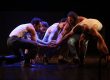
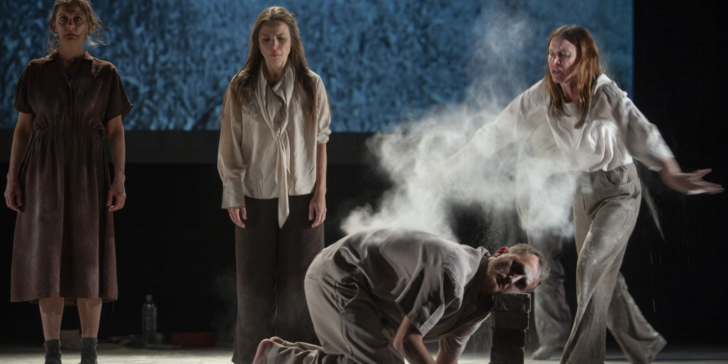
The stage is covered in flour from the very beginning of the performance. As the action unfolds, the flour often turns into a fine dust, settling on the actors’ clothes as they regularly send clouds of it into the air, covering both the space and themselves.
The performers are dressed in similar clothes, in earthy tones, beige, brown and shades somewhere in between, making them look as though they belong to the same collective. The flour, the dust, becomes a marker of identity, but at the same time a sign of its absence. “I only said bread, and you thought of the story itself,” one of the actors tells us.
Iphigenia in Tauris, along with Aristotle’s interpretations of the myth, is used to create an atmosphere that is at once mythological, humorous and somewhat emotionally detached, offering a distant perspective from which we can approach more personal, lived-in and relatable stories.
Beyond the main narrative, six or more different stories, not necessarily connected to one another, are told by the performers. The text is generally fragmented. Co-written by Kosovar playwright Jeton Neziraj and Georgian writer Davit Gabunia, it feels as though one can sense the differences between the stories, their tonalities and the various approaches through which they convey their truths.
Unrecognised
The stage, with its few elements, flour, a table, chairs, and a handful of other small objects, is backed by a screen showing black-and-white filmed images. These, much like the music, help establish the atmosphere without intruding on the performance.
The production is essentially narrative-driven and relies heavily on the actors’ performances, and they do not fail to deliver. In Shkëlqim Islami’s monologue about crossing the border to audition for an audition in a neighbouring country, one can feel the tension and humiliation he experiences at the hands of the border police. The same is true of Maria Salomaa’s and Ellen Jelinek’s monologues: one recounts the experience of a pregnant woman crossing a checkpoint guarded by armed teenage soldiers; the other tells the story of her loved one, her fiancé, a soldier consumed by war and lost in its clouds of smoke. What did he see? What did he do?
This narrative-driven approach lends itself to the choice of legends and myths through which the production explores the other’s lack of belonging, whether that other is a character or a story. You never quite know which border is being crossed, which country or city is under attack, or which war is being fought this time. Even though some of these stories may feel familiar to certain audiences, who might recognise the people and places they refer to, they are nevertheless about an unrecognised land. Tauris is an unrecognised land that gradually expands to become a home or a world.
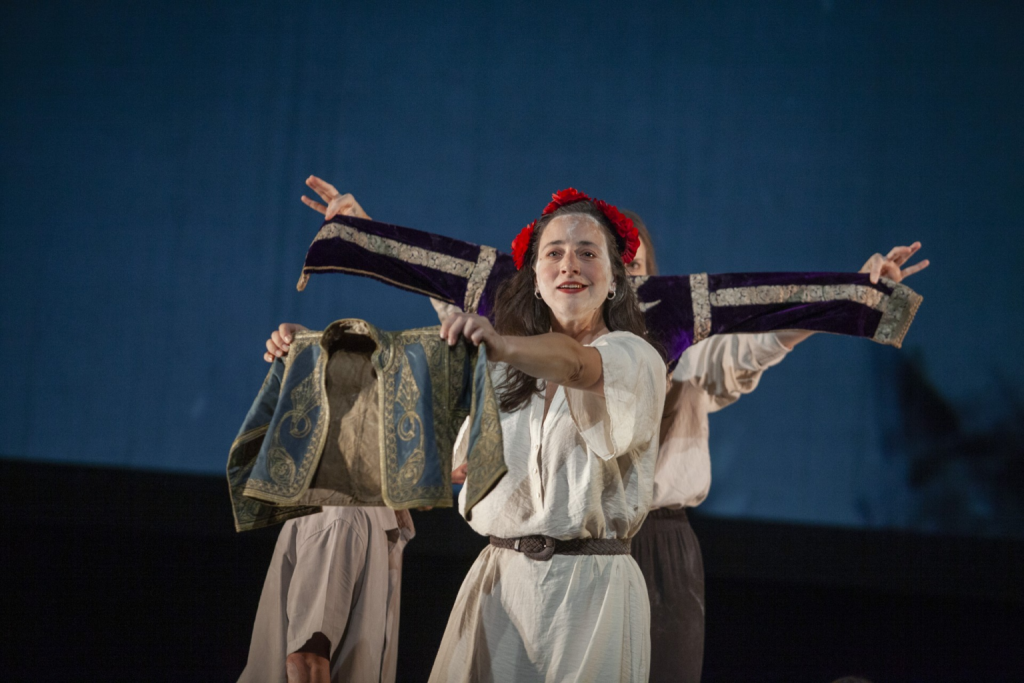
A return to sacrifice. The legend of Rozafa, the bride who is sacrificed within the walls of a castle(a bridge, in this case) so that it may remain standing, is staged in the same narrative style, with few but sufficient elements. The staging is visually beautiful, yet the interpretation of the myth feels less developed. Rozafa, played by Kato Kalatozishvili, is a soulful presence. The character playing her husband has a strange reaction when he is told that one of the wives must be sacrificed, and again when he learns that this woman is Rozafa. His reaction feels somewhat exaggerated and unconvincing. Beyond the recurring suggestion that it is often the woman who must become the sacrifice, the production’s position on sacrifice itself remains unclear. For me, who I already have the story in my head, it looks like it is not worked on, like a clay not worked into a pot.
Towards the end, we return to Tauris, where everything is going to hell. The crops have withered, the wells have run dry, and famine has taken hold of the city. People take to the streets in protest. The authorities respond with force: tear gas, violence, rubber batons against bodies, rubber bullets against bodies.
The citizens begin making sacrifices. Animal sacrifices do not work; sacrificing people only makes things worse, until someone comes up with the brilliant idea of sacrificing the king. The king’s blood is used to anoint the small statues of Artemis, and suddenly the crops return, life begins to improve, and things fall back into place. Isn’t the problem obvious? Do we have to explain?
At the end of the performance, presented as a guest production at the National Experimental Theatre, a text appears on the screen behind the stage expressing support for the student protests and the Flamingo Revolution in Albania. Do we have to explain?
Text: Davit Gabunia and Jeton Neziraj | Direction: Data Tavadze | Cast: Ellen Jelinek, Kateryna Kisten, Kato Kalatozishvili, Maria Salomaa, Johannes Wanselow and Shkëlqim Islami | Producer: Anders Öhrn | Composer: Nikoloz Pasuri | Stage, Light & Video: Ludde Falk
For more information, visit: qendra.org
Further reading: Georgia protests: Theatre is the last stage standing for the voice of freedom
Flamur Dardeshi is a freelance writer based in Tirana. He has contributed in the areas of translation, analysis, and poetry. His main fields of interest are literature, cinematography, and theatre.