
Drama Theatre Skopje, premiere 19 September 2026
More than three centuries separate Jean Racine’s Phèdre from Sarah Kane’s Phaedra’s Love. At Drama Theatre Skopje, director Dino Mustafić compresses that distance into a single interval, placing Jelena Žugić at the centre of two different theatrical worlds. In Phaedra, she is confined to a bright, mirrored gym, attempting to discipline desire into silence and make her body more desirable. In Phaedra’s Love, she returns to a dark stage where desire becomes open, direct and destructive. The distance between the productions lies in what a woman is allowed to say, what the world is willing to hear, and the different consequences she faces once her desire can no longer be contained.
Phaedra’s story changes with every society that retells it. In Euripides’ Hippolytus, her desire becomes an instrument of Aphrodite’s revenge; in Seneca’s Phaedra, she assumes greater agency by declaring it directly to Hippolytus. Racine centres her divided consciousness, while Kane takes Seneca’s material into a world where the old order has collapsed but people remain no closer to understanding themselves or one another. Dino Mustafić, a renowned regional director and recipient of the MESS Festival’s Golden Laurel Wreath, brings the texts together as Phaedra: Anthropology of a Desire.
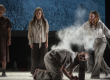
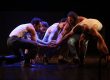
In Phaedra, Mustafić removes Racine’s tragedy from the palace without abandoning its discipline. Scenographer Dragutin Broz transforms the stage into a gym in which bodies are watched, trained and compared. Mirrors multiply movement, screens hang overhead and costume designer Antonija Guginska-Jordanoska dresses the court in sportswear. The predominantly white palette suggests order and cleanliness while leaving nowhere to hide. The gym translates the conflict between passion and duty into a contemporary faith in self-improvement: if the body can be perfected, perhaps life can also be controlled.
Leonardo Lazov’s Hippolytus embodies this promise. His physique and self-assurance suggest narcissism, but Lazov exposes the insecurity beneath them. Diminished beside a father who has fought wars and exercised power, he devotes himself to mastering his body. Theramenes (Zlatko Mitreski), recast as adviser and personal trainer, translates their relationship into contemporary self-discipline. Watching him, Phaedra exercises too. Before the mirror, her attempts to improve her body reveal a belief that changing it might heal an emotional wound or win his attention. Žugić’s glances between him and her reflection betray what her posture attempts to contain.
Phaedra: Anthropology of a Desire. Photos: Dragan Gajić
Racine wrote Phèdre in verse, a form retained in this production and rarely heard on Macedonian stages. The ensemble makes the language vivid and engaging, with each actor finding a distinct rhythm and manner of delivering the lines. Žugić uses its order as a second body: the lines remain measured while her voice grows fragile and urgent. When Phaedra confesses her desire to Oenone (Nina Elzeser) and approaches Hippolytus, it feels as though desire is breaking through the form meant to contain it. Vlatko Stefanovski’s music and Zlatko Mitreski’s live saxophone and piano carry softness beneath this restrained world.
Lazov’s response prevents an easy division between victim and villain. His Hippolytus is repelled but not needlessly cruel; he draws a clear boundary. Aricia’s exchanges with her confidante Ismene, played by Jovana Spasić, introduce a gentler register. Opposite Ivana Pavlaković, Lazov becomes shy and almost boyish. Their tender ‘Ne me quitte pas’ makes his rejection of Phaedra more painful. Hippolytus can love, only not her.
The televisions sharpen the conflict between public information and private truth. They carry changing reports about Theseus, while Panope (Trajanka Ilieva-Veljić) rehearses the announcement and later waits with a camera to capture the reaction. They also transmit intimate speeches by Phaedra, Hippolytus and Theseus. At first, the screens seem to deprive us of the actors’ live presence when it matters most. Gradually, however, this distance acquires meaning, as the screens reveal confessions the characters cannot make in front of others.
After almost eight years away from Drama Theatre, Dejan Lilić returns with undiminished intensity, giving Theseus authority without constant aggression. Once he returns, physical absence gives way to emotional distance; father and son spar as though combat were their only language of intimacy. After the accusation, Theseus sends Hippolytus to the front. A military uniform and a letter reporting his death replace the mythical sea monster with contemporary war. The truth cracks Theseus’s composure only briefly before he faces the press, announces his son’s death and moves to the next matter of state.
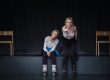
After the interval, Kane’s world appears as Racine’s negative image. The bright gym becomes a dark room where privacy is impossible. Hippolytus’s tilted circular platform is covered with discarded clothes and socks, the habitat of someone who expects nothing from himself. If Lazov’s prince responds to inadequacy with discipline, Lazar Hristov’s retreats into neglect. Everything is available to him, so almost nothing remains desirable.
Hristov finds more than apathy. Beneath his disgust lie dark humour, loneliness and a need for something powerful enough to reach him. Even Phaedra’s attempt at sexual intimacy leaves him emotionally unmoved. Her accusation, however, cuts through his apathy. His body becomes more alert and a restrained excitement enters the performance. Deniz Abdula doubles as the Doctor and the Priest, figures of care and moral guidance who cannot reach him. The Doctor provides no meaningful help, while the Priest loses authority when Hippolytus exposes his hypocrisy.
Žugić now releases everything the earlier Phaedra forced into verse. Her speech is faster, her body restless, her determination feverish. Her confrontation with Strophe (Anja Mitić), who tries to reason with her mother, is the strongest scene. The daughter must become the adult, but Phaedra hears no warning. Her death has no rhetoric: Žugić places a scarf around her neck and leaves. The accusation that remains turns private obsession into public action.
That action belongs to the visible actor-musicians: Tomislav Davidovski on drums, Marjan Naumov on guitar and Gordana Endrovska on vocals. First they compete over who admires Hippolytus most; later, one calls for his crucifixion and the others join in. They also become police officers and pallbearers. Public opinion forms like music: someone establishes the rhythm, and everyone else enters before considering where it leads. Their live performance gives this contagion a raw punk pulse.
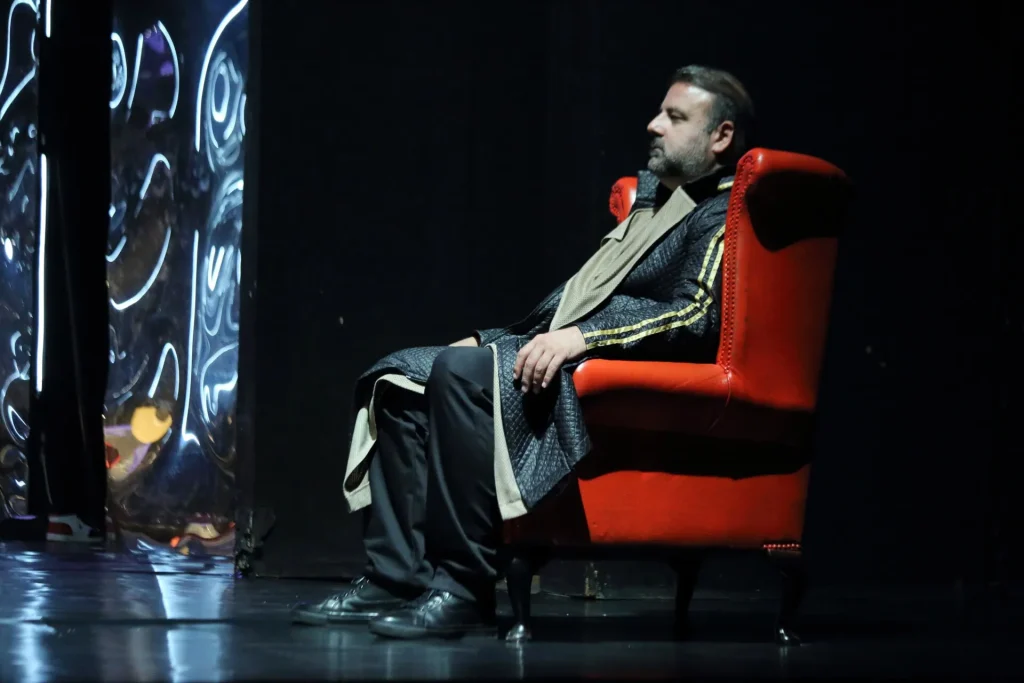
The crowd smears blood and mimes consuming Hippolytus, but the contact remains stylised and Hristov stands almost untouched. At his funeral, Aleksandar Stepanuleski turns Theseus into a recognisable contemporary oligarch. Seated in a red armchair with a microphone, he performs authority and grief for the public while remaining detached from his family. Strophe’s pain is unguarded. Mitić’s performance of Leonard Cohen’s ‘If It Be Your Will’ enters this punk world like a quiet prayer, without offering absolution.
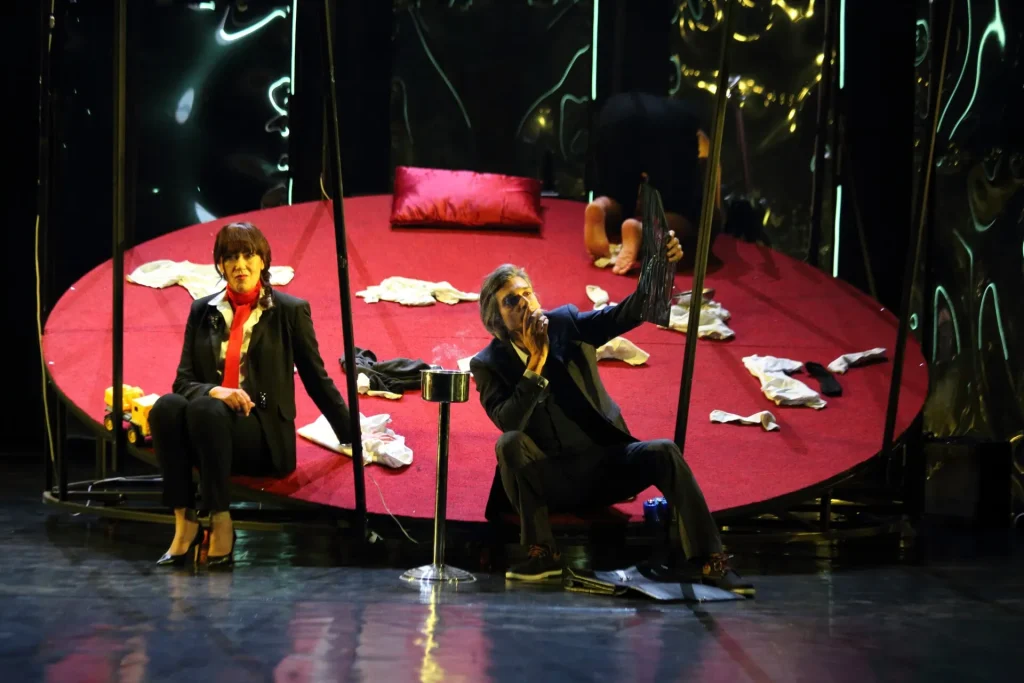
Phaedra: Anthropology of a Desire. Photos: Dragan Gajić
Across Phaedra’s Love, Mustafić treats the sexual explicitness, emotional cruelty and physical brutality of Kane’s text with restraint. I would have welcomed a more uncompromising encounter with this material. Still, the unease in the auditorium suggests that he goes far enough to disturb without turning the text’s most extreme elements into spectacle.
The spaces invert public and private. Phaedra unfolds in a public gym, yet its drama remains within the individual, audible in a change of tone or visible in the mirror. Phaedra’s Love takes place in a bedroom invaded by the outside world. One Hippolytus perfects his body because he feels he has done too little; the other abandons his because he has never had to do anything. Both versions of Theseus place status above the family’s emotional life.
Jelena Žugić holds the diptych together, carrying both productions with remarkable energy, control and emotional range. She creates two distinct Phaedras connected by the same impossible desire. Kane’s is not merely a louder version of Racine’s; each is shaped by her theatrical world. Their quiet deaths point in opposite directions: Racine’s Phaedra restores Hippolytus’s innocence by revealing the truth, while Kane’s leaves an accusation that the crowd is ready to turn into fact.
The diptych offers an unusual experience in Macedonian repertory theatre. It brings together two full-length productions, complete in themselves yet conceived to resonate across an interval. Although their combined running time exceeds three hours, the sharp shift in rhythm and aesthetic renews attention rather than exhausting it. On the evenings I attended, not everyone in the audience stayed to make that crossing. Later repertoire listings place the two works separately, usually on consecutive evenings. This still allows them to be experienced in proximity, and each remains convincing on its own. What may be harder to access is the additional meaning generated by their immediate dialogue.
The full title, Phaedra: Anthropology of a Desire, describes precisely what the diptych achieves. It turns a single desire into a study of the forces that shape, contain and judge it. Although Racine’s and Kane’s texts were written centuries apart, Mustafić stages both in recognisably contemporary worlds where those forces operate differently. In Phaedra, moral law and family obligation are internalised until Phaedra becomes her own judge. In Phaedra’s Love, desire is spoken and acted upon more openly, but this apparent freedom meets emotional indifference and the judgement of the crowd. Phaedra’s desire is unreciprocated, obsessive and ultimately destructive. By refusing either to romanticise or dismiss it, the diptych asks who defines legitimate love, how those definitions are enforced, and whether society can distinguish between what causes harm and what merely falls outside an accepted form.
Credits
A diptych comprising Phaedra by Jean Racine and Phaedra’s Love by Sarah Kane
Director: Dino Mustafić// Dramaturgy: Aleksandra Boškovska (Phaedra); Viktorija Rangelova-Petrovska (Phaedra’s Love)// Assistant director: Dimče Nikolovski// Set design: Dragutin Broz// Costume design: Antonija Guginska-Jordanoska//Music: Vlatko Stefanovski//Music selection: Dino Mustafić//Additional original music for Phaedra’s Love: Marjan Naumov, Tomislav Davidovski, Gordana Endrovska, Lazar Hristov and Anja Mitić//Stage movement: Filip Petkovski
Cast of Phaedra
Jelena Žugić, Dejan Lilić, Leonardo Lazov, Ivana Pavlaković, Nina Elzeser, Zlatko Mitreski, Jovana Spasi, Trajanka Ilieva-Veljić
Cast of Phaedra’s Love
Jelena Žugić, Aleksandar Stepanuleski, Lazar Hristov, Anja Mitić, Deniz Abdula, Tomislav Davidovski, Marjan Naumov, Gordana Endrovska
For more information, visit: Dramski.mk

Katerina Markoska is a translator, theatre critic, and emerging author from North Macedonia, living between Skopje and Sofia. She is currently completing a master’s
degree in Theatre Arts and Dramaturgy at the National Academy for Theatre and Film Arts “Kr. Sarafov” in Sofia. Her translations of contemporary drama have been
recognized by Eurodram, and her creative texts have been published in collective books in Bulgaria.