SNG Drama Ljubljana, premiere 23rd April 2026
When an earlier project could not be realized, Ivana Dijas, the new director of SNG Drama Ljubljana, had the opportunity to introduce a new play into the repertoire. Her choice, The Unwomanly Face of War is based on the book by Svetlana Alexievich, provided a glimpse of the kinds of texts and themes that interest her in theatre.
Alexievich’s book is an extensive testimony of women who fought in the Red Army, mainly from Russia and Belarus. The Nobel-winning author is known for her ability to listen and accurately transfer spoken language into her documentary writing, which gives her works an exceptional sense of honesty. Her main goal always seems to be giving a voice to her interviewees. Alexievich and her reportages do not analyse or interpret wars in any way – they describe them through the voices of the participants. However, her ability to preserve the style of spoken language, the chronology of statements matching the chronology of events, and the thematic arrangement of the women’s testimonies create a coherent whole. Thanks to this, the reader can easily understand the protagonists, feel emotionally moved, and also draw critical conclusions about historical events, politics, and patriarchy.
The Macedonian director Biljana Radinoska, making her debut in Slovenia, and the writer Špela Frlic follow the same path. The text consists of statements selected by Frlic, which together create a documentary polyphony of voices. The author preserves the chronology of wartime events and divides the testimonies into thematic segments that flow smoothly from one to another, while still allowing the audience to follow the subject clearly. Therefore, the beginning summarizes the women’s motivations for joining the army, their everyday lives, and small personal problems, before later moving on to strictly wartime topics such as battles, killing, and the thoughts connected to these experiences. In the end, the themes of victory and post-war trauma appear. Moreover, the text is often built from contrasting statements, in which joy frequently turns into sadness or anger.
The themes selected from the book and presented in the play focus on the most diverse experiences of war, as well as on the threads that, taken together, make up the overall experience of war from a woman’s perspective. Hence the references to simple needs like hairdresser during the war, a bodily topics like period, emotional romance and pride after the victory, as well as death, killing, helping enemies, and rape. In this sense, the play seems to be a skilful journey through the most important themes contained in the book, giving the impression of a kind of summary of Alexievich’s work.
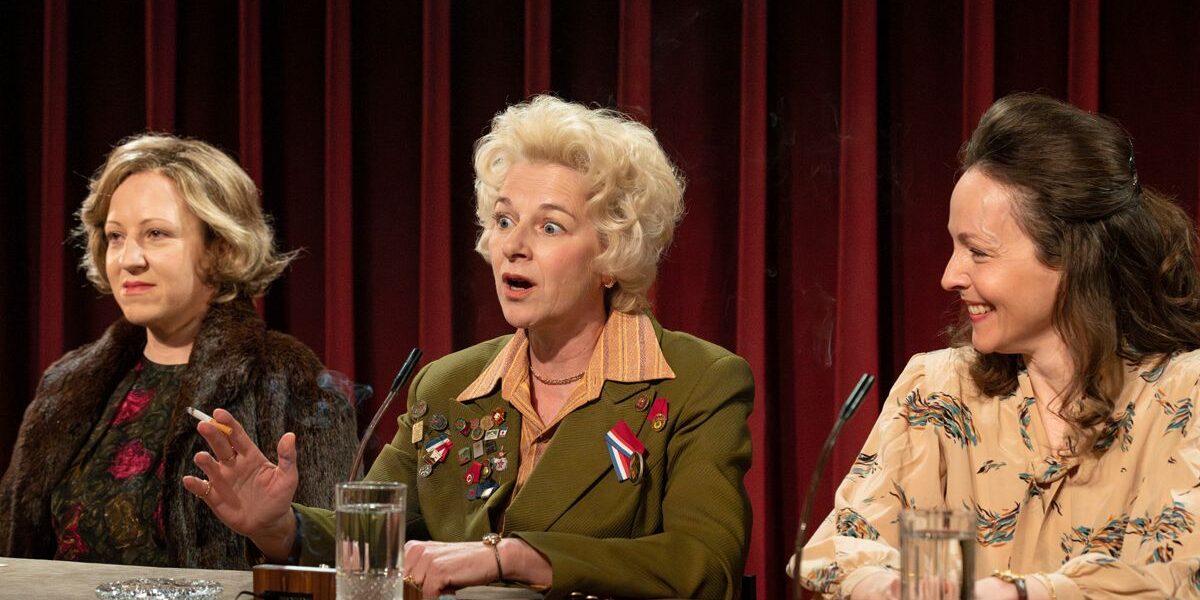
Together with the set designer Maruša Mali, Radinoska decided to reflect the simplicity of the author’s style. Just as there are no unnecessary adjectives, ornaments, or summaries in Svetlana Alexievich’s book, the form of the performance also reflects the documentary character of the reportage. On stage there is a long table with microphones, behind which the actresses sit and give testimony on behalf of other women. As in the book, where the reader often feels like part of the conversation between the author and her protagonists, the performance is built around the aesthetics of a press conference or a meeting with witnesses, giving the audience the impression of taking part in an event with women veterans. This effect is strengthened by the minimalist scenography, which refers to communist ceremonies – a carefully decorated table, a velvet curtain behind it, and bouquets of red and white flowers placed in front. The minimalism and formal character of the set, together with the elegant costumes – including a military uniform worn by one of the actresses – highlight the pompous atmosphere often associated with official Soviet-era events.
The opening melody of the performance, which is a Russian version of a Polish partisan song, also helps recreate the spirit of the period. I am not sure to what extent this was intentional, because from what I have been able to establish, the Russian lyrics differ from the original Polish version. In Polish, however, the song begins with the words: The girl burst into tears, her shining eyes raised through sorrow at the soldier’s harsh and cruel fate. Do not send us sorrow that breaks the heart. Do not cry, girl, because life at war is not so bad. Although most interpretations claim that the song refers to a woman waiting for a soldier going off to war and trying to comfort her, in the context of this performance the lyrics become a kind of foreshadowing, introducing both the themes and the interpretative direction of the play.
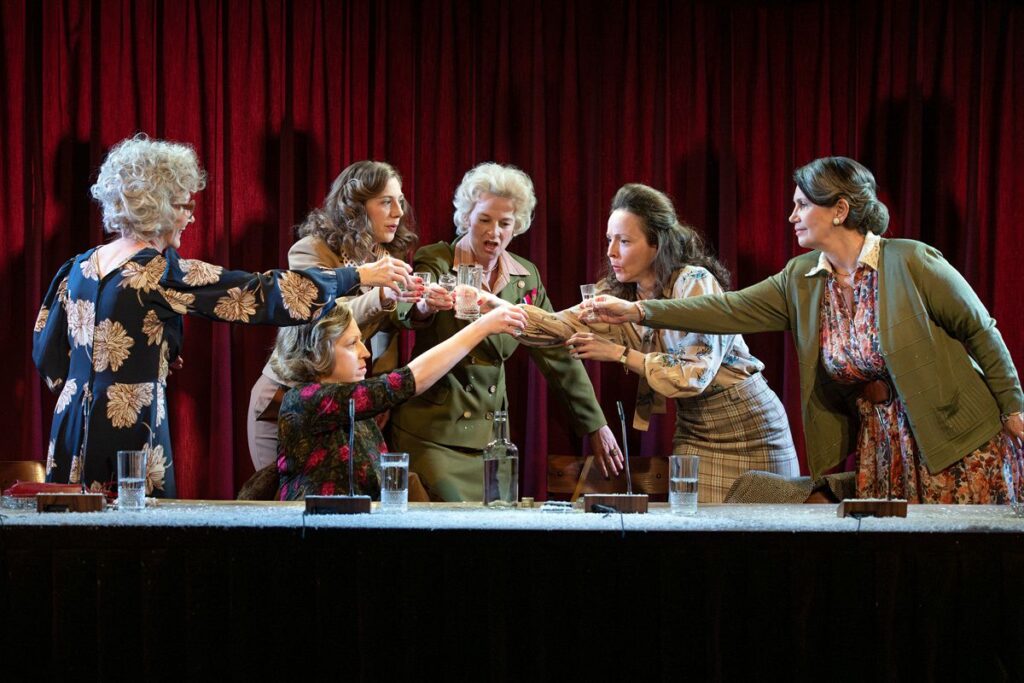
The Unwomanly Face of War. Photo: Peter Uhan
The structure of the play is also minimalist. It consists of actresses taking turns to speak about their wartime experiences. The actresses strive to convey the information presented in the book with the greatest possible understanding of the protagonists’ struggles. However, it is difficult to speak of the characters’ existence within the play. The actresses are, in a sense, a tool for bearing witness to the atrocities of war. The only moment that takes the actresses out of the conference-style format is the story of victory. The actresses stand up and act out a conversation between female war heroes who share their hopes for the future. This is intended to create the impression of a flashback, allowing us to immerse ourselves in the optimism of 1945.
This story overturns the conventional narrative of war. Not only does it focus on small, previously unknown stories that do not fit the narrative of heroic figures, but it also tells the stories of women who are not usually associated with the battlefield or military uniforms. Neither the book nor the play attempts to shift the narrative from male to female, nor does it romanticise or glorify female soldiers. On the contrary – it portrays them as people who, for various reasons, found themselves in the Red Army. As a result, the audience does not follow the great victories or war heroes, nor does it fetishise war. Instead, it is possible to draw conclusions and discover the true, human face of historical events, along with their brutality.
The performance is in its own way a feminist one, although it does not include narratives of women’s emancipation or explicit feminist slogans. What happened to women during the war, as well as how they were treated after it, reveals the hidden mechanisms of patriarchy. Interestingly, this is done without directly describing what patriarchy is or naming it. The women’s testimonies themselves, as well as the factual and “dry” nature of the accounts, make it possible to notice inequality, violence, and abuse that women in the army had to face. The feminist dimension of the performance also appears in the way the topic is placed in relation to the institution and its regular audience. The theatre is not known for frequently presenting feminist or queer stories, so a performance that is not openly feminist, but which allows the audience to discover the mechanisms of patriarchy through personal stories, gains a new function as a kind of educational experience for viewers who are not used to or familiar with a female perspective and herstories.
The performance ends with a girls’ choir singing a song in English. Although I believe that the performance and its subject matter are important for SNG Drama Ljubljana, it is still hard to leave the theatre without a certain sense of incompleteness and an unresolved story. Because today women are also fighting, not in the Soviet army, but in the Ukrainian one. It is a real pity that the performance was not symbolically updated in order to give voice to women fighting in Donbas.
Credits:
Director: Biljana Radinoska// Adapted by Špela Frlic
Translator: Jani Rebec//Špela Frlic//Language consultant:Tatjana Stanič//
Set design: Maruša Mali//Costume design: Jelena Proković
For more information, visit: drama.si

Karolina Bugajak is a theater critic from Poland, currently living in Ljubljana. She studied culture and contemporary art at the University of Lodz. The title of her master's thesis was "Theatricality and Exaggeration. Camp aesthetics as a strategy for creating new identities in the plays of Grzegorz Jaremko". Her main theatrical interests include topics such as institutional criticism, the representation of marginalized groups in plays, and most recently the theater of the former Yugoslav states.