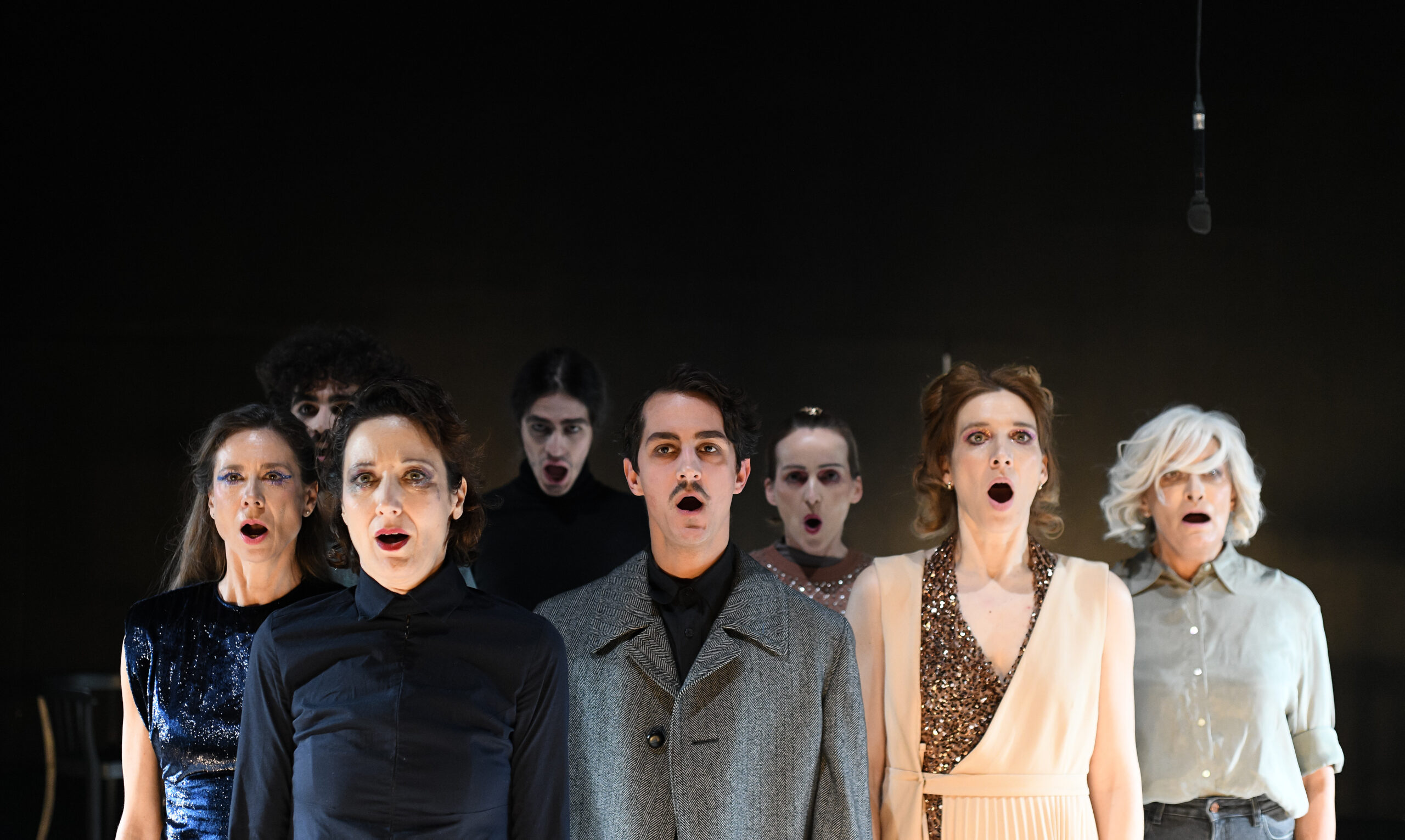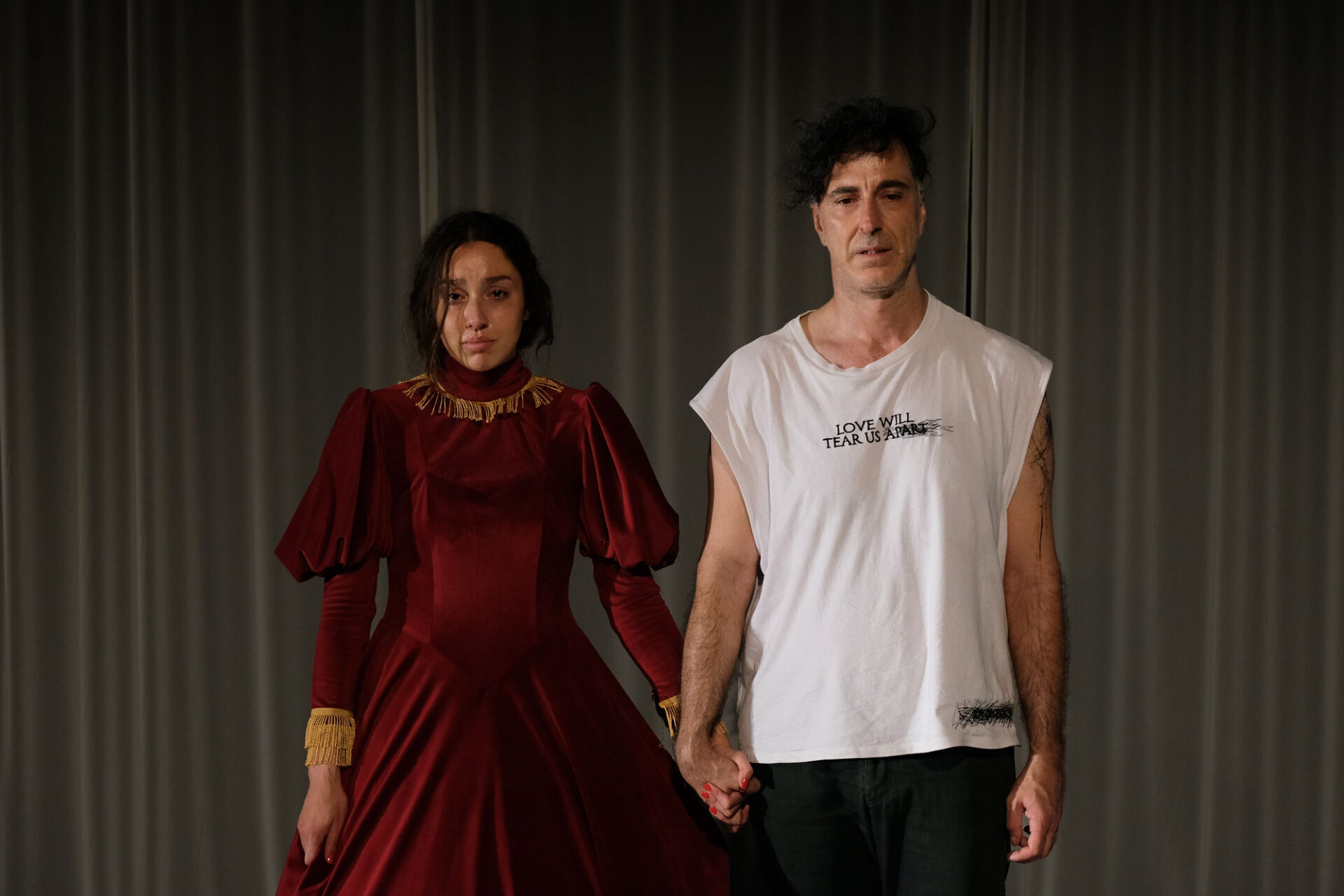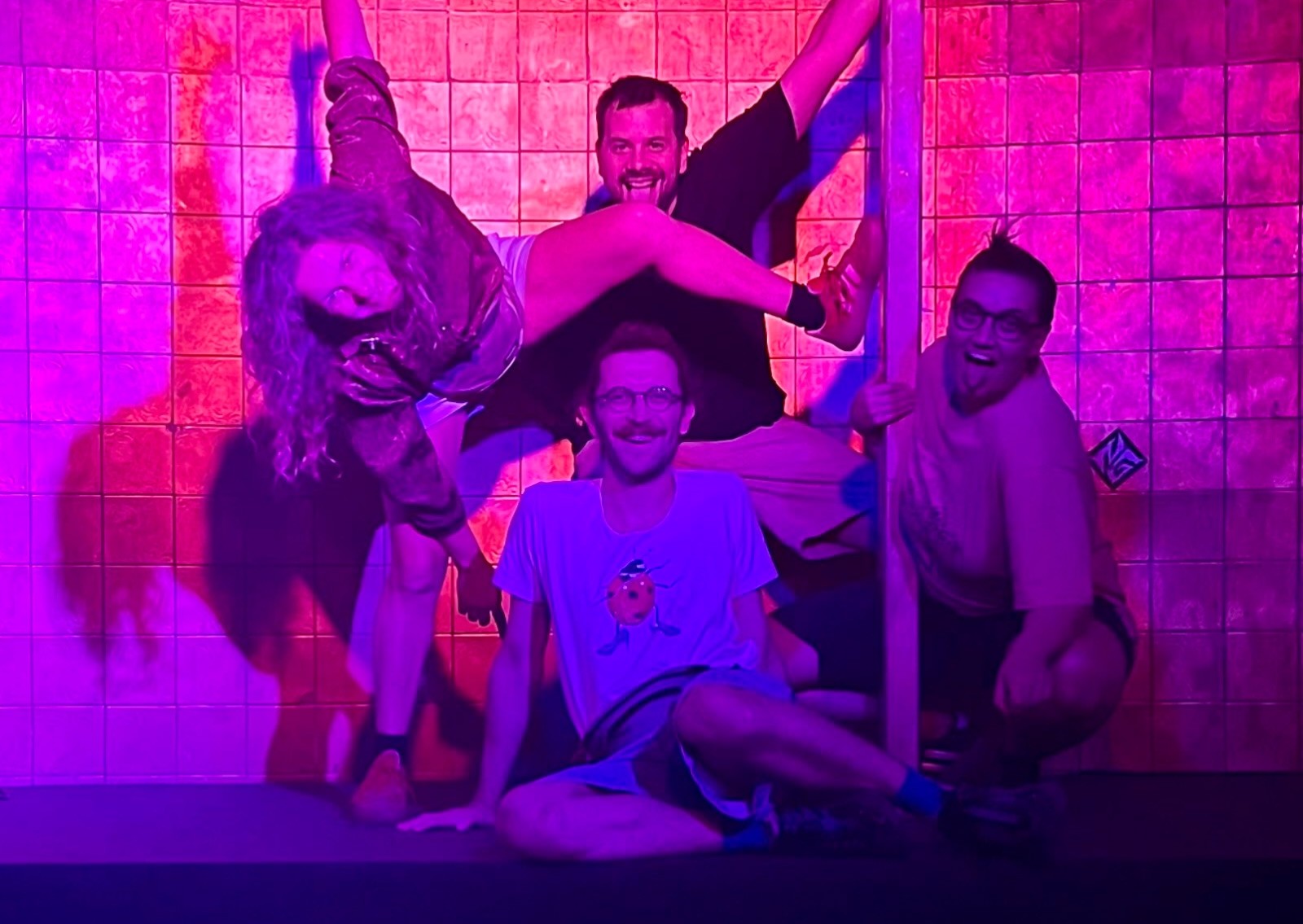
Pogon, Zagreb, premiere November 2025
Politpornography, one of the more exciting performances I’ve seen this season, is a play inspired by the legacy of new Yugoslav film and student protests of the late sixties. The piece focuses on Želimir Žilnik’s first feature film “Early Works” (1969) which was made in response to student unrest in Serbia, to question the staggering alienation between revolutionary rhetoric and action, as well as youth’s political orientation. The play is devised by Anna Javoran together with the performing ensemble featuring Miloš Janjić, Tea Kantoci, Ana Novković, Ivan Pašalić and Linda Tarnovski. The ensemble is somewhat specific, given that it consists of dancers, actors and even curators, which only adds to the performance because possible differences in their performing ‘ability’ aren’t noticeable at all. The performance consists of three parts to say so, they differ in space they are performed at and each is dramaturgically different from the other (support by Nina Gojić and Vida Zelić).
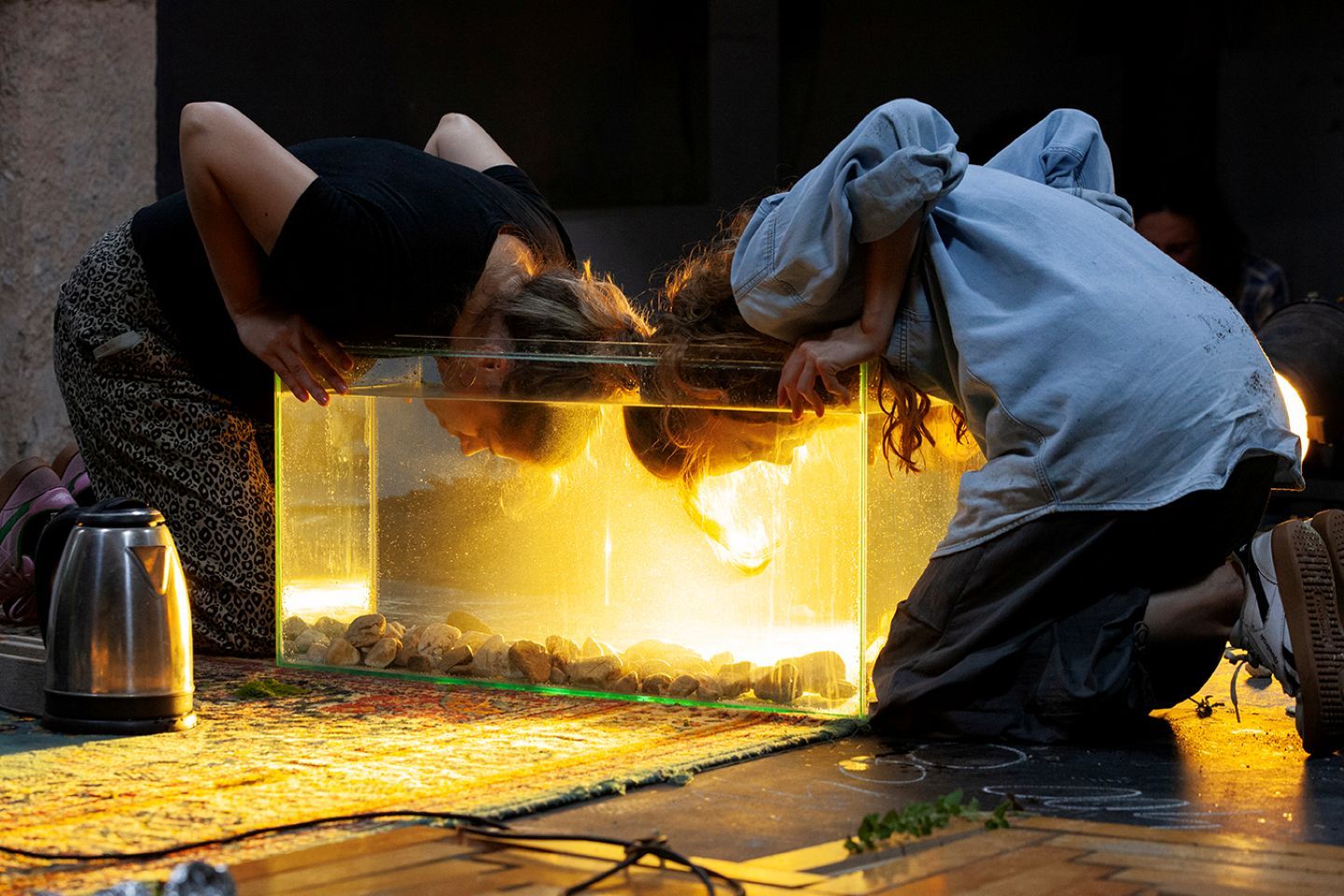
The first part of the show works as a kind of interactive warm-up, the performers go up to the audience and test their political energy. The individual conversations between the audience and performers go in different directions, some private, some educational on how student plenum works, hinting at Serbia’s latest student protests. Usually the audience is led to the dam beside Pogon which is situated next to the Sava river, however, on this occasion, the first part took place inside Pogon’s small hall because a violent windstorm was taking place. Nevertheless, the ensemble managed to warm us up with a same effect they had at the November premiere.
The audience’s participation isn’t necessary or forced. Anyone who’s willing is welcomed to participate in the warm-up exercises for future protest and activism. In this part, the performers make a reference to Žilnik’s film, the scene where protagonists are pushing a car up the hill, slowly introducing film’s motifs to audience. Preliminary knowledge on Žilnik, his and Yugoslav filmography and the political context of late 60s isn’t crucial for understanding the referential setting due to the performer’s strong emotional engagement.
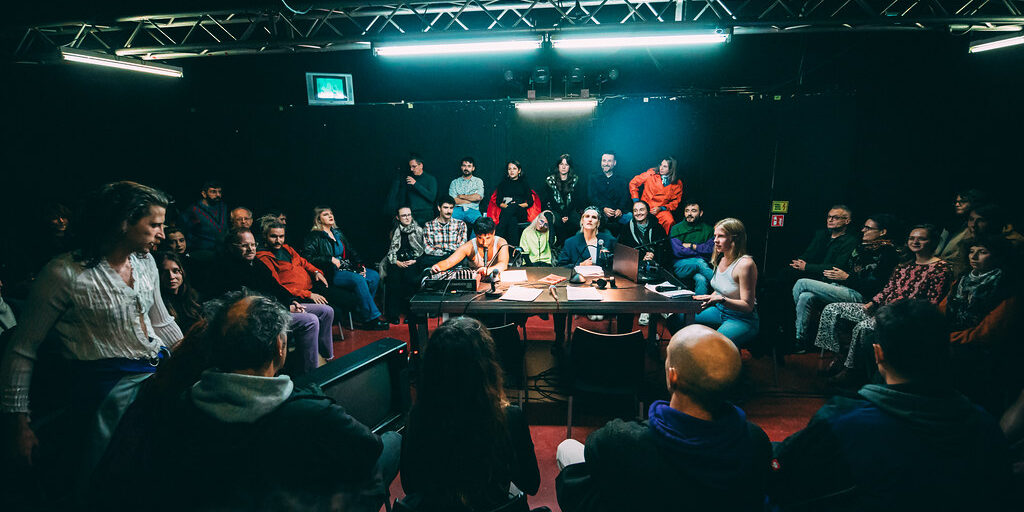
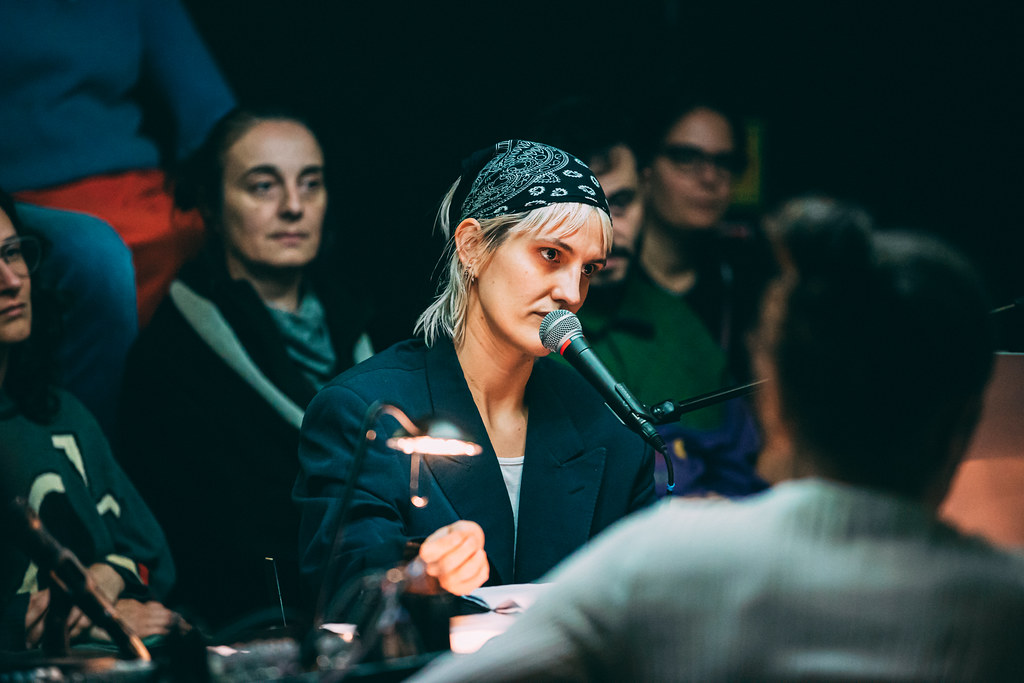
After this playful warm up, we are taken back to Pogon where, inside the big hall, where we find a table that’s surrounded with several rows of chairs on all four sides. Five performers take their places at the table, each with a microphone in front of them. There are several old thick small TVs, some showing the film “Early Works”, some connected to a close-up camera that will later be used to closely showcase a book on the film and other listing the quoted articles in this part. The ensemble takes us back to 1969 when Žilnik faced a trial and a temporary ban of “Early Works” because it has ‘severely damaged societal morality’. All of them are simulating the trial process with Tarnovski playing Žilnik who was representing himself in court as a law graduate, while the others play other key judicial figures (judge, prosecutor, etc.).
Pašalić as prosecutor explains how Žilnik’s film is actually inappropriate because it shows rude behaviour, nudity and how it calls on for dismantling socialist system since its subtitled as ‘comedy of ideology’. Interestingly enough, we learn that Žilnik was willing and had made changes to the ‘problematic’ parts in order to swiftly lift the ban and be able to showcase the film on various film festivals i.e. in Berlin. Because the film is set to tour around Europe, the controversy sparked out fear how Yugoslavia would be perceived as an authoritarian state since, from the prosecution’s point of view, the film doesn’t demonstrate the whole scale of the events regarding the protests. This fearful attitude and censorship sprouts from the general idea that, these young film directors are all anarchists and are able to affirm themselves only with film that negatively portray their country. This is further elaborated through an interview with Žilnik himself which was audio-recorded in August 2025.
Politpornography: A Case Study
However, Žilnik’s interview isn’t simply played for audience to listen to, just as the court ‘discussion’ isn’t straightforwardly acted out. During the court simulation, the performers stop each other from time to time and suggest different acting interpretations or textual interventions, making the atmosphere more relaxed. Personally, this whimsical and playful attitude held my focus and had me even more interested in the case, since the court ‘tone’ is often monotonous and uneventful which makes it easy to lose focus on who is saying exactly what. The whimsy and humour really reaches its peak when each of the performers one by one recites Žilnik’s words from the interview. To clarify, the performers carry headphones through which they listen to Žilnik and then simultaneously try to replicate his answers. Again, this is highly amusing for their effort to recite the director word for word that seems like this approach makes the interview almost more life-like than it would perhaps be to just simply listen to the recording. On the recording, he reminisces on those late sixties, his involvement with the protests and amateur film clubs and everything that inspired him to shoot ‘Early Works’.
For the third and final part, the rest of the performance is moved to the other part of the big hall. The performing space is, again, surrounded by the audience but it’s much longer and wider with spectators equally distributed around which creates an isolation between the audience members as if we are now witnessing the performance almost on our own. The performers are silently observing each other, assessing their body language and faces before asking something from one another. The requests they can be considered rather physically intimate, like listening someone’s heartbeat, lying on one another, whispering words of comfort or encouragement, trust fall exercise, or counting grey hairs. There’s a noticeable pattern during this part, with every performer addresses the other by name, asking them if they can do a specific action and then waiting for the response. Before accepting of denying the request, performers take their time thinking about whether or not they want to comply to it. There’s no rush, these activities are done mindfully, with others usually watching intently.
Slowly, the requests become more kink-like, putting fingers down the throat and throwing derogatory insults. Some even contemplate nudity which is masked with costume exchanges. Suddenly, a lonely spectator turns to a voyeur, watching consensual interactions amongst the performers, until it escalates to borderline violence and aggression. The tension and discomfort raises because now the performers tell other what to do to a third person, culminating with a recreation of a group police search on a single person. Tension doesn’t just spark from the uneasiness of the situation where someone needs to be striped, but from constant asking if the performer is okay and not really stopping the action. The simultaneous pressure to strip-naked their colleague and making sure they aren’t overly uncomfortable during the performance stirs up a strange mixture of emotions within me. At the same time, I believe they care for each other and don’t want to overstep other’s personal ‘performing’ boundaries but insisting on the stripping made me properly uncomfortable.
Thankfully, it doesn’t last long before someone suggests they all get nude for a moment with everyone from the audience closing their eyes besides one volunteer that will vouch for the performers nudity. It’s a strange but fair compromise – only one person from the collective is given the trust to see the performers naked while the others spectators don’t. It’s an interesting game of consent and trust that happens amongst performers and the audience.
Politpornography manages to intertwine political and erotic body in an intellectually convoluted way that leaves the audience with a deep emotional and physical sensation which is why I came back for a second viewing and would go back for another. Despite the distress of the final part, the context of student protests and film ‘Early Works’ presents a collage of actual political power of a single person. Beside the interesting historical cultural story of a rare Yugoslavian film gem, this piece was conceptually and emotionally impactful for me personally. There’s a brain knot I’ve yet to detangle in terms of political engagement and displayed Eros – perhaps, a third watch?
Credits:
𝘈𝘶𝘵𝘩𝘰𝘳: 𝘈𝘯𝘯𝘢 𝘑𝘢𝘷𝘰𝘳𝘢𝘯 / 𝘊𝘰-𝘢𝘶𝘵𝘩𝘰𝘳𝘴 𝘢𝘯𝘥 𝘱𝘦𝘳𝘧𝘰𝘳𝘮𝘦𝘳𝘴: 𝘔𝘪𝘭𝘰š 𝘑𝘢𝘯𝘫𝘪ć, 𝘛𝘦𝘢 𝘒𝘢𝘯𝘵𝘰𝘤𝘪, 𝘈𝘯𝘢 𝘕𝘰𝘷𝘬𝘰𝘷𝘪ć, 𝘐𝘷𝘢𝘯 𝘗𝘢š𝘢𝘭𝘪ć, 𝘓𝘪𝘯𝘥𝘢 𝘛𝘢𝘳𝘯𝘰𝘷𝘴𝘬𝘪 / 𝘋𝘳𝘢𝘮𝘢𝘵𝘶𝘳𝘨𝘪𝘤𝘢𝘭 𝘴𝘶𝘱𝘱𝘰𝘳𝘵: 𝘕𝘪𝘯𝘢 𝘎𝘰𝘫𝘪ć, 𝘝𝘪𝘥𝘢 𝘡𝘦𝘭𝘪ć / 𝘊𝘰𝘴𝘵𝘶𝘮𝘦 𝘥𝘦𝘴𝘪𝘨𝘯: 𝘛𝘦𝘢 𝘒𝘢𝘯𝘵𝘰𝘤𝘪 / 𝘚𝘤𝘦𝘯𝘰𝘨𝘳𝘢𝘱𝘩𝘺: 𝘈𝘯𝘫𝘢 𝘔𝘦𝘳𝘨𝘦𝘥𝘶š / 𝘋𝘦𝘴𝘪𝘨𝘯: 𝘔𝘪𝘭𝘰š 𝘑𝘢𝘯𝘫𝘪ć / 𝘚𝘰𝘶𝘯𝘥 𝘥𝘦𝘴𝘪𝘨𝘯𝘦𝘳: 𝘕𝘪𝘬𝘰𝘭𝘢 𝘒𝘳𝘨𝘰𝘷𝘪ć / 𝘓𝘪𝘨𝘩𝘵𝘪𝘯𝘨 𝘥𝘦𝘴𝘪𝘨𝘯𝘦𝘳: 𝘚𝘢š𝘢 𝘍𝘪𝘴𝘵𝘳𝘪ć / 𝘗𝘳𝘰𝘥𝘶𝘤𝘵𝘪𝘰𝘯: 𝘗𝘖𝘎𝘖𝘕𝘈𝘛𝘖𝘙 2025. 𝘢𝘯𝘥 𝘵𝘩𝘦 𝘊𝘦𝘯𝘵𝘦𝘳 𝘧𝘰𝘳 𝘋𝘳𝘢𝘮𝘢𝘵𝘪𝘤 𝘈𝘳𝘵𝘴 (𝘊𝘋𝘜)
For more information, visit: pogon.hr

Nora Čulić Matošić (1998) is a student of Comparative Literature (MA) at the Faculty of Humanities and Social Sciences in Zagreb. She has written theatre criticism for the Croatian radio programme Theatralia and web portal Kulturpunkt.hr. Besides theatre, her interests are other forms of performing arts (particularly dance performances) and film.