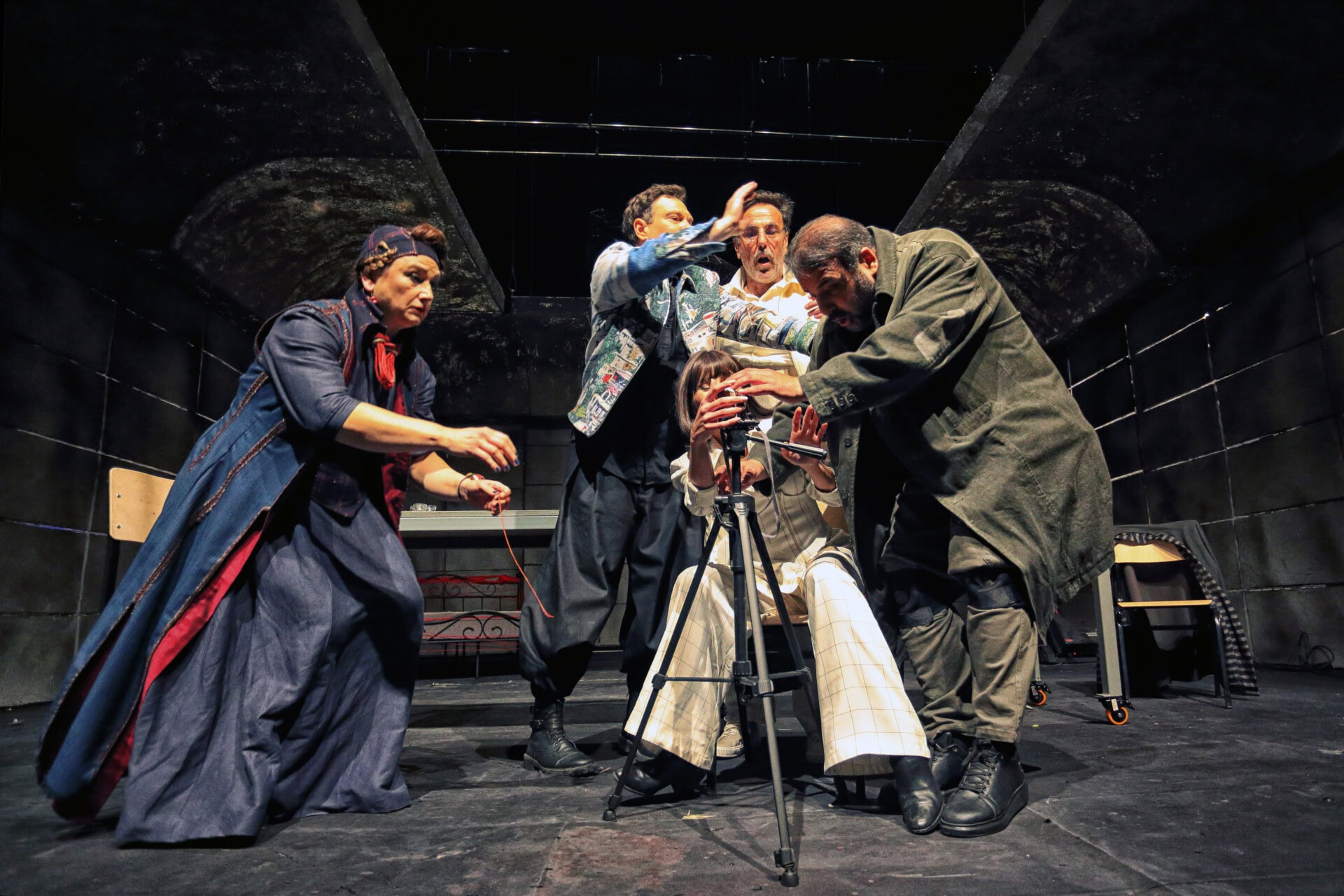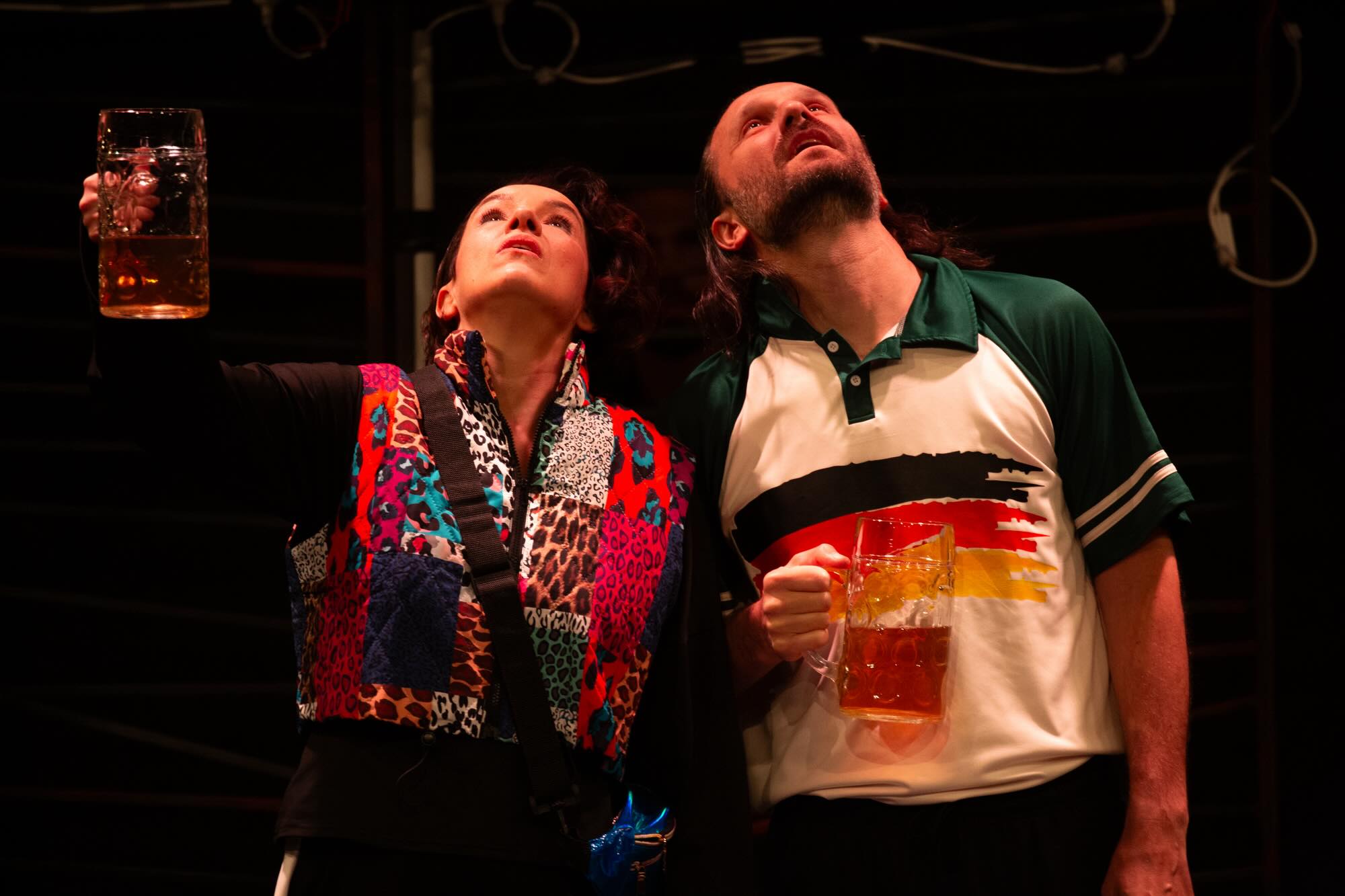
Kolektiv Igralke, Maska Ljubljana in partnership with HNK Ivana pl. Zajca
Slovenian theatre responds to ongoing wars quite slowly. Compared to other countries, at a time when new wars are breaking out around the world, there is still relatively little theatrical production addressing this topic in Slovenia. There are performances from the past and today dealing with Balkan wars but not many were done on Palestine, Ukraine, or Sudan.
One of the most significant recent performances on the topic of a current war was Incubator, directed by Oliver Frljić and produced by Mladinsko Theatre in 2025. In the performance, Frljić takes a closer look at the genocide that Israel is committing in Gaza. The situation in Gaza has also received increasing attention in Slovenia, with activists and citizens visibly expressing their support for the Palestinian cause, however there has been little reflection of this topic on stages.
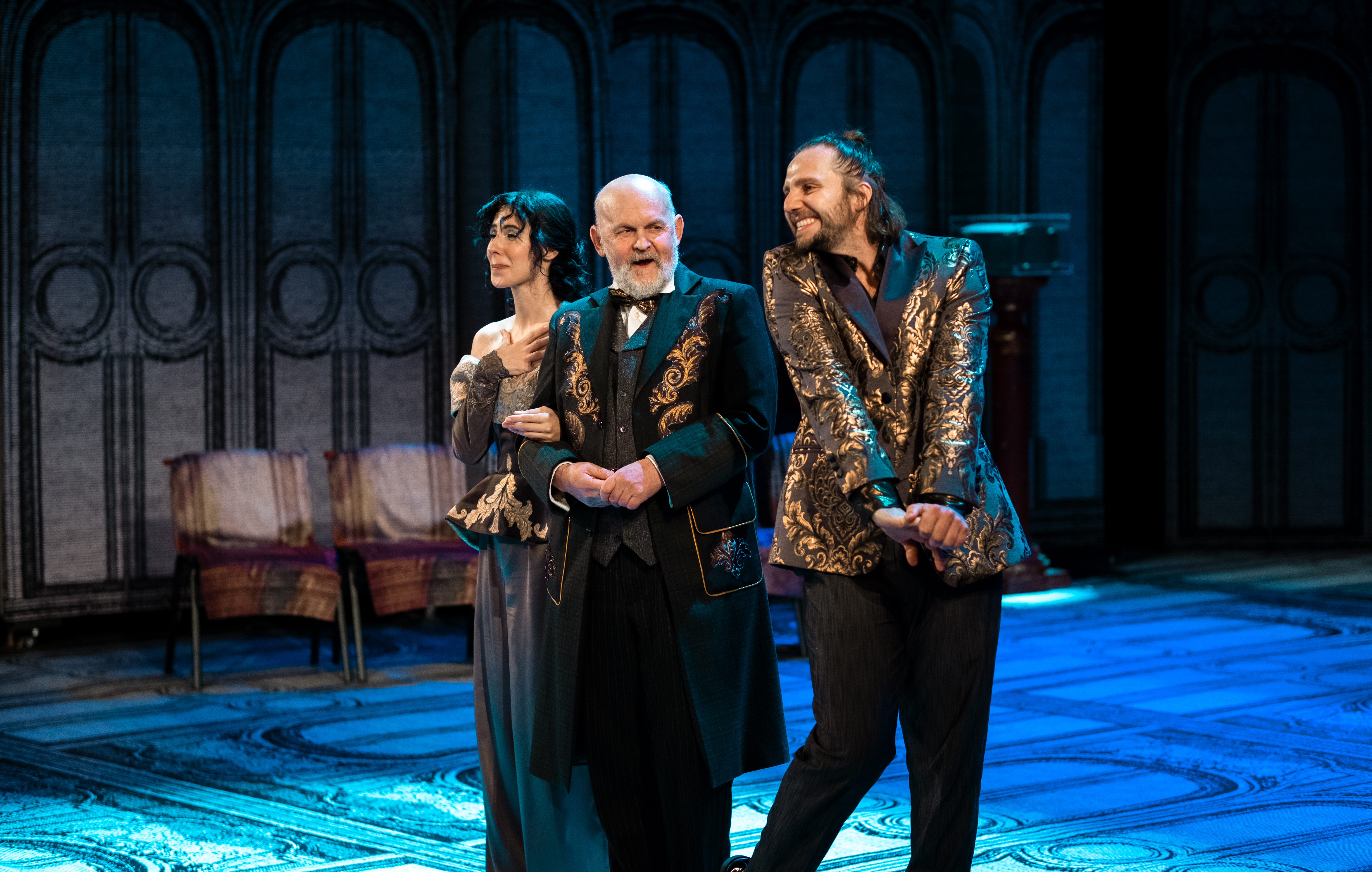
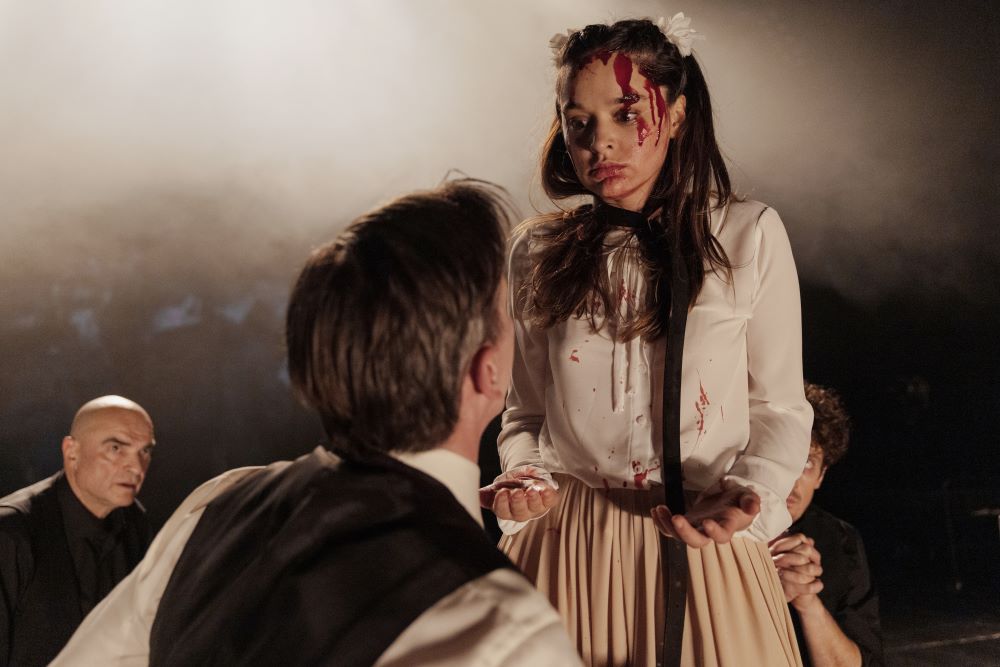
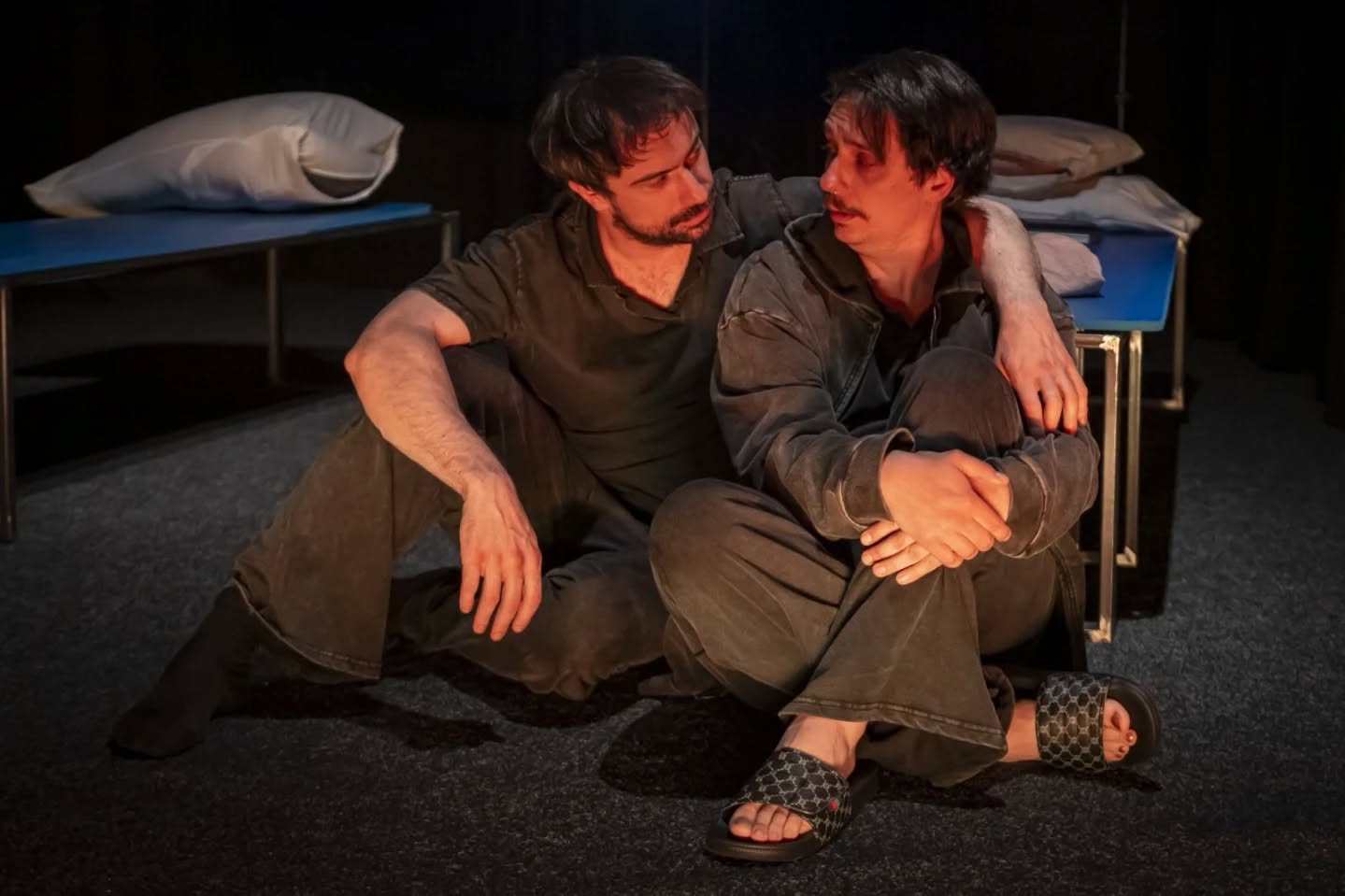
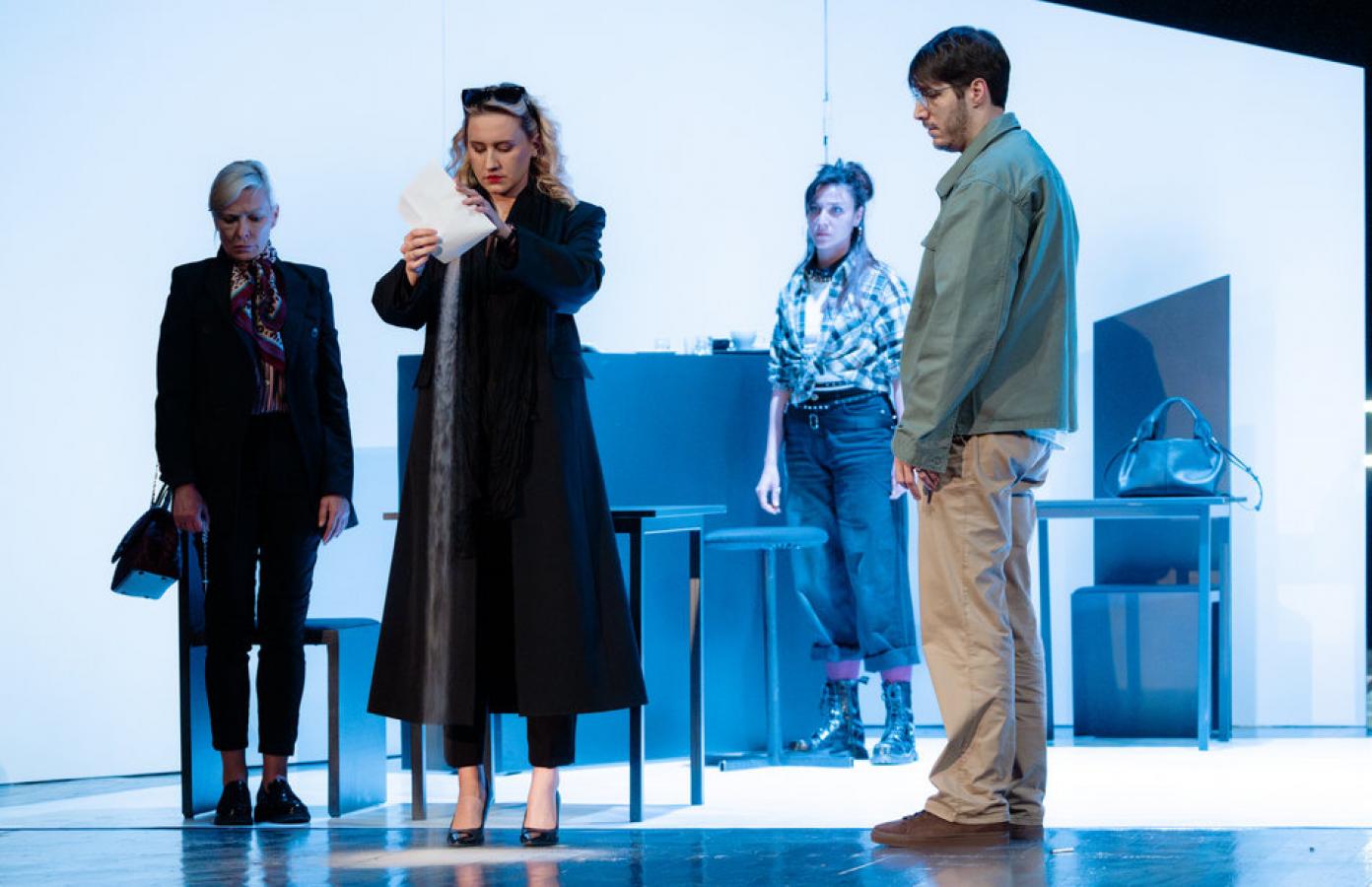
Now Žiga Divjak and the Kolektiv Igralke have just joined the small number of Slovenian theatre productions dealing with this topic with their performance Vozel, which explores militarisation and the fear associated with war – a topic that is crucial today.
In other parts of Europe, we can find multiple examples of performances dealing with war. In Poland, there is Magda Szpecht, who is known for her pro-Ukrainian approach and for incorporating strategies of activism and journalism into her performances. In one performance, she trolled Russian soldiers, while in another, she investigated the propaganda used by Russian recruiters to encourage young men to join the army. Fucking Truffaut is Polish production, created in collaboration with the Maxim Gorki Theatre, where Bliadski Circus Queelektyw uses an interesting cabaret approach to deal with stories from shelled Ukraine. Another Polish-Berlin collaboration, also supported by the Maxim Gorki Theatre, is Mothers. A Song for Wartime, a 2023 performance by Marta Górnicka. The director created a choir of 21 Ukrainian, Belarusian, and Polish women aged between 9 and 71, who share their testimonies of fleeing war zones. There are many more Polish examples – these are some of the most significant ones that challenge conventional understanding of war theatre.
Poland is not the only country interested in the subject of war. In the Baltic region, many productions have also been created on this topic. One of the most important groups seems to be the Estonian collective Vaba Lava, which has also collaborated with Magda Szpecht. The group has produced several performances dealing with war, for example Choose a Better Version, created in collaboration with Ukrainian playwrights, and Inner Climate / Sisekliima, which explores military production and its influence on a town, drawing on interviews with factory workers. Vaba Lava often works within the tradition of documentary theatre and I Didn’t Leave Ukraine is done in the same style – it focuses on war veterans and their trauma.
Another example from the Baltics might be CLAP & SLAP by Latvian choreographer Agnietė Lisičkinaitė with collaboration of Belarusian artist Igor Shugaleev – they talk about Eastern Europe and who is responsible for the war in Ukraine. Because of their geographical location and shared histories linked to imperialism of Soviet Union, and Russia – Poland, Baltic countries, and Germany have shown particular interest in the topic of the war in Ukraine. However, across Europe we can also find interesting projects addressing genocide in Palestine, such as Perzen. Triomf van Empathie, produced by NTGent and Action Zoo Humain; Letters from the Children of Gaza – a reading, a project by TR Warszawa, and This Is the Situation, which deals with the war in Palestine and the reactions of Dutch society to it.
All of the above-mentioned examples are characterised by research-based strategies, political engagement, and an activist approach. Many of them are based on the real-life stories of people who have experienced war, giving them an opportunity to speak and ensuring that their voices can be heard. Many of these performances also explore the political and social aspects of war. Others focus on using theatre as a form of resistance, giving artists a sense of agency during wartime in which theatre actually could follow a popular phrase that theatre changes the world. Unfortunately, Vozel did not have any of these characteristics.
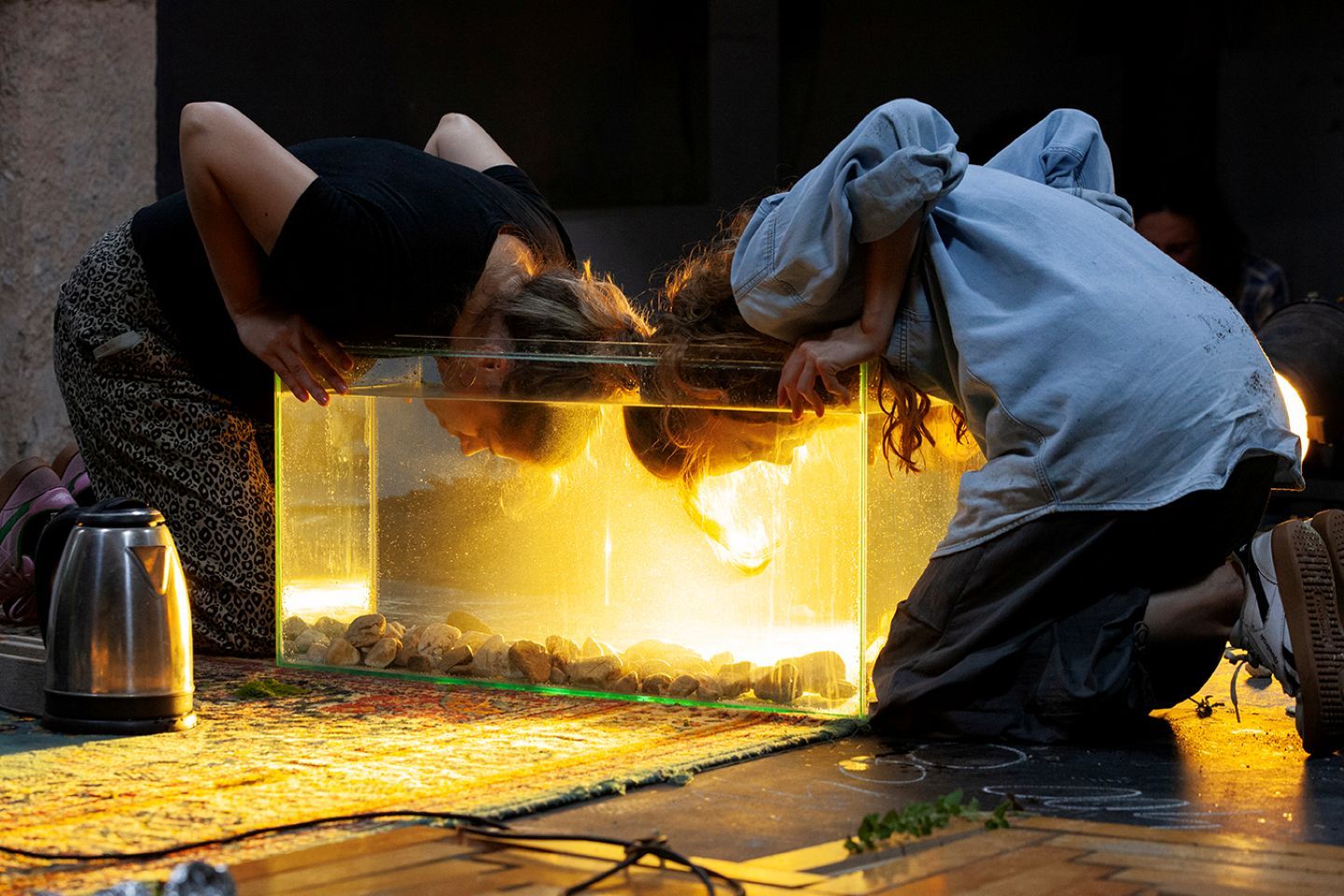
The audience sits around a raised stage, designed by Igor Vasilijev, among the performers. The stage represents a miniature world that the performers gradually create throughout the performance. There is grass, moss, a socialistic building built by the performers from bricks, and a fleet of ships constructed with the help of the audience, who follow the creators’ instructions. The stage, resembling a miniature model that could be displayed in a museum, also functions as a miniature ecosystem composed of both natural and human-made elements.
The performers jump from one topic to another, however, little of what they say is directly about war. There are many references to everyday life, such as rising prices resulting from ongoing wars, or the everyday presence of nationalist slogans in Rijeka, which can be seen on buildings throughout the city.
There is also a story about a grandfather, a former Partisan, and the men in the family who were involved in different wars on different sides. An important part is based on a story of a city Rijeka, where this show premiered, and where a local company produced military ships however this story refers to the past and to a more general idea of responsibility of the city that is involved in war.
Only one story explicitly mentions an ongoing war – an actress recalls being scared when a Russian drone entered Croatian airspace. The stories are mostly told from a first-person perspective, revealing the performers’ personal experiences and private stories. There are more micro-stories than grand historical narrative which usually helps when dealing with sensitive topics. However, in this case, the micro-stories do not help to create a broader picture of the situation, as their subjects are highly diverse and do not come together to form a coherent narrative.
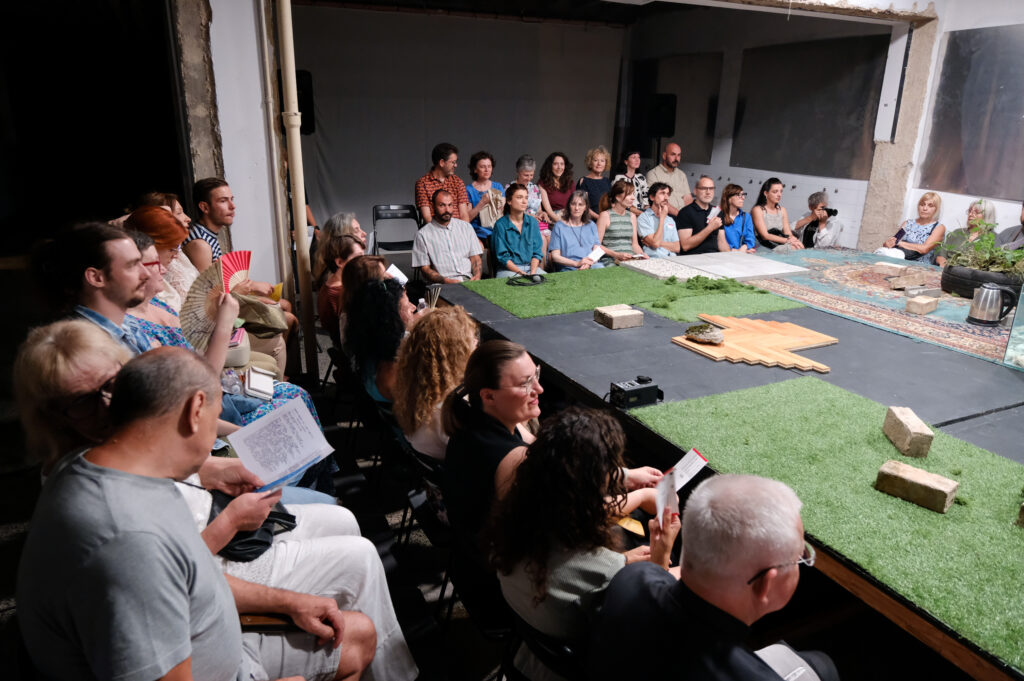
Vozel/The Knot. Photo: Nikola Blagojević
Žiga Divjak and Kolektiv Igralke have created a performance in which it is difficult to identify a statement beyond the rather banal idea that “war is horrible” and politics create this hell for us. The fact that war is horrible is news to no one. The performance begins with the slogan “FREE PALESTINE,” and, unfortunately, its activist dimension ends with this slogan as well. This is followed by a statement about the EU’s introduction of the ReArm Europe initiative, presented as a response to increasing Russian aggression towards European countries. The performance grows out of a very Western way of understanding war. I would even argue that it presents a perspective that is distant and self-involved, with little understanding of what countries directly involved in war are going through.
The statement about the EU can be read as a critique of contemporary society and its growing militarisation. However, perhaps a more important question for the artists to ask themselves is why the EU has begun to militarise in the first place. This is not a decision made out of nowhere, but rather a response to growing aggression and hybrid warfare that is already taking place in Eastern Europe. I should acknowledge that my own position is not neutral either, as Poland is much more emotionally engaged in the war in Ukraine. However, given my awareness of the daily news about Russian provocations in EU countries, as well as the increasing number of people in the EU whose lives are affected by this war, I find this perspective problematic.
It seems to me that, instead of engaging with the actual problems, asking difficult questions, and offering support, the performance risks turning theatre into a form of escapism from the real problem by delivering a universal message. The creators don’t take sides, rather they discuss in somewhat vague terms the idea of falling society. My key issue is that is difficult to put all the wars into one bag. Of course, in all cases we might talk about an imbalance of power and the relationship between the oppressed and the imperialists, but it’s impossible to compare all of them as the historical and sociological context of each country is different.
Another important question that keeps coming back to me is how can we create meaningful theatre about war? Perhaps, rather than trying to search for a universal truth, it would be more productive to focus on agency, or on creating communities. In an interview, Magda Szpecht said: “I was looking for a way to be useful; I wanted to prove to my community that it is not true that nothing can be done. We can have agency, we can hack the system, and we can look for new solutions.” This suggests that theatre does not have to remain passive and reproduce stories of the past but it can also become a space for action, solidarity, and activism.
During the performance, it is said: “Everything is OK, the war is far away.” And this sense of distance is palpable in the way the performance is constructed, not only is it geographical (even only Hungary is between Slovenia and Ukraine) but it is also emotional. The stories are framed within a philosophical reflection on the Anthropocene, the destruction caused by human activity in the world, and the power rich politicians hold. It is a considerable privilege to be able to speak about war from such perspective. If the creators did not want to focus on a particular ongoing war, at least they could have acknowledged the privilege from which they were approaching the subject.
Credits:
Director and dramaturg: Žiga Divjak// Authors: Žiga Divjak, Klara Kovacic, Anja Sabol, Vanda Velagic// Scenography: Igor Vasiljev//Sound: Blaž Gracar
Cast: Klara Kovacic, Anja Sabol, Vanda Velagic
Further reading: Interview with Žiga Divjak: “We have to completely change our value system”

Karolina Bugajak is a theater critic from Poland, currently living in Ljubljana. She studied culture and contemporary art at the University of Lodz. The title of her master's thesis was "Theatricality and Exaggeration. Camp aesthetics as a strategy for creating new identities in the plays of Grzegorz Jaremko". Her main theatrical interests include topics such as institutional criticism, the representation of marginalized groups in plays, and most recently the theater of the former Yugoslav states.