Presented by the Sarajevo Theatre Showcase
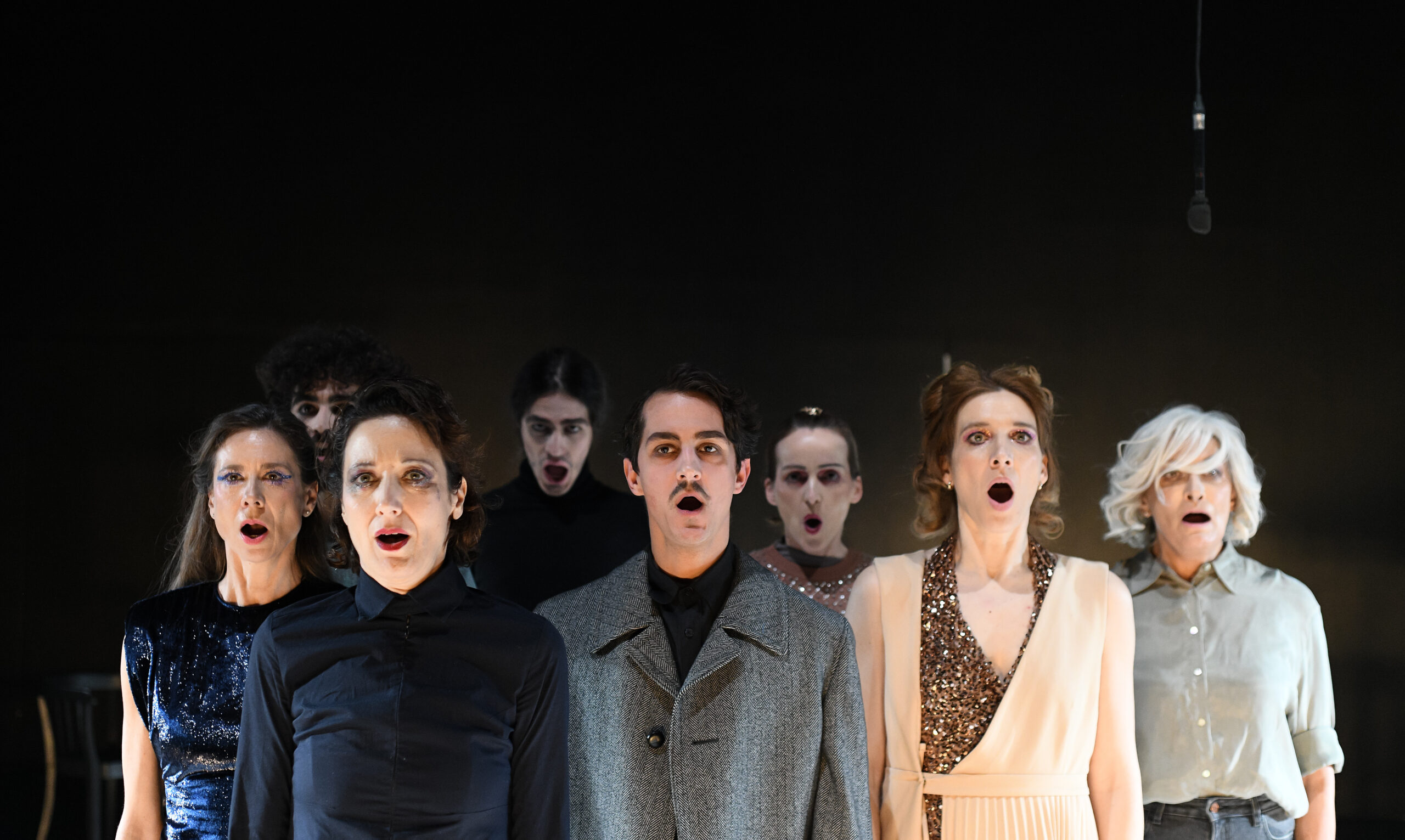
In Short Cuts, even simple tasks become struggles. The performers try to free themselves from objects, language, emotion and each other, caught between the need for control and the desire to flow. Inspired by J. L. Borges’ short story Two Kings and Two Labyrinths, the collectively devised production is directed by Sanja Nešković Peršin. Short Cuts explores what it means to travel through a contemporary artistic labyrinth, where the seesaw between stone-cold control and fleeting freedom is constantly tipping and seemingly simple tasks become difficult to complete.
Each “cut” is a premeditated, yet also actively meditated, self-contained scene. Together, these scenes form a maze of abstract settings featuring different “protagonists” who gradually flow in many directions, a loop with no escape. The repeated struggle to escape a pattern is powerfully conveyed. Failing to escape seemingly minor frustrations to the point of an impasse – this is the aesthetic core of Short Cuts. It is also the core of contemporary lifestyle and its rocky, helter-skelter, oscillatory interactions. It could be seen as a metaphor for the creative process, as well.
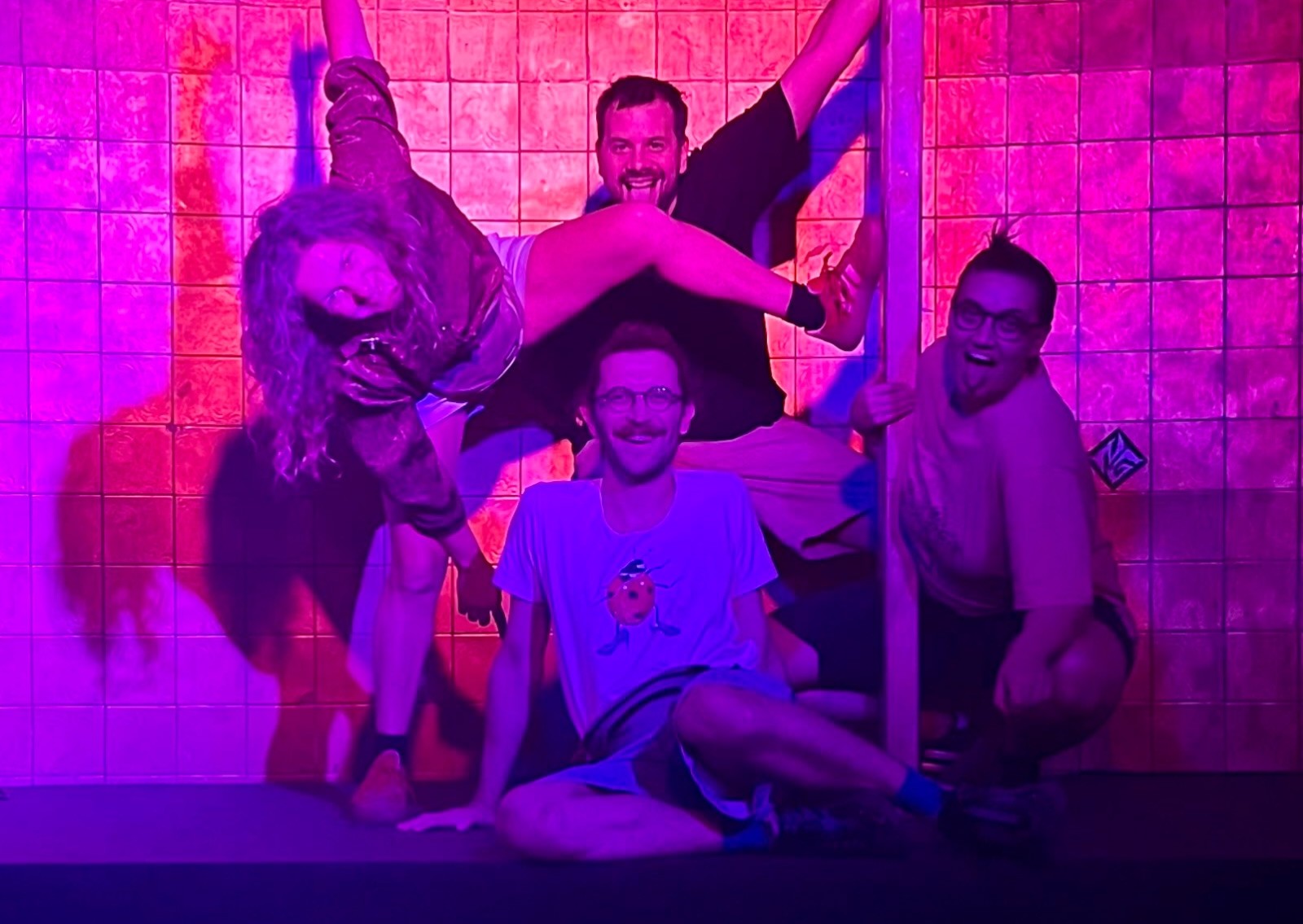
The ensemble brings together contemporary ballet, acting, and circus. Testing the limits of breaking a pattern and reaching a goal, these performers create remarkable tension between mind and matter. This is evident in their interactions with different media: space, objects, each other, virtual reality, sound, and language.
The elements that the performers face defy control. The interactions become layered in endless, seemingly aimless but valiantly executed contact. Andrej Tomše recites safety instructions over and over in several European languages, changing their emotional tone. Mateja Železnik strives to separate herself from furniture. Filip Mramor attempts and ultimately fails to make a point through fluent gibberish while experiencing various emotions and later engages in a verbal spar with Luka Bokšan, failing to escape circular logic and virtual reality. In duet with Železnik, Luka Ostrež strains to remove another’s dead weight, and as a soloist struggles to keep balance, sense of direction, and connection to the ground. These patterns tend to overlap in the end, introduced with the “cut” of Mramor and Bokšan’s unaccompanied singing.
Exploring the performance space and mediums to conquer the labyrinth of interactions has multiple layers. Jaka Simenc’s lighting efficiently weaves and cuts through Chamber Theatre 55’s intimate space, creating a visual dialogue between horizontality and verticality, and all the directions in between, especially complementing the dancers’ to-and-fro with the set (Andrej Tutta), stage space, and each other. Meanwhile, Uroš Belantic’s blue-and-grey colour palette and Sašo Kalan’s score give the production a clean, sophisticated feel.
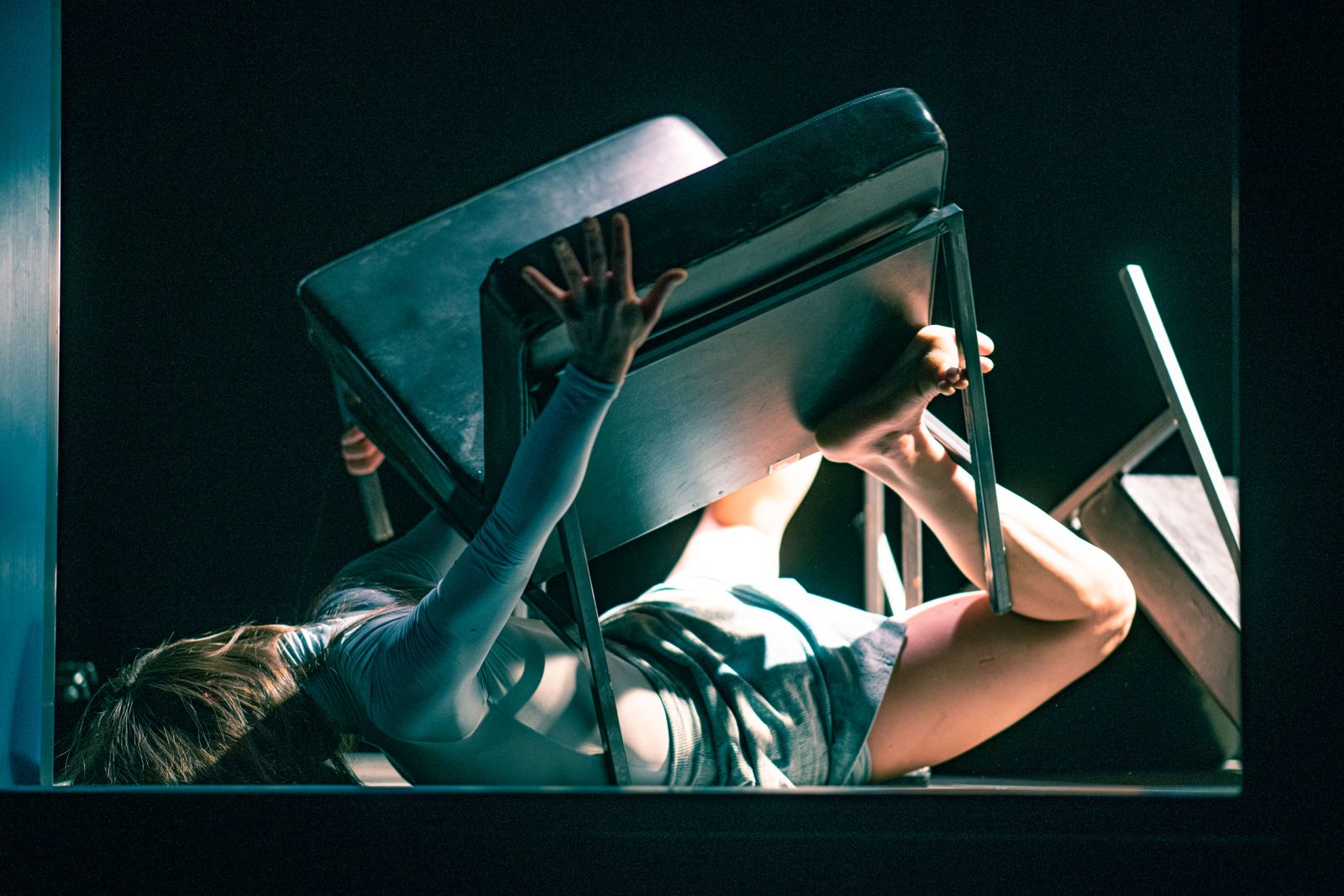
Short Cuts, photo: Borut Peterlin
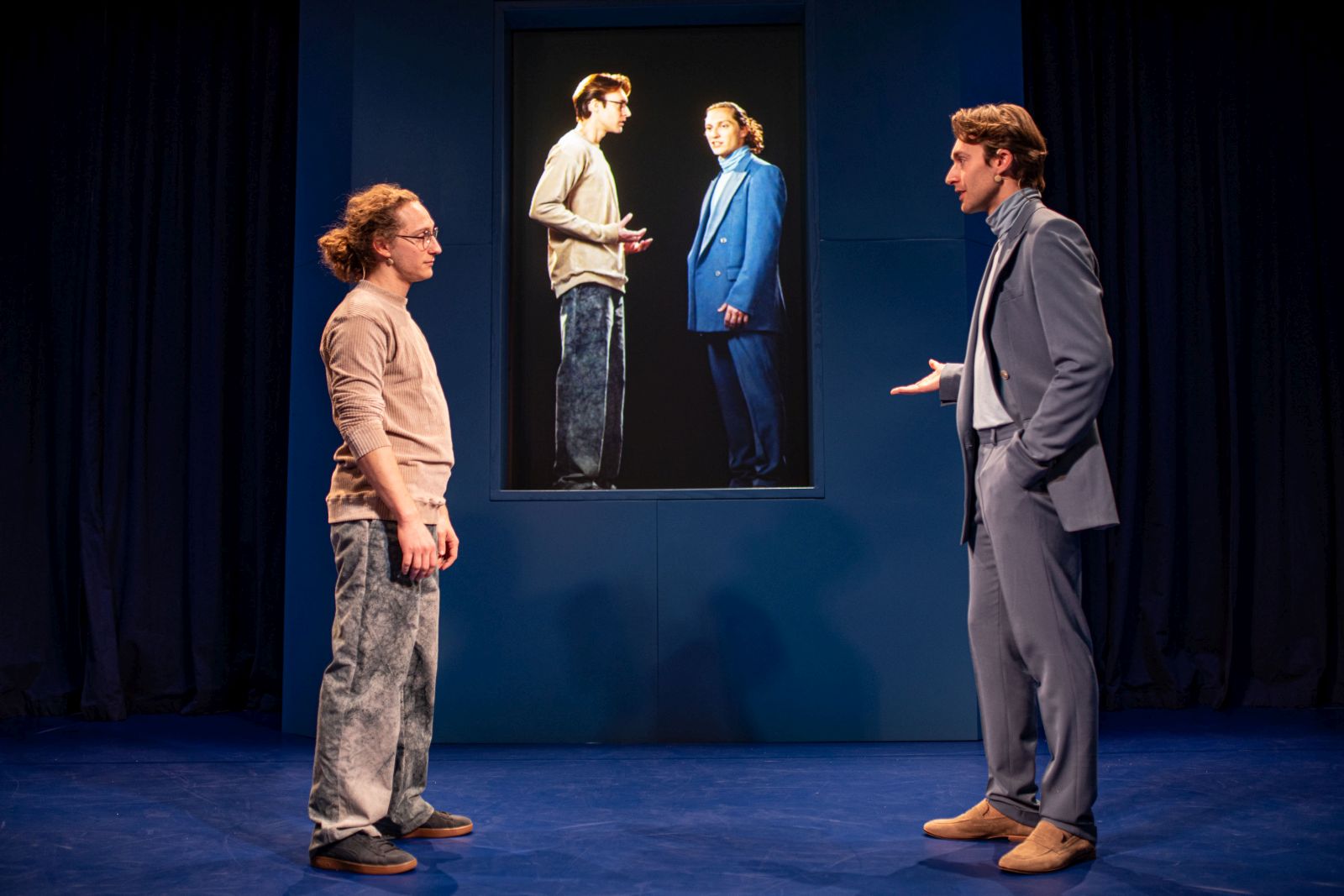
In one striking “cut”, Mramor and Bokšan perform alongside a recording featuring themselves in the same position, matching it word for word in real time. Gradually, the realities of live and recorded exchanges blur into an endless back-and-forth. This is also the most verbally and self-referentially structured “cut”. Mramor plays an actor asking a director for a more serious, preferably Shakespearean, role. As the director declines, questioning Mramor’s emotional range and expressive nuance, his level-headed request gives way to unhinged dramatics, which, in turn, prompts the director to question the actor’s sanity.
Short Cuts is a highly physical piece. It opens with drawn-out collective movement in the background, gradually advancing through the space of Chamber 55, before circling back to its collective starting point.
Cutting through space holds different qualities. Mramor’s range of body language and intonation is remarkable. Stuck in place, he uses pauses, stutters, shifts in volume, word flow density and gestures to move between laughter, rage and tears, whether speaking gibberish or scripted words. His gestures track each vocal shift, giving even the nonsense a convincing emotional display.
The awe-inspiring dancers keep pushing through a labyrinth of mass and spatial awareness, such as Železnik, who balances her entire body precariously against contemporary-looking furniture, flowing under and draping herself over armchairs, while her supple ballerina limbs contrast against the rigid shapes. Later, brought forward into the proscenium area, her clinging body makes Ostrež bend over backwards, trying to discard it, which is weirdly reminiscent of Železnik’s furniture duet – only now she is an organic piece of furniture, and their bodies tangle in the air and on the floor, locked in eternal struggle. Ostrež’s own search for balance and direction is compelling, connecting the physical planes of Chamber 55, similarly to how Mramor and Bokšan’s virtual reality breach creates a rhetorical loop. Andrej Tomše juggles elements of the same sequence, playing with the inflectional movement of different languages and discovering how their specific tonalities in relation to fixed content collide to create a maze of meaning.
The overall effect of Short Cuts is impressive, to say the least. The final “cut” breaks the pattern, breaking the fourth wall along the way. A lone actor “escapes” and delivers a speech to assuage our metaphysical anxieties, which, nevertheless, comes across as a somewhat bland ending to an otherwise fantastically layered piece of theatre.
Credits:
Directed by Sanja Nešković Peršin,
Created by: Tevž Logar, Filip Mramor, Luka Bokšan, and Andrej Tomše
Dramaturg: Tevz Logar//Composer: Saso Kalan//Set designer: Atej Tutta//Costume designer: Uros Belantic//Lighting designer: Jaka Simenc//Video designer: Atej Tutta
Producer: Anton Podbevšek Theater
For more information, visit: antonpodbevsektheater.si
Marta Brkljačić is a Zagreb-based independent theatre critic and researcher, and a Croatian
Critics and Theatre Scholars (HDKKT) member writing reviews, essays and commentary
online/in print. She holds MAs in English and Comparative Literature from the University of
Zagreb. Her work brings together online and print criticism, academic research, and public
theatre mediation, with a special focus on drama, ballet, and adaptation.