Ulysses Theatre and Sarajevo War Theatre, Sarajevo premiere 28 September, 2026
It remains a thorny question whether art can, or should, be separated from the artist — their political views, moral standpoints, biographical controversies, whatever else. The urgency with which it is raised, though, depends on time and place. For German conductor and composer Wilhelm Furtwängler there exists only one type of distinction: that between good and bad art. Set in post-war Germany during the Allied Denazification process, British playwright Ronald Harwood’s 1995 play Taking Sides follows Furtwängler’s interrogation by US-major Steve Arnold, who seeks to determine whether his decision to stay in Nazi Germany was an act of artistic integrity or political complicity.
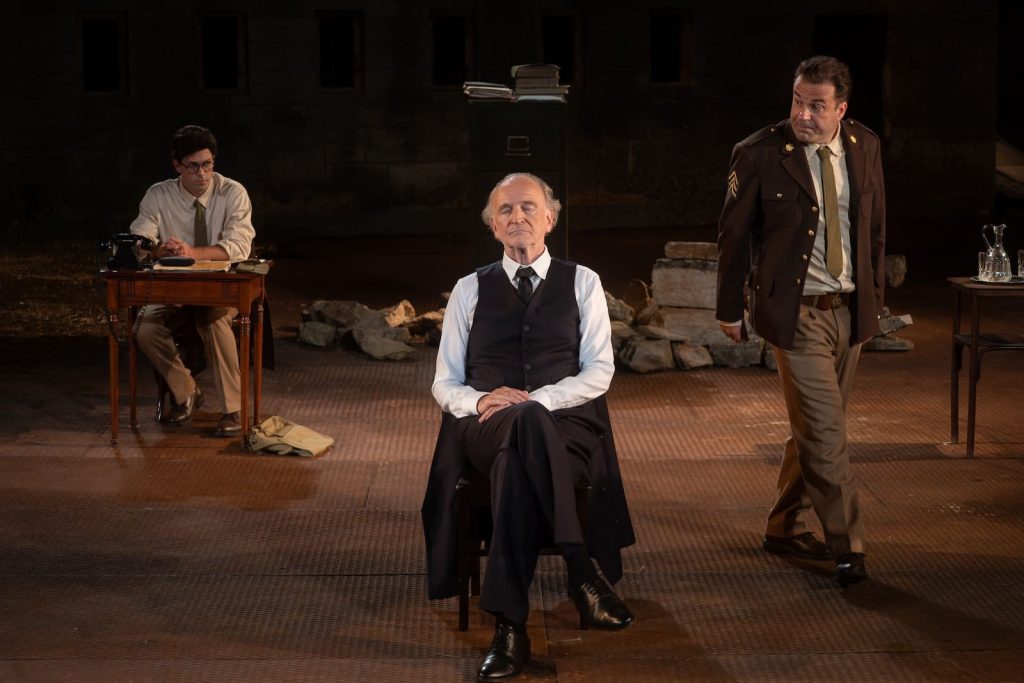
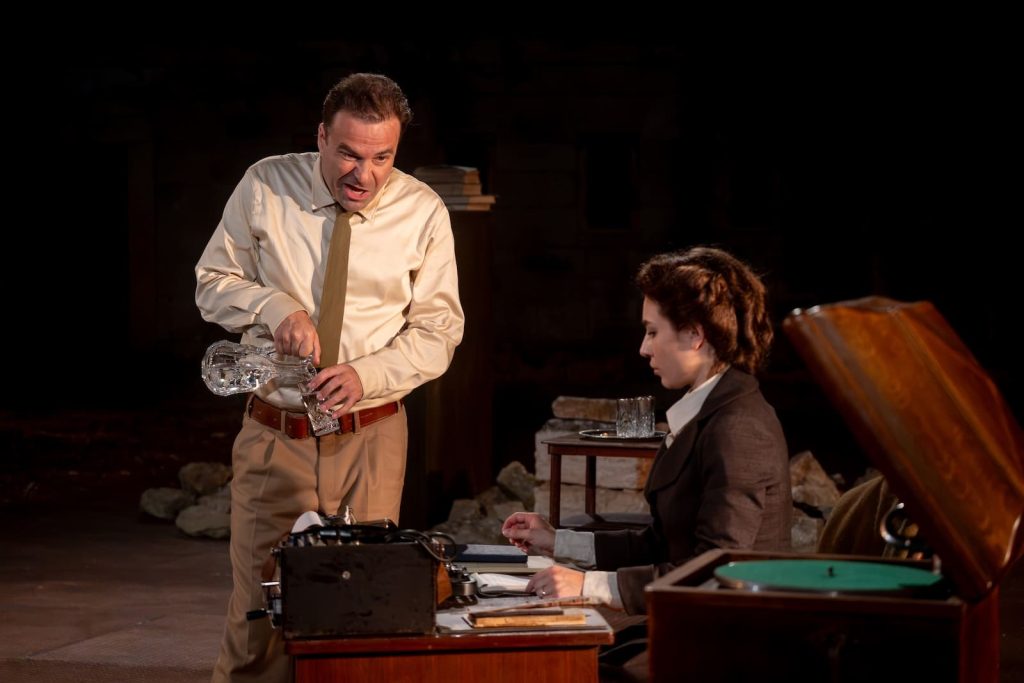
A pompous, familiar melody mingles with the audience’s restless murmurs and the bothersome rustling of candy wrappers. Beethoven’s Fifth Symphony crackles from a scratchy old phonograph, surrounded by a flash flood of fog. As the spotlight thickens, Lejla Hodžić’s minimalist set design becomes visible: two tables on both sides of the stage, equipped with corded telephones and a typewriter, a sage-coloured filing cabinet and other such essentials that display an office from the late 40s. Unobtrusive and yet, flashily out of place, a pile of heavy rubble lies in the background. With this, set designer Hodžić prudently evokes the association of the so-called Trümmerliteratur, but also foreshadows an upcoming dramaturgical shift by the end of the play. Costume designer Bjanka Adžić Ursulov complements the restrained scenography with period-appropriate attire, prioritising historical authenticity before anything else.
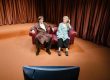
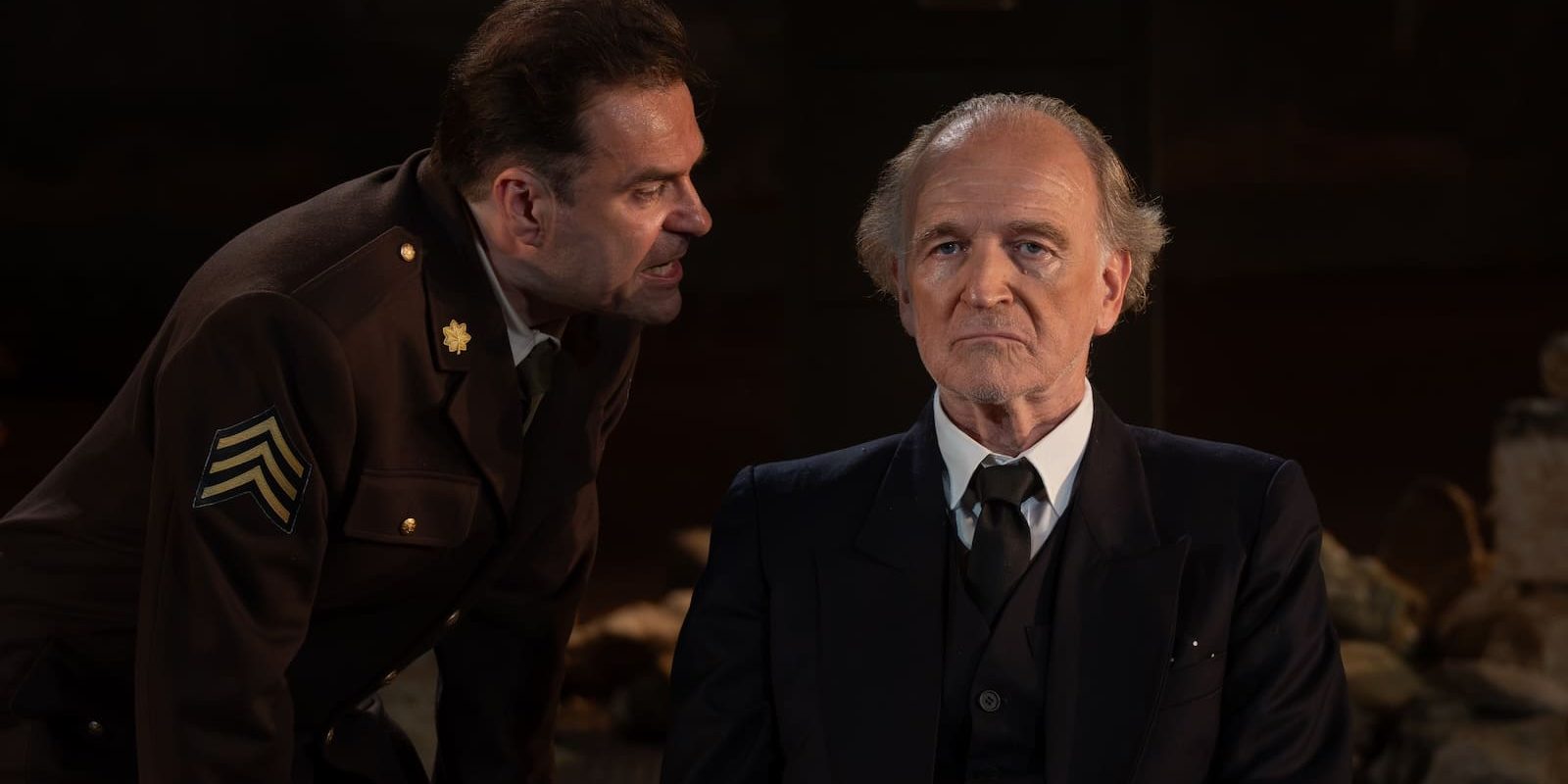
One side of the stage is taken by US-Major Steve Arnold (Ozren Grabarić), the other by his secretary Emmi Straube (Matea Mavrak), who is the daughter of a recently deceased resistance-fighter or, as Arnold puts it, “one of the good Germans”. From the beginning, it is made clear that, even though both of them advocate the same political standpoint, that is the American blue-red-n-white-coloured promise of freedom, they surely cannot agree on the terms. Their relationship follows a familiar good-cop/bad-cop dynamic, with Arnold’s blunt, confrontational approach contrasting with Emmi’s more measured idealism.
While Mavrak delivers a heart-warming performance of a music aficionado that balances empathy with grief, both for her father but more so for the countless victims of war; Grabarić gives an exhilarating embodiment of a man whose PTSP and longing for justice justifies the scrupulous means by which he is ready to hunt down Nazis. In his best moments, he resembles, inversely, Hans Landa, played by Christoph Waltz, in Tarantino’s revenge fantasy Inglourious Basterds from 2009.
However, Arnold alone occupies one of the central roles in the story’s conflict, soon to be joined by a stoic Furtwängler (Svetozar Cvetković). Depending on which side you’re on, it remains debatable who stands on which side of the moral divide. What is certainly not debatable is Cvetković’s virtuoso portrayal of ambiguity. No matter how often he claims his innocence, the actor succeeds in making the audience question it, using all the tricks at his disposal: mostly stoic, sometimes lamenting, always unbelievably believable.
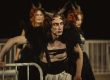
Taking Sides, Ulysses Theatre
Unlike him, Helmuth Rode (Alban Ukaj), second violinist in the Berlin Philharmonic, is far more transparent in his intentions, though no less compelling to watch. Ukaj’s undeniable mastery unfolds in subtle physical actions that scoff every line with rich subtext: during the interrogation scenes, his eyes wander, a sudden break in normal eye contact, followed by prolonged staring to overcompensate; and then his hands, where to put his goddamn hands? Every gesture seems to betray something his words attempt to conceal, revealing a man whose certainty is perhaps as much a performance as Furtwängler’s innocence.
This tremendous ensemble is rounded out by an unfortunately bland Lieutenant David Wills (Davor Sabo) and Tamara Sachs, embodied by a fantastic Džana Džanić. An absolute force of nature, Džanić delivers hysterical tantrums with infectious energy, while also capturing the vulnerable absent-mindedness of a widow whose husband was lost in Auschwitz and who is willing to fight vigorously until he receives the justice he deserves.
As for Beethoven’s Fifth, it will serve as a luminous beacon throughout this theatrical evening. Ever-reflecting on the conundrum of artistic autonomy and the artist’s undeniable responsibility, Harwood’s congenial text poses a question as timeless as the tides breaking on the shore: “We’re simply here to find out the truth” — “Whose truth?”
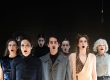
Serbian director Lenka Udovički uses the premise of the play not only to probe this moral dilemma, but also to explore its resonance in today’s war-stricken global village. By overlaying the second half of the play with visual references to Alain Resnais’ influential Auschwitz/Majdanek documentary Night and Fog (1956) — the lingering fog onstage and the occasional projections — and musical references to Vedran Smailović, the cellist known as the “Cellist of Sarajevo,” embodied by Belma Alić, Udovički invokes the siege of Sarajevo, as well as ongoing atrocities in Palestine and Sudan, delivering an explicit condemnation of genocide through passive dramaturgical means. Leaving Harwood’s text largely untouched, these additions feel awkwardly out of place, like foreign bodies in an otherwise coherent and conservative production.
Nevertheless, by asserting her altruistic stance in such an in-your-face manner, Udovički makes it clear that, for her, the initial question is less a head-scratcher than a no-brainer: People first, art second, case closed.
Following its premiere on July 31 at the open-air Ulysses Theatre on the Croatian Brijuni Islands, Taking Sides inaugurated the crisp new 2026/27 season at Sarajevo War Theatre in Bosnia and Herzegovina’s capital. While it would be tempting to count it among the many successful summer co-productions between the two theatres, this particular staging obviously carries a distinct historical and political weight. Both locations bear their own, albeit different, legacies of the Nazi era, lending the production a symbolic significance that extends beyond Harwood’s original text.
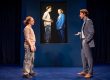
Taking Sides, Ulysses Theatre
However, while Sarajevo’s wartime history finds its way into the staging through references to the 1990s siege, the Croatian context goes chiefly unexamined. Given the production’s explicit moral stance, this omission is all the more striking: rather than invoking the conflicts of the 1990s, it could have confronted the region’s more immediate histories of fascism and collaboration, including Croatia’s wartime alliance with Nazi Germany, and drawn a more unsettling connection to the present-day resurgence of far-right politics in the Balkans.
In this day and age, altruism is much needed, and it sure is intended in this production. But good intentions don’t necessarily make for good deeds.
Whether Furtwängler — whose father’s name was, ironically enough, Adolf — was “Hitler’s pampered maestro” or plainly a maestro is, indeed, an open question. He was officially denazified in 1947, when, following the intercession of Jewish musician colleagues, he was declared an “exonerated person” by the American occupation authorities. However, for a play that is called Taking Sides and which is based on factual historical events, waving a white flag of “Nie wieder!” (Never Again) Lena Udovički’s interpretation remains, for a wonder, on neutral ground.
As Egyptian-born Canadian writer Omar El Akkad famously put it: “One day everyone will have always been against this.” Yet the production seems more concerned with condemning atrocities elsewhere than with confronting the historical and political realities closer to home. While its references to Sarajevo, Palestine and Sudan invoke the horrors of fascism, war and genocide, the resurgence of present far-right politics across Europe and the Balkans is implied fairly indirectly. In a region with its own history of fascism, collaboration and nationalist violence, the past is not merely something to commemorate, nor is the present someone else’s tragedy. It is happening here, too, right now.
Credits
Director: Lena Udovički/ Author: Ronald Harwood/ Translation: Đorđe Krivokapić/ Dramaturg: Emina Kovačević-Podgorčević/ Costume Designer: Bjanka Adžić Ursulov/ Set Designer: Lejla Hodžić/ Composer: Nigel Osborne/ Choreographer: Staša Zurovac/ Video artist: Adla Isanović/ Light designer: Endi Krakić/ Sound designer: Davor Rocco/ Assistant Director: Ajša Đuherić
Cast: Ozren Grabarić, Matea Mavrak, Džana Džanić, Alban Ukaj, Davor Sabo, Svetozar Cvetković, Belma Alić (Violoncello)
For more information, visit: ulysses.hr

Berina Musa is a writer, dramaturg, and critic based in Sarajevo and Freiburg. She studied German linguistics, literary studies, and art history at the University of Freiburg and is currently completing a second degree in dramaturgy at the Academy of Performing Arts in Sarajevo. Her plays and short films have been presented at the Bosnian National Theatre Zenica, MESS, the Sarajevo Film Festival, and the Mostra Internazionale del Nuovo Cinema di Pesaro.