Sarajevo War Theatre, premiere 25th May 2026
He was a penniless chauffeur with a pessimistic world view, she an office employee with a hedonistic appetite for life. Ödön von Horváth’s tragicomic play Casimir & Caroline from 1932 is set during the Great Depression at the Munich Oktoberfest, following a young couple whose relationship begins to fall apart after Casimir loses his job. Through their separation, the play exposes how economic insecurity, class differences, and social ambition can erode love and human connection.
This production marks the first professional theatrical work by director Isidora Ratković, an alumna of the Academy of Performing Arts in Sarajevo, who previously gained attention with her graduation short film Good Luck, Sara! (Sretno, Saro!), receiving an honorable number of international awards. There is no doubt that Ratković belongs to an aspiring generation of artists who wrestle for new forms of expression, no matter the medium. This ambition also breathes throughout her interpretation of Casimir & Caroline, a play she chose for its continued actuality. Clearly influenced by the sensibilities of contemporary works such as Celine Song’s The Materialists, the production attempts to translate Horváth’s critique of social aspiration and romantic disillusionment into the emotional and economic realities of the present here and now.
At the same time, together with dramaturg Vedrana Božinović, Ratković takes the liberty of substantially reworking the original text through radical cuts, fragmentation and newly written passages intended to establish direct links to the local and contemporary context. For example, at the beginning of the performance, Casimir and Caroline address the audience directly, recounting Horváth’s absurd death by a falling branch in Paris and connecting it to the death of a woman killed by falling masonry in Sarajevo. Other insertions touch on parking lots, the life of an ageing actress, and similar topics. The logic of these interventions remains unclear. Their placement and dramaturgical function seem arbitrary, while their added value is questionable. If the original play already speaks across time and space, one may ask why it needs to be made contemporary so insistently. By spelling out its relevance, the production leaves little room for the audience to discover it on its own. As in an attempt to make water wetter, night darker or gravity stronger.
Casimir and Caroline, SARTR
From a literary perspective, the news-like insertions recall techniques associated with Neue Sachlichkeit, yet unlike the montage structures found in works such as Döblin’s Berlin Alexanderplatz or Kästner’s Fabian, here, they rarely feel organically integrated. Instead, they shift the focus away from the central couple and the play’s core theme of love in favour of a rather diffuse exploration of power relations. The attempt to test the elasticity of the canon rather than merely reproduce it is noteworthy, particularly within Sarajevo’s generally text-faithful dramaturgical landscape. Yet the intervention ultimately lacks consistency and precision.
The production often feels more like a work in progress than a fully consolidated performance. The house lights remain on throughout, musical cues appear arbitrary, and stretches of the mise-en-scène feel oddly vacant, punctuated by unmotivated entrances and exits that create movement without dramatic necessity. This may partly be a consequence of the dramaturgical cuts: Horváth’s play consists of 117 scenes and features 17 characters, not including those the author himself refers to as “Abnormalities and Oktoberfest people”. By reducing the ensemble to only six performers, the dynamic succession of scenes—in which one poor decision and scandal leads inexorably to the next catastrophe—is weakened. As a result, narrative tension and overall pace are diminished, producing a sense of stagnation. In the first half of the performance, moments of complete silence and stillness repeatedly emerge on stage. What initially appears to be a deliberate directorial strategy for creating dramatic pauses ultimately feels less like a conscious intervention than a by-product of the production’s uneven rhythm.
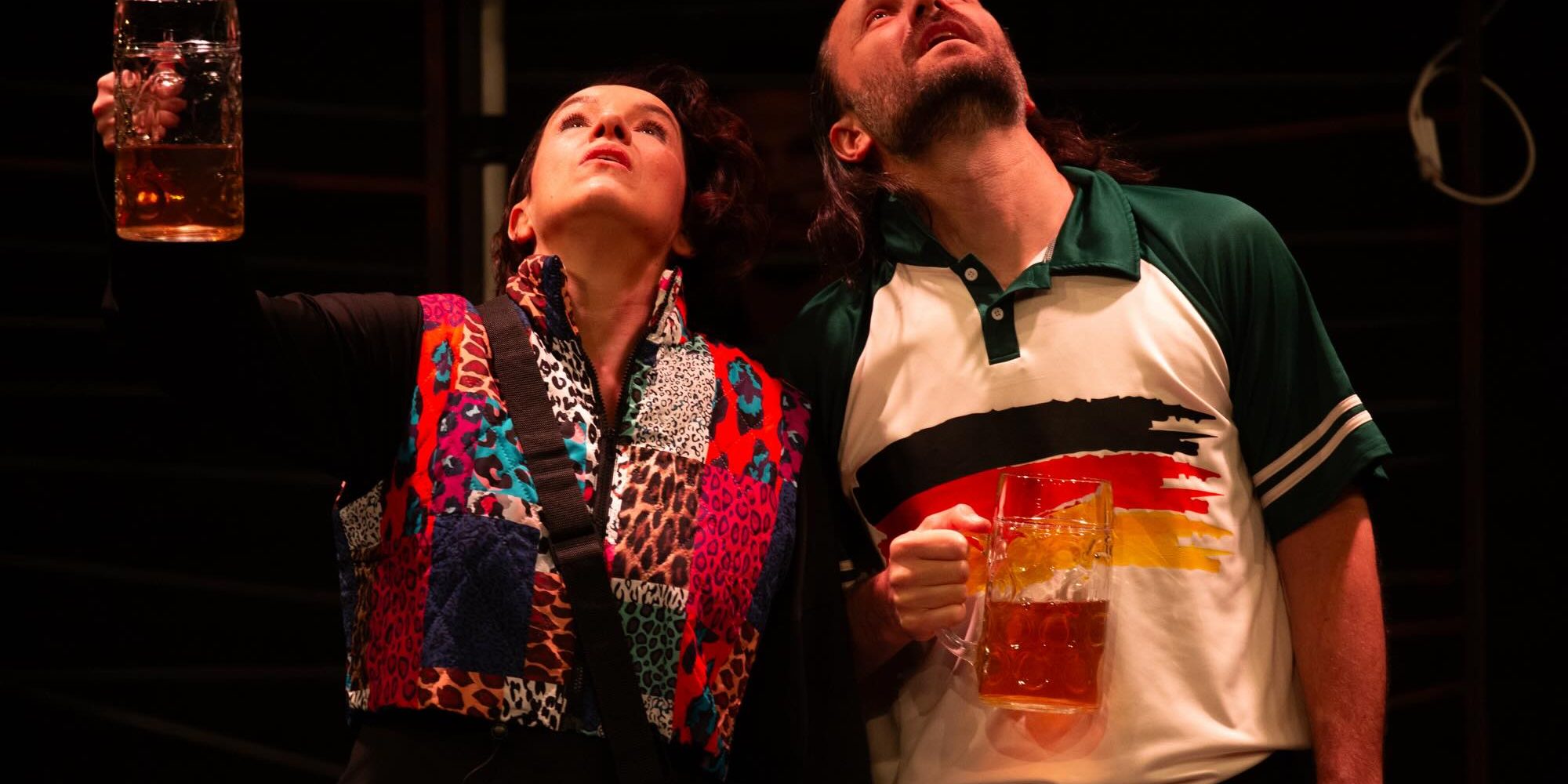
The production also suffers from inconsistencies and duplication. This is evident in the gap between spoken text and stage action: alongside the titular couple, Merkl Franz and Erna are repeatedly described as broke. Nevertheless, all four characters roam the stage carrying beer steins and ice cream they should not be able to afford. At times, the actors are so overloaded with props that they distract from the emotional core of a scene.
The tendency towards doubling, already visible in the dramaturgical interventions, also manifests itself in the directing. After being beaten by her partner Merkl Franz, Erna turns en face to the audience, removes her shirt and delivers a heartfelt monologue about “things you can die from”, one of them being the invisibility of an ageing actress. While the topic itself is worthy of discussion, its placement feels detached from both character and situation. The fact that the monologue is delivered by a talented actress securely employed within the ensemble further complicates its claim to urgency. Moreover, the gesture of emotional exposure is already contained in the text itself; the nudity merely reiterates what has already been communicated, adding a layer of illustration where none is needed.
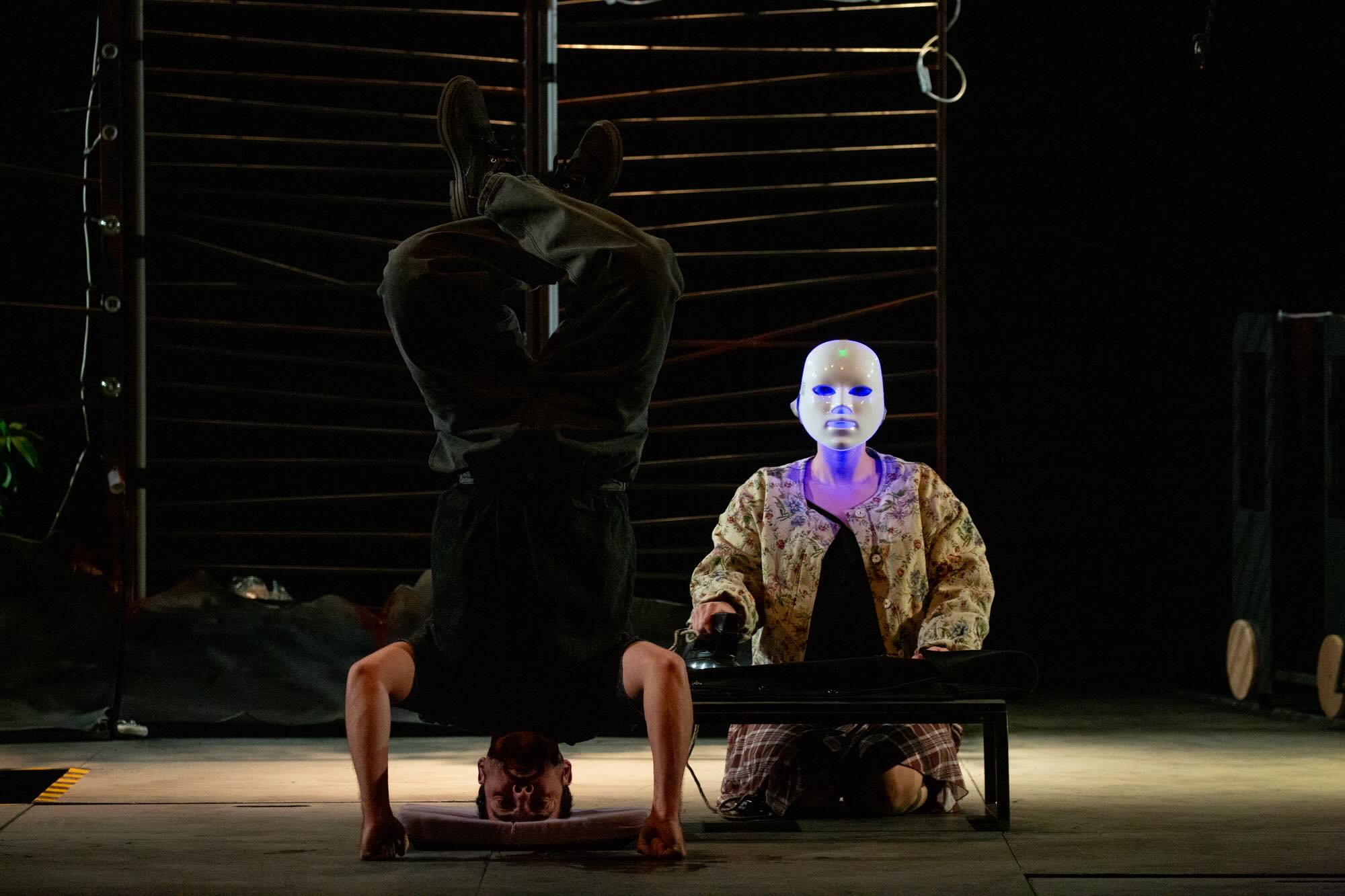
However, where Ratković’s directorial concept truly moves into gear is in its visual language. Choosing collaborators such as Adisa Vatreš Selimović for set and costume design, as well as the Belgian choreographer Thomas Steyaert, demonstrates a keen eye for strong visual storytelling, which seems to come from her experience in film. The stage resembles a theatrical playground: climbing poles, garlands with bronze-coloured flags, and an invisible trampoline hidden beneath the stage floor. Then there is the zeppelin that appears and disappears into the fly tower, shaped like an ominous UFO hovering over the festivities. The costume design, meanwhile, translates Horváth’s social types into a contemporary visual code: Adidas chav-chic, but fashionable. Tracksuits, sportswear and casual street fashion evoke a recognisable aesthetic. Steyaert’s choreography, though it remains only one short episode in the whole, adds a layer of physical articulation to the otherwise text-driven staging.

Casimir and Caroline, SARTR
Another strength of the production is the ensemble, with two performers in particular standing out. The first is Jasenko Pašić, whose interpretation of Casimir captures the character’s complexity with lightness. Like a pendulum, Pašić swings between fatalistic nihilism and naive hope, creating an abyss-like pit of self-pity that is gradually filled again by the possibility of new love. It is here that the play’s epigraph, “And love will never cease,” comes into effect. His new love interest Erna, the part-time petty criminal, is embodied by Mirela Lambić, who delivers a comedic yet heartfelt performance. Even in moments when she assumes the role of the victim, she demonstrates strength and a surprising inner resilience.
Ana Mia Karić’s Caroline is sweet in a way that almost makes one forgive her for having “only wanted to ride the carousel.” Like most characters in Horváth’s work, Merkl Franz initially appears as a stereotype, yet ultimately serves as a symbol. Adnan Kreso meets this challenge with confidence and strong comic timing. Enes Kozličić’s Schürzinger is playful, witty and, just as Caroline, easy to forgive in his naivety and sugariness. Amar Selimović’s Rauch functions as something of an MC, a string-puller and voyeur who remains in the background, constantly observing and waiting for the right moment to seize an opportunity. The sharpening of Rauch as a symbol of abuse of power and capitalism is particularly intriguing, a reading that seems to emerge from both Selimović’s performance and Božinović and Ratković’s broader directorial framework.
Actuality is not a concept in itself, nor is dramaturgical deconstruction an end in its own right; it must be anchored in a clear directorial language. To what extent, then, do Ratković’s borrowings from post-dramatic strategies constitute a style of her own? Ratković reads Horváth through a socio-critical lens, foregrounding class, transactional relationships, narcissistic self-fashioning, and the rise of fascism. These references form a recognisable network of ideas, yet the production still searches for a fully articulated directorial voice. Rather than a fixed conclusion, the evening suggests an artistic approach in formation, pointing towards a potential authorial signature in future work.
Credits
Director: Isidora Ratković//Dramaturgy: Vedrana Božinović//Set & costume designer: Adisa Vatreš Selimović//Composer: Nedim Zlatar //Choreographer: Thomas Steyaert
Cast: Jasenko Pašić, Ana Mia Karić, Adnan Kreso, Mirela Lambić, Enes Kozličić and Amar Selimović.
For further information, vist: sartr.ba

Berina Musa is a writer, dramaturg, and critic based in Sarajevo and Freiburg. She studied German linguistics, literary studies, and art history at the University of Freiburg and is currently completing a second degree in dramaturgy at the Academy of Performing Arts in Sarajevo. Her plays and short films have been presented at the Bosnian National Theatre Zenica, MESS, the Sarajevo Film Festival, and the Mostra Internazionale del Nuovo Cinema di Pesaro.