National Theatre Sombor, premiere 21 May 2026
The border between fact and fiction is not given in things themselves. (Paul Ricoeur)
In the second volume of Miguel de Cervantes’ Don Quixote, the protagonist becomes aware he is a character in a book, which unsettles him. In Pirandello’s Six Characters in Search of an Author, the characters seek a creator who rejects them. Mate Matišić’s characters contend with a writer who cannot escape them.
Mate Matišić is regarded as one of Croatia’s most controversial living playwrights, notably for works such as Angels of Babylon and Fine Dead Girls. When his play Men of Wax premiered at the Croatian National Theatre in Zagreb in 2016, audiences sought to identify real individuals behind its fictional characters, interpreting the drama as biographical. This response directly inspired the sequel, My Sad Monsters, in which Matišić further examines the relationship between fiction and reality. Through meta- and auto-fictional techniques, he poses critical questions: Can the boundary between illusion and reality be defined? Who decides what may be said, and how?
After successfully directing Man of Wax at the National Theatre Sombor, Ivan Vanja Alač has returned to stage its sequel at the same venue. This follow-up stands on its own, presenting three stories (with one from the original play intentionally omitted) in which the character Matišić confronts his inner monster:
his own story and the blurring of imagination and fact (Look Me in the Eyes: a woman who has escaped a psychiatric hospital claims to have received a cornea transplanted from the real person on whom the character of Jasna in Man of Wax was based); his homeland and his past (Me Too: upon learning he has a tumour, the writer wants to purchase a burial plot in his home village); and society (Column of the Dead Child: a journalist who has been blackmailing adoptive parents learns of her daughter’s death, while her own victimhood is revealed).
Matišić consistently blends the personal and the social in his writing, often incorporating current issues that sometimes appear as digressions, as seen in Father, Daughter, and the Holy Spirit, which is more overtly satirical. In this production, however, themes such as feminism and the migrant crisis arise organically from the characters’ inner experiences.
Alač makes an excellent dramaturgical intervention: he doubles the character of Matišić into the protagonist (relying on situational humour, ironic and expressive within the bounds of the character’s frustration, played brilliantly by Nikola Knežević) and into Matišić the writer, an observer of his own characters and the events happening to Matišić (Saša Torlaković). This Matišić-writer watches his life unfold, offers commentary, and reveals how the onstage characters will end. This achieves two things: the textual metafiction finds its scenic articulation, and the potentially didactic, even maudlin, self-pitying commentary of a character reflecting on himself is avoided entirely. The role of the omniscient writer-narrator could easily have become a trap, a presence that reads as an impression without substance. However, Torlaković refuses to let that happen. With immense concentration, presence and self-awareness, he creates on stage a charming and assured demonstration that a writer has a duty to follow his characters and that, despite a promise made to his wife (who is also a character), the play must be written.
The production would be stronger with more radical cuts. The first story opens too cautiously, as though the director fears audiences unfamiliar with Man of Wax will be left adrift without explanation. The cemetery scene in the second story, following a deeply harrowing monologue about the murder of a little girl, Ljilja, which places an immense emotional burden on the viewer, should have ended far sooner. After the interval, the opening of the third story dissolves into extended conversational sequences in a café. This slows the audience at a moment when it should build anticipation for the climax: the journalist’s confession, which holds equal emotional weight. Bolder cuts could enhance the piece, but that does not mean the production suffers from poor pacing or includes unnecessary material. Instead, condensing and tightening the focus would benefit the characters significantly.
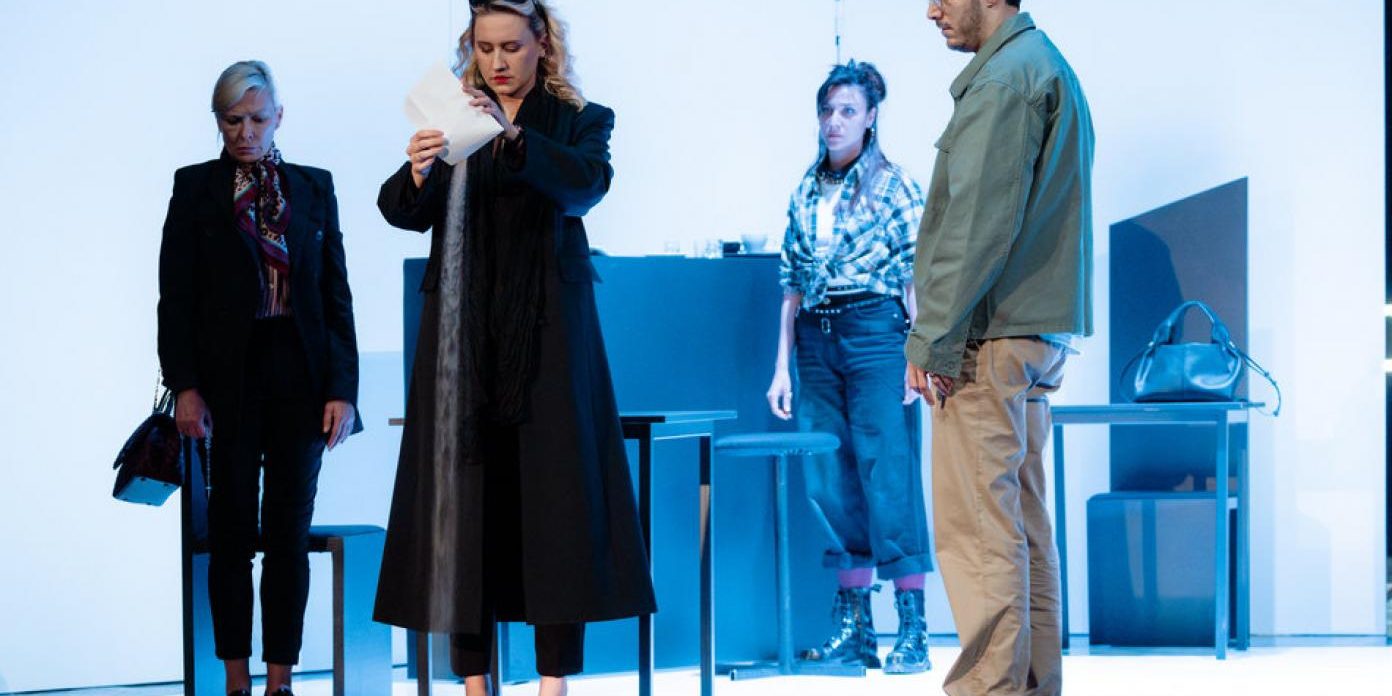
This is undoubtedly Ivan Vanja Alač’s most mature direction to date. He finds a directorial language perfectly suited to Matišić’s grotesque by flirting with elements of gothic horror. This ranges from the set design (Andreja Rondović), which suggests a claustrophobic, almost surreal space using cold neon lighting with multiple meanings and chairs acting as tombstones; through the realistic costumes (Biljana Grgur) that serve as a counterpoint; all the way to the music (Dragana Jovanović), which creates an atmosphere of unease, featuring choral singing that makes your fingertips tingle. Every word and scene seems finally at home, precisely here and precisely like this. It seems as though this is the only possible staging (though that is certainly untrue, given that Vito Taufer directed the premiere of the text at the GDK Gavella a few years ago in an entirely different manner).
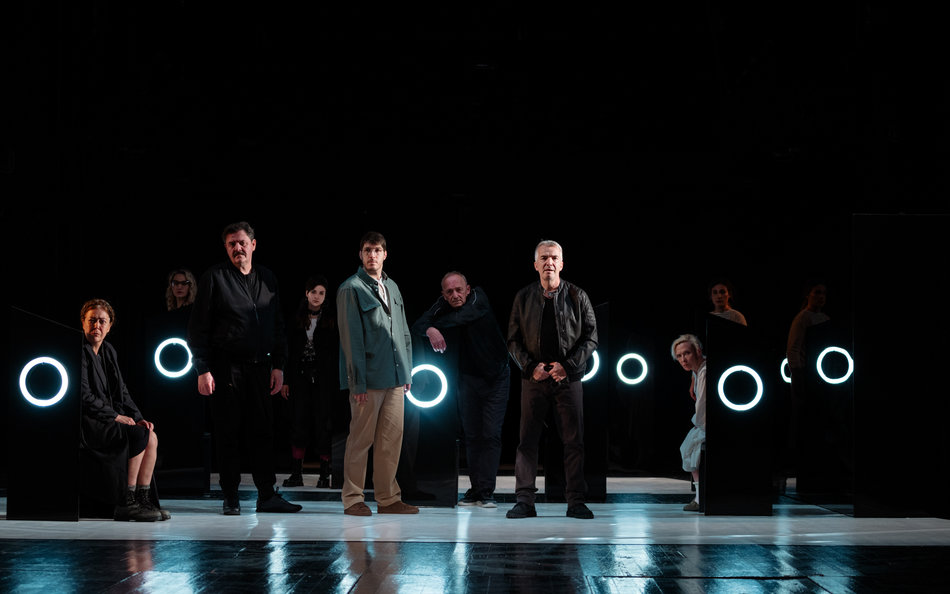
My Sad Monsters. National Theater Sombor
However, the director omits one of the most compelling elements from the earlier stories in the third: the choral sound-making that previously enhanced the atmosphere of collective dread and the sense of intrusion by disruptive characters. Its absence in the final scene reduces the aesthetic coherence of the production. The most visually striking moment occurs in the second story, where, instead of descending into the tomb holding the migrants, a lowered lighting frame shifts our perspective. By reminding the audience they are in a theater, not only by breaking the fourth wall but also by creating and dissolving illusion, the director achieves a thought-provoking theatrical experience.
The themes of persecution, journalistic ethics, war trauma, institutional hypocrisy, abuse, and violence against women and migrants are universally relevant. Matišić explores the painful, the painfully beautiful, and the deeply sad aspects of these issues. However, staging the play in Serbia diminishes the impact of Ivan’s monologue about the girl Ljilja. Srđan Aleksić delivers a powerful performance in this challenging role. The account of the Ustaše murdering a Serbian child resonates differently in Sombor than it would in Croatia, aligning with Serbian collective memory. At a pivotal moment in the second scene, the director introduces a significant pause, a silent invitation for reflection. Just as Matišić addresses monsters in Croatia, the pause suggests that similar conversations are needed in Serbia. This moment stands as the production’s most direct political gesture, grounding the play in its local context.
The Sombor ensemble, as expected, was excellent. Ana Rudakijević, one of the most important theatre actresses of the younger generation, playing a journalist who evokes both condemnation and compassion, does so without sentimentality, employing a cold precision that is far more convincing than any pathos. Jugoslav Krajnov is outstanding, balancing between madness and lucidity, both as the worried brother of the ill Lidija (with whom the audience empathizes to some extent) and as a local mobster. Ivana V. Jovanović, as Lidija, ventures even deeper into the labyrinth of the irrational than the playwright himself, a feat that demands genuine courage on stage. Biljana Keskenović, as the furious and combative Slava, a widow enduring sexual violence, delivers a true masterpiece of acting. The resistance she offers in her refusal to submit to violence is incredibly layered, full of vitality, and poetically precise. Pero Stojančević, Nemanja Bakić, and Anica Petrović are superb, suggestive, imaginative, yet almost documentary-like in their respective roles. Although the character of Mate’s wife is most often surprised and caught off guard, Adriana Salahović has created a genuinely caring and supportive woman. Vlasta Ramljak also did an outstanding job as the stage speech advisor, as the actors completely mastered various Croatian dialects.
French philosopher Paul Ricoeur, quoted at the beginning of the text, wrote that imagination and history are not opposed – both are narratives. The National Theatre Sombor has a production whose very center revolves around a well-told story. It also has a director and an ensemble who knew exactly what to do with it. Of course, as Paul Ricoeur would say, fiction and reality share the same root anyway.
Credits:
Director, adapted by: Ivan Vanja Alač// Set design: Andreja Rondović //Costume design: Biljana Grgur // Music: Dragana Jovanović // stage speech: Vlasta Ramljak // Sound recording and design: Aleksandar Vaci // Lighting design: Ivan Nikolovski, Andreja Rondović, Ivan Vanja Alač // Scenography assistant: Isidora Mihaljčić // costume design assistant: Olivera Damjanović
For more information, visit: npozoristeso

Divna Stojanov is a dramaturg and playwright. She writes mainly for children and young people.