66. International Theatre Festival MESS, National Theatre, Sarajevo, October 4 2026
“Shame has to change sides.” — these are the eminent words spoken by Gisèle Pelicot, the French survivor and activist whose decision to make public the trial of 50 men accused of raping her while she was unconscious – after being repeatedly drugged by her then-husband, Dominique Pelicot, who had orchestrated and filmed the assaults over almost a decade – has transformed her into a symbol of the fight against sexual violence. Last year, the trial itself was transformed into a scenic oratorio by French dramaturg Servane Dècle and Swiss theatre-maker Milo Rau. A production of Wiener Festwochen, in cooperation with the Festival d’Avignon, The Pelicot Trial premiered in June 2025 in Vienna, before travelling to the Cloître des Carmes in Avignon the following month – the very city in which the actual criminal trial of Dominique Pelicot and his co-defendants had concluded just six months earlier.
Since then, the piece has been travelling the globe, both physically and virtually. It seems to be an inherent part of the world tour, which has already taken it from Lisbon and Belgrade to Stockholm, Warsaw, New York, Milan, Bergen and Oslo, that performances are frequently made accessible to audiences beyond the theatre through livestreams and online video recordings, available to watch on YouTube, free of charge. This democratic gesture of extending the theatrical experience beyond the physical confines of the auditorium seems to stem from the production’s inherent message: “to pay tribute to an ordinary woman who opened the way to change”, as its official description puts it.
As part of its world tour, The Pelicot Trial arrived in Sarajevo, where it was presented at the National Theatre as part of the main competition programme of the 66th International Theatre Festival MESS. As in other cities, the performance was restaged in the local language with a new cast of actors and public figures. Fifteen actresses, eleven actors and one countertenor make up the Sarajevo ensemble.
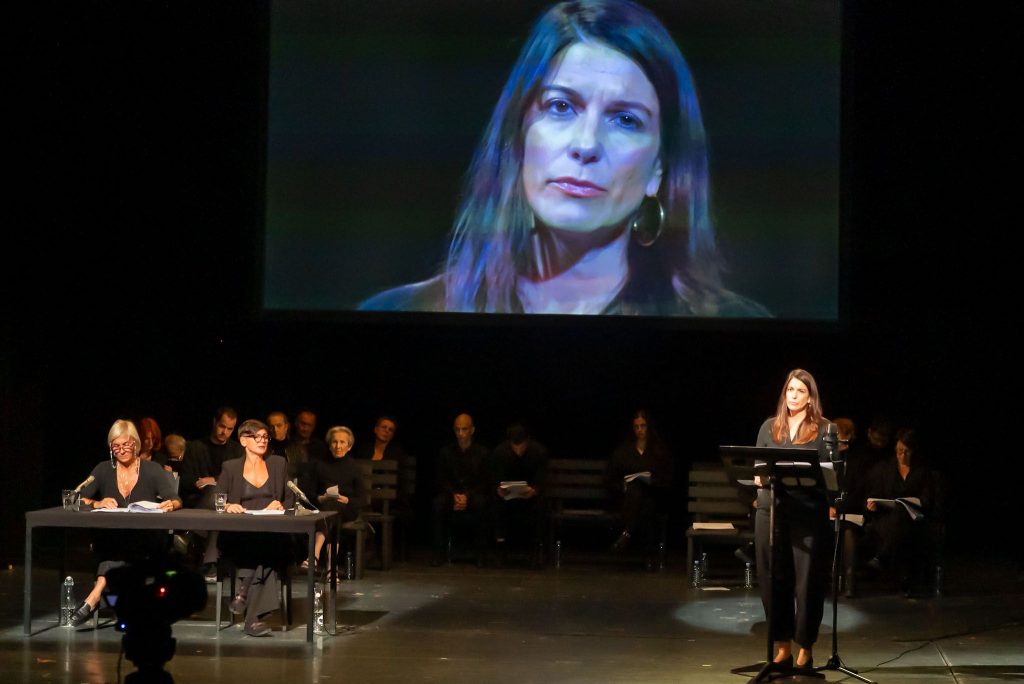
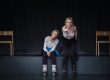
Slucaj Pelicot at National Theatre Sarajevo
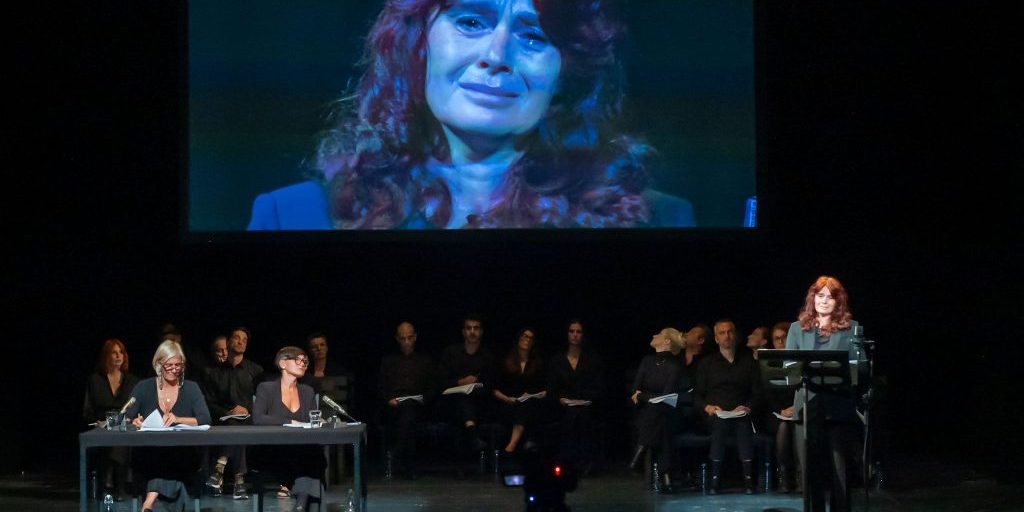
The overture begins with a sharp spotlight that falls on countertenor Edi Ćefo, whose voice opens The Pelicot Trial with “The Cold Song” from King Arthur (1691), a semi-opera by the English Baroque composer Henry Purcell. Then, Kaća Dorić takes centre stage. Behind them, tiny dots of white emerge from the darkness. What appears to be a myriad of faces gradually reveals itself as the faces of the 26 performers who are about to spend almost five hours reading, recounting and reconstructing the facts of what became Gisèle Pelicot’s reality for nearly a decade.
One by one, they take their place at the lectern. There is no conventional theatrical dialogue, no fictional character to inhabit, no dramatic arc to follow. Instead, there are testimonies, statements, excerpts from court proceedings, journalistic accounts and personal reflections. The stage becomes a courtroom, and the actors are witnesses, defendants, lawyers and observers. The sheer number of voices is matched by the overwhelming volume of material: a four-month trial condensed into a theatrical event lasting four and a half hours.
Fifty men. That is how many men were convicted alongside Dominique Pelicot for raping or sexually assaulting his then wife, Gisèle, while she was unconscious. 22 and 67. That is how old the youngest and oldest defendants were at the time of the trial. Lorazepam, combined with anxiolytics. That is the toxic cocktail Dominique Pelicot used to render his wife unconscious before inviting men he had recruited online to rape her.
As much as it is fact-based, the stagework is also, quite truthfully to its classification, an oratorio. Traditionally, an oratorio is a large-scale musical composition for solo voices, choir and orchestra, usually based on a dramatic or religious subject and performed without theatrical staging. Here, the musicality is embedded in the structure itself, framed by an ouverture and a finale. Beyond these musical bookends, there is little to distract from the documentary material, except for the rhythm and pace with which the ensemble reads.
Four and a half hours of this inevitably wear you out. The sheer volume of information becomes monotonous at times, forcing the spectator to sharpen their senses and summon the necessary powers of concentration. Inevitably, moments of boredom emerge, accompanied by an eye-opening shadow of shame. One should not be bored listening to such atrocities. And yet, boredom, in the face of suffering, may be connected to something more troubling than simply losing interest: ignorance, emotional numbness, or an unwillingness to engage with another person’s suffering.
Milo Rau, one of the most prominent practitioners of European documentary theatre, has been transforming trials into performances for over two decades. In 2007, he founded the theatre and film production company International Institute of Political Murder (IIPM), under whose banner he produced works such as The Last Days of the Ceausescus (2009), The Moscow Trials (2013) and The Congo Tribunal (2015), repeatedly turning real-life crimes and political conflicts into theatrical proceedings.
However, The Pelicot Trial bears a different kind of urgency. For one, its subject matter is painfully contemporary. For another, unlike some of his previous projects, it does not concern a distant political conflict or a historical event, but a case that forces us to confront the structures of violence embedded in our own everyday lives. The perpetrators were not mythologised monstrosities from some distant, incomprehensible world, but ordinary men — husbands, fathers, neighbours, colleagues.
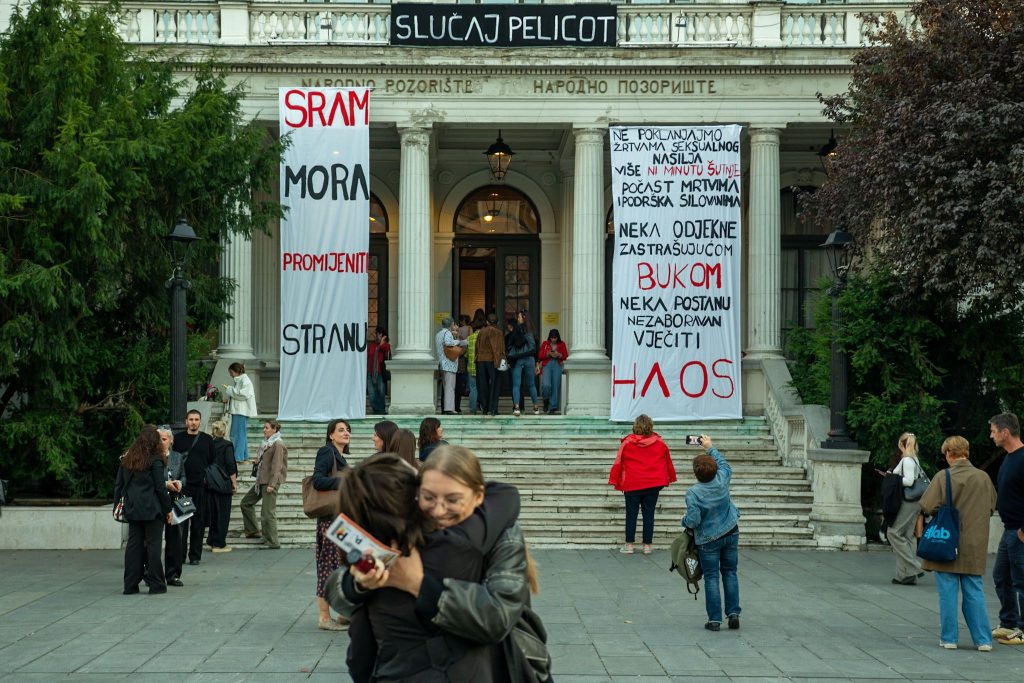
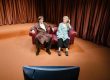
Slucaj Pelicot, National Theatre of Sarajevo
In discussing the production and its international tour, Rau draws a much bigger picture, reflecting on the implications of the case beyond the individual perpetrators: “This is a trial of a society, the trial of a civilisation, the trial of a way of living together.” And perhaps this is where the production’s greatest challenge lies. In confronting the audience not only with juristic faculties, but with the social conditions that allowed this case to happen in the first place.
Servane Dècle, who co-developed the production with Rau, brings her own multidisciplinary background as a dramaturg, performer and playwright to the project. A former civil engineer and graduate of the Conservatoire de Nantes, she has been collaborating with Rau for several years, as well as working with other theatre-makers, including Simon Roth.
Their approach to The Pelicot Trial is grounded in collective research and an attempt to look beyond the extraordinary circumstances of the case towards its less conspicuous, more structural dimensions. As Dècle herself puts it in an interview conducted by Natalie Assmann in March 2025, the intention is not necessarily to reconstruct the trial in its entirety, but to give voice to what happened and keep its story alive.
And yet, after four hours and forty minutes of listening, reading and witnessing, what remains? Perhaps not a newfound understanding of the case – the facts are, after all, devastatingly clear – but a question that is considerably harder to answer: how do we continue living together in a society in which such violence is not an exception, but a possibility woven into its everyday structures? If Gisèle Pelicot’s words called for shame to change sides, Rau and Dècle’s oratorio asks us to consider what that change might actually entail. The courtroom may have delivered its verdicts. The trial of society, however, is far from over.
Credits
Research, dramaturgy & directing: Milo Rau and Servane Dècle/Production dramaturgy: Nastasia Griese/Produced by Wiener Festwochen, MESS and Austrian Cultural Forum
Cast: Kaća Dorić, Belma Lizde-Kurt, Mediha Musliović, Selma Alispahić, Vedrana Božinović, Ejla Bavčić, Mirela Lambić, Maja Salkić, Maja Izetbegović, Mona Muratović, Nadine Mičić, Dina Mušanović, Irma Alimanović, Helena Vuković, Emela Burdžović, Izudin Bajrović, Edhem Husić, Mehmed Porča, Semir Krivić, Amar Selimović, Benjamin Bajramović, Aldin Omerović, Damir Kustura, Goran Popović, Haris Bidžan, Asadullah Nekemi and Edi Ćefo
Further reading: Review of The Pelicot Trial at ne:BITEF, Belgrade
Berina Musa is a writer, dramaturg, and critic based in Sarajevo and Freiburg. She studied German linguistics, literary studies, and art history at the University of Freiburg and is currently completing a second degree in dramaturgy at the Academy of Performing Arts in Sarajevo. Her plays and short films have been presented at the Bosnian National Theatre Zenica, MESS, the Sarajevo Film Festival, and the Mostra Internazionale del Nuovo Cinema di Pesaro.