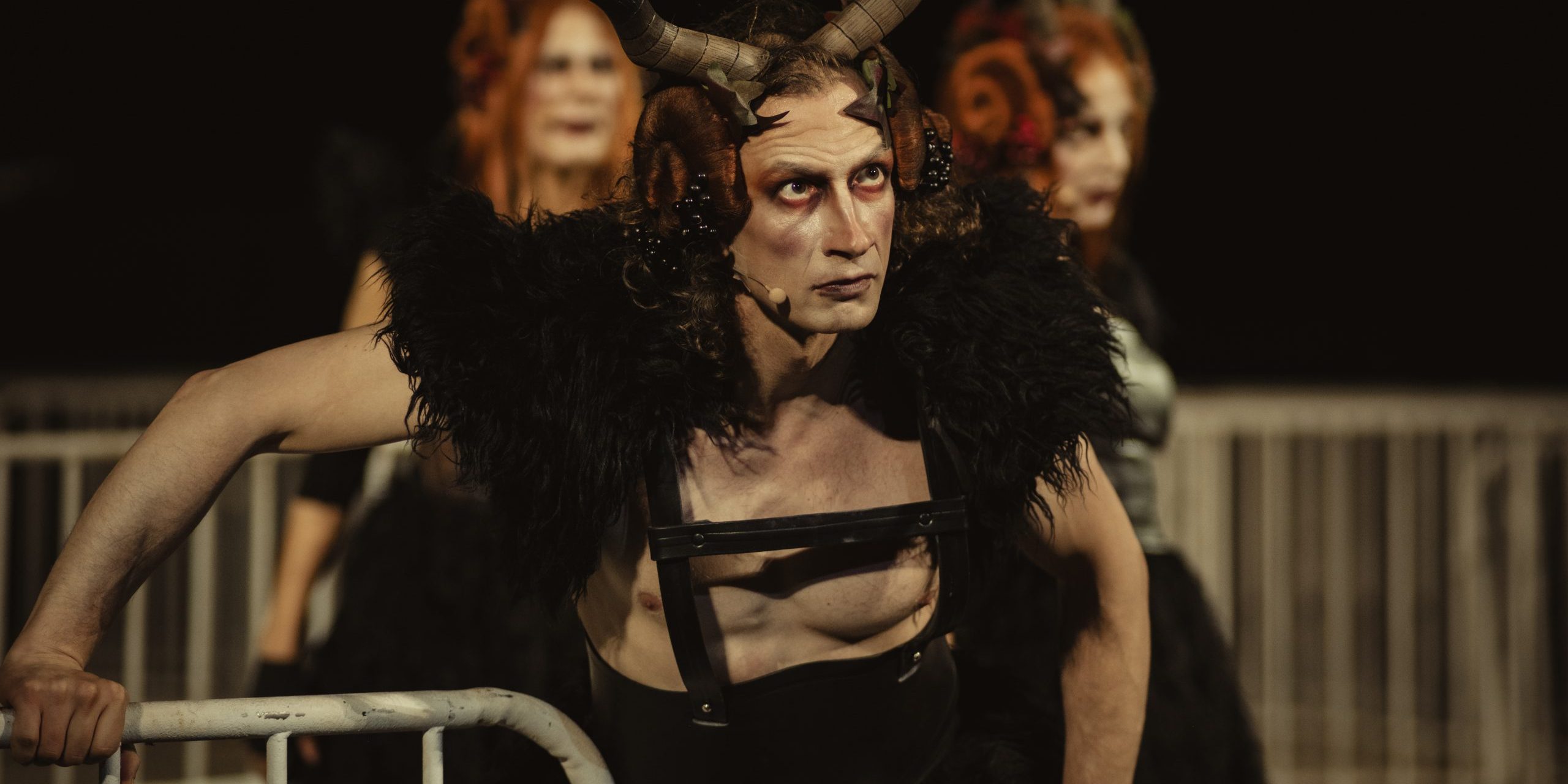
Premiere in Greece, Ancient Theatre of Epidaurus, 10 & 11 July 2026; Premiere in Bulgaria, Ancient Theatre of Plovdiv, 30 September 2026, and National Palace of Culture, 9 October 2026
The National Palace of Culture in Sofia is mostly used to host concerts, but on this occasion, I am here to watch Bacchae, directed by Javor Gardev, one of the most established figures in contemporary Bulgarian theatre, whose work has also gained recognition abroad. The international reach of his work is also reflected in this production, a major Bulgarian-Greek co-production, which brings together the Ivan Vazov National Theatre, the Athens Epidaurus Festival, Vegas Cultural Co. and the National Theatre of Northern Greece, with music by The Tiger Lillies, the British avant-garde trio known for their blend of dark cabaret, punk and theatrical music. The scale of the production is palpable even before the performance begins.
I am seated in the very last row, trying to imagine how the production might sound in its natural setting: an open-air amphitheatre. (It had its world premiere at the Ancient Theatre of Epidaurus in Greece in July this year). From this position, however, the distance from the stage seemed to threaten to dominate my perception and weaken my immediate connection with what was unfolding. And yet, certain images managed to transcend that distance.
Metal barriers greet the audience as soon as they enter the hall. It is as if the rebellion has already begun. Or perhaps it was announced before the performance even started. The space creates a tension that precedes the action itself — a sense that some order has already been disrupted and that a confrontation is imminent, one whose consequences will not remain confined to the boundaries of the stage.
Later, this tension is also reflected in the actors’ stillness. Their bodies seem poised for impact, their movements restrained, as though ready to absorb a blow. The sense of impending confrontation emerges not only from the metal barriers but also from the actors’ physical presence. This emphasis on intellectual and philosophical undercurrents may also be characteristic of Javor Gardev’s work, in which ideas often resonate beneath the surface of the stage action.
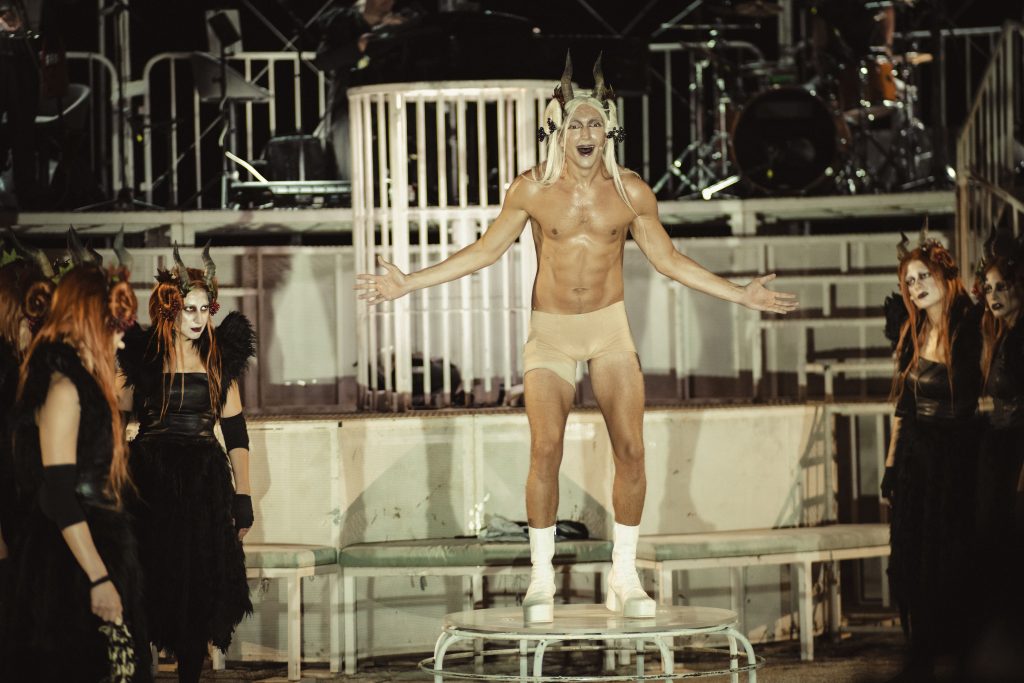
Bacchae. Photo: Petko Mavrodiev
This initial sense of tension is confirmed by the appearance of Tiresias (Samuel Finzi), who opens the action slowly, almost ritualistically. He moves along the metal barriers, touching them with his staff and drawing a metallic sound from them. There is no panic in his behaviour, nor any attempt to stop what is about to happen. On the contrary, his calm carries a sense of resignation, as though he already knows that something has been set in motion and that its course cannot be prevented. The sound of the metal thus becomes a kind of starting point for the soundscape of the production, which The Tiger Lillies will subsequently develop into a musical line that intertwines with the action and comments on its progression.
Soon afterwards, we see Dionysus (Leonid Yovchev) – unwavering in his intentions and ironic in his manner. He is resolute in the change he brings, yet there is also a particular serenity about him, as though he has no need to prove his strength because he already knows that victory is near. His presence has left its mark: the Bacchae have been drawn to him, and the celebration is already underway. In a sense, they seem to be celebrating victory before the confrontation has reached its conclusion. Or perhaps the celebration itself is a form of rebellion – a way of asserting their existence before they have succeeded in imposing their own order.
With the appearance of Dionysus and the Bacchae, the metal barriers acquire another meaning. They do not simply mark a boundary; they seem to delineate the space of order, embodied by Pentheus (Michail Tabakakis), which is about to be shaken – or even replaced by a new order. Against this backdrop, Dionysus’s calm makes his presence all the more unsettling: the conflict does not simply unfold between two opposing forces, but seems to begin at a moment when one of them is already convinced of its victory.
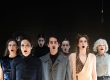
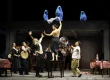
And if Dionysus brings change with unusual calm, among the Bacchae it takes on an entirely different dimension – physical, noisy and collective. It is as though they have been waiting a long time for their leader to appear. They move between ritual and the demonstration of strength. Their stamping against the metal barriers turns the celebration into a loud assertion of presence, one that refuses to fit within the boundaries set out for it. The rebellion now has its own sound and image. The Bacchae do not simply follow Dionysus; they transform the change he brings into collective action.
The division between the two worlds is also clearly conveyed through the costumes. There is something animalistic and primal about the Bacchae – the horns and fluffy fabrics seem to connect them with an untamed force of nature. Their bodies appear to belong to a world that does not submit to established rules, but follows its own rhythm and instinct. Opposite them stand the king’s men, with a contemporary, sterile aesthetic that conveys control, discipline and distance. Thus, the conflict between the two worlds emerges not only through the characters’ actions but also through their visual language: on one side is untamed vitality, and on the other, the order that seeks to contain it.
Against this backdrop, The Tiger Lillies’ music introduces an entirely different feeling – gentle, sad and profound, as though another, quieter story is unfolding beyond the visible confrontation. The musicians are positioned on a raised platform, separate from the rest of the stage action. Their position creates a sense of distance, as though they are beyond the boundaries of the polis, in that mountainous space associated with Dionysus and the Bacchae. From there, they do not merely accompany the action; they seem to observe and comment on it, like witnesses who stand outside its course yet know where it is leading. Their music also resembles an elegy, as though the mourning has begun before the tragedy has reached its end. This sadness finds a natural continuation in the figure of Agave (Loukia Michalopoulou). The mother, who, in the grip of madness, kills her own son Pentheus without recognising him (a madness brought about by Dionysus), must subsequently face the unbearable truth of what she has done. At this moment, the elegiac quality of the music seems to acquire an even more concrete meaning – it does not merely foreshadow the tragedy; it remains with those who must bear its consequences.
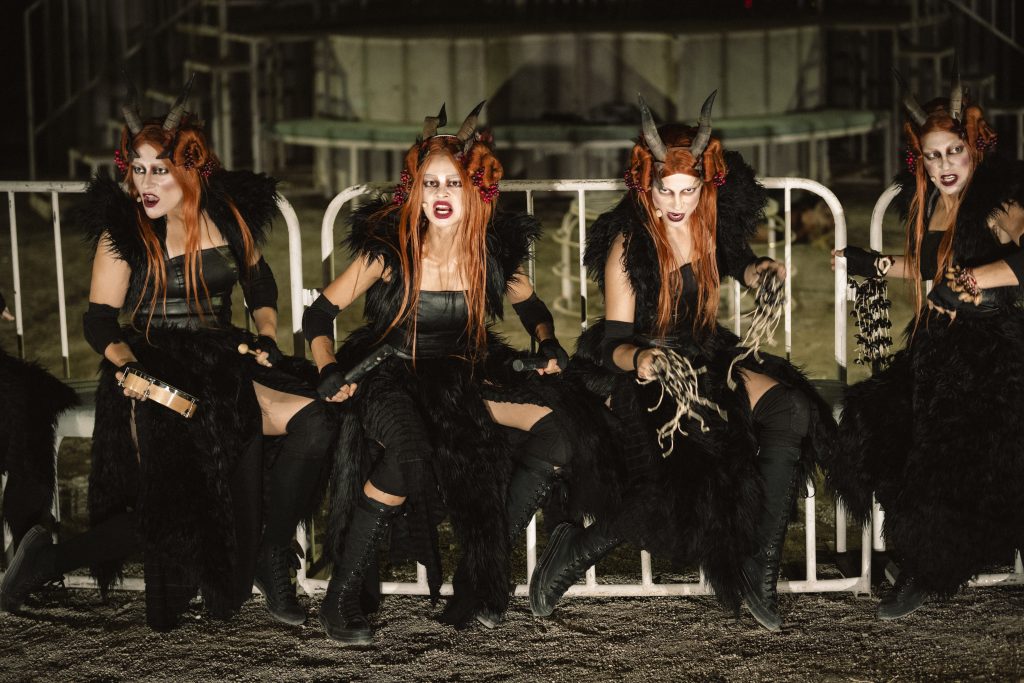
Bacchae. Photo: Petko Mavrodiev
And perhaps it is precisely here, beyond the clash between order and rebellion, that the question of the cost of this struggle emerges. But before we can arrive at that question, another remains: what actually makes the confrontation inevitable? What happens to that which does not fit into a community’s image of itself? Is it possible to accept difference without turning it into a threat that must be eliminated? What happens when, in trying to protect order from what frightens us, we ourselves create the conditions for its collapse? And what, in fact, does change consist of?
All these questions inevitably lead to a larger one: why Bacchae today? And it is precisely in the context of the Bulgarian-Greek co-production that the performance, through association, leads me towards the conflicts of the Balkans, in which differences in identity and notions of belonging become grounds for opposition. Towards the fear of the other, towards the way the unfamiliar becomes a threat, and towards how an attempt to protect the established order can develop into a desire to reject or destroy whatever does not fit within it. This brings me back to another question: when does the defence of one’s own order become a refusal to accept the existence of the other? And can an order be sustainable if the price of preserving it is the exclusion of those who do not fit within it?
In this sense, the co-production between the Ivan Vazov National Theatre and its Greek partners — the Athens Epidaurus Festival, Vegas Cultural Co. and the National Theatre of Northern Greece — acquires significance beyond the creation of a single performance. The encounter between cultural institutions from Bulgaria and Greece creates a space for shared work and dialogue, in which differences need not be erased in order to be considered together. The co-production itself does not resolve contradictions, but demonstrates the possibility of confronting them through encounter, cooperation and mutual understanding.
For more information, visit: NationalTheatre,bg
Credits:
Conceived and directed by Javor Gardev, with the special participation of The Tiger Lillies
Adaption: Ioanna Remediaki and Javor Gardev//Music: Martyn Jacques//Set design: Nikola Toromanov//Costume: Maria Ilenia Douladiri//Choreography: Uršula Teržan//Lighting: Stella Kaltsou//Dramaturgy: Ioanna Remediaki and Pavlina Doublekova//Production and stage management: Bogdan Dimitrov//Sound: Titos Kargiotakis, Orestis Patsinakidis
Cast:
Martyn Jacques, Adrian Stout, Budi Butenop (The Tiger Lillies), Leonid Yovchev, Alexandros Milonas, Samuel Finzi, Loukia Michalopoulou, Michail Tabakakis, Ivan Nikolov, Ivan Yurukov, Martin Dimitrov
Chorus of Bacchae – Alexandra Gaithatzi, Alexandra Svilenova, Angeliki Kintoni, Danae Stamatopoulou, Eleni Thimiopoulou, Efthymia Daniilidou, Kremena Slavcheva, Nadya Keranova, Nefeli Anthopoulou, Polyxeni Spiropoulou, Xenia Grammatikou, Zoe Efthymiou
Co-production between the Ivan Vazov National Theatre, Athens Epidaurus Festival, Vegas Cultural Co., and the National Theatre of Northern Greece

Ana Bateva is a theatre director and manager of SPAM Studios in Bulgaria.
She has written five children’s stories, published in Macedonia and three plays, two of which have been staged in Bulgaria. She has participated in over 40 theatre festivals and has won more than 20 awards."