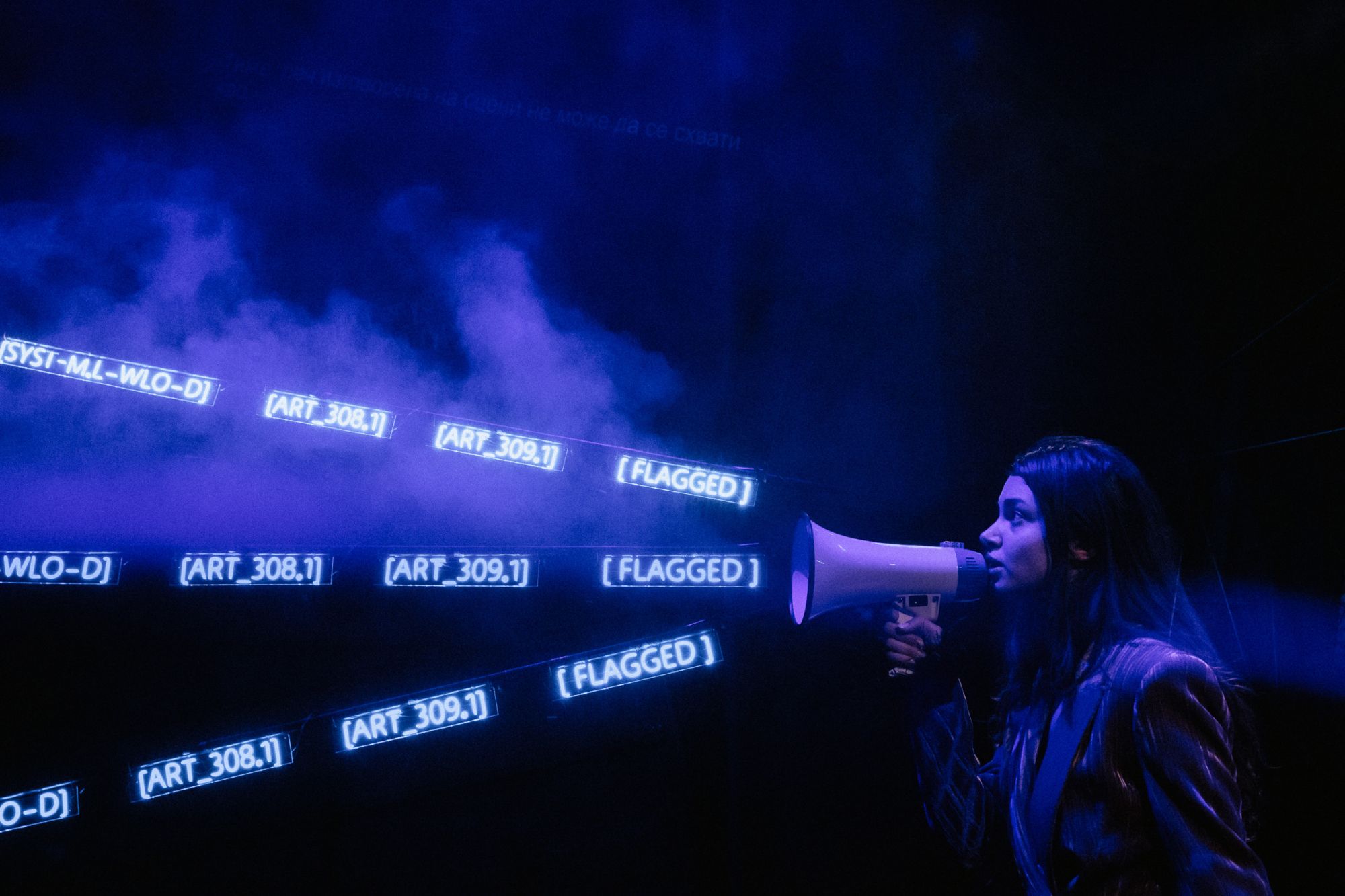
Director Andreja Kargačin’s Dora or Who Will Stitch the Vests? tells the story of a Serbian student activist living in exile. She talks to Divna Stojanov about the reality behind the show and navigating risk and repression as an artist.
Andreja Kargačin is a Serbian performance artist, theatre director, choreographer, visual artist, and writer whose work actively intersects theatre, visual art, and political activism. Her show titled Dora or Who Will Stitch the Vests?, produced by Bitef Theatre, was showcased recently at the Wiener Festwochen. The piece is inspired by personal correspondence with her childhood friend, Dora, a student activist from Novi Sad. Dora has been in exile since March 2025, along with five colleagues from the STAV group, after BIA illegally wiretapped a meeting between STAV and members of the liberal Movement of Free Citizens (PSG). Audio recordings of the meeting were subsequently broadcast on several pro-government channels, leading to the arrest of their fellow activists who remained in Serbia. INTERPOL recently confirmed the political nature of this prosecution by refusing the Serbian authorities’ request for red notices against the exiled students.
Through a touching, witty, and conceptually layered approach, the show Dora explores female friendship, state repression, and daily life amidst the struggle for freedom. In this interview, Andreja shares how personal intimacy transforms into stage resistance and why friendship remains the most radical act against dictatorship,
Divna Stojanov: What was the moment like when you decided your personal correspondence with Dora would become material for the play?
Andreja Kargačin: Dora recently reminded me of that moment. She recalled that I had called her using the secret app we relied on at the time and asked if she would be interested in making a play about her. I was genuinely afraid she might be offended or perceive my proposal as exploitative, but she found my apprehension almost amusing. She appreciated that I asked and felt that creating the play was precisely what she needed at that time.
Divna Stojanov: During the exchange of letters, you were aware that your words would be heard by someone other than the two of you. Did that awareness of an audience change the way you wrote? Did it lead to self-censorship or, on the contrary, a sense of liberation?
Andreja Kargačin: It is important to clarify that the letters in their original form and the letters as they are heard on stage differ; we needed to shorten them for the stage. In their original form, the letters are longer and include internal references that would not resonate with an audience and would require excessive explanation. Although this was not the case from the very first letter, we soon realised we were writing with an audience in mind. Nevertheless, the letters remained primarily for the two of us. Through this correspondence, we communicated more honestly and thoroughly than ever before. This process created a distinctive language in which private and general elements intersect. For example, Dora might write a poetic sentence she likely would not have written without the awareness that others would be listening, followed by a reference to someone only we would recognise. During the early research phase, we read the correspondence between Slavoj Žižek and Nadya Tolokonnikova during her imprisonment in Russia. Those letters are clearly intended for a public audience. Our letters are different, and they also differ from our Instagram messages or voice notes. In staging the letters, our primary goal was to maintain the tension between public and private communication.
Divna Stojanov: Why was it important to you, as the director of the play, to also be a performer in it?
Andreja Kargačin: I am a performer, so the stage is familiar to me. However, I’m not an actress, I’m a dancer. Learning to speak lines on stage wasn’t easy, even when they were my own. The decision was not easy, and we deliberated extensively. Honestly, it’s easier to explain the other way around: the actress (Natalija Stepanović) plays Dora because Dora can’t be there. In a way, she’s Dora’s artistic advocate; she “defends” her onstage, speaks in her place. So if I’m already there, capable of speaking for myself, why wouldn’t I? This raises a whole new set of questions: Is the person I am onstage the same as the person I am offstage? Or am I, in some way, just a character? If someone were to bring me in for questioning over something I did onstage, would that be the real me, or a different version?
Divna Stojanov: The production directly addresses recent, significant events: the blockade of the Faculty of Philosophy in Novi Sad, the canopy collapse, and the system’s subsequent retaliation. How do you manage to address such fresh, politically and emotionally charged topics with humour and without falling into pathos?
Andreja Kargačin: I believe this naturally arises from how Dora and I communicate and understand the world. We both tend to joke about serious matters, and as for crying, we save our tears strictly for trivial things.
Divna Stojanov: The show highlights how friendship itself is a political space. In what ways do female friendship and mutual solidarity become a form of resistance against state repression and isolation?
Andreja Kargačin: To me, this show revolves around three main themes, and one of them is female friendship versus dictatorship. When I first started working on it, I was angry and wanted revenge on those who had taken my friend away from me. The initial ideas I had were seemingly more radical, belonging to a whole different narrative. It was Ana Dubljević, a collaborator who has been immensely important to us throughout this entire process, especially at the very beginning, whom I credit with helping me realise that friendship is actually the most radical thing of all in a situation like this. Dora is many things to many people: an activist, a terrorist, an ally, an opponent, the accused. But to me, she is simply Dora. And I choose to stand by her as her friend, regardless of what the authorities or parts of the opposition might think or say about her.
Divna Stojanov: You display ready-made objects belonging to Dora that were handled by the police during interventions at the blockades, alongside wiretap transcripts from the Serbian Security Intelligence Agency (BIA). How did you approach the conceptualisation of these objects and materials? Where do you draw the line between police oppression and an artistic exhibit?
Andreja Kargačin: The exhibition aspect was crucial for establishing the connection between art and terrorism. We spent considerable time thinking about the processes that transform objects. Among Dora’s belongings, there are props specifically created for the show, including Dora’s passport featuring Natalija’s photo. This raises fundamental questions about the nature of reality: Are we obligated to tell the truth in theatre, and what does that really mean? Ultimately, who is this Dora that everyone keeps talking about?!
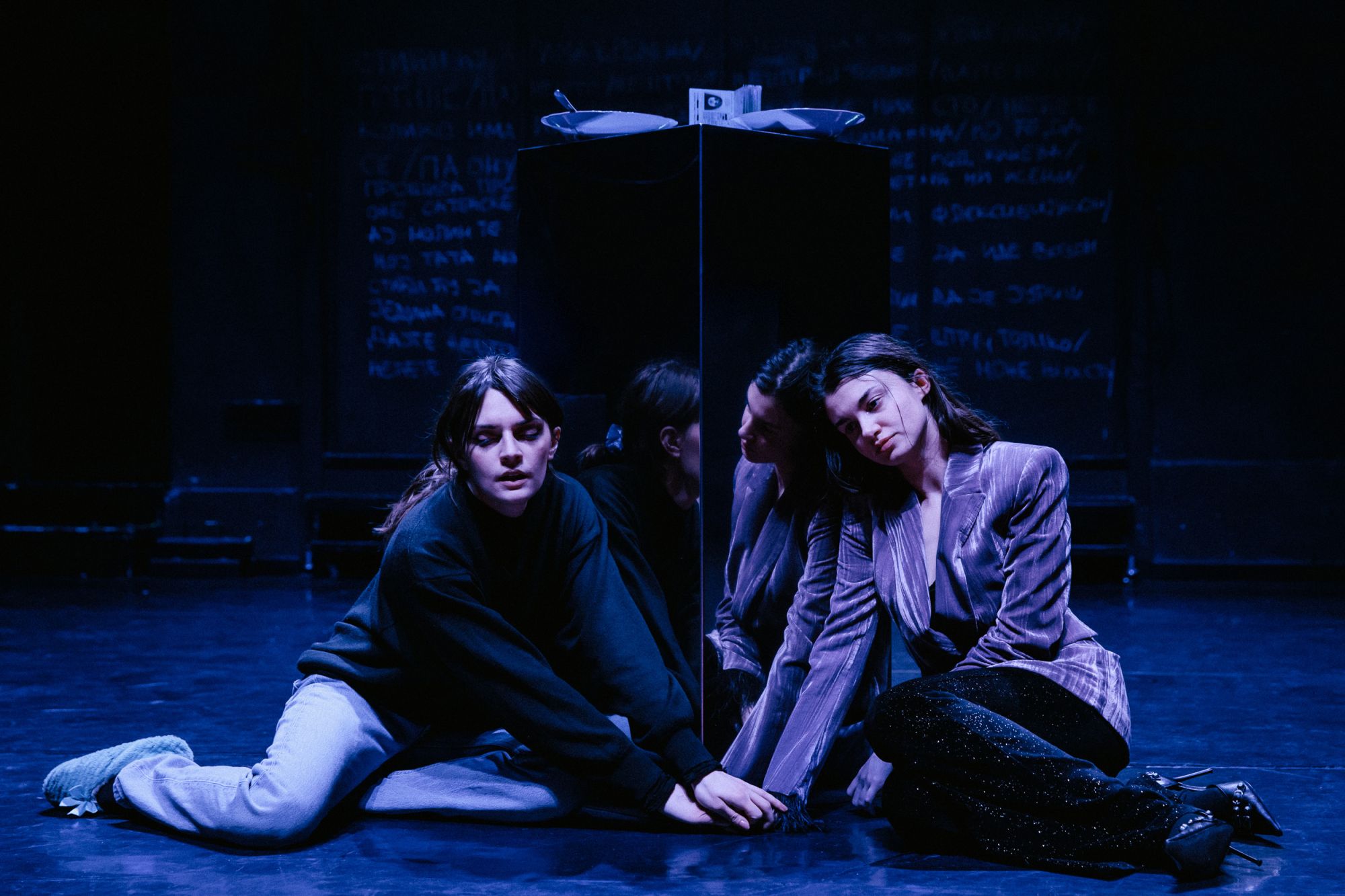
Dora or Who Will Stitch the Vests?
Divna Stojanov: In the show, you mention that exile is more of a state of mind than a physical location. How did that realisation shape the concept and direction of the piece?
Andreja Kargačin: Another central theme we explored was exile as a condition of fractured consciousness. We were first introduced to this perspective through Iker González-Allende’s essay Women’s Exile and Transatlantic Epistolary Ties in the Work of Pilar de Zubiaurre. This essay examines not only the experience of exile itself but also the act of writing during exile, with a particular focus on letter writing. After reading the essay, I asked Dora if it resonated with her own experiences. From that point, the pieces began to fall into place. Dora’s exile represents a state of fractured consciousness for several reasons. She was not only removed from one context and thrown into another, but she also faced additional forces that detached her from her life. These include the court proceedings, media witch-hunts, and the revocation of her identity documents.
Dora put it best herself: Now that I don’t have a passport or an ID card to prove it, I want to prove that I am me more than ever. And another quote of hers: If I choose to look at it this way, it means I’ll be ending two toxic relationships within six months. I have to admit, the state really helped me out with that by acting as if I never existed. If it weren’t for the news articles, it would soon become difficult to find any evidence that I lived there for nearly my entire life.
Divna Stojanov: A striking detail in the production is the presence of a lawyer, Emina Đuran Milić, on stage. How did the idea and the necessity of including legal protection in the performance come about?
Andreja Kargačin: During rehearsals, Dora’s situation was quite different from what it is now. She wasn’t speaking publicly in the media, her location was unknown, and we had no idea if there were risks to her safety or her ongoing court case. So hiring a lawyer was a strict necessity, not an artistic choice. But I wanted the lawyer on stage with us because I feel actors and lawyers actually share a very similar line of work.
I remember a phone conversation with Miloš Lolić, when we discussed some of my ideas. He mentioned that a lawyer acts like an ancient oracle. I absolutely loved that idea because it is so accurate. Lawyers speak a language that none of us truly understand.
Divna Stojanov: During the show, there is a clear exchange of identities between you and Dora. What does this overlap of identities mean to you and actress Natalija Stepanović?
Andreja Kargačin: Thank you for this question. It is actually my favourite part of the show, yet no one has ever asked me to talk about it! The process of swapping identities is incredibly complex and carries multiple meanings that seem to shift with each performance. I believe it means something different to everyone in the audience, which is precisely why I love it; I wouldn’t want to spoil that for them. Natalija and I discovered this concept spontaneously during a rehearsal when it was just the two of us. We instinctively felt that it was right, even though we struggled to articulate why. We invited a few collaborators to watch and share their thoughts. They all expressed the same thing: they felt it belonged in the piece, although they couldn’t explain why. Everything became clear to us later, but in that moment, the concept itself seemed to be smarter than we were.
To me, this speaks volumes. On a fundamental level, this suggests that any of us could have been Dora, as her case reveals much more about the state of our justice system than it does about her as an individual. It speaks to the importance of empathy and how friendship can transform us. It also highlights the deep connections between my life as an artist and her life as an activist, or even a terrorist, depending on one’s perspective. Ultimately, this situation reflects something essential about the nature of theatre itself.
I often experience moments in my daily life that bring me back to that scene, allowing me to understand it a little deeper each time. For instance, right after the premiere, we received information from a reliable source suggesting it might be wise for me to leave for a few days to avoid a potentially uncomfortable situation for both Dora and me. I walked into my apartment, placed the bouquets from the opening night on the table, and left immediately on a trip. When I returned a few days later, I found those flowers sitting on the table, completely dry. As I stood there looking at them, I felt like both Dora and Andreja.
Divna Stojanov: Dora joins the performance live, in real time, from exile. What kind of risk does this carry for her, and how did you navigate her presence, both stage-wise and emotionally, given that it exists and does not exist at the same time?
Andreja Kargačin: At certain points in the process, it was extremely risky, whereas now the biggest risk is simply that the internet connection might drop. Dora actually loves joining live. She is great at it and really enjoys it. I am proud of all of us for finding an ideal solution in the end. Right from the start, I was intrigued by the challenge of working in theatre, a medium inherently grounded in physical presence, with someone who is not allowed to be present. This show is essentially a sequence of different ways Dora can be present: through her belongings, her words, and through another person.
Divna Stojanov: Is there potential for the show and your correspondence with Dora to continue evolving? Do you plan for the production to follow Dora’s real-life journey, and how do you envision the end of this story, both on stage and in reality?
Andreja Kargačin: Dora and I continue to write to each other, though at a more relaxed pace. We hope to publish our full correspondence together someday. As for the show, it naturally evolves alongside Dora’s life. I always make a point, especially in the third act, to stay updated on everything happening in her life and to find ways to surprise her on stage, just as she surprises me. A significant and thrilling milestone for us was our first performance in Vienna, where Dora was able to make an appearance on stage in person for the very first time, and it went wonderfully. Of course, we hope that Dora will soon be free, which will undoubtedly transform the show once again.
Divna Stojanov: The show combines elements of an exhibition, performance art, dance, cooking, and classical drama. How does the audience respond to this shift in conventions, especially at the beginning when entering has its own unique dramaturgy? Are there noticeable differences in how audiences react in Serbia, where many have experienced repression firsthand, compared to those in Western Europe?
Andreja Kargačin: It seems to me that audiences in both contexts find the shift in artistic expression engaging and easy to follow. During the first part of the exhibition, people abroad approached us with far more questions, naturally because the situation is less familiar to them. They are genuinely interested and listen very carefully.
The biggest differences, however, lie in how people react to the police, though not quite in the way I anticipated. In Serbia, people respond to our police characters based on their personal relationship with the police in real life: some laugh at them, while others are completely terrified. A few people mentioned that, for a moment, they thought it was actual police, which is not an impossible scenario at a theatre in Serbia.
I was initially worried that the police presence might come across as naive to foreign audiences. However, in Vienna, the audience seemed particularly afraid of the police and followed their instructions without hesitation. Soon, we will be heading to Ljubljana for the Mladi levi festival. Since Slovenia lies between Western Europe and the Balkans, I am very curious to see how the audiences there will react.
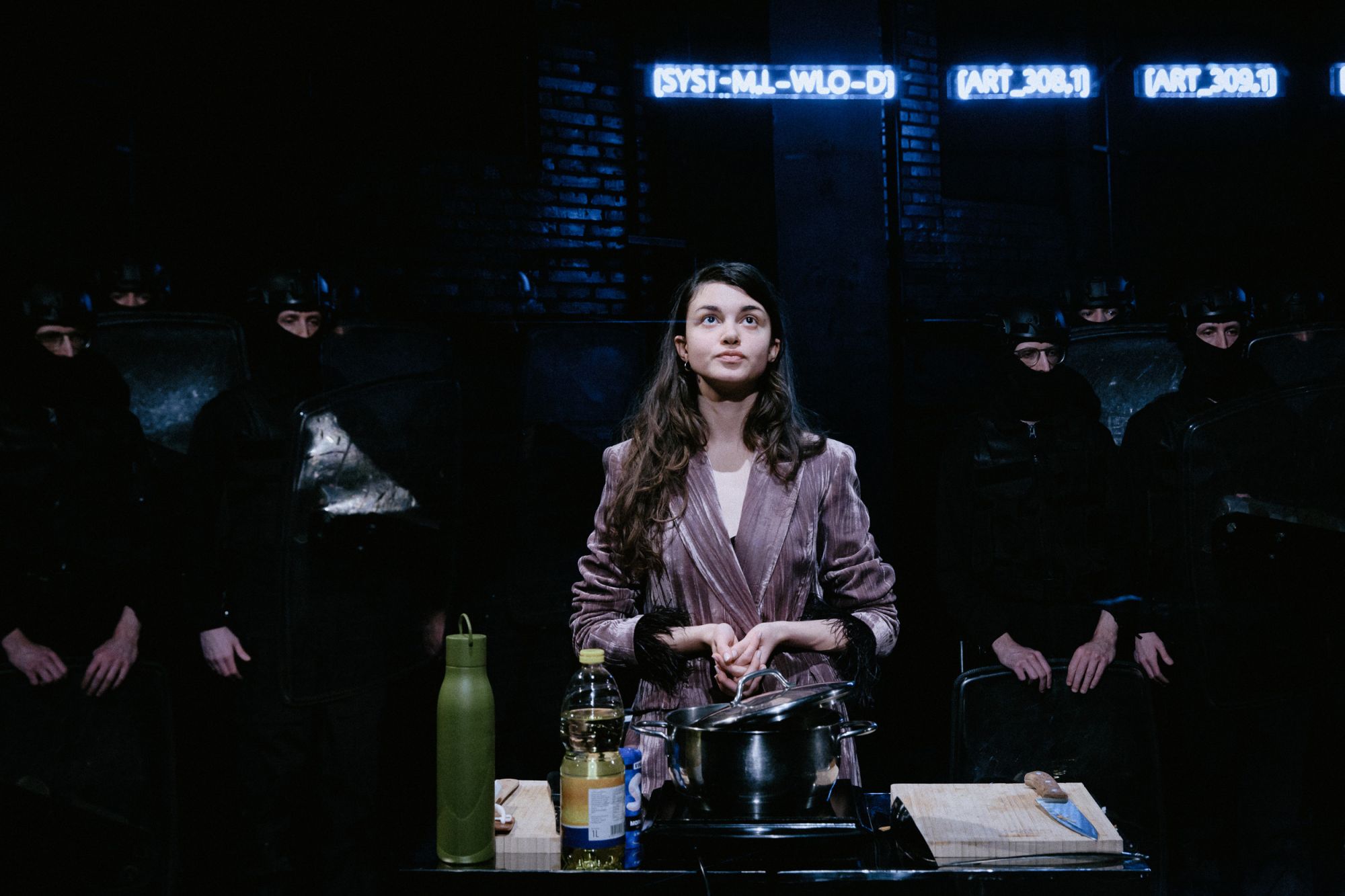
Dora or Who Will Stitch the Vests?
Divna Stojanov: It was originally meant to be part of last year’s BITEF festival, but that fell through when funding was pulled following Milo Rau’s speech about Rio Tinto. How did that setback and the show’s subsequent repair process impact your relationship with institutions and your own work?
Andreja Kargačin: It is honestly incredible to look back at everything we went through across the various stages of working on Dora. We halted and restarted production multiple times, witnessing every single phase of BITEF being dismantled and rebuilt. As stressful as it all was, a lot of good came out of it for us as well. For one, genuine friendship and solidarity grew among everyone caught up in that huge drama. Another positive outcome was that BITEF Theatre stepped in to produce our show instead of the festival. Like most of my colleagues coming from the independent dance scene, I am not naturally inclined to put much trust in institutions. However, this process taught me to demand what is rightfully mine. Institutions are a public good, and we have to reclaim them. We must demand that they work for us.
Divna Stojanov: You mentioned the exhibition segment functions differently for Western audiences, who sometimes view it almost fetishistically. How do you balance the risk of exoticization with the desire to reach as wide an audience as possible?
Andreja Kargačin: That phrase, fetishistic, was actually used by a dramaturgy student in Munich during a panel discussion, and I was absolutely thrilled because that was precisely what I had hoped for.
So much changes when we perform abroad. In Serbia, the exhibition serves a more informative purpose, establishing the relationship between art and terrorism, and setting the stage for the police intervention. In the West, however, you have an audience from a “developed” country watching a sad story about girls from the fringes of civilisation. What I love is that I do not have to be heavy-handed about that dynamic; it just happens naturally. That allows us to laugh at that fetishisation and critique it in numerous ways as the show progresses. Some of those moments are lines that carry a different weight in Western Europe, while others were crafted specifically for tour dates. For instance, the lawyer will have a unique speech tailored to each guest performance, and Dora and I always improvise the entire third act anyway, making sure we hold nothing back. I find endless joy in swearing Ursula von der Leyen in German-speaking regions and look forward to many more opportunities to do so.
Divna Stojanov: Given the current situation in the cultural sector, which is marked by management dismissals, cancelled premieres, and a nearly nonexistent arts budget, did you and your team take into account the personal and professional risks associated with creating a show that directly addresses repression? How did you navigate those challenges?
Andreja Kargačin: We certainly thought about it, but we never felt afraid because we knew we were in this together. I believe that same feeling is shared by other colleagues who have stood up against repression, not only within the arts world but across every profession.
Divna Stojanov: At one point in the performance, it is mentioned that part of theatre’s political power lies in making a person on stage unarrestable. How do you view the political power of theatre?
Andreja Kargačin: Differently every single day. Some days I see none at all, and on others, I find it remarkably concrete.
Further reading: Serbian theatre: Between resistance and appeasement
Further reading: The international community resists the state capture of BITEF
Divna Stojanov is a dramaturg and playwright. She writes mainly for children and young people.