Drama Theatre Skopje, premiere 21 April 2026
Above the family home hangs the outline of a cat’s head, faceless, silent and constantly present. Beneath it, private life is gradually invaded by fear, obedience and systems of control. This is the world of Cat’s Head by Venko Andonovski, directed by Dejan Projkovski. Although the production carries the memory of Goran Stefanovski’s Wild Flesh, it remains firmly centred on Andonovski’s own dramatic universe. From that reference, another, darker and more distorted story emerges, one that speaks to the present while carrying the weight of the past and the shadow of a future already taking shape.
In this world, the family home becomes the point at which private life, history, ideology and social fear collide. The pressure around it is dispersed and contemporary, administrative, economic, psychological, global and intimate all at once. The home is watched, regulated, threatened, bought, surrounded and eventually destroyed. What should be the last space of personal safety becomes the last fragile shelter of human dignity, endangered from outside by systems of power and from within by fear, obedience and betrayal.
Projkovski builds his staging around this condition of pressure. His theatre does not simply illustrate the text, but translates it into a network of visual, sonic and performative signs. The production creates a playful yet deeply unsettling dystopian aesthetic, moving between grotesque, dark humour, family drama, myth and political nightmare. Its world is absurd, but never unreal. Its absurdity feels recognisable because it belongs to systems we already know, where rules pretend to protect, institutions humiliate, power hides behind procedure, and people learn to survive by obeying what slowly destroys them.
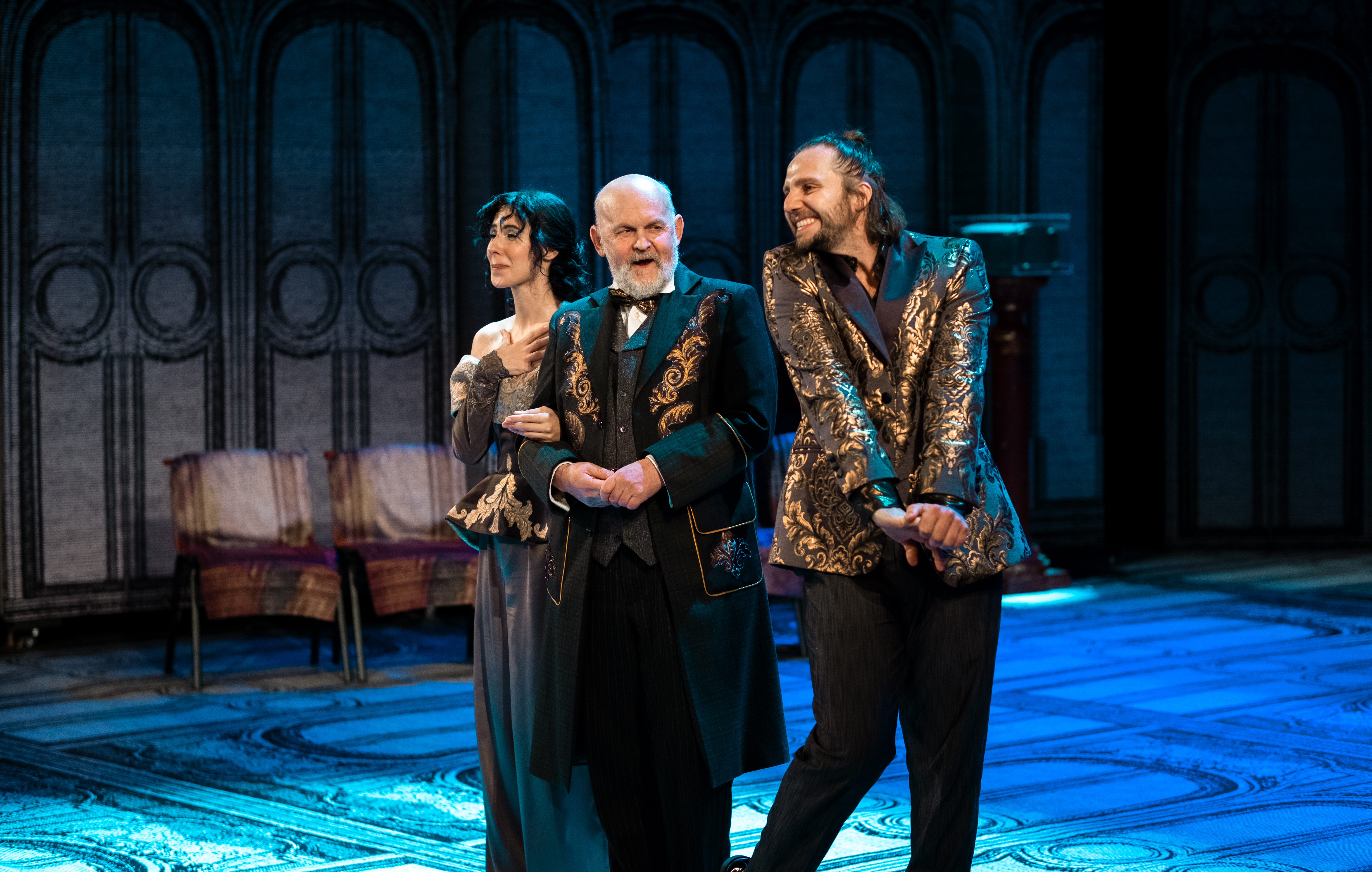
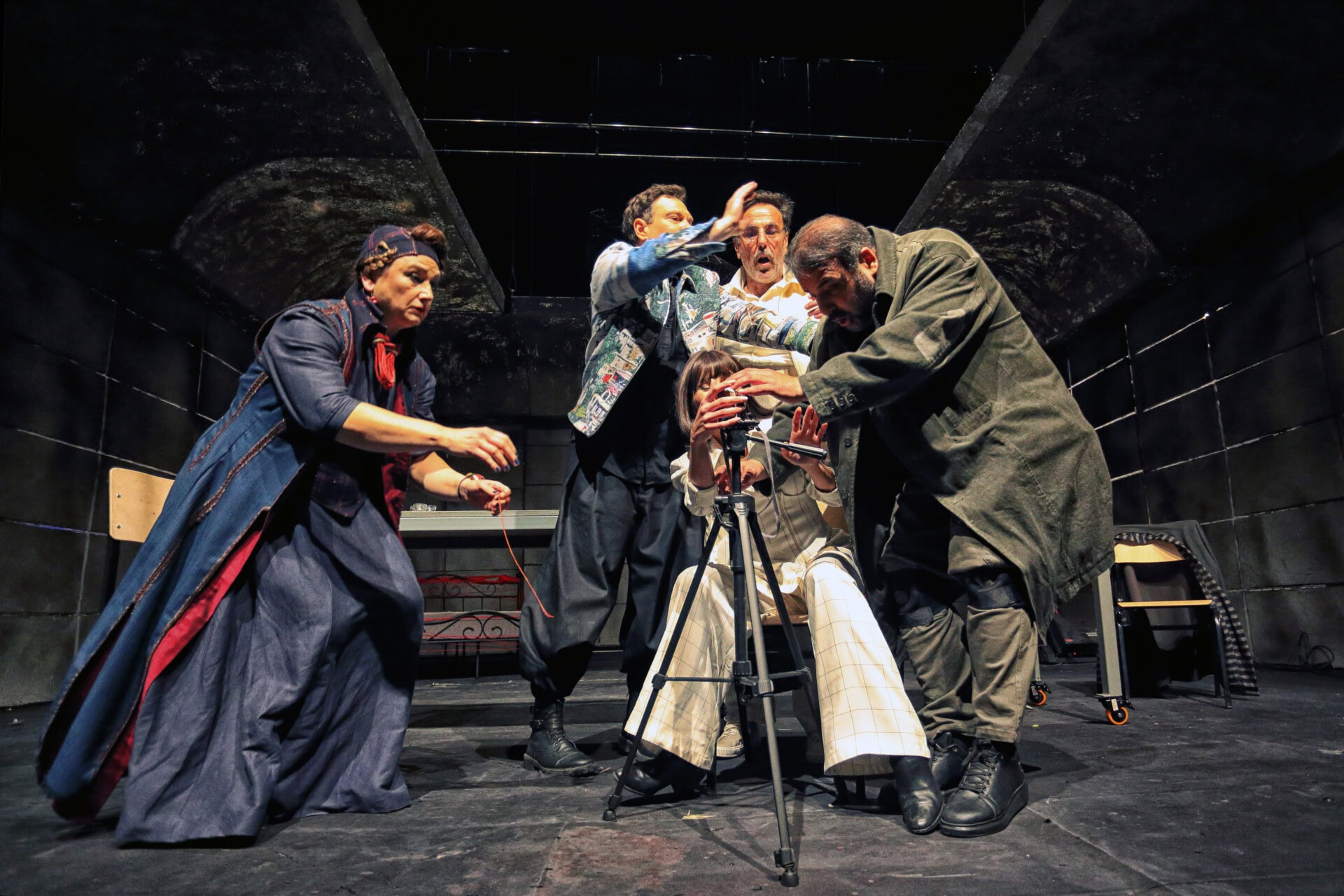
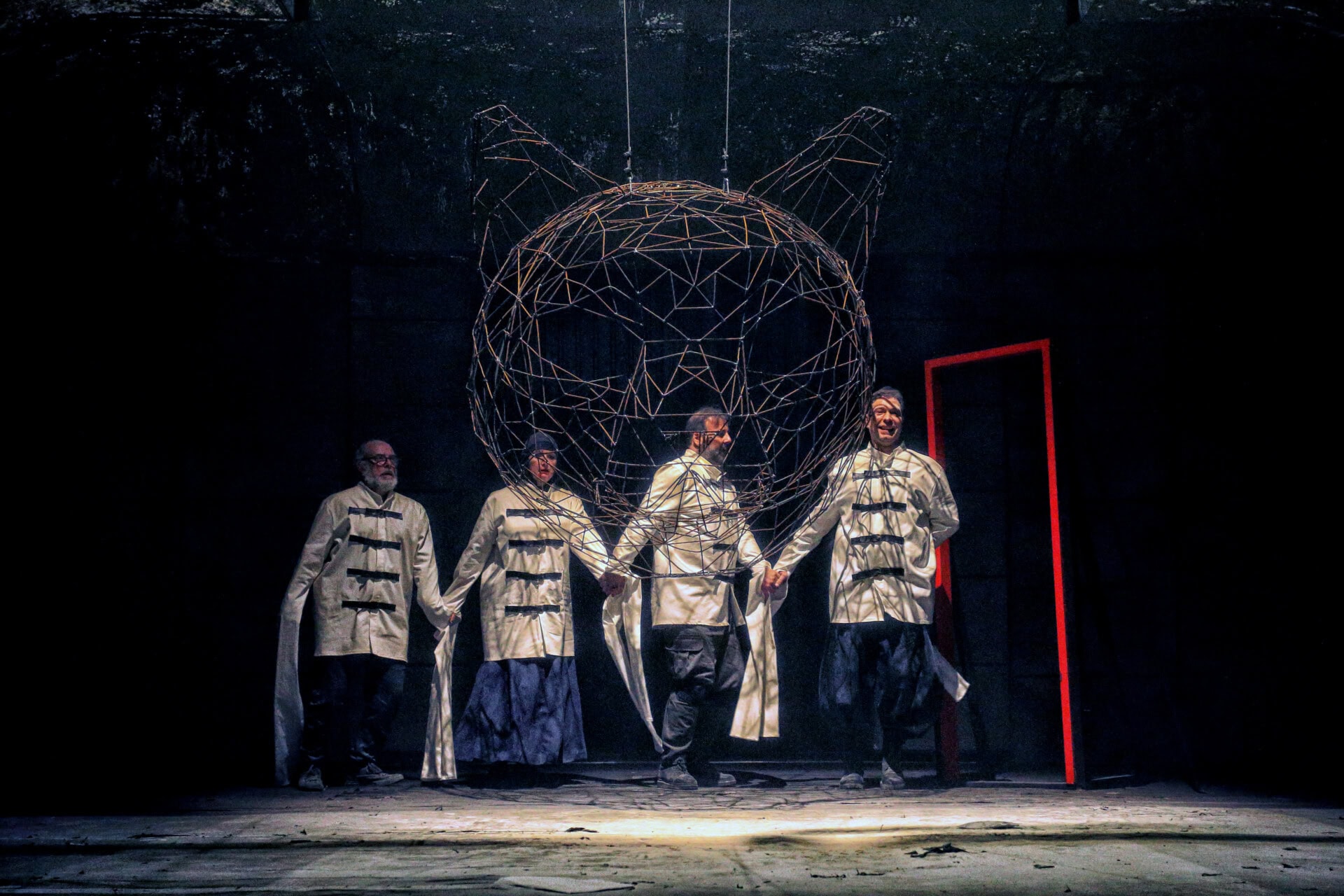
The scenography by Valentin Svetozarev gives this world an oppressive visual frame. The house seems half transformed into a bunker or construction site, a place where people still live, but where life itself has become provisional. Above everything, a metal sculpture by Angel Petrovski, shaped as the outline of a cat’s head, hangs over the stage, not as a ruler with a face, but as a faceless mechanism of power. The red threads handled by Marija spread across the bed and the space like lines of memory, blood, fate or inherited fear. Together with the nooses above, the falling construction dust, the concrete walls and the suspended cat head, they create a stage world in which every image is disturbing because it functions as a warning.
Cat’s Head. Photo: Dragan Gajik
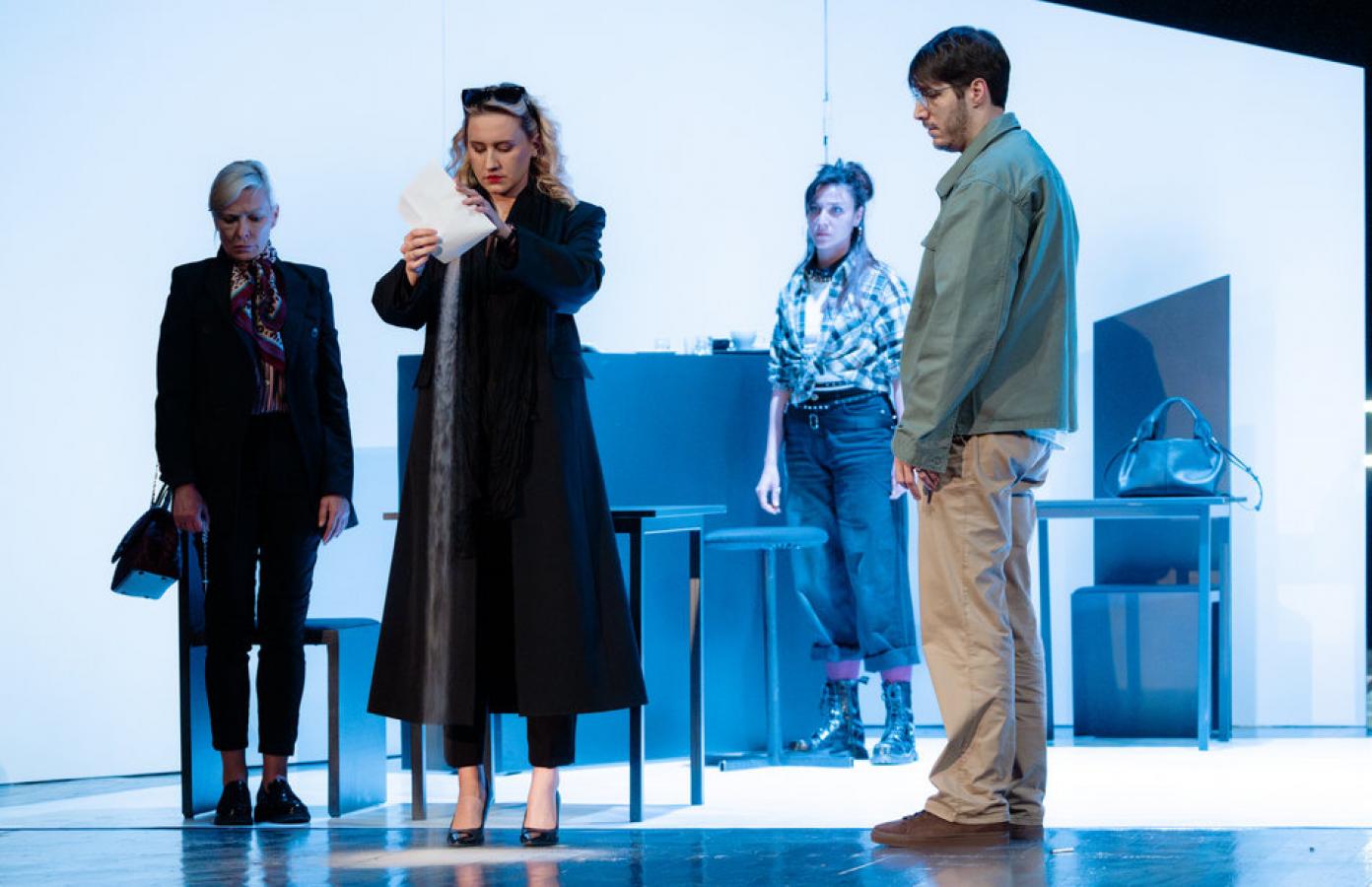
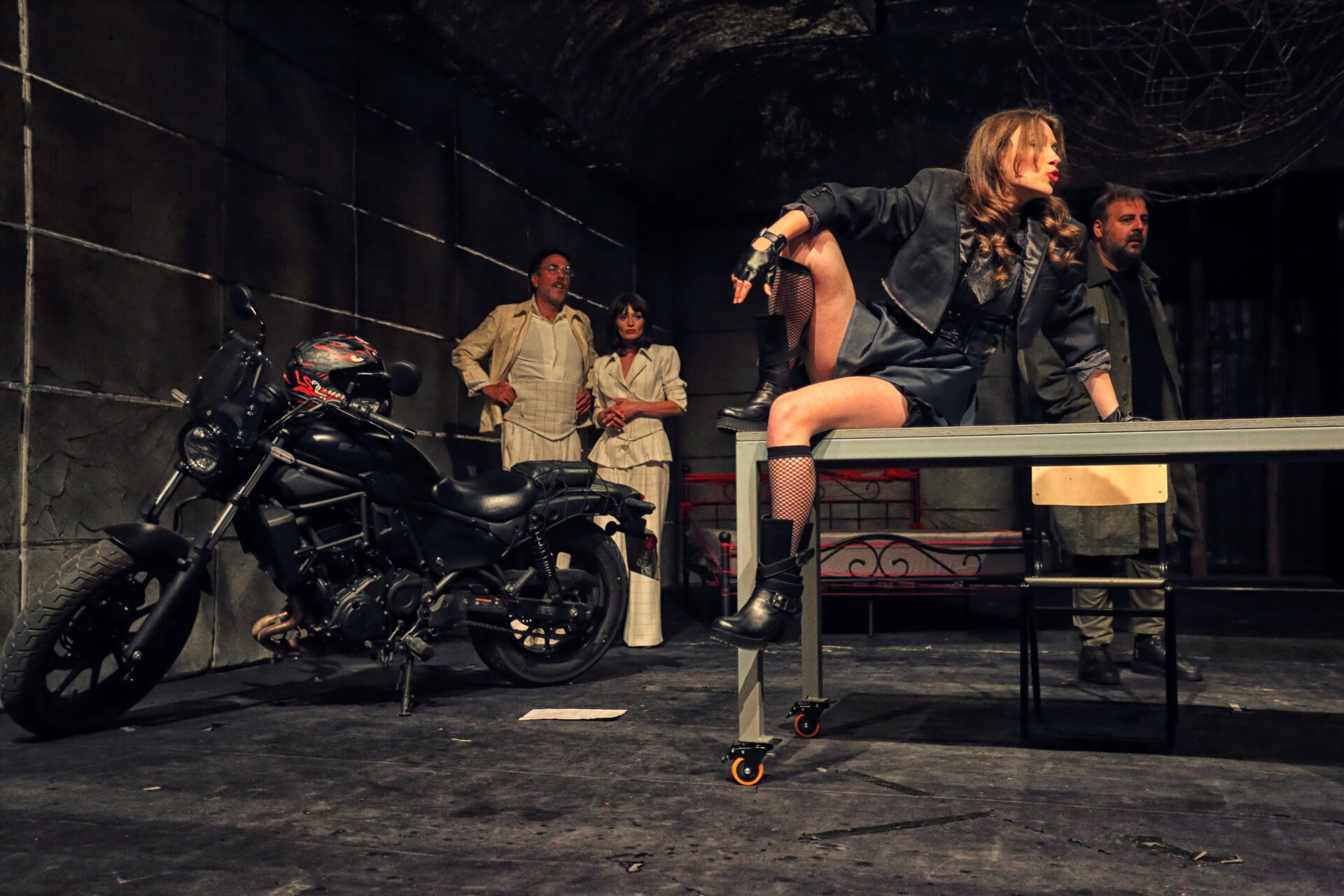
Goran Trajkoski’s music deepens this atmosphere with a heavy, prophetic tone. Marija Pupuchevska’s costumes work in a similar symbolic direction. Darker, worn tones connect the family to the concrete enclosure of the house, while the cleaner and brighter silhouettes of the foreigners separate them from the world they enter and gradually colonise. Sara’s leather clothes and motorcycle image bring a sharp sign of rebellion, while Marija’s red details connect her to memory, myth and warning. By the end, the white costumes create an almost institutional image, as if the family has been stripped of its private identity.
Within this visual system, the actors do not function as isolated psychological portraits. Their performances are precise and fully integrated into the larger stage organism, each shaped through a distinct physical rhythm, building the image of a family trying to breathe inside a structure that constantly narrows around them.
Rubens Muratovski gives Spiridon, the father of the family, a powerful contradiction. He is patriarchal, conservative and controlling, yet visibly afraid. His authority inside the home grows from his own obedience outside it. He dominates because he has already surrendered, and that is what makes him both oppressive and tragic.
Marija (Biljana Dragićević-Projkovska), the mother of the family, carries the emotional memory of the home without turning it into melodrama. Her care for the children is practical, almost hidden in actions rather than declarations, while her body seems burdened by trauma, repetition and exhaustion. Her movements around the bed, the red threads, the humming, the sudden cries, and the moments in which she almost collapses create a woman who is both mother and warning figure. Through her, myths are not decorative folklore, but a form of knowledge that others dismiss until it is too late.
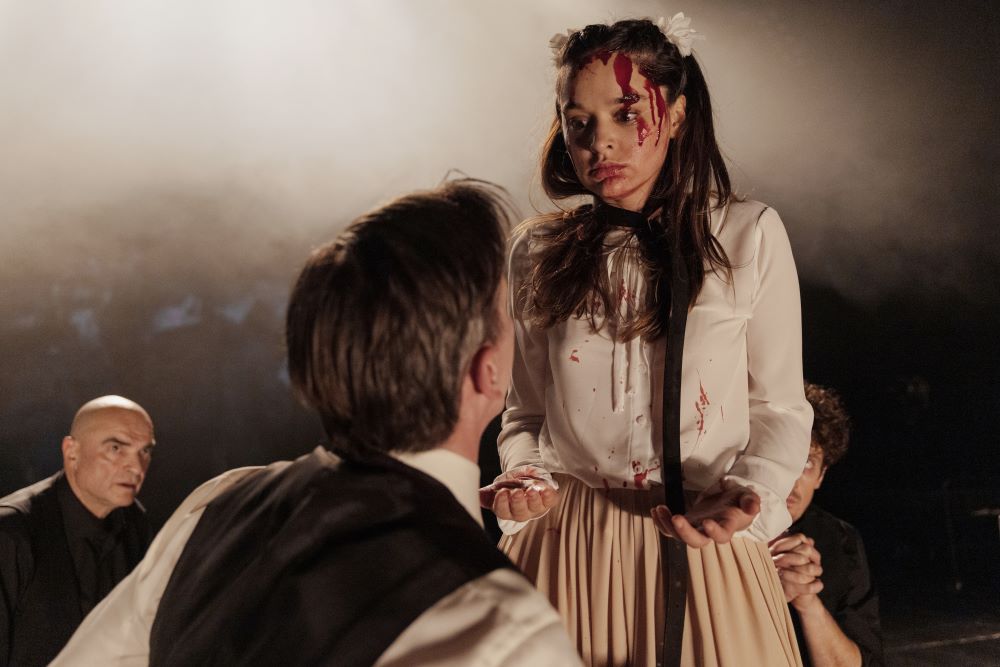
The children, Zvezdan (Filip Trajkovikj) and Sara (Sara Klimoska), embody two different attempts to escape the closed family world. Zvezdan is caught between imagination and impossibility, dreaming of becoming a film director while remaining trapped inside the home and the reality around it. His naïve openness toward the foreigners comes from a desperate need to believe that the outside world might still offer an exit. Sara, by contrast, has already left. She returns as a figure of rebellion and refusal, cutting through the space with her motorcycle and leather image. Yet the production does not romanticise escape. Even the freedom she has claimed remains vulnerable to manipulation.
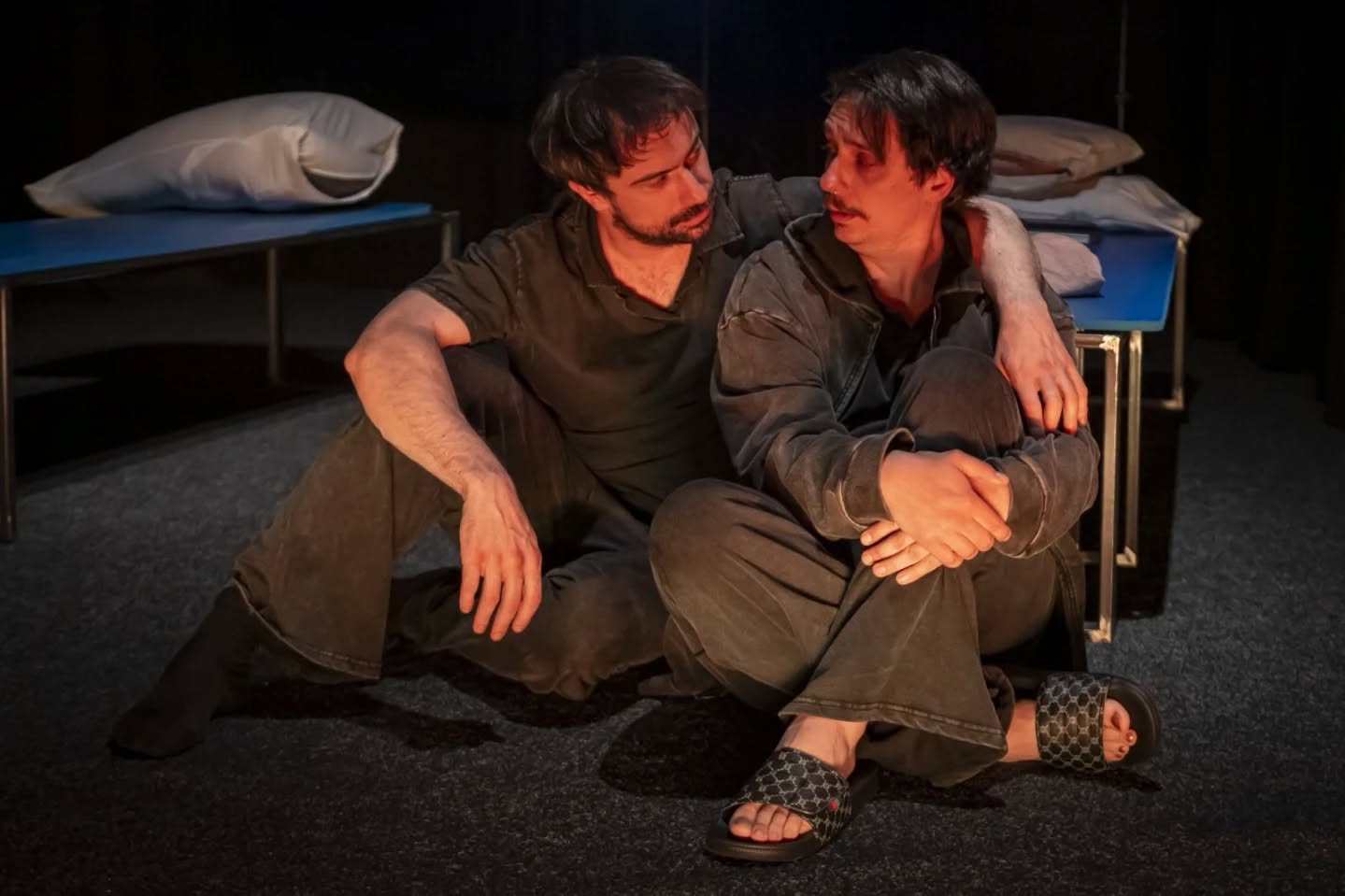
Simon (Aleksandar Stepanuleski), their brother and another wounded member of the family, is one of the figures that most clearly shapes the play’s tragicomic pulse. In his performance, drunkenness, intelligence, religious reflection, bitterness and physical decay coexist impressively, without reducing the role to a comic drunk. Wounded, lucid and already collapsing, he opens some of the production’s sharpest moments, where humour, pain and tragedy are inseparable.
Cat’s Head. Photo: Dragan Gajik
His attempt to obtain official approval for the ownership of his unborn child is one of them. Forced to run on a treadmill while waiting for a bureaucratic procedure, although he is the only one present, Simon becomes the body of a citizen exhausted by rules that have lost all human purpose. In front of him, Shterjo (Zlatko Mitreski), sits among papers, forms and stamps, insisting on procedure while enjoying the small power of the person who enforces it. With controlled absurdity and sharp comic timing, Mitreski turns Shterjo into the human face of an otherwise faceless system, a recognisable bureaucratic figure whose seriousness makes him even more ridiculous. Together, the treadmill and the paperwork create a painfully accurate image of modern mechanisms of humiliation combined with old systems of control.
The foreigners, George (Igor Angelov) and Merien (Sanja Arsovska), enter through the promise of art, curiosity and international attention, but what they truly seek is suffering as material. Their English-speaking presence first marks them as outsiders, until it becomes clear that they have understood far more than they admitted. They are not simply observing collapse; they are producing it, breaking the family from within so the home can be taken from the outside. Merien enters the most intimate spaces of the family by sleeping first with Simon and then with Sara’s girlfriend, while Sara’s hanging becomes one of the production’s most unsettling morbid images, where private pain is framed as spectacle. George, with his comic surface and false therapeutic authority, continues the same logic through the placebo experiment with Simon, giving him nothing but planting the idea of madness. Together, Merien and George represent a polished form of exploitation, the civilised vocabulary of destruction. The neighbour Panzo(Predrag Pavlovski), adds another image of surrender: by selling his house first, he allows destruction to begin from the side, until even the air above the family home seems no longer theirs.
When the two pine trees at the back of the stage are cut despite the warning attached to them, myth and reality enter the same frame. The legend about the underground water reservoir they hold back may seem like superstition, until it proves to be prophecy. In the last image, the family appears in white costumes, almost inside a psychiatric or clinical order. They say their hands are tied, only to realise they are not, but this freedom changes nothing. When captivity has been internalised for too long, visible chains are no longer necessary. What remains is only the dance, the repetition, the performance of identity inside a world that has already emptied it.
In the end, the production does not ask only what Wild Flesh would look like today, but why we still need to return to that question. What kind of world have we built if the family home remains the battlefield of history, ideology, fear and survival? Through Andonovski’s text and Projkovski’s stage language, Cat’s Head becomes a disturbing theatrical cry against a reality that preaches one thing and does another. It shows what remains of the individual when every grand idea forgets the human being it claims to protect. What remains most frightening is not only collapse, but the loss of conscience.
Credits:
Author: Venko Andonovski// Director: Dejan Projkovski//Set Design: Valentin Svetozarev//Costumes: Marija Pupucevska//Music: Goran Trajkoski//
Sculptor: Angel Petrovski//
Cast: Rubens Muratovski, Biljana Dragićević-Projkovska, Filip Trajkovikj, Aleksandar Stepanuleski, Sara Klimoska, Igor Angelov, Sanja Arsovska, Zlatko Mitreski, Predrag Pavlovski

Katerina Markoska is a translator, theatre critic, and emerging author from North Macedonia, living between Skopje and Sofia. She is currently completing a master’s
degree in Theatre Arts and Dramaturgy at the National Academy for Theatre and Film Arts “Kr. Sarafov” in Sofia. Her translations of contemporary drama have been
recognized by Eurodram, and her creative texts have been published in collective books in Bulgaria.