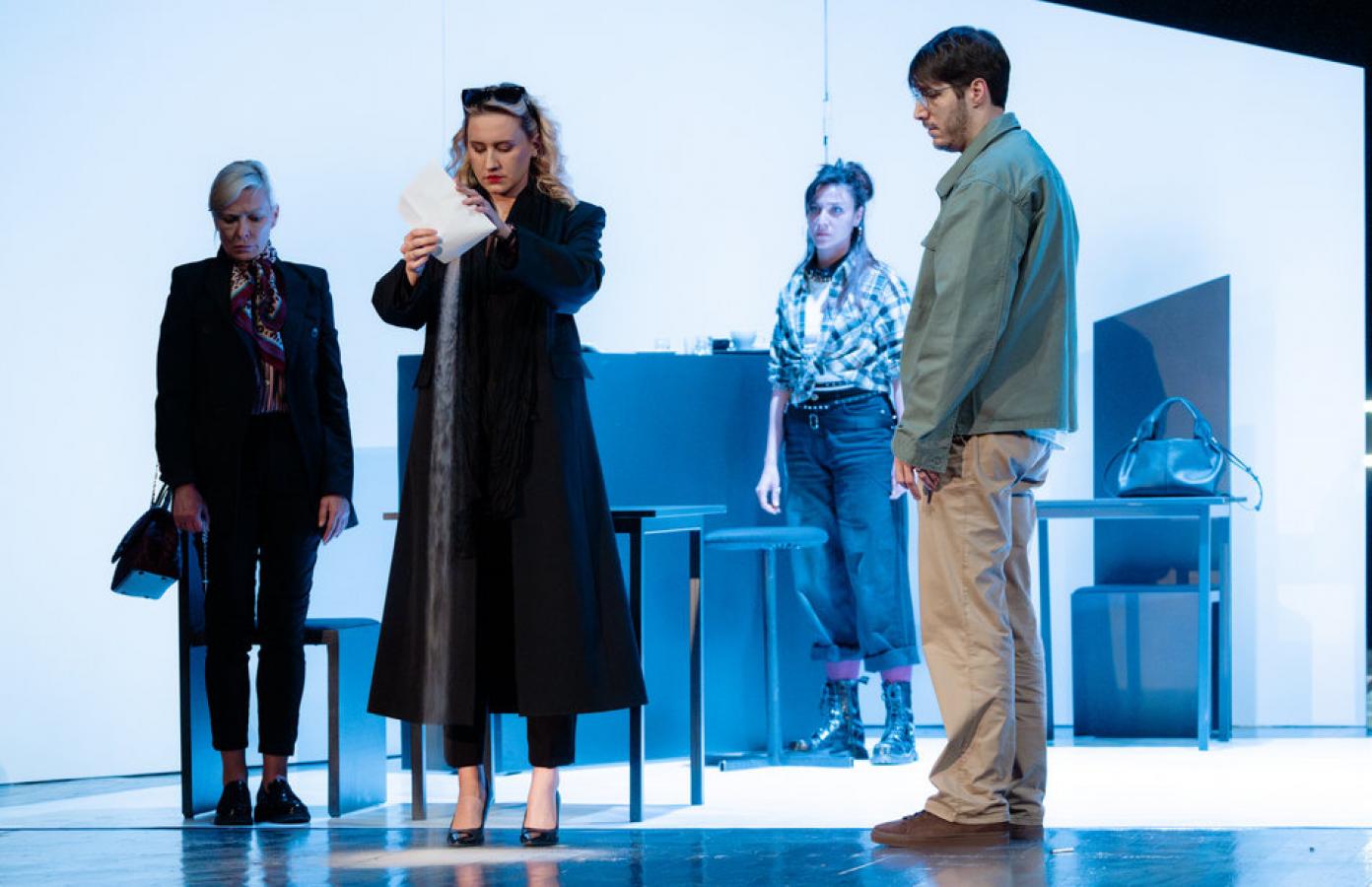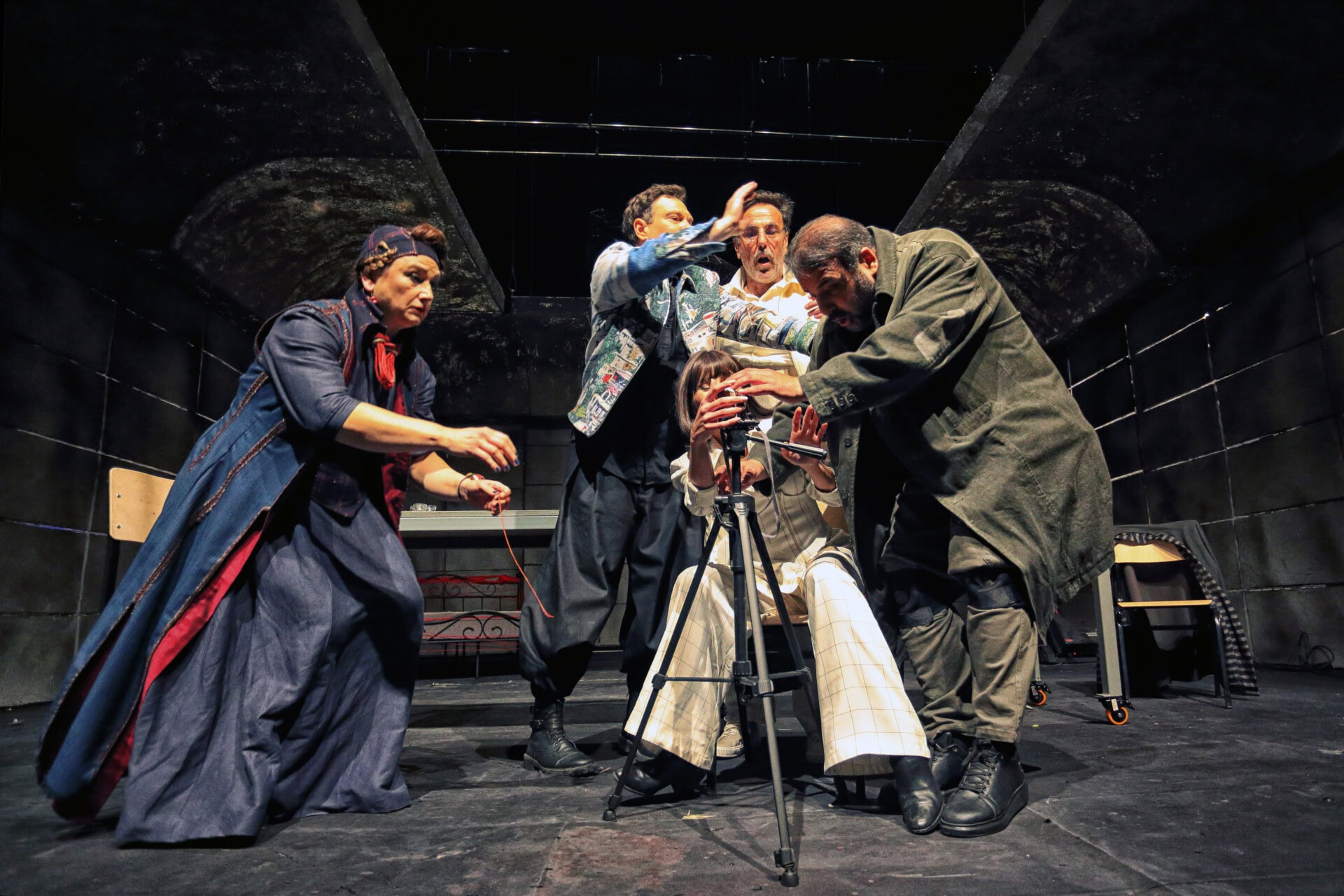
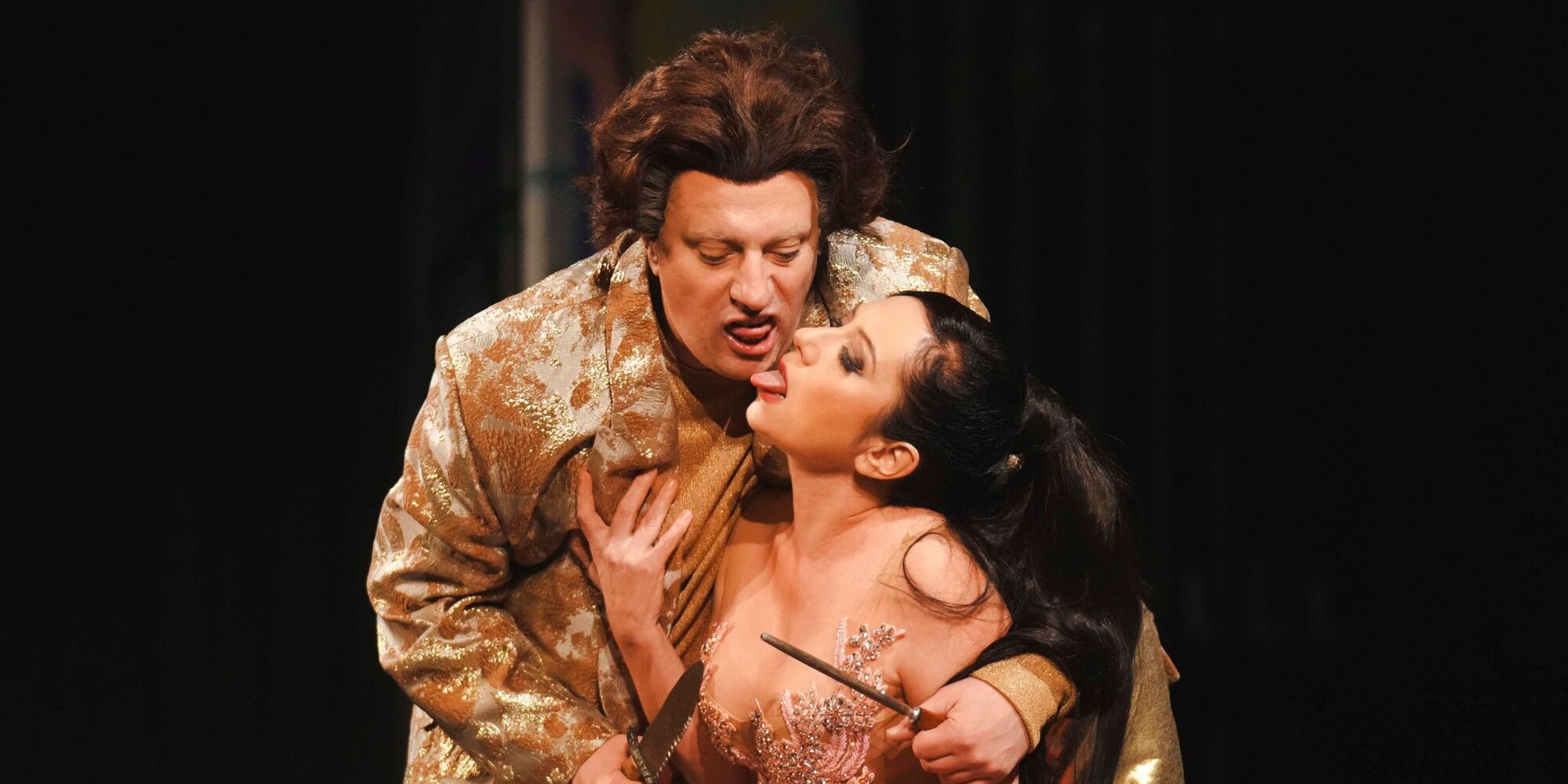
Belgrade Drama Theatre, premiere 20 February 2026
European theatre has, over the past decades, tested the boundaries of what is permissible and acceptable to such an extent that creating a new theatrical scandal has become rather difficult. Controversy depends not only on what happens on stage but also on the expectations with which the audience enters the theatre. The tradition of mocking bourgeois morality, as well as undermining the forms of artistic self-affirmation of the bourgeois class, was initiated by the fifteen-year-old Alfred Jarry in 1888 at the Lycée in Rennes, when he wrote a derisive little play about his teacher Hébert. Only in 1896 would that play, in a revised form, be performed in Paris, to the astonishment of the audience of the time, whose ears reacted to the very first spoken word: Merdre!
Accounts report that an uproar of indignation immediately broke out among the scandalized audience, while others among them were intrigued by what they were hearing. For a full fifteen minutes two opposing reactions battled in the auditorium before curiosity prevailed and the performance of King Ubu continued – a reincarnation of Rabelaisian grotesque and parody of Shakespeare’s Macbeth that at the time offended bourgeois taste. Then it was quickly forgotten, only beginning to influence avant-garde writers half a century later, after the greatest horrors of the twentieth century had taken place. It gradually acquired the status of a classic, one that inspired the theatre of the absurd and other anti-dramatic currents.
Martin Esslin, the father of the term Theatre of the Absurd, points out that Jarry prophetically anticipated the reality that could be encountered in 1945. He is not alone in this view, for witnesses to countless moments of suffering and devastation, corruption and ruthless enrichment, the seizure of power and the liquidation of opponents, have recognized their times in Ubu. Thus, Staša Koprivica, the director of the new staging of Jarry’s play at the Belgrade Drama Theatre, writes that she sees contemporary Serbia in Ubu.
What at the end of the nineteenth century tore the audience apart now fits seamlessly into the expectations of today’s spectators. Koprivica assigns more concrete coordinates to the universal qualities of the drama. The scenographic concept of a garbage dump with a large sewage drain through which the characters pass (set designer: Vladislava Munić Cunnington), combined with brightly coloured costumes (costume designer: Magdalena Klašnja), suggests the abstract desire of a corrupt elite to rule even over scraps. Yet certain material elements, and above all verbal ones, evoke moments of reality more directly.
In Koprivica’s production, Ubu emerges from a refrigerator in which, as he says, he keeps his conscience so that it remains fresh, while others leave theirs in the sun, where it quickly spoils. The ironic gesture unmistakably recalls the figure of Aleksandar Vučić, who is often said to appear in the media so frequently that he seems to be popping out even from refrigerators. So much so that, a few days before the 2022 elections, the president of Serbia decided to embrace this criticism by appearing in a political programme and stepping onto the stage from a refrigerator. As the president of a municipality built on a dump, Ubu also helps residents while being filmed for social media, only to seize their property as soon as the phones are turned off. The reference inevitably recalls real events, such as the demolition of private property in Belgrade on election night in 2016, when citizens’ homes were secretly destroyed to make way for the luxury complex Belgrade Waterfront, on the pretext that the area had been an eyesore and a dump.
The production verbally invokes many other features of the present. Ubu will be troubled by the fact that Mother Ubu is cheating on him with migrants who are supposedly taking jobs from the local population. He will express a desire to create a national reality show (of which Serbia has many). He will call special sessions of parliament, which in Serbia have become a regular occurrence. Along with numerous other indirect references, in accordance with Jarry’s vocabulary, actors perform various obscenities and utter a series of vulgarities.
Nevertheless, Jarry’s dramaturgy functioned effectively while it was confronting bourgeois ideals with means that were at the time unacceptable. By embracing and further developing the vulgarity of Jarry’s text, Koprivica amplifies the grotesque and satirical puns and banter to the point of caricature. In a time when such devices are already widely used and are considered conventional, this approach leaves the impression of self-satisfied, and at times tasteless, mockery. In the end, one might say that, in criticising the government, it employs the same immoderate patterns it attempts to expose.
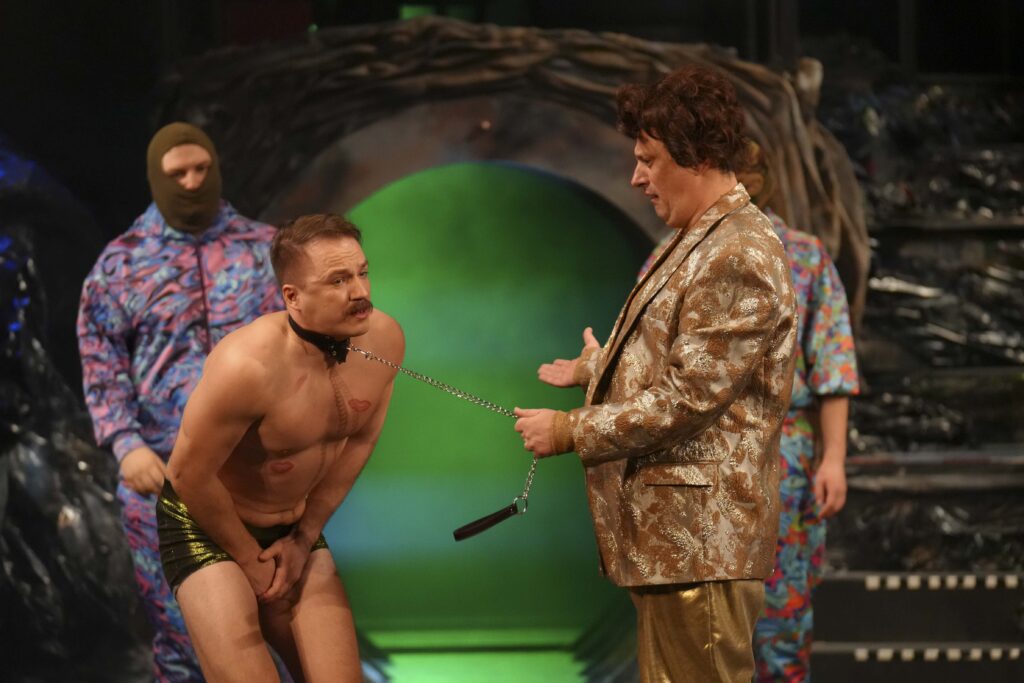
King Ubu, Belgrade Drama Theatre
This feeling is reinforced by the decision to cast Andrija Milošević in the title role. An extremely popular comedian who gained fame primarily through countless television roles, sketches and performances, Milošević builds his Ubu on a stream of quips, exaggerated mimicry and vocal mugging that he repeats and intensifies for as long as the audience is willing to support him with laughter. His Ubu resembles a variation on Milošević’s television persona, so that the audience seems to be happily following a theatrical extension of the screen entertainment to which it has grown accustomed.
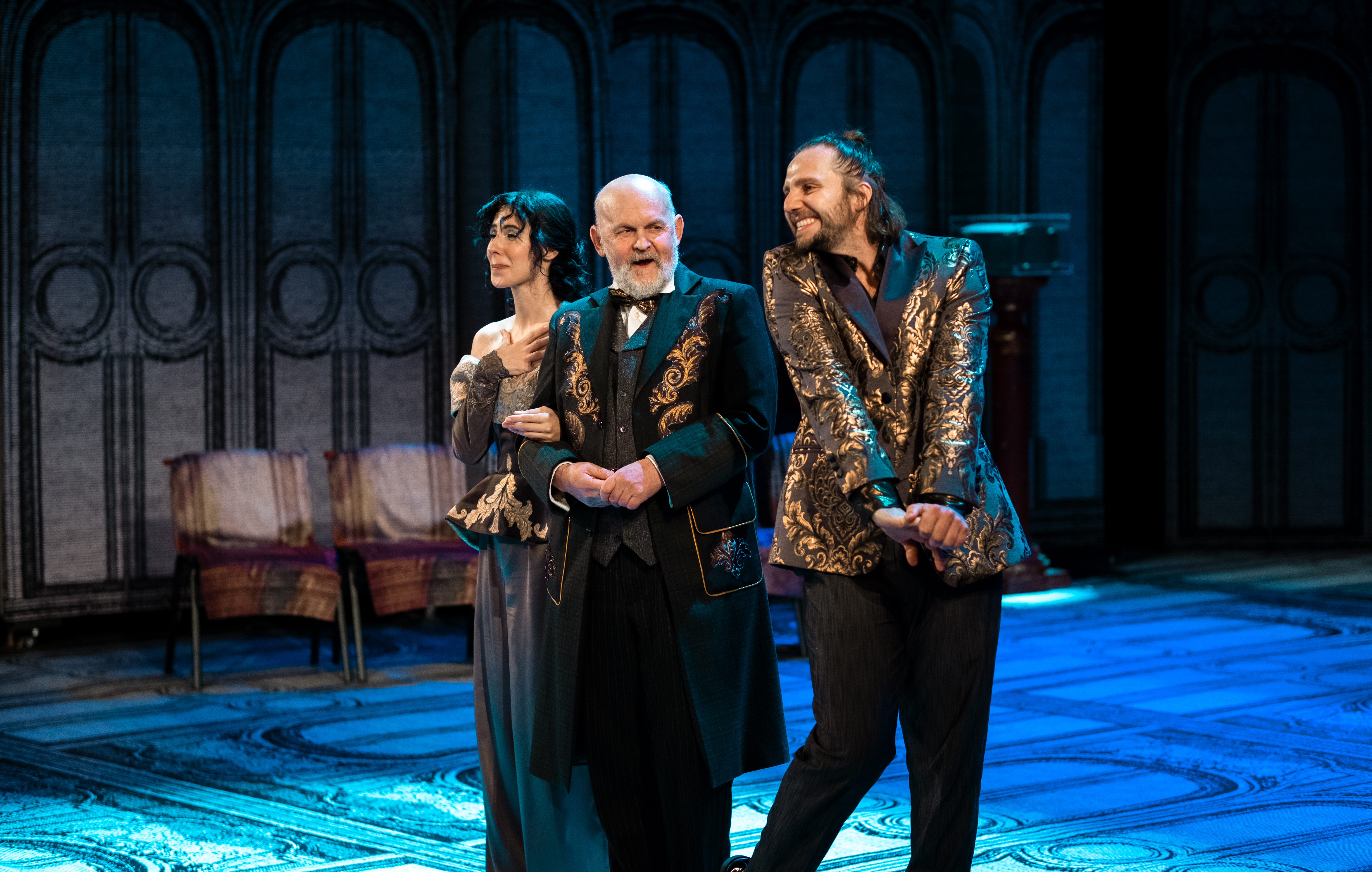
The rest of the cast is made up of the now traditionally well-rehearsed young ensemble of the Belgrade Drama Theatre: Paulina Manov, Aleksandar Jovanović, Milan Kolak, Bojana Stojković /Iva Ilinčić, Ivan Zablaćanski, Mina Nenadović, Rista Milutinović, Nikola Mijatović, and Arsenije Arsić. All of them consistently perform a series of madcap gags and physical antics that are above all brought together with measure and great talent by Aleksandar Jovanović in multiple roles. They form the main support for Milošević’s dominance, which Staša Koprivica perhaps somewhat overvalues, since she extends King Ubu with scenes and motifs from Jarry’s subsequent comedy, Ubu Enchained. There Ubu goes to France and, in order to distinguish himself from others, decides to become a slave. This further prolongs an already long performance merely to offer a stereotypical version of a Western utopia, after which Ubu, following a brief excursion to Turkey, announces that he will head for Belgrade – as though he had not symbolically been there all along.
As the famous actor is the central figure of the production, one gains the impression that the play King Ubu was chosen for staging as a convenient platform for the kind of frivolous merriment cultivated by Andrija Milošević, not to mention that his performances undoubtedly sell tickets. The somewhat hidden allusions to daily political situations serve to provide the appearance of a serious artistic approach.
Bourgeois audiences in Serbia enter the theatre expecting to attend a culturally refined and high-brow event. Even when the stage offers the kind of comic forms that barely differ from television sketch comedy, the institutional framework of theatre lends such content the appearance of artistic quality. Thus, even the most frivolous productions strive to retain at least a minimal element of social critique, most often in the form of routine mockery of those in power. That is a very important ingredient because it sustains the impression that the theatrical experience is somehow more valuable than everyday entertainment – even though it is precisely this illusion that today makes a theatrical scandal, or rather a genuine artistic provocation of power, increasingly difficult to imagine.
Credits:
Adaptation and direction: Staša Koprivica// Translation: Vlada Stojiljković//Scenography: Vladislava Munić Cunnington//Costume: Magdalena Klašnja //Composer: Aleksandar Sedlar
Cast: Andrija Milošević, aulina Manov, Aleksandar Jovanović, Milan Kolak, Bojana Stojković /Iva Ilinčić, Ivan Zablaćanski, Mina Nenadović, Rista Milutinović, Nikola Mijatović, and Arsenije Arsić
For tickets and further information, visit: bdp.rs

Andrej Čanji is a theatre critic and theatrologist based in Belgrade.