
Slovensko narodno gledališče Nova Gorica, premiere 28 May 2025
Anhovo tells a story that is known throughout Slovenia, yet still feels deeply shocking when told in theatre. It is a story that does not seem like something that could have happened in the green paradise of Slovenia. And yet, it happened.
The title refers to the name of a Slovenian village where, in the 1920s, Emilio Stock founded a cement company. After the Second World War, under the Yugoslav government, the Salonit factory began producing asbestos-based products. After years of polluting the region and after the devastating effects of asbestos on human health became clear, the factory was eventually transformed into a waste incineration plant. Despite many deaths and growing awareness of the environmental damage, the pollution – and the consequent impact on the health of the local population – has continued to this day. A Slovenian valley, in a country known for its forests and crystal-clear lakes, became a valley of death, lies, and ecological disaster.
As director Žiga Divjak and playwright Katarina Morano, with whom he regularly collaborates, point out, this is not just a story about ecological issues, but also about the people who live there and their strategies of resistance and solidarity.
Divjak has built a reputation in Slovenia as a director who creates ecologically engaged performances. No one should be surprised that he decided to tackle one of the biggest environmental scandals in his country. I also think this works in favour of his practice – he has a particular sensitivity towards these issues and understands both nature and the injustices caused by human greed, land exploitation, and overuse of resources. After the conceptual Crises on the environment, the activist generational dialogue on climate change in Fever, and the detailed, documentary The Flock, Divjak returns with a well-written story and characters. The greatest strength of this particular performance is its focus on private stories that are not widely known in discussions about environmental issues…intimate narratives that become political.
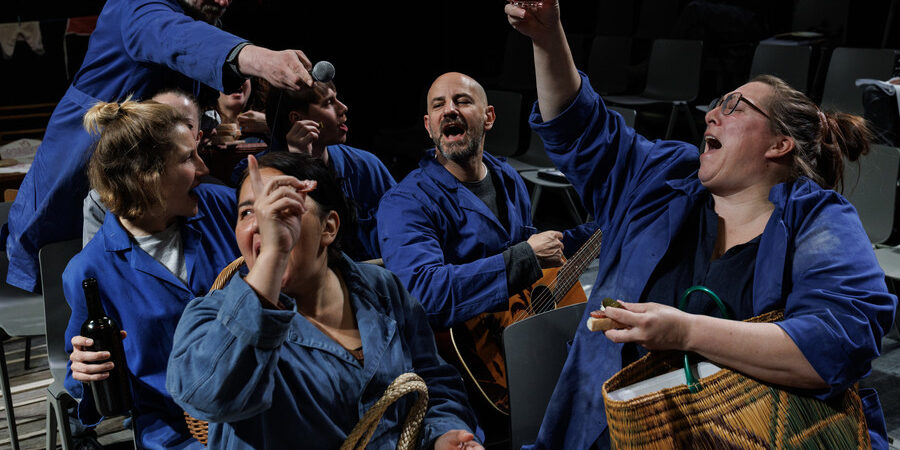
After the tiringly static and monotonous The Flock, it is refreshing to see a Divjak performance that engages the imagination and employs a more theatrical devices. It must be said, however, that these are techniques the director has already used before. Most of the performance is built on interwoven narratives, with actors seated in a circle among the audience, completing each other’s sentences and gradually constructing the story of Anhovo. In this respect, it resembles The Fever. And, similarly to The Flock, it reinforces its arguments by presenting photographs and documentary evidence, which are later hung on one of the walls. These are therefore devices already familiar from his earlier productions. What feels new is the creation of a kind of character-driven narrative – because in Anhovo we do have characters. And although they are most likely composites of multiple stories, part of the performance consists in following Dominik who decides to oppose the pollution of the valley and later uncovers the truth about the effects of asbestos. His story often serves as a starting point for constructing the chronology – they say it could happen before Dominik decided to speak with the director, or several years later, after Dominik has appeared at the director’s office.
The piece doesn’t deploy psychological theatre or exaggerated acting. The characters are often representations of their own stories. What brings life to their lines is the tone of the written text full of simple, natural language and honesty. The actors follow the atmosphere of the script and incorporate it into their performance, often creating very emotional and sincere monologues. And all of this while speaking in the Primorska accent. It is very refreshing to hear a dialect in a play where it is not used to mock anyone. Hence, it is not surprising that Divjak and Morano were awarded for the best newly written play at the 56th Week of Slovenian Drama in Kranj this year.
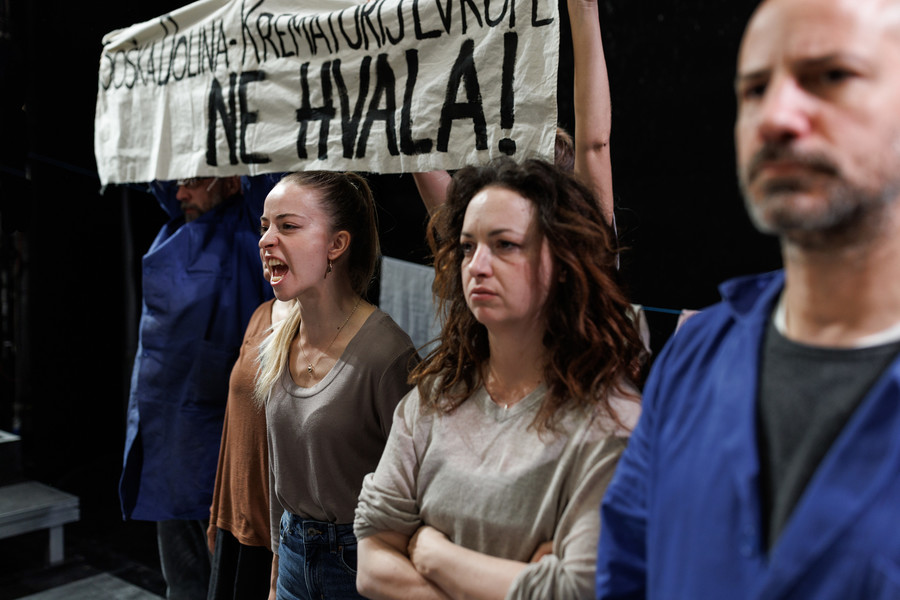
The whole performance takes place in a space dominated by a wall that resembles and symbolizes roofs covered with asbestos. Together with the powder used during the play, which also looks like asbestos and is often scattered by the characters or shaken out of their clothes, it becomes an element that takes the audience out of their comfort zone. It affects emotions by creating the feeling of being exposed to a similar danger to the one experienced by the characters in the stories. Not only in my own mind, but also in conversations overheard in the theatre, people wondered whether it was real asbestos. This material therefore plays the strongest role in the set design and props. In the next part, the white powder changes into black dust to represent pollution caused by the landfill, and next to the wall appears a mountain of tires that are currently being burned at Salonit. At the other end of the room, there is a table with chairs where Dominik and other workers, dressed in blue work uniforms, search for the truth about the poisoning of their valley and plan a meeting with the management. And within this simple setup, characteristic of Divjak’s minimalist performances and documentary theatre, the creators decided to tell the story of Anhovo.
Anhovo, SNG Nova Gorica. Photos: Matej Povše
They decided to explore all the historical stages of the Salonit company – from its beginnings in the 1920s, through the optimistic postwar period when Salonit seemed to offer hope and employment opportunities in Slovenia, to the darker years marked by illness and death, followed by the 2000s and new ideas for the company’s future, and finally to the present day, highlighting activism in Slovenia that seeks to bring change to the region. The actors become narrators who present the story from both a micro and macro historical perspective. All of them, the director, the writer, and the actors, seem to understand the meaning of the factory in people’s lives whether it’s a good one or a bad one.
Each part is based both on facts and contrast. Facts – because the creators conducted extensive research on the valley, including information about the number of deaths and illnesses, while also quoting a doctor who has been treating these cases in Anhovo. Contrast – because the audience is almost always presented with personal stories, which are then confronted with morally indifferent statements from company directors focused on profit rather than the quality of life and health of the workers. In fact, the statements themselves are not even necessary to understand the perspective of the management since the story alone is enough, showing that attention was only paid to the asbestos problem after two factory directors died.
Divjak and Morano therefore opted for several narrative threads that the viewer can latch onto and follow: the thread of private stories, the thread of the company’s history, the environmental thread, and also the thread of resistance. The latter resonates particularly strongly due to the consistently shown injustice and insensitivity of the authorities toward the workers and residents of Anhovo. This is reinforced by information such as the fact that every second patient in one of the nearby villages was diagnosed with cancer, or that, following the start of new destructive industrial activity, additional types of cancer are being discovered. It is also reflected in the characters’ accounts of the deaths of loved ones or the number of funerals they have attended. When the actors imitate a protest, the slogan “Anhovo Dachau” is shouted, and it resonates particularly strongly.
This performance, although simple in form, carries a great deal of empathy and understanding. As I have already mentioned, a major strength lies in the text and its ability to guide the narrative and construct stories in such a way that they feel close to the audience and invite emotional engagement. Another strong point is its locality – the story might not have resonated with such force if it had been created in Ljubljana or Maribor. Perhaps the proximity of these two cities – Anhovo and Nova Gorica – adds another layer of emotional intensity. This is present both in the text and in the staging – and on the faces of the audience.
Credits:
Director: Žiga Divjak//Authors of the Text: Žiga Divjak, Katarina Morano//Dramaturg: Katarina Morano//Expert Counsellors: Jasmina Jerant, Monika Weiss//Language Consultant: Anja Pišot//Set Designer: Igor Vasiljev//Costume Designer: Tina Pavlović//Composer: Blaž Gracar
For more information, visit: sng-ng.si
Further reading: Interview with Žiga Divjak: “We have to completely change our value system”
Further reading: Interview with Katarina Morano: “I deal with fear a lot in my work”

Karolina Bugajak is a theater critic from Poland, currently living in Ljubljana. She studied culture and contemporary art at the University of Lodz. The title of her master's thesis was "Theatricality and Exaggeration. Camp aesthetics as a strategy for creating new identities in the plays of Grzegorz Jaremko". Her main theatrical interests include topics such as institutional criticism, the representation of marginalized groups in plays, and most recently the theater of the former Yugoslav states.