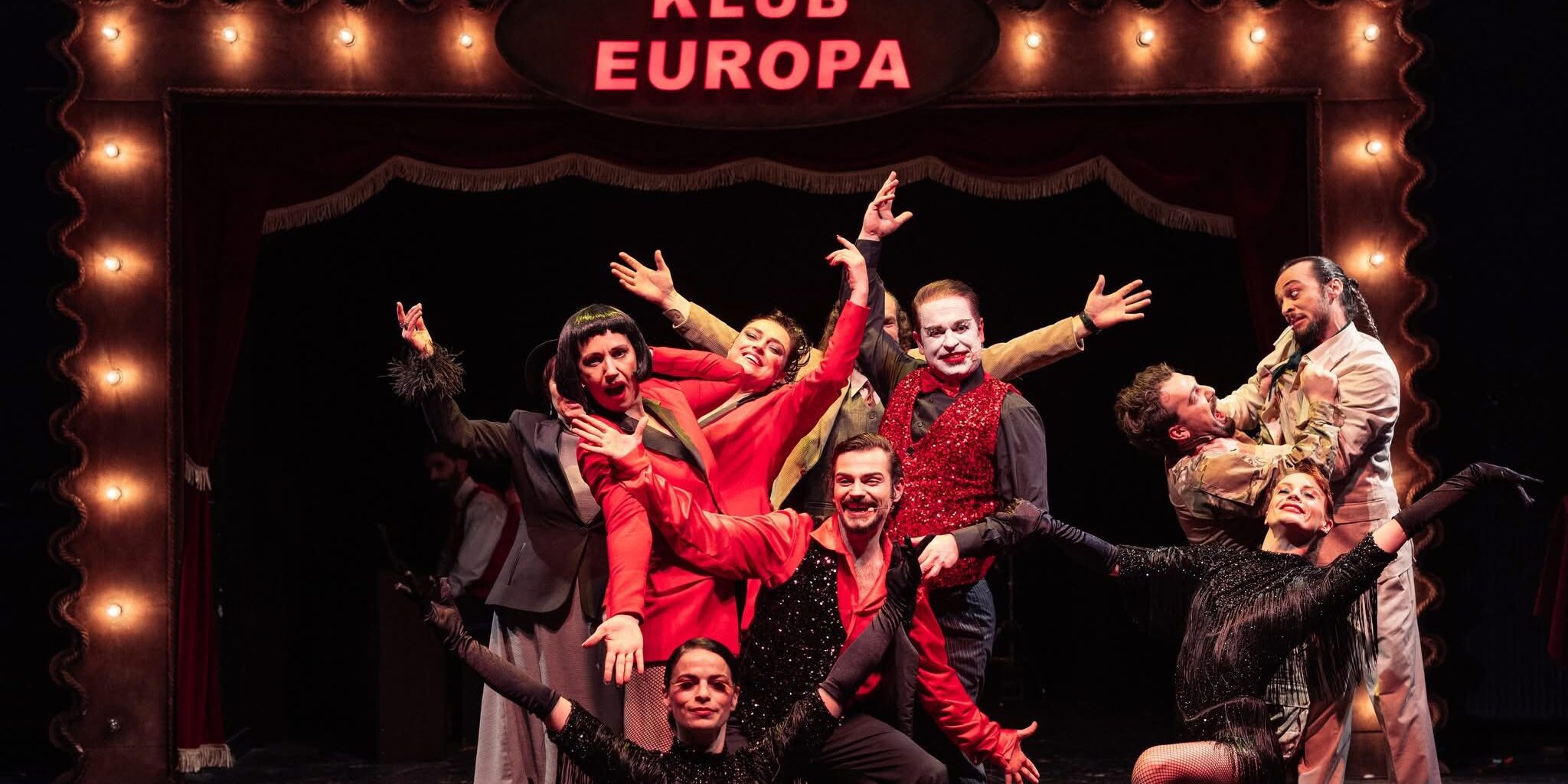
Gjilan City Theater, premiere 5 February
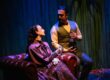
“Maybe I’m not a good novelist, but I am a good liar,” admits Aida (Semira Latifi), the protagonist of Kabare 1999, adapted and updated from the classic1966 Kander and Ebb musical by Zana Hoxha. It’s a line that reflects that feeling of not really being in control of where your life is going, but still trying to make it all sound like it makes sense, even if that means bending the truth a little, trying to convince others, and maybe even yourself.
You can feel the weight of those lies in a city like Prishtina, which the characters describe as a place where “everything can happen.” Yet the way this is said does not sound hopeful or exciting. It sounds restrained, almost a little strange, more like a warning delivered with a frozen, uncertain smile. This makes sense given when the play is set, in 1999, shortly after the war, a moment that still feels fragile, unresolved, and deeply present throughout the performance.
Though Hoxha’s adaptation follows the story of the original musical – itself an adaptation of John Van Druten’s play I Am a Camera, based on the semi-autobiographical novels by Christopher Isherwood – relatively closely and the show contains echoes of the famous Bob Fosse choreography, it never feels like something imported from somewhere else. Set in1930s Germany, the musical captured a society in which war was imminent. Hoxha’s version fits just as naturally into its post-war setting, as if it belongs to a reality where the aftermath of the war is still present, like something that hasn’t fully passed. The shift of central character to Aida, instead of the original’s Isherwood stand-in, also changes something in how you move through the story. While it’s clearly based on Cabaret, it never feels like a copy.
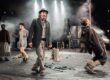
Nor does Hoxha ease the audience in. The show starts loudly with the iconic opening song Willkommen with some Albanian added to the multilingual mix. This is performed by Kushtrim Qerimi as the MC, his face caked in white makeup. The bodies of the dance troupe, especially those of the women, give the sense that they are there to be in service of the gaze, to be consumed, almost to the limits of discomfort. The performance puts you in a double position: you are laughing because the songs and dances are comic, but you are not fully comfortable with that. This has the effect of making you feel all the more intrigued, wanting to understand what will happen next, or simply where all of this is leading.
Kabare 1999 tells the story of Aida, a young writer from Skopje, who arrives in Prishtina and meets a man (Gezim Bucolli) at the bus station who helps her find an apartment and later a job at Klub Europa (the show’s version of the Kit Kat Club). From that moment on, things begin to unfold in a way that can be read as her “bad luck,” not through one clear turning point, but through a gradual accumulation of small situations that slowly start to define her experience.
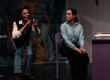
We are also presented with the story of landlady Afërdita (Aurita Gashi), a widow who slowly finds herself moving back toward love, but in a way that feels slightly off, almost playful and absurd, where small everyday moments turn into something bigger than they should be. A pineapple becomes a proposal, and that same thread eventually leads to a wedding staged inside the cabaret, where the husband, Agimi (Ali Demi), dies. Dudija (Safete Mustafa Baftiu) brings a different kind of disruption into the home, as her nightly visitors create a tension. And then there is the older woman played by (Mejreme Berisha), who keeps coming back, always in search of her son, Fatbardhi, who was taken from her during the war. Her presence feels almost repetitive, but not in a way that becomes tiring. It feels necessary. As if the play refuses to let that absence disappear into the background. While other scenes move, shift, or even lean into humour or absurdity, she remains fixed, unable to move forward. Her search does not develop, nor does it resolve, and that is exactly the point. It interrupts the rhythm of the cabaret and reminds us that for some, the war is not something that ended, but something that continues in a different form.
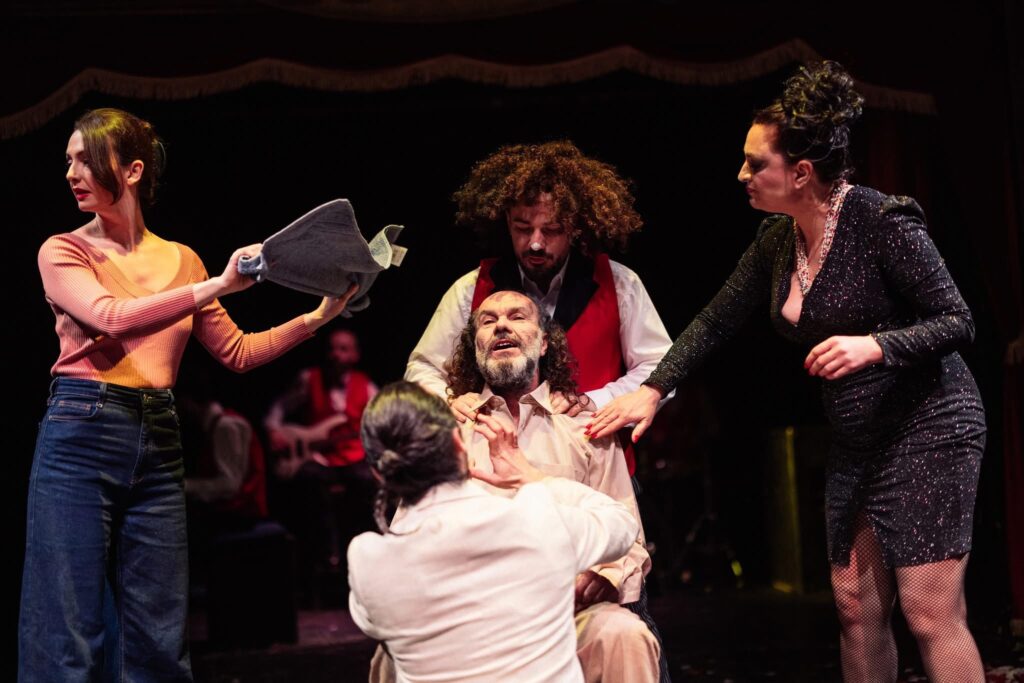
Kabare 1999
The way in which the men in the play function is particularly noticeable. They are present, but rarely the main focus. They move through the scenes more as interruptions, as obstacles, or as passing forces that influence the situations of the women without fully belonging to the emotional core of the story. The man at the bus station appears briefly in Aida’s story, then disappears into the background. Others appear through Dudija’s encounters or within Afërdita’s storyline, but they do not carry the same depth or continuity. Instead, they come across more as figures that set things in motion or interrupt them, but never really stay.
In contrast, the women are the ones you keep coming back to. Their stories overlap and keep returning in different ways. That’s where the emotional weight of the play really sits. It doesn’t feel random. Kabare 1999 isn’t just about post-war reality in general, but about how it impacts the lives of these women.
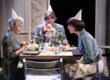
The scenography, by Bekim Korça, is designed in a way that made the audience feel like part of it, like guests at Klub Europa. We were seated at small tables which were draped in red and placed around the stage in typical cabaret fashion, each with a candle in the middle and a box of matches. At one point, when the electricity went out during the performance, we were asked to light the candles ourselves. It was a simple but powerful detail, reflecting something every citizen here has experienced, especially in the post-war period. I especially appreciated how they included a moment that felt familiar to many of us. When the lights went out, the theatre turned into a space for sharing stories about the war, each from a different perspective. At one point, one of the actors, sitting among the audience, began to speak about how afraid he once was to say the words “Kosova Republikë.” It showed just how delicate and difficult that time was, when even expressing a simple thought could feel unsafe.
The play keeps moving from one moment to another, letting different stories exist next to each other without trying to force them into one direction. Some scenes stay with you without fully explaining themselves, and you find yourself thinking about them after they’ve already passed. Klub Europa becomes the place everything returns to, not to explain anything, but to hold these lives for a while. It feels like a space where things happen, linger for a moment, and then slip away again. What stays with you is that sense of continuation, that these lives extend beyond the stage, even as the play itself begins to gather them into a single, shared moment.
Kabare 1999 offers a sense of closure, though not by neatly finishing its storylines. Instead, it allows these different stories to settle, where the past is neither erased nor fully processed, but simply acknowledged.
Credits:
Adaptor and director: Zana Hoxha//Scenography Bekim Korça
Producers: Gjilan Theater and Artpolis.

Fatlinda Daku is a human rights activist who is currently working as a researcher and freelance journalist. She studied Political Science at the University of Prishtina and has working experience in the civil society sector.