Slovenian National Theatre Drama Ljubljana, premiere 10 October 2025
The programme of the 56. Week of Slovenian Drama, during which this piece was presented, was shaped by the theme of politically engaged performances. As the festival’s director Rok Bozovičar stated, the selection made by curator Zala Dobovšek seeks “conflict – social, aesthetic, and ethical. In this context, engagement is not a stylistic label but a modus operandi: an openness that allows theatre to become a space of confrontation.” The programme featured great Slovenian productions such as the feminist Now, Suddenly, I Was a Creature of Vice, Article 55, and The Art of Living; the Act of Killing, the anti-war Incubator and Boško and Admira, as well as the ecologically engaged Anhovo.
Many performances in the program were produced by Mladinsko Theatre and the theatre in Nova Gorica, alongside a strong representation of smaller, independent productions, for example from Bunker Ljubljana and Zavod Maska. Together, they form a kind of map of socially and politically engaged organisations and institutions. Among the selected works, there is also a production from the National Theatre Drama Ljubljana, which is somewhat surprising, as Drama has not typically been associated with bold political statements or with creating a space of confrontation. However, its presence in such a clearly defined selection may suggest that the theatre’s direction is beginning to shift? At the same time, the treatment of the theme in the performance Mama is the First Word, directed by Brina Klampfer Merčnik, indicates that such an institution as Drama still operates on a different level of engagement with these issues than the other organisations represented in the program.
The performance is a staging of a text by two young playwrights, Tjaša Mislej and Pia Vatovec Dirnbek, who were laureates of the 2024 Playwriting Competition. Both the text and the production consist of several stories centred on female protagonists – mothers, or women who either want or do not want to become mothers. It is therefore a narrative about motherhood in a broad sense, as well as about the situation of mothers in the contemporary patriarchal world.
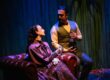
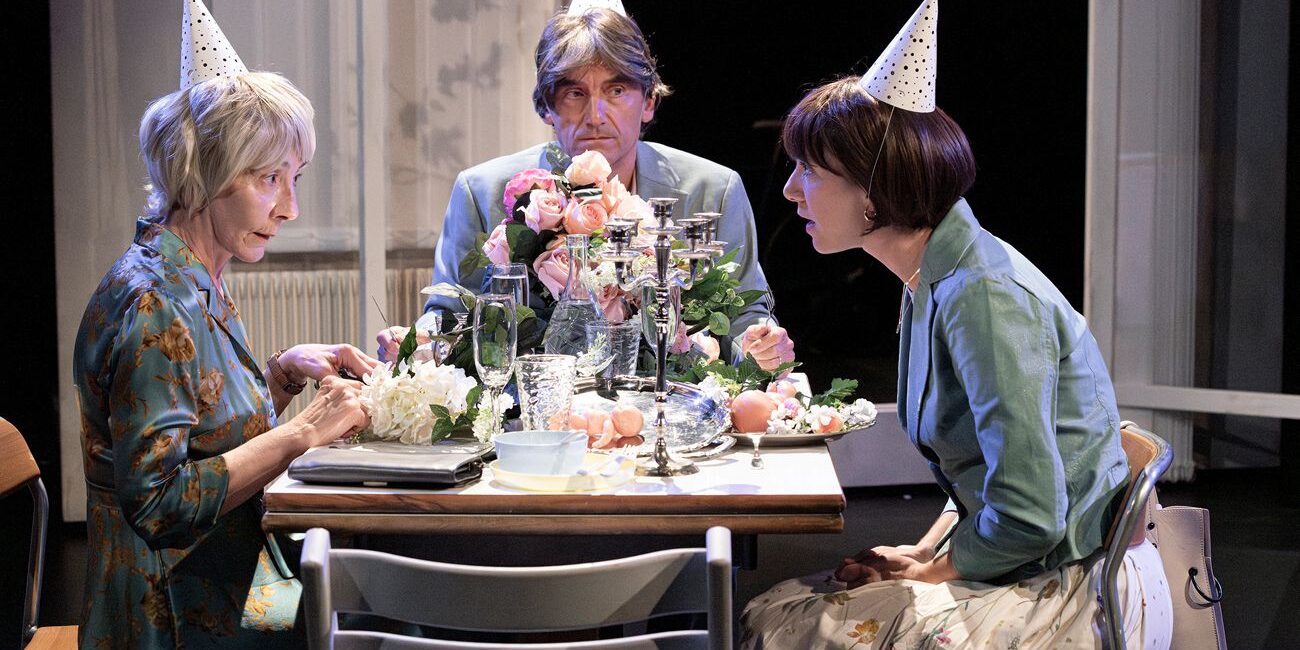
Hence, we are presented with the story of an older, conservative, and strict mother, her new partner, and her daughter, who meet for dinner in a fancy restaurant. As the scene unfolds, a growing tension emerges between the daughter and her mother, who remains constantly dissatisfied with her. In the end, it is revealed that the daughter became pregnant at a very young age, and that her mother forced her to give birth and give the child up for adoption so she could freely pursue her career as a doctor. The daughter, understandably, cannot forgive this.
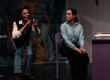
There is also a story about a married couple with an age gap who struggle to conceive due to the husband’s age. Against her partner’s wishes, the woman uses a sperm donor, as becoming a mother is her primary goal in life, causing immense pain for her partner. Another story is set in a village forty minutes away from Ljubljana, where a young mother lives with her workaholic husband, who does not help at home, and their two children. The mother, who used to party frequently, and was in a process of pursuing a PhD, stopped this life because of her responsibilities as a mother. She is visited by a friend who does not have children and cannot understand her new reality, even judging her for embracing the role of a housewife – (in her eyes) – opposite of a modern, emancipated woman. This story ends with the mother becoming overwhelmed and hitting her five-year-old daughter, who then runs into the forest, where she is found cold and scared.
There is also a story about an aunt who does not want to have children but is a supportive presence for her niece. She must come to terms with her own capacity to care for children and teenagers, who she often does not fully understand. The final story presented in the performance follows a young couple in which the girl decides to have an abortion. Fully supported by her partner goes through a painful procedure that is described on the stage. However, her decision meets disapproval and disappointment from her boyfriend’s family, highlighting the conservative mindset of the older generation.
Besides the stories of women, there are also other characters. The ones that raise the most questions are two characters played by Tina Vrbnjak and Benjamin Krnetić. They act as observers who follow the characters, appearing randomly in the stories dressed in white. They often intervene in the scenes and play realistic roles, yet they always seem somewhat outside the world of the story. They move between scenes and along the edges of the scenography, merging and connecting all the stories together.
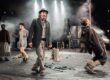
The structure of the performance takes the form of a kaleidoscope, with scenes coming rapidly, one after another. This creates the illusion of watching episodes from several different series. However, there are moments when all the characters appear on stage simultaneously, creating a break from the realistic worlds and pulling us fully into the realm of theatre. The stories are usually cut off at the climax and never finished. The form balances between total imitation of realism and theatrical disintegration. What does help to hold an illusion of real world is the almost literal scenography with a table as a centre, which, depending on the scene, serves as either a home.
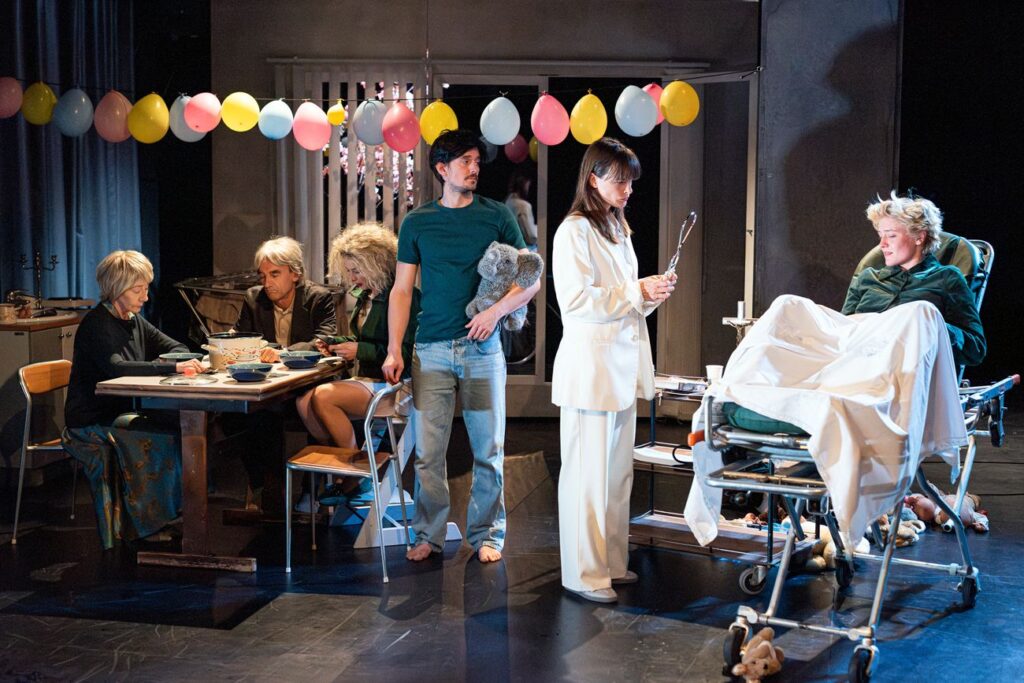
Mama is the First Word. Photo: Peter Uhan
I am not sure whether this term is used in other countries, but in Poland there is a term that can be most closely translated as “bourgeois theatre” (teatr mieszczański). It originally referred to a type of theatre created for a social group defined as the bourgeoisie. Over time, the meaning of the term has evolved, and in Polish it now carries slightly different connotations. Most often, it refers to theatre that is considered unsophisticated and predictable, catering to the tastes of a relatively unrefined – though affluent – audience, who attend performances partly to be seen as “cultured.” This type of theatre is often characterized by strong acting, however, the plot tends to be predictable, and the characters are frequently based on stereotypes. Formally, it rarely pushes aesthetic boundaries and shows little interest in exploring new theatrical languages.
Personally, I am not a big fan of this type of theatre, but I am also not strongly against it, as theatre would be boring if there were only one kind. Maybe it’s simply not for me as a critic. As the Polish critic Stanisław Godlewski once stated, this kind of theatre doesn’t need critics. It communicates easily with its audience, and no one needs to explain it.
As long as bourgeois theatre tells stories with interesting plots or offers strong acting and psychological depth, it should continue its mission of providing entertaining yet serious theatre. But what I find important is representation, especially in theatre that focuses on ongoing issues such as reproductive rights, the position of women, and the stigmas surrounding them. The problem with Mama is the first word begins with its main idea. What we get from all the stories is the message that being a mother does not bring much happiness, but mostly problems. It also suggests that it is impossible to have a good relationship with one’s mother, or that motherhood is the main goal in a woman’s life. The only character who challenges this idea is the aunt, who, ironically, seems to be the happiest person in all the stories. This suggests that being childless may lead to happiness for a woman. While this was a strong perspective in the 70s and 90s, the approach to motherhood is now changing.
Today, motherhood is often seen as a feminist way of life that can gently influence the world by creating communities and bringing more attention to care, support, and listening. This aspect of motherhood is completely missing from the performance. There are also several other problems with the way the topic is presented. For example, there is a lack of representation of women from rural areas and women from outside the middle class, who face very different problems than, for example, an unfinished academic career. In the same storyline about a woman losing her career because of having children, the creators decided to switch the gender of the character. The mother is played by a man, which often causes laughter from the audience and at the same time makes women’s issues seem less serious.
Such theatre rarely causes discomfort or provokes confrontation – unless it is created by a director who knows how to deepen plot-driven and psychologically grounded family drama. (Kornél Mundruczó is a good example of someone who does this).
Once again, the “theatre of the centre” (another term popular in Poland to describe this kind of work) is important, as it clearly has its own audience. However, this particular performance with one perspective on motherhood appears tepid when juxtaposed with other bold and complex work that genuinely push boundaries and create confrontation.
Credits:
Text: Tjaša Mislej and Pia Vatovec Dirnbek//Director: Brina Klampfer Merčnik//Dramaturg: Eva Kraševec// Scenography: Vasilija Fišer//Costumes: Marina Sremac
For further information visit: Drama.si

Karolina Bugajak is a theater critic from Poland, currently living in Ljubljana. She studied culture and contemporary art at the University of Lodz. The title of her master's thesis was "Theatricality and Exaggeration. Camp aesthetics as a strategy for creating new identities in the plays of Grzegorz Jaremko". Her main theatrical interests include topics such as institutional criticism, the representation of marginalized groups in plays, and most recently the theater of the former Yugoslav states.