Ruhrtriennale, Kraftzentrale, Duisburg, German premiere 3 September 2026
Marina Abramović sure is a powerful figure. From the radical endurance of Rhythm 0 to the visceral confrontation with war and memory in Balkan Baroque, and the almost mythologised stillness of The Artist Is Present, she has spent five decades turning her own body into a stage. Her name carries such authority that nobody seems to be looking over her shoulder anymore, when, in fact, somebody should be rapping her over the knuckles for stamping an auteur’s signature onto centuries-old fertility rituals that were never hers to appropriate. Before being reframed through Abramović’s stylised dramatization, the eleven rites selected for the performance had been passed down through countless communities, not only across the Balkan Peninsula, but, strangely enough, in Turkey and Russia as well. That is, if these rites are truly authentic in the first place, since some are so extraordinarily graphic that it is difficult to believe they ever existed.
Abramović herself calls Balkan Erotic Epic her most ambitious and biographical work yet. And indeed, as a descendant of a Partisan family — a fact she never fails to mention — and someone born and raised in Belgrade, former Yugoslavia, she has a personal connection to the geographical and cultural sphere she attempts to encompass in this theatrical spectacle. This biographical dimension is mainly embodied by Abramović’s mother, stoically played by Danica Rosić. Likewise, the work’s persistent preoccupation with death, materialised through in-your-face memento mori symbols, might also be read as a more immediate biographical concern for an artist now in her eighties, confronting, not only the figurative friction between Eros & Thanatos, but the actual proximity of mortality.
Beyond these obvious points of reference, however, one might wonder what some of the scenes depicted have to do with either the rituals themselves or Abramović’s life story — such as the photographic depiction of Serbian throat singers, their massive genitals hanging from the flies of their cotton čakšire trousers.
Balkan Erotic Epic, the stage version, originated from Abramović’s 2005 work of the same name, which emerged from her research into Balkan fertility rituals and their enduring relationship to the body, sexuality and the sacred, which she staged and filmed in Serbia. Originally conceived as a video work and subsequently presented in an exhibition context, the project was reimagined almost two decades later as a four-hour theatrical performance, transforming its filmed rituals into a live, collective encounter with the audience.
The German premiere, held almost a year after the work’s first premiere at Aviva Studios (Factory International) in Manchester, took place on September 3 2026, as part of the Ruhrtriennale’s final year under the artistic direction of Ivo van Hove. Staged inside the Kraftzentrale Duisburg, a former power station dating back to the Industrial Revolution, the performance accommodates around 1,500 voyeurs, who are invited to roam through the shiny plastic-and-latex amusement park of Abramović-Land.
The particularly loaded term “voyeur” is deliberate, because the conditions imposed on the audience suggest less the welcome extended to visitors than the precautions taken against potential intrusion: telephones have to be sealed away in rectangular anthracite-coloured bags with magnetic locks (a rule the rest of the performing arts could happily steal), while not even note-taking is permitted throughout the performance. The atmosphere is further unsettled by reports that spectators at previous performances had been caught gawking at performers’ genitalia and, ultimately, even sketching them onto their admission cards.
The show is about to begin as a marching band starts playing the farewell tune for the funeral procession of General Josip Broz Tito, slowly leading the audience into the cavernous 6,000-square-metre hall. From here on, the voyeur-visitors are left to their own devices, free to dwell in a realm of fertility, sex and death for four hours. What awaits them is a catalogue of instantly recognisable tropes, neatly contained within the title itself, blown up to monumental proportions.
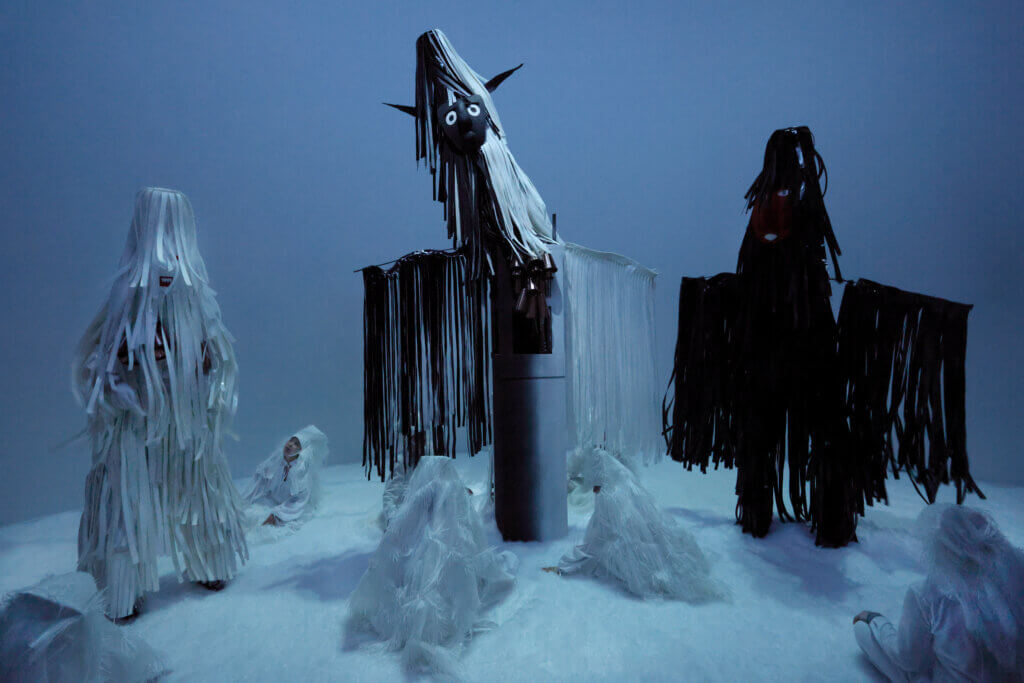
Photo: Photo: Marco Anelli
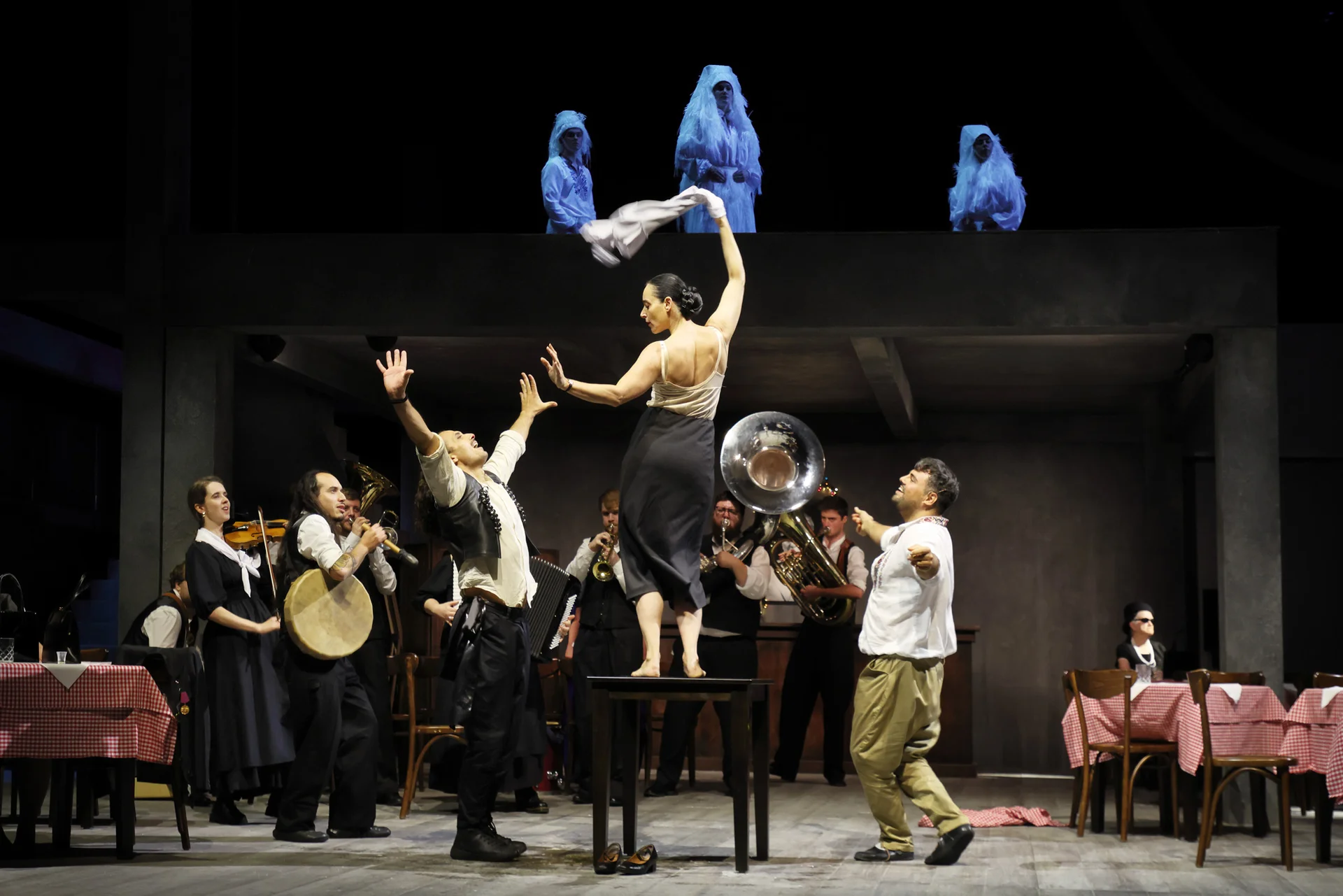
The Balkan comes most vividly to life in the Kafana-Komplex: the stage is a two-storey concrete structure, with a kafana on the ground floor and a group of ghostly, white-clad kolo dancers above. As they stomp their feet, concrete particles rain down from the flaking ceiling onto the hats of three women in mourning clothes, seated at red-chequered tables, each equipped with the S.O.S. kit for a broken heart: a bottle of homemade rakija and a packet of cigarettes. It looks as though they have just arrived from Tito’s funeral procession. Those who have been to a kafana, an Italian bar, an Irish pub or, really, any kind of drinking establishment know that time flies when you’re having fun — and even more so when you have come to drown your sorrows, staring deep into the glass in front of you. And so, after a while, tamburaši musicians enter the place with a loud “Oppa!”, accompanied by opera singer Aleksandar Timotić, whose singing voice is otherworldly and whose hip swing is delightfully quirky. At one point, Abramović’s mother figure suddenly appears. She climbs onto the tables, undresses (lest we forget about the erotic), drinks, knocks glasses to the floor and waves her hands in the air, just as they do in cult Kusturica films such as Time of the Gypsies (1988), but rarely in the real, living kafanas across the Balkans.
As this fever-dream unfolds, the German audience gathered around the stage stands bolt upright and perfectly still. We are invited to observe from a distance, but not to participate, as though looking at exhibits from some unknown, exotic, faraway place. For a brief moment, the arrangement begins to resemble a human zoo — exposure as a dramaturgical device, seemingly unmasking the theatregoer once again as voyeur. Regardless, it is a thin line between critical demystification and aesthetic mystification in the name of the cause — which, here, is not communism (capitalism, perhaps), but art itself. Very expensive art. Taken together, these stereotypical images create a stylised patchwork that reduces the Balkans to a malleable fantasy rather than a historically layered cultural space made up of radically different peoples, traditions and lived realities.
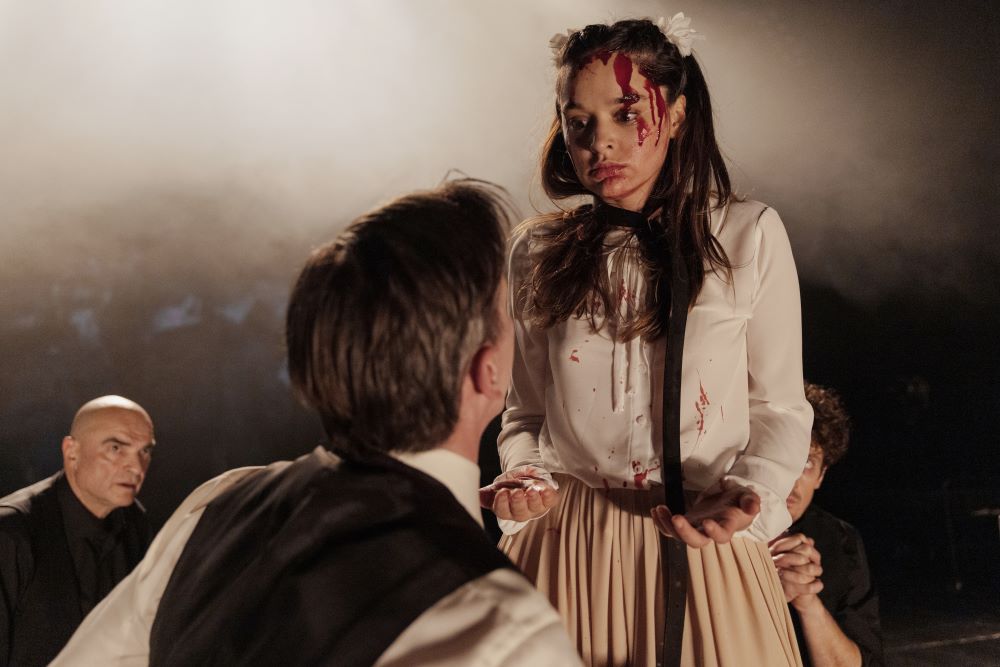
Even though Abramović defines the erotic as a collective force permeating all areas of life and argues that it must find a public form through artistic and political practices lest it turn into violence and war, the whole scenery of Balkan Erotic Epic feels strangely devoid of life. The most energetic part of the performance is, in fact, the voyeur-visitors rushing from one stage to another, aggressively paving their way through the mass of 1,500 people as if a pathological case of FOMO had befallen them. And yet, while everything in the performance screams the conflict between Eros and Thanatos, fertility and death, desire and decay, there is little excitement in these opposing poles, as the imagery feels too clichéd. This is partly due to the profoundly unsensual materiality of the set design by Anna Schöttl: gigantic papier-mâché wieners rising from artificial soil, plastic skeletons, synthetic corpses resembling low-budget dolls from the horror ride at your local Goose Fair — an entire ecology of ersatz matter. The life energy Abramović seeks to invoke has little chance of flowing through a landscape made almost entirely of inorganic material.
Once, Roland Barthes claimed, “There nowhere is, nor has been, a people without narrative.” In Balkan Erotic Epic, Abramović turns to folk traditions surrounding sexuality, fertility, death and the relationship between humans and nature, reframing them as a monistic epic of the Balkans. What is genuinely epic about the performance is not only its scale, but the way in which it surprisingly echoes the oral tradition of word-of-mouth storytelling. Wherever the voyeur-visitor happens to be, gazing upon the different rituals — Black Wedding, Knife Dance or Massaging the Breast / Orgy, and so forth — there is a polyphony of sounds spilling from one scene into another. Voices, digitally played music and live instruments overlap across the vastness of Kraftzentrale, creating an auditory space in which everything boundlessly converges into one collective whole.
Stretching from 7th-century Podravje in Slovenia, through 4th-century Braničevo in Serbia, to 19th-century Vladimirskaya guberniya in Russia, Balkan Erotic Epic sets out to dramatise centuries-old fertility rituals on a monumental scale. Yet beneath all the spectacle, it barely scratches the surface of the cosmos it claims to explore. Abramović seems to have lost touch with the very thing that once differentiated her work and made her the groundbreaking artist she is deservedly celebrated as today: the real — or, to use a more common term: authenticity. She has spent decades insisting on the distinction between performance and theatre. For her, acting means taking on the role of somebody else, whereas performance, by contrast, is rooted in the real. For all its scale, spectacle and theatrical bravado, the stage version of Balkan Erotic Epic feels heroically removed from that very principle. It gives us the image of ritual without its lived experience, the spectacle of collective memory without any powers of recollection, and the body without the life that makes it so painfully perishable… and therefore real.
Credits
Concept, Artist & Director: Marina Abramović/ Co-Director: Georgine Maria-Magdalena Balk/ Director of Durational Performance: Billy Zhao/ Choreographer: Blenard Azizaj/ Film Director: Nabil Elderkin/ Composers: Marko Nikodijević & Luka Kozlovački/ Light Design: Urs Schönebaum/ Set Design: Anna Schöttl/ Costume Design: Roksanda Ilinčić/ Animation Design: Sonia Alcón & Fredrik Nordbeck/ Creative Consultant, Singers: Svetlana Spajić & Aleksandar Timotić/ Producers: Martha Wilson & Yasemin Kandemiroğlu
Singers & instrumentalists: Dragana Jovanović, Svetlana Spajić, Aleksandar Timotić, Valerie Barr, Maxim Kemp, Will Bird, Grace Harman, Georgine MacDonell Finlayson, Sam Milton, Emilio Yànez Ruiz, James Seabrook, Alessandra Cesarato & Natascha Jakobs-Linssen
Dancers: Louis Baxter, Elena Cattardico, Molly Crabtree, Chiara Duccini, Ayesha Fazal, Lucy Harries, JP Hon, Spike King, Mak Korda, Gabriella Lemma, Ting Lee, Margherita Mattia, Sara Maurizi, Nicole Nevitt, Vilim Poljanec, Emma Poyer, Dominic Rocca, Clara Selberg, Sophie Thomas, Jack Trotter, Yue Ying Ho
Performers: Elke Luyten, Maria Stamenković Herranz, Herma Auguste Wittstock, George Adams, Lily Antonia, Anna Berndtson, Gloria Carobini, Rowena Gander, Owen Gaynor, Vanda Hagan, Tom Halls, Smila Vita Hoppe, Neil Jacob, Jakob Jentgens, Moonjoo Kim, Goa-Louisa Kollewijn, Florian Kreßer, Maisha Kungu, Julian Mattlinger, Francesco Marzano, Ali Matthews, Lizzy Owen, Gaia Pellegrini, Konstantin Pütz, Janina Schweitzer, Yuma Sylla, Evgenia Tsanana, Stylianos Tsatsos
Further reading: Interview with Balkan Erotic Epic choreographer Blenard Azizaj: “Dance is a way of telling stories through the body”
Berina Musa is a writer, dramaturg, and critic based in Sarajevo and Freiburg. She studied German linguistics, literary studies, and art history at the University of Freiburg and is currently completing a second degree in dramaturgy at the Academy of Performing Arts in Sarajevo. Her plays and short films have been presented at the Bosnian National Theatre Zenica, MESS, the Sarajevo Film Festival, and the Mostra Internazionale del Nuovo Cinema di Pesaro.