Sarajevo War Theatre, premiere 24 March 2026
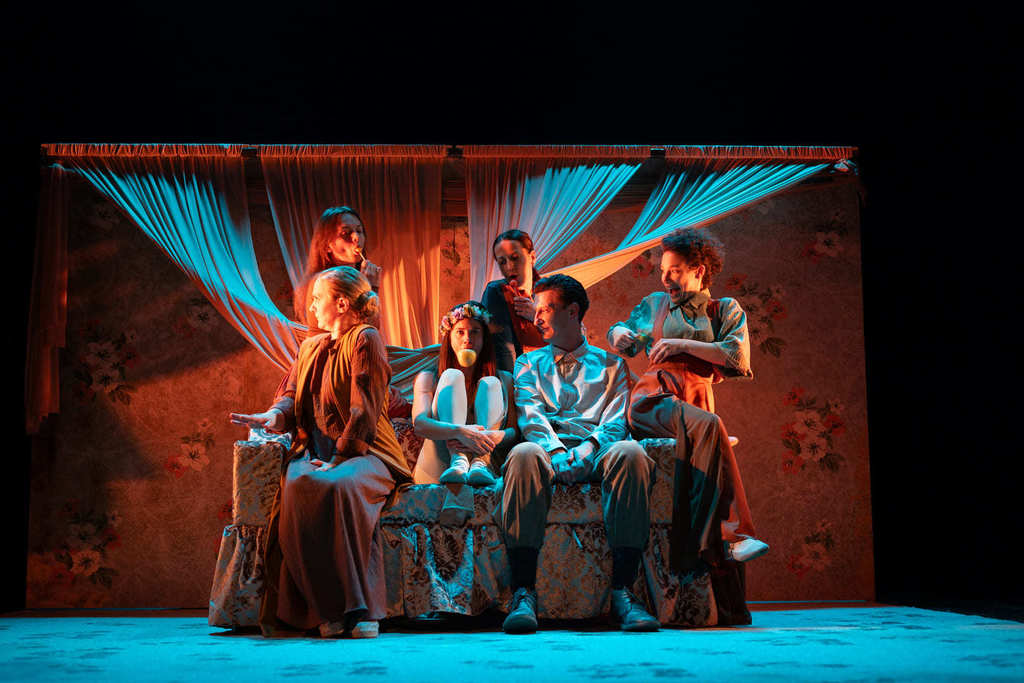
A window is embedded in the wall, yet it leads nowhere and reveals nothing. Behind its pale curtains, a female chorus appears almost mummified, suspended between presence and absence. From within the folds of fabric, their hands emerge and point toward a direction that may be the future awaiting the orphan born between them. It is an opening image caught between birth and prophecy, intimacy and ritual, one that immediately announces Metamorphosis: Genesis of a Decline as a theatrical myth governed less by realism than by symbolic association and poetic vision.
This is neither the first staging of one of writer Teodora Marković’s works in Sarajevo nor is it her first collaboration with director Luka Jovanov. Both alumni of the Faculty of Dramatic Arts in Belgrade, they previously collaborated on About Love (orig. O ljubavi), a theatrical performance developed through an artist residency at the Sarajevo-based art collective Station3 at Collegium Artisticum in March 2025.
There are certain similarities between the two projects, especially dramaturgically, as both of Marković’s plays span a wide range of time. In About Love, it was centuries; in Metamorphosis: Genesis of a Decline, it is the lifetime of a single heroine. The play follows the biography of an orphaned girl through different stages of her life, tracing a distinctly female experience marked by ambition, longing, emotional displacement and finally, her decline.Then again, both plays have one immanent flaw: in attempting to tell the story of all love, or in this case the story of the female experience as a whole, the play turns into a synecdoche, a figure of speech in which a part is used to represent the whole. For the sake of universality, however, the narrative becomes so generalised that it is difficult to grasp the protagonist as a singular human being rather than merely an emblematic idea.
Formally, Metamorphosis: Genesis of a Decline evokes the structure of a classical Greek tragedy: it is written in verse, follows a pyramidal dramatic composition, and draws on other ancient devices, such as a chorus that comments on the narrative, and the use of episodic elliptical structuring reminiscent of classical dramaturgy. Yet, despite a title that foreshadows catastrophe, the play neither culminates in a fully tragic ending nor offers reconciliation. Instead, it concludes in a kind of digression. The death of the mother, which should perhaps function as the emotional climax, arrives almost as a transitional state, leaving the narrative suspended in a liminal space scented by blossoming linden trees. The story feels unfinished, without intention, not as if the protagonist’s life simply continues beyond the frame of the play, but as if something is sincerely missing.
Marković privileges metaphor over mimesis, atmosphere over action, and associative imagery over psychological realism. What emerges is a work that is ultimately more poetic than dramatic. While this creates several striking moments, the text at times lacks emotional depth and coherent character development. The heroine often appears more as a symbolic figure than as a fully embodied dramatic character.
Still, Marković accomplishes something genuinely admirable and bold: she dares to experiment with form, meaning and theatrical language instead of taking the safer, more conventional route. Formally, the play constantly seeks to surprise through unforeseeable artistic turns and abrupt tonal shifts. Dramaturgically, however, this approach becomes problematic, as the piece occasionally borders on becoming an art pour l’art exercise: aesthetically captivating, but emotionally self-contained, like a beautiful object referring only to itself; whereas, so it seems, rather aims to refer to an abstract whole.
Metamorphosis: Genesis of a Decline
Luka Jovanov’s direction follows a similar logic. Scenography, ambient lighting and a bass-driven, multifaceted soundtrack form the foundation of his concept, which, much like Marković’s dramaturgical approach, is more poetic than dramatic. His visual storytelling is often powerful and sensuous, but it cannot entirely compensate for the emotional and narrative gaps within the text itself. With that comes a mise-en-scène clearly influenced by contemporary dance and other performance forms that place the actor’s body at the center of expression. At times, these choreographed movements and tableaux become repetitive, yet overall the performance maintains a compelling visual rhythm.
Among the most memorable moments is the opening scene, which immediately establishes the production’s dreamlike and melancholic tone. Equally striking is the electro-kolo sequence during the party episodes, where the protagonist attempts to escape reality through dancing, drinking and fleeting social encounters. Yet it is precisely there, on the same dance floor that was supposed to serve as her refuge — a temporary space of release and emotional rest — that her peace is shattered by the man who will irreversibly alter the course of her destiny.
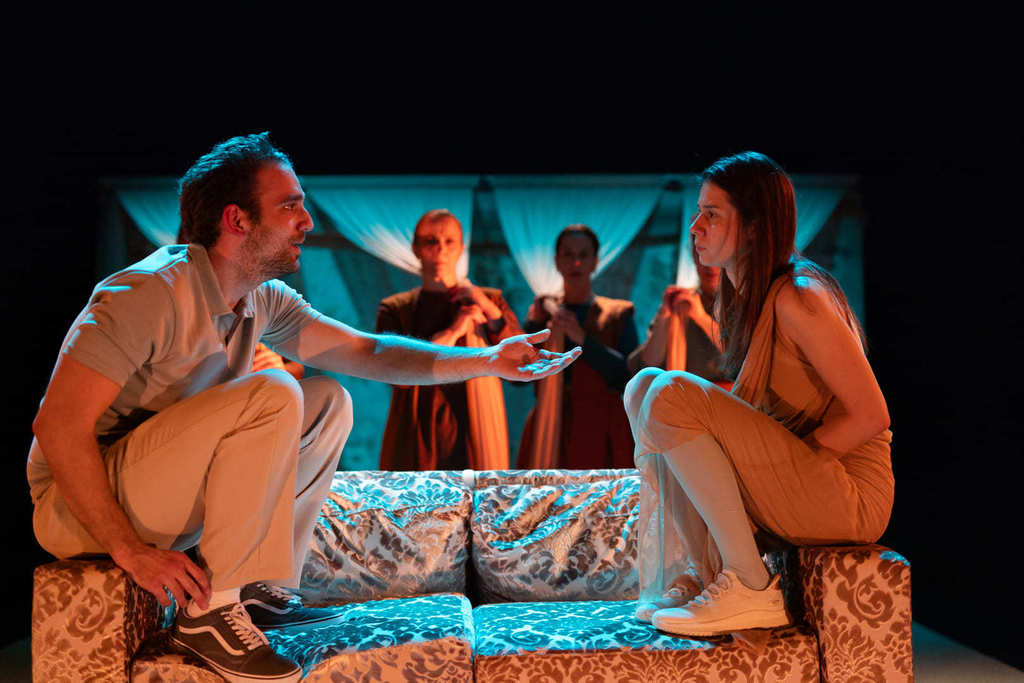
As Jovanov places such strong emphasis on visual storytelling, set and costume design become essential dramaturgical tools and, therefore, independent sources of meaning in their own right. Monika Močević, an established costume and set designer who has worked extensively across theatre productions in Zagreb and Sarajevo, relies heavily on materiality. She foregrounds the softness of the meter-long fabrics, which at times function as the curtains of a realistic living room and at others become metaphors for the interiority of the female body — even the womb itself. The visual language is dominated by tender beige and rose tones, creating an atmosphere suspended somewhere between intimacy and dream.
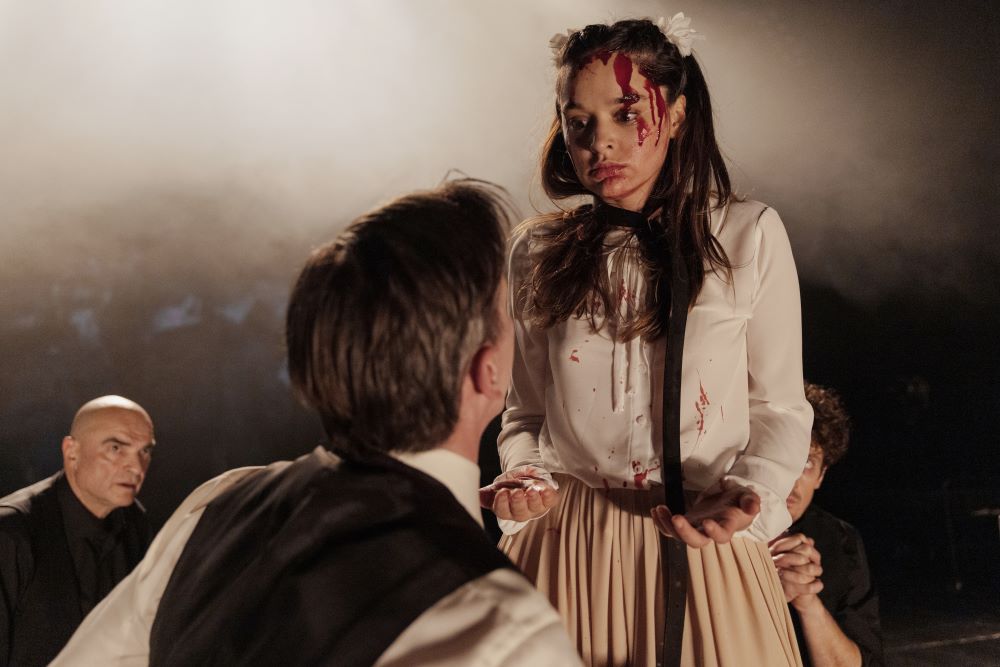
The acting ensemble carries this poetic world with varying degrees of success. Hana Zrno brilliantly embodies the different life stages of the protagonist, moving fluidly between fragility, rebellion and emotional exhaustion. Her performance occasionally recalls Emma Stone in Poor Things — particularly in the heroine’s childlike curiosity and gradual confrontation with the violence of adulthood.
Selma Alispahić, as the mother, represents not only an authority figure within the protagonist’s life, but also the authority of acting itself. Her grace and grandeur create a stage presence that strikes almost like lightning, as though emerging from some deep and ancient emotional reservoir. The production’s most powerful scene belongs to her: a monologue in which the mother gradually transforms into a child. In that moment, daughter becomes mother and mother becomes daughter — a painful inversion that briefly reveals the emotional complexity the play is often searching for elsewhere.
The remaining cast members mostly portray fragmented or stereotypical figures, which makes it difficult for them to develop fully layered dramatic identities. Nevertheless, Sead Pandur, Ana Mia Karić, Džana Džanić, Matea Mavrak and Faruk Hajdarević contribute with strong physical presence and a collective energy that sustains the performance’s rhythm.
With a committed ensemble led by the mother-daughter duo of Alispahić and Zrno, Metamorphosis: Genesis of a Decline succeeds in intriguing both visually and lyrically. Still, the sense of wonder it seeks to evoke rarely lasts long enough to leave the spectator in a state of lasting emotional awe or intellectual clarity. What the production ultimately lacks is stylistic continuity and a stronger dramaturgical arc that would grant the protagonist’s story the emotional depth it deserves. Yet considering the youth of both the director and the playwright, such shortcomings may also be understood as part of an artistic process still courageously searching for its definitive form. If both of them, Marković and Jovanov, are eager enough to continue this quest, one day, their courage might lead them to the laurel wreath — metaphorically and literally.
Credits
Direction: Luka Jovanov/Text & Dramaturgy: Teodora Marković/Set & Costume Design: Monika Močević/Assistant to Set & Costume Designer: Nermina Hrnić/Composer & Sound Designer: Tihomir Radić/Choreographer: Emir Fejzić/Light Design: Nedim Pejdah/Make Up Artist: Sanela Aličković Ćatović/Set Manager: Goran Filipović
Cast: Selma Alispahić, Hana Zrno, Sead Pandur, Ana Mia Karić, Džana Džanić, Matea Mavrak, Faruk Hajdarević
For more information, visit: sartr.ba

Berina Musa is a writer, dramaturg, and critic based in Sarajevo and Freiburg. She studied German linguistics, literary studies, and art history at the University of Freiburg and is currently completing a second degree in dramaturgy at the Academy of Performing Arts in Sarajevo. Her plays and short films have been presented at the Bosnian National Theatre Zenica, MESS, the Sarajevo Film Festival, and the Mostra Internazionale del Nuovo Cinema di Pesaro.