Zagreb Youth Theatre, premiere 20th March 2026
To say this was the most awaited premiere this season in Zagreb might be a bit of an overstatement, but it certainly was for me. As a fan of Nina Rajić Kranjac’s work, I could barely contain my excitement when it was announced she was adapting plays by Miroslav Krleža, the most important Croatian writer of 20th century. Krleža in Croatia is like Chekhov in Russia or Ibsen in Norway – a household name of a national literary canon.
One of the most notable aspects of Krleža’s playwriting is the multilingual intellectual language his characters speak, with decorative and sometimes even poetically descriptive stage directions. The plays are also rich with references of the period in which the plots are set in, to make it even more challenging for future adaptations. The two plays Rajić Kranjac and dramaturg Goran Injac have chosen, Camp and Golgotha, are both from Krleža’s early expressionistic phase (1920-30s); there’s a certain angst to them, plot and character-wise. Because of this historical and literary significance, there’s a weight of expectation when it comes to adapting Krleža in Croatian theatre.
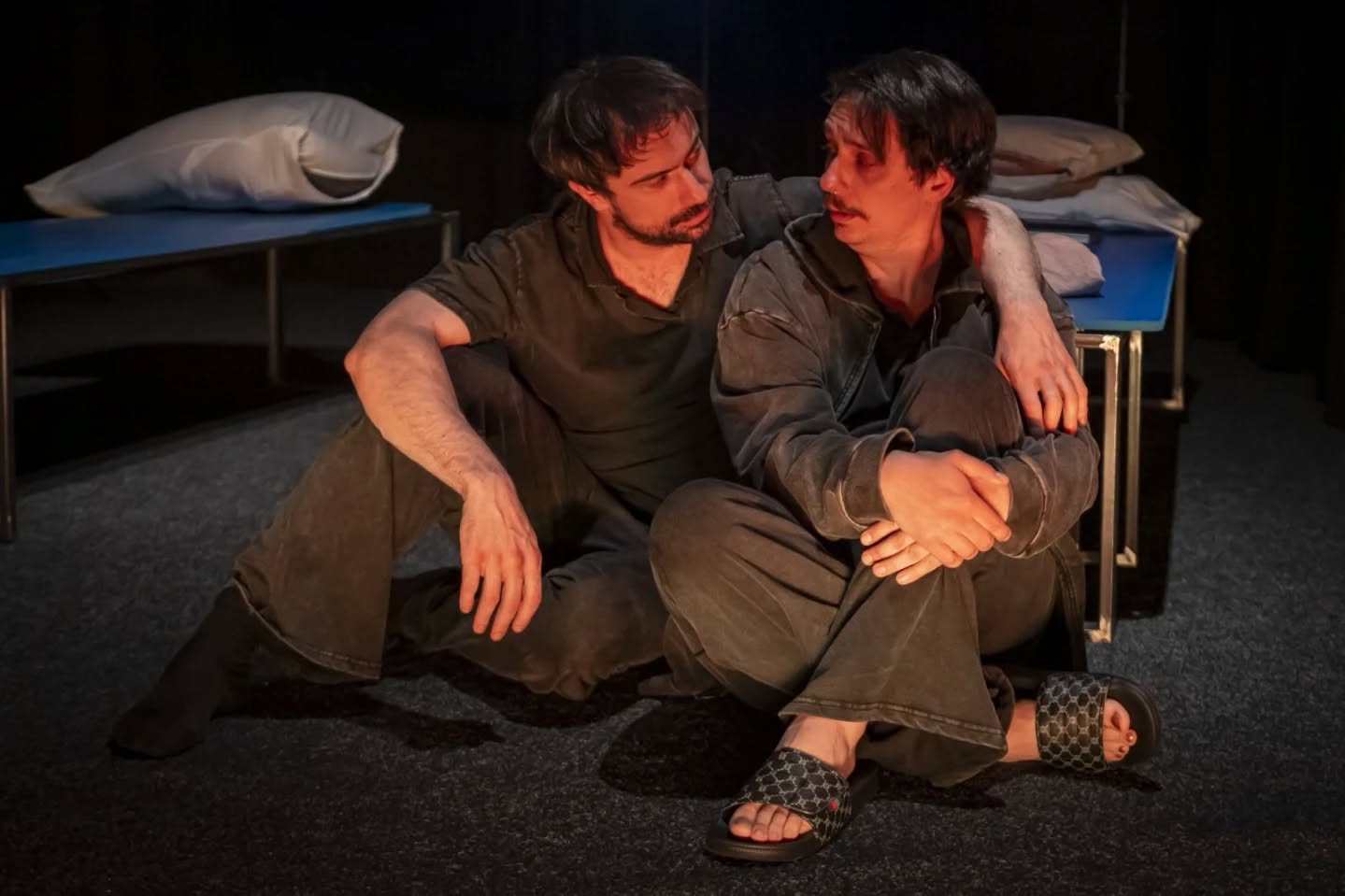
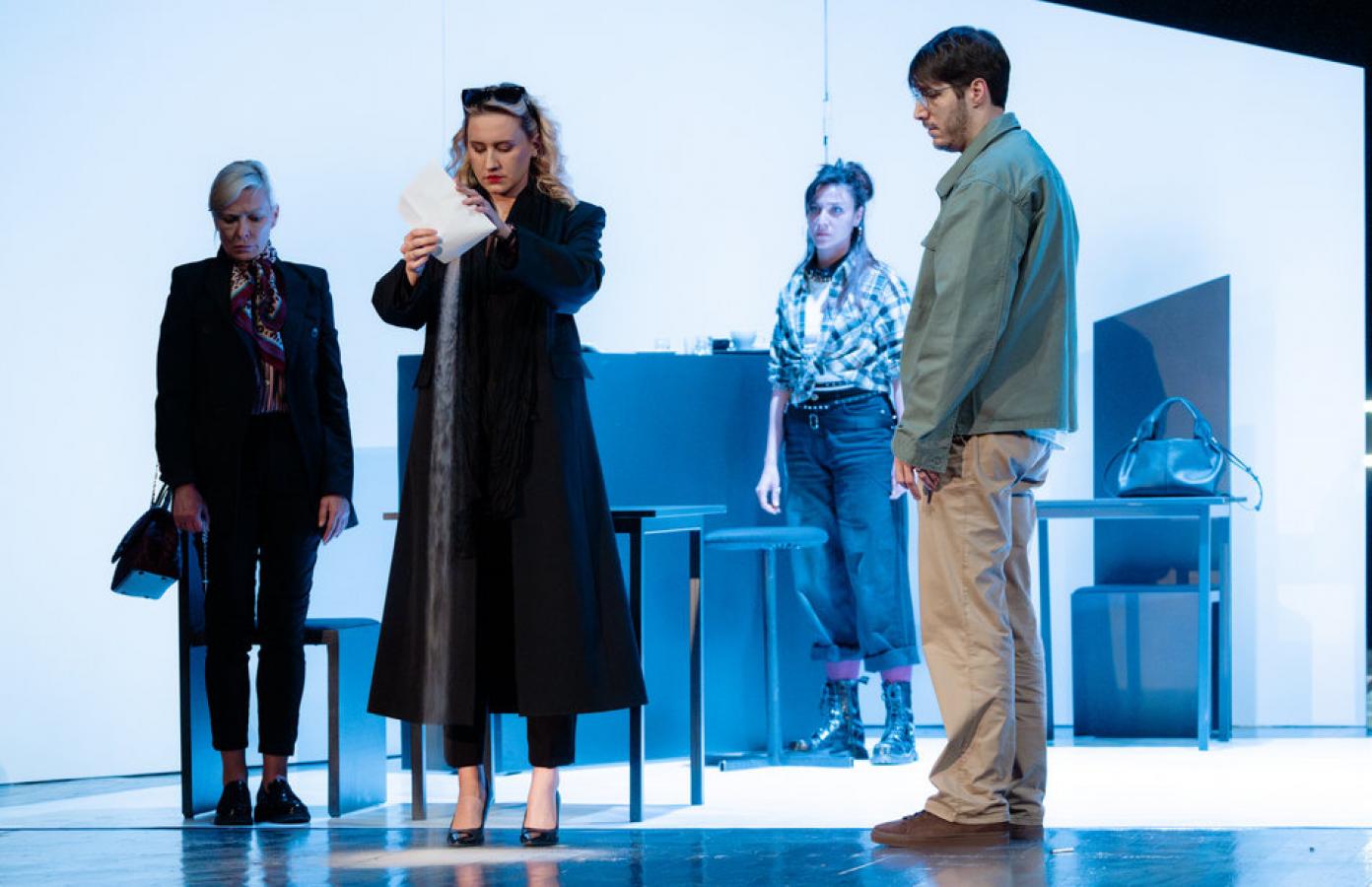
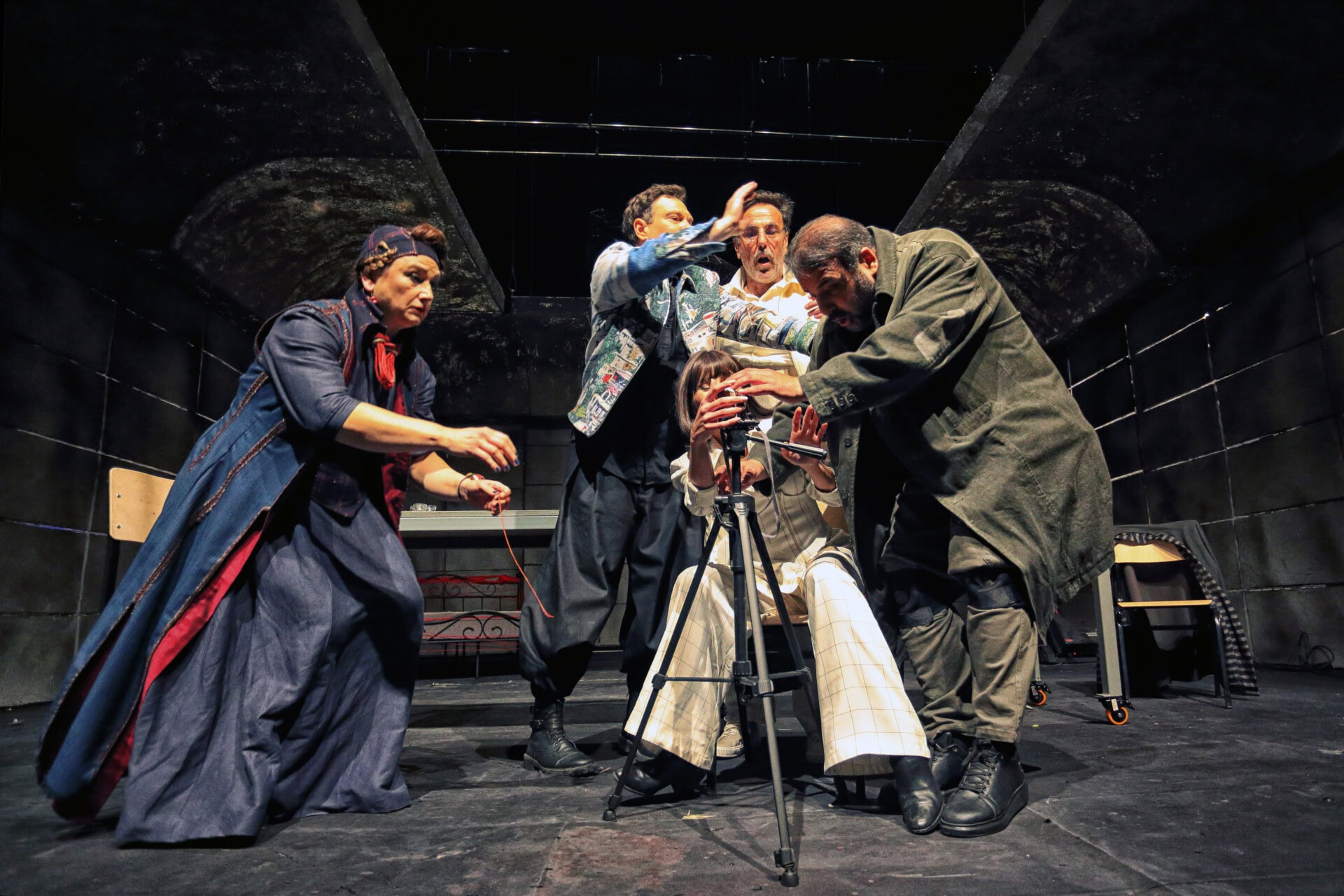
The first thing to say is that the dramaturgical combination of these two plays works really well. Camp is set in 1916 during the Second World War in a camp in Galicia, today’s Poland, while Golgotha takes place in 1919 in a port town, closely following the aftermath of the war inside a shipyard during the workers’ strikes. Besides the plays’ close timelines, these two works complement each other’s plots – they both feature a protagonist who tries to keep his place within a social structure and his peace of mind from the horrors of war or politics. This is additionally enhanced by the way in which scenes from both plays simultaneously follow one another, sometimes even conducting at the same time. The stage design by Urša Vidic follows the simultaneous dramaturgy, it looks messy on the first glance with many movable elements until you spot two doors on the centre of the stage, one white and the other red, dividing the performing space into two dramatic worlds where the ‘older’ Camp influences the chaos of the ‘newer’ world of Golgotha. The two doors end up functioning like signals for the audience where one play ends and the other starts.
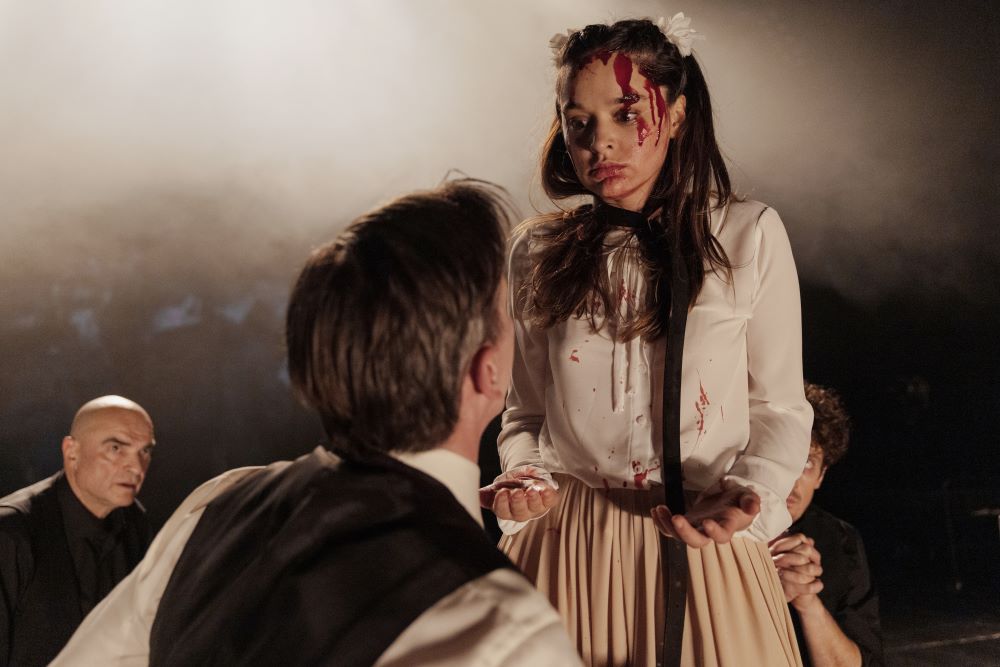
Another adhesive intervention is Petra Svrtan’s role as Someone in Camp and Everyone in Golgotha. Apart from taking part in smaller roles from both plays, she recites the stage directions which illustrate the scene, characters’ descriptions and everything else Krleža wrote to thoroughly describe the drama’s atmosphere. Svrtan essentially holds the role of a narrator, often ‘interrupting’ dialogues by underlining the pauses from the text. She starts of the performance, after a piece of plaster suddenly fell from the top of the stage, with a monologue on the wars that seemingly never end on our planet and how it’s clearly connected to capitalism and that humanism as a faith in common reason is an illusion long gone. Within the four-hour long duration of the performance, the war-torn world image will slowly hit closer to home, mostly in the Golgotha parts, with a reality check for the local socio-economical context of growing privatization and precarity. The hard truths are effectively designed with various symbolisms and signs, with that unmissable Rajić Kranjac’s stamp – it truly feels like getting a vision from a theatre machine, an ominous warning that comes (too) late.
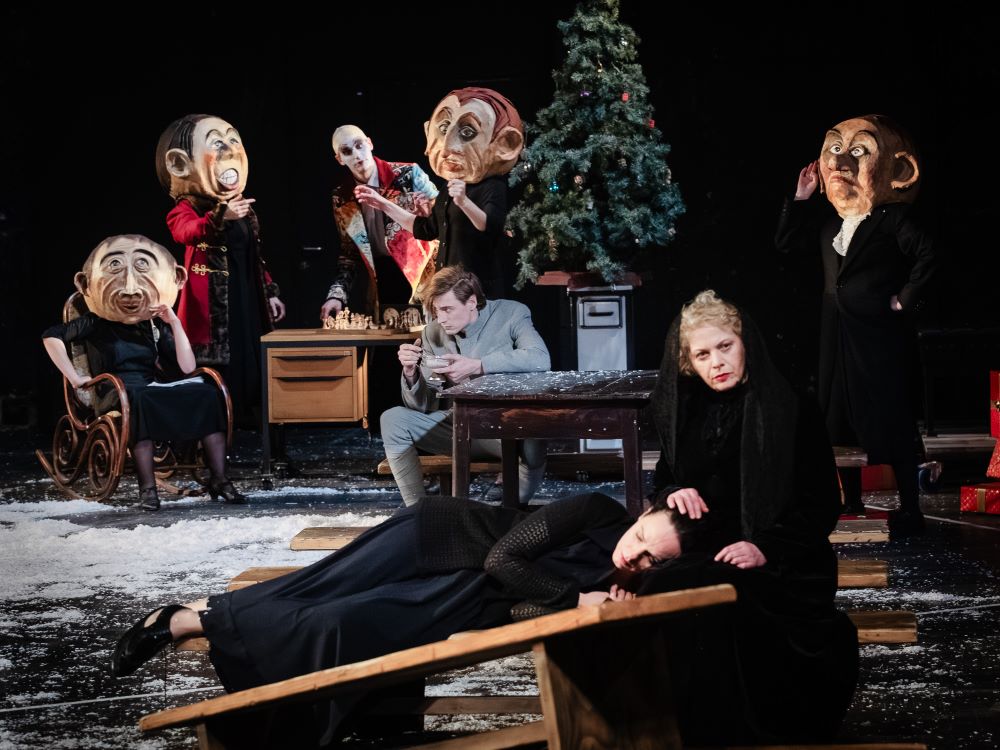
Camp/Golgotha, ZKM
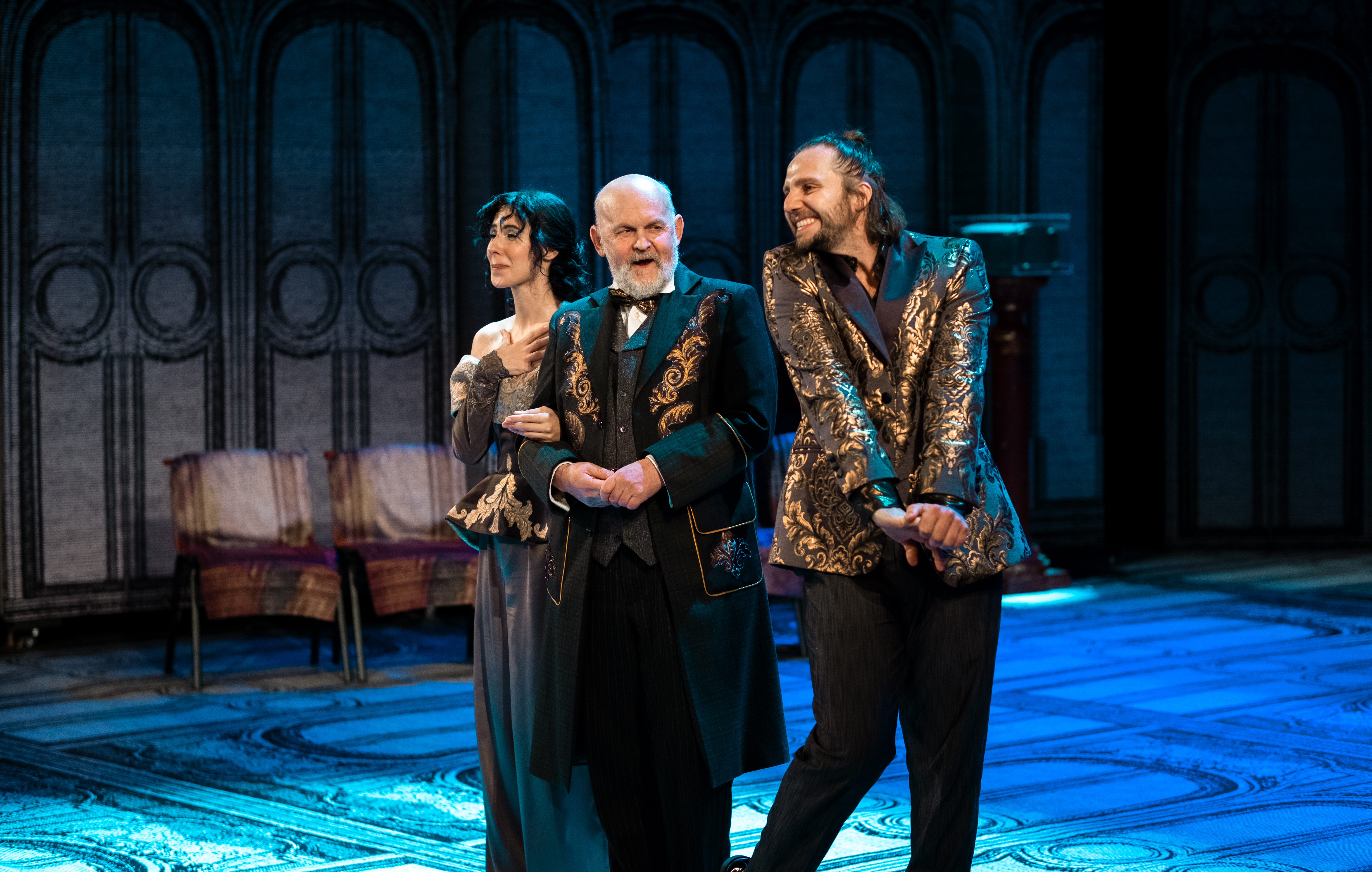
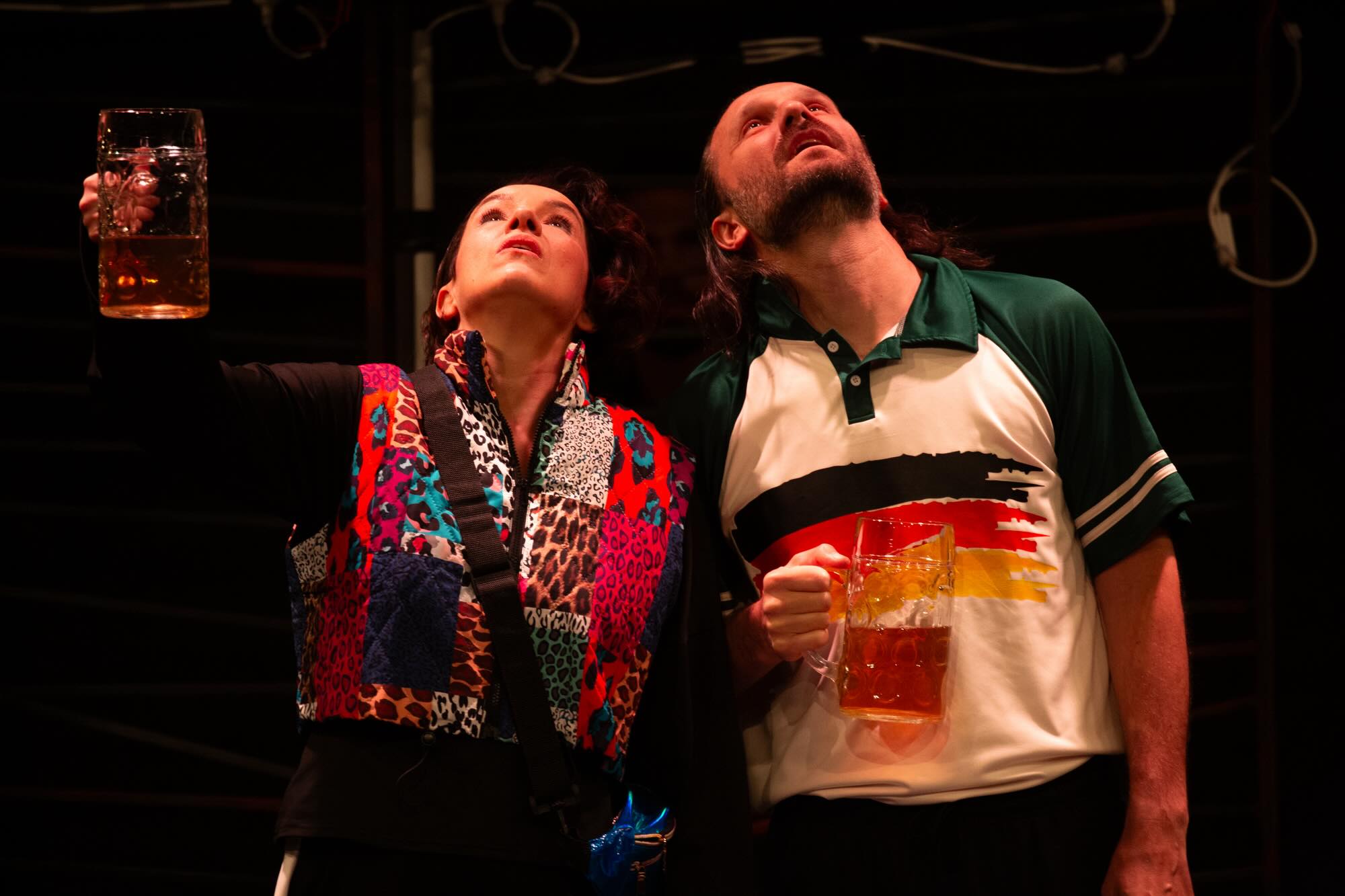
Sadly, these visual grandiose images ate up so much of the ensemble’s time, it’s a struggle to single out indivdual performances. The omnipresent carry-on smoke machine let out too much smoke at times to the point it took over from the actors and their performances. Nevertheless, two of them managed to stand out from the cumulative scenic symbolism: Rakan Rushaidat as Walter in Camp and Katarina Bistrović Darvaš as both Baroness Meldegg-Cranensteg in Camp and the Doctor in Golgotha. Her Baroness is a playful, lustful noblewoman who, of course, takes young men for lovers, such as Horvat (surprisingly underwhelming performance by Luka Knez), a young intellectual and pianist, the central character in Camp. She represents the privileged rich who aren’t as affected by war as others, particularly since her husband is in the military. Speaking of military faces, Rushaidat easily fits the role of a cruel lieutenant who takes pleasure in torturing and bullying his subordinates; he genuinely enjoys the war horrors and violence it brings. His character is the antagonist to Horvat who, despite seeing through the militant propaganda, fails to disobey the Lieutenant’s order to kill an old lady Romanowicz – Russcukova (Mia Melcher) for cursing out the Baroness out of despair caused by the poverty.
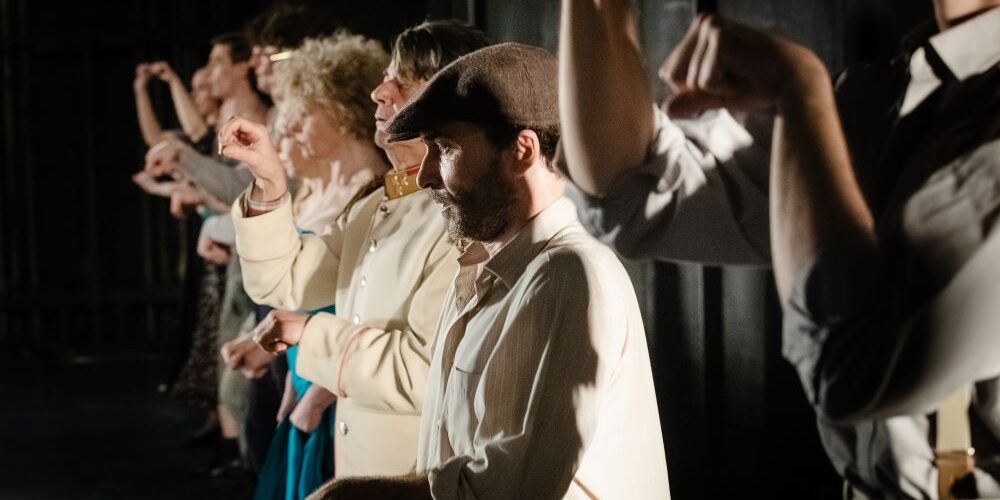
Contrary to Horvat, Kristijan (a convincing performance from Ugo Korani) as the main character in Golgotha conspires against his fellow comrades to supress the workers’ revolt in order to gain more personal power and money in the union. Both characters, Horvat and Kristijan, are Krleža’s typical protagonists – young pseudo-intellectual men who are more versed in theoretical words than actual praxis/action, imagine Dostoevsky’s Raskolnikov. They talk a big game, but can’t handle its consequences. Despite their different morals and agendas, both of them will face a tragic end and lose their most precious piece of themselves. Both Camp and Golgotha have a pessimistic ending with an almost apocalyptic illustration which was creatively executed on stage, making it look like a renaissance painting.
After Svrtan’s final line of stage direction, there’s darkness and owl noises you often hear before sunrise. She starts another added monologue like the introductory one to finally wrap up this long dramatic journey. Even though the two plays end rather depressingly, this monologue tries to spin the dreary atmosphere into a slight positive vibe. Yes, wars seemingly never end and they won’t for a long time, the humanity will continue to kill itself in endless cycles of violence. However, we all need to have faith and deep down we feel that we know how one day, a final war will break out, a war to end all other wars. The utopian existential sentiment is an interesting spin on the two dramas with devastating plots filled with death and suffering – the only question remaining is whether you are willing to believe this fatalistic idea or is even that too convoluted to understand.
Whatever your personal philosophical beliefs are, Rajić Kranjac’s debut in Zagreb will certainly leave a mark on the local scene. The complexity of Krleža and his works are tied up with lush theatre symbolism and references to the current state of the world in a way that takes time to digest.
Credits:
Director: Nina Rajić Kranjac//Adaptation: Nina Rajić Kranjac i Goran Injac//Dramaturg: Goran Injac
Scenography: Urša Vidic// Costume: Marina Sremac
For more information, visit: ZeKaEm.hr
Further reading: Interview with Nina Rajić Kranjac: “Questions of identity fascinate me”

Nora Čulić Matošić (1998) is a student of Comparative Literature (MA) at the Faculty of Humanities and Social Sciences in Zagreb. She has written theatre criticism for the Croatian radio programme Theatralia and web portal Kulturpunkt.hr. Besides theatre, her interests are other forms of performing arts (particularly dance performances) and film.