Serbia is in the midst of Europe’s largest student protest movement since 1968, but you wouldn’t know it from looking at the work produced on its institutional stages. With so many cultural workers supporting the protests, critic and dramaturg Borisav Matić asks where is the work that reflects that?
As the theatre season comes to an end in Serbia, I am grappling with a seemingly contradictory feeling, I have never felt more alienated from the institutional repertoire and yet I’ve never felt more impassioned to use culture as a space of freedom when such places are progressively under threat by the autocratic regime in Serbia.
Serbia is currently experiencing the greatest disruption of cultural production and cultural life since the end of World War II. The majority of cultural institutions have seen their funding slashed by at least 50 percent compared to 2024 levels. Many festivals that have continuously existed since the middle of the 20th century were cancelled last year, including FEST, the most important national film festival, and the oldest theatre festival in the country, Festival of Professional Theatres of Vojvodina, which was founded in 1947. The Ministry of Culture, municipal and provincial governments effectively cancelled the majority of open calls for co-financing cultural projects last year and those that were realized saw funding stream into suspicious newly founded organization with no track record but that are connected to the ruling Serbian Progressive Party (SNS). The independent scene has effectively been left with no funding from domestic authorities. In addition to financial coercion, many cultural workers across the country were fired from institutions for engaging in protest, as documented in the Chronicle of Repression by the self-organized Community of Art and Culture (ZUK).
The repression is a coordinated vengeance of the autocratic regime led by the president Aleksandar Vučić and his SNS party. After the eruption of student protests in November 2024 that have created the most massive and decentralized anti-authoritarian movement in contemporary Serbian history, the government is on track to punish anyone who has taken a part in it. And the cultural community has been a vocal member of the movement from the beginning. In February 2025, theatres from 4 cities staged an unprecedented week-long strike in support of students, artists performed shows and participated in other events at the faculties while they were under blockade and high-profile actors became public faces of support for the movement. Perhaps the most distinguishable protest gestures were banners and red hands that ensembles presented during curtain calls – red hands meaning “your hands are bloody”, directed toward politicians.
Yet it is highly ironic that these rebellious symbols stand in stark contrast to the shows actually being performed. A year and a half after the start of the social uprising, the repertoire of institutional theatres has remained largely indifferent to the current political moment. Shows have ranged from outright escapist to pretending to be socially engaged under thick layers of metaphors and allusions. In other words, if theatre historians from the future looked at the repertoire from 2026, they never would have guessed that Serbia is in the midst of Europe’s largest student movement since 1968.
So, what to make of this contradiction, that the vast majority of cultural workers are enthusiastically taking part in the anti-regime struggle, yet that same scene is creating conformist art? The first important thing to emphasize is that the collectives of almost all national and city theatres might be on the students’ side but their managing directors, who are appointed by respective levels of government, are not. The management tried to sabotage the strikes, pressured employees to not protest and has carefully calibrated the programme not to be too offensive to the regime. Few theatres that staged critically-minded work saw their managing directors dismissed by the government, as are the recent cases of Miloš Latinović being sacked as the head of BITEF Theatre and Ivana Nedeljković as the head of Theatre in Lazarevac. Incidentally or not, both houses had open doors to alternative practices and experimental aesthetics and rare bridges between the institutional and independent scene, which will almost certainly change under the new leadership.
Things get complicated when the leaderships of theatres are not only interested in maintaining the conformist repertoire but also in preserving the image of artistic and moral legitimacy, which is especially the case with more respected houses. And since the audience is almost exclusively comprised of citizens who have been marching on the streets in the last year and a half, the maintenance of that reputation became a necessity for the survival at the box office. Theatres balance these needs by collaborating with authors who are also talking a tightrope, signalling political engagement to audiences while not crossing the line that would anger the management and the government. Directors have, thus, often resorted to staging classics like Shakespeare’s Richard II and Alfred Jarry’s King Ubu that contain the critique of power on the universal level, but potential references to our very own tyranny of today are politically benign. By staging this appearance of critical taught, together with undeniable escapist examples like Atelje 212’s vaudeville Ode to Joy, the repertoire creates the illusion of “normal” life in Serbia at a time when nothing is “normal”.
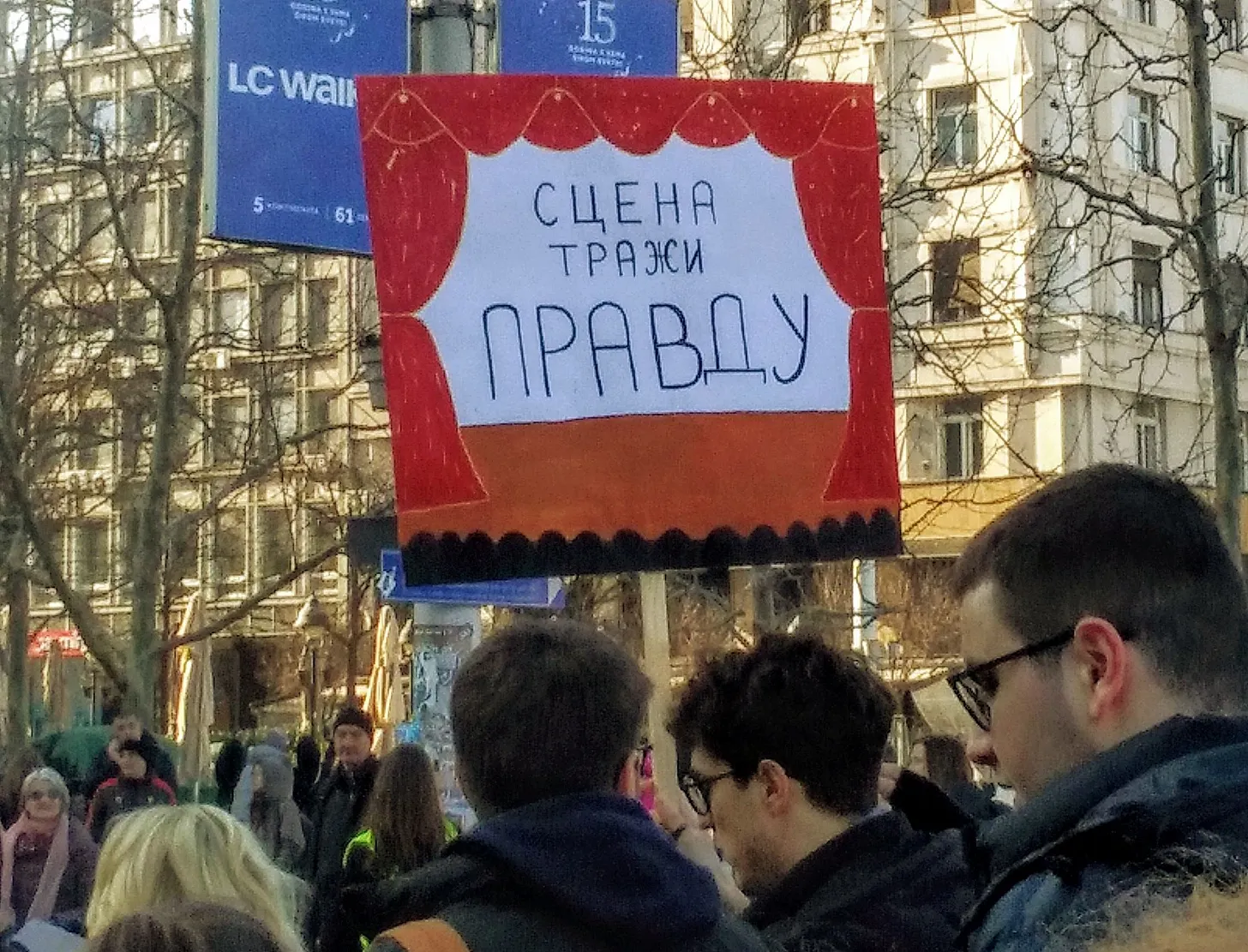
Protests in Belgrade
There is an argument to be considered, that I sometimes hear in theatre halls, that escapist art is necessary in difficult times like these, for the wellbeing of the audience. But this argument fails when put into a historical perspective. In the first half of the 1990s, theatres in Belgrade, in particularly Atelje 212 and Yugoslav Drama Theatre (JDP) as the biggest houses, based their repertoire on entertainment theatre by producing vaudevilles, melodramas and farces. At a time when Yugoslav wars were raging and poverty flourished in Serbia under international embargo, the scholar Aleksandra Jovićević notes in the 118 issue of Teatron (2002), the escapist trend demonstrated not only a high level of social disengagement but also the absence of empathy for the suffering of others. In other words, during the historical turmoil big theatres “minded their own business”, which in practical terms translated into entertainment for the privileged i.e. the city middle class shielded from the worst effects of social decay.
It’s only in 1994 when JDP started to slowly introduce anti-war shows into its repertoire. But the real pivot was in 1996 when the opposition to Milošević won local elections in more than 40 cities and towns, which created preconditions for certain institutions to become havens of free and critical art, which was both the case with JDP and Atelje 212. In this period classics were recontextualized and staged to directly relate to the social reality that the audience was living through but also a whole new generation of playwrights emerged who wrestled in their work with everyday life under harsh political conditions. Jovićević also notes that such works stayed longer on the repertoire compared to the boulevard shows, even if some of them were less aesthetically refined, because the audience had the possibility of catharsis by relating the problems on stage with their experience. Performances and plays from this period are still studied for its artistic merit and social relevance.
While certain institutions were temporary and changeable free spaces, the independent scene that truly formed only in the 1990s was at the forefront of opposition to Milošević’s rule. It organically intertwined its anti-war, anti-nationalistic and anti-fascist ideas with alternative artistic practices. Independent cultural centers were founded, like “Rex” and Center for Cultural Decontamination, and newly formed troops and collectives changed the history of domestic performing arts. But the independent scene back then was abundantly supported by international foundations, most notably by George Soros’ Open Society Fund, so much that some working conditions in culture of that dark period might be even enviable from today’s perspective. An artist whom I interviewed for a research project years ago told me how she used to go to the foundation’s center in Budapest, since Serbia was under sanctions, to pick up a sack full of money to fund her theatre company. The donors’ rationale for supporting culture was that it could be used for protesting against the autocracy and the war, if we want to be benevolent. But perhaps the rationale could have also been to destroy the remains of state socialism – perverted under Milošević, no doubt – and incorporate Serbia into the free market.
Today, foundations are hardly lining up to support Serbia’s dying cultural sector. Apparently, fighting an autocrat like Aleksandar Vučić who cozies up to politicians and investors from the East and the West doesn’t give you enough leverage. On the contrary, all embassies in Belgrade are collaborating with Vučić’s government in promoting EXPO 2027 that is supposed to take place in Belgrade, a project that the cultural scene has unanimously denounced as corrupt. “A disproportionate share of public funds has been redirected toward this project, concentrating resources within structures aligned with the regime, while further undermining the already fragile cultural infrastructure and leaving the majority of local artists and cultural workers without access to basic support”, reads a statement of the Community of Arts and Culture. The non-transparent nature of the project with inflated realization expenses drew numerous accusations that SNS is allocating funds to friendly businessmen at a time when they are a step away from loosing power.
Rare potential lifelines to Serbia’s independent organizations are EU grants from schemes like Creative Europe and Erazmus plus – if they are able to access them since competition for such calls is increasingly fierce as cultural organizations from across the continent also face defunding and hostile political environments. Thus, the Serbian scene is drowning in the Bermuda triangle of scarce international funds, virtually non-existent domestic funds and institutions that are under occupation by government appointees (unlike at the end of ‘90s, there is not a single city that’s not under the rule of SNS). These conditions have devastating affects on the independent scene. Many respected organizations receive little to no money annually and it’s become a laborious challenge for independent artists to make a living without resorting to commercial or work outside of culture. These financial pressures are long-term, systematic and caused by the neoliberal economy, but they are peaking at this very moment. They have achieved the government’s goal – forced the independent scene to fight for its existence and brought its production to a minimum. Thought the ultimate goal of suffocating this most vocal part of the cultural sector is far from achieved.
It is easy to spiral down the rabbit hole of ever-increasing repression in the cultural sphere but it is also important not to sideline incredible cases of creative resistance. The Center for Cultural Decontamination (CZKD) is currently functioning as a haven of free culture and debate with the policy of programming work that cannot be shown anywhere else. Considering the ever-present censorship in institutions and that CZKD has perhaps the only highly-functional theatre stage on the independent scene, their programme has been quite packed recently. The Cultural Center “Magacin” is an example of a different oasis, a semi-squat and self-organized collective of a few dozen cultural organizations. This free space functions with bare minimum resources but it bustles with its youthful spirit and humane and non- hierarchical approach to labor organization. There is a fair number of similar spaces in other cities, like the Alternative Cultural Center “Gnezdo” (AKC “Gnezdo”) in Kruštevac or the Village Cultural Center in Markovac (SKC Markovac), though many such centers face financial coercion and the threat of eviction.
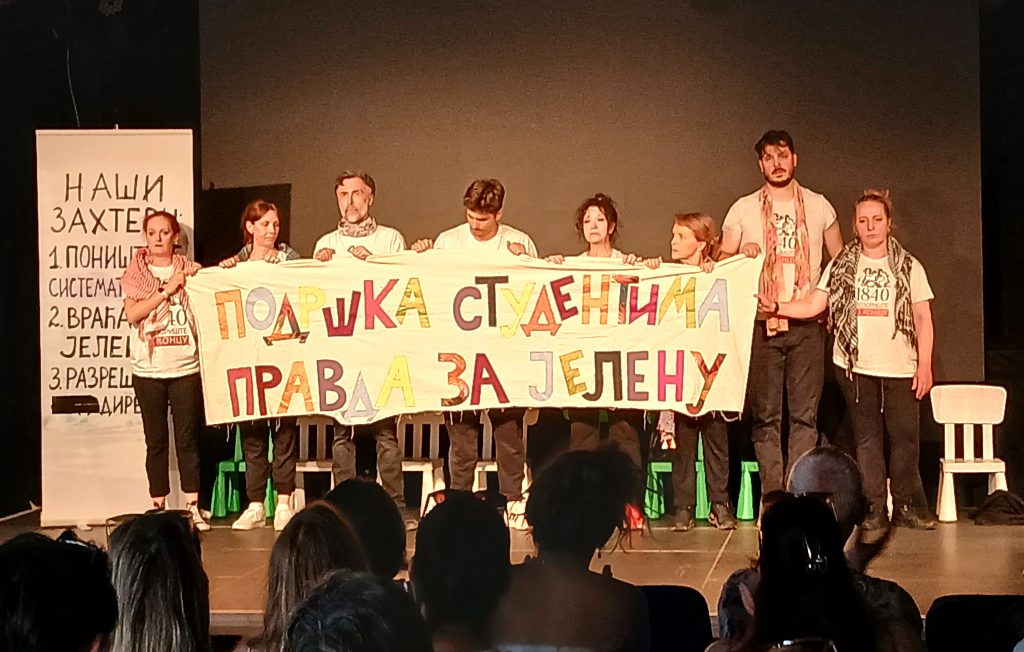
Ovo nije predstava by the actors of Šabac City Theatre
The cultural scene also learned a great deal from the student movement which is based around the idea that we must create alternative institutions of care and cooperation once the official fail us. When students occupied the Students’ Cultural Center in Belgrade for 5 months in the first half of 2025 – an institution that its corrupt leadership reduced it to a pale shadow of the artistic beacon it once was – they proved that a collectively lead cultural center can function with fantastic success. When the Board of the Belgrade International Theatre Festival (BITEF) censored last year’s programme of the curatorial team I was a part of, we organized an independent, guerilla edition of the festival with the slogan “BITEF is wherever we gather”. When the managing director of Šabac City Theatre prevented its ensemble from having a single premiere in the last season as punishment for protesting (she also fired an employee for the same reason), the actors created a performance about their experience outside of their home theatre, titled This is not a theatre show.
The last year and a half have shown that segments of the cultural scene are able of creating spaces of resistance and freedom even under harshly repressive conditions. And this should all be a reminder to us, if we managed to achieve this in such terrible environment, imagine what we could do in a truly democratic society. When it looks likely that SNS will lose the next parliamentary elections, which is the main reason why Vučić is refusing to call snap elections, it is tempting to dream of this freer time. But cultural workers, joined with other sectors, are preparing for the hard battle ahead, for the campaign that is in a sense already under way and for all irregularities, to use a euphemism, on election day that will require swift and firm reaction. Certain bodies like the Association Independent Cultural Scene of Serbia and self-organized cultural workers in collaboration with students are creating strategies for the renewal and developments of the field after the political change. These prospects open a possibility that spaces of freedom in culture will no longer be isolated oases but the norm.
Further reading: Time for Change: How Serbian students are making theatre during the blockades
Further reading: Ne BITEF: The Pelicot Trial

Borisav Matić is a critic and dramaturg from Serbia. He is the Regional Managing Editor at The Theatre Times. He regularly writes about theatre for a range of publications and media.
He’s a member of the feminist collective Rebel Readers with whom he co-edits Bookvica, their platform for literary criticism, and produces literary shows and podcasts. He occasionally works as a dramaturg or a scriptwriter for theatre, TV, radio and other media. He's the administrator of IDEA - the International Drama/Theatre and Education Association.