Mladinsko Theatre, Ljubljana, premiere 26th February 2026
Camp is an aesthetic that is difficult to describe, one that in some way expresses the triumph of ‘style’ over ‘content’, of ‘aesthetics over morality’, and of irony over seriousness. And this, it would seem, is what director Tijana Zinajić wanted to achieve in The Comic Mysteries. But as Susan Sontag later wrote in Notes on Camp, in works where camp is deliberate, one can detect cynicism, which perhaps better describes Zinajić’s production.
The Comic Mysteries is a work written by Italian artists – Nobel laureate Dario Fo and Franco Rame. Fo was an artist renowned for his satire. He created theatre based on improvisation, the grotesque and the commedia dell’arte tradition. The themes of his work often served as a critique of the Catholic Church, which caused him many problems in Italy. At the same time, however, he sought to give a voice to those who usually don’t have one – the workers and farmers.
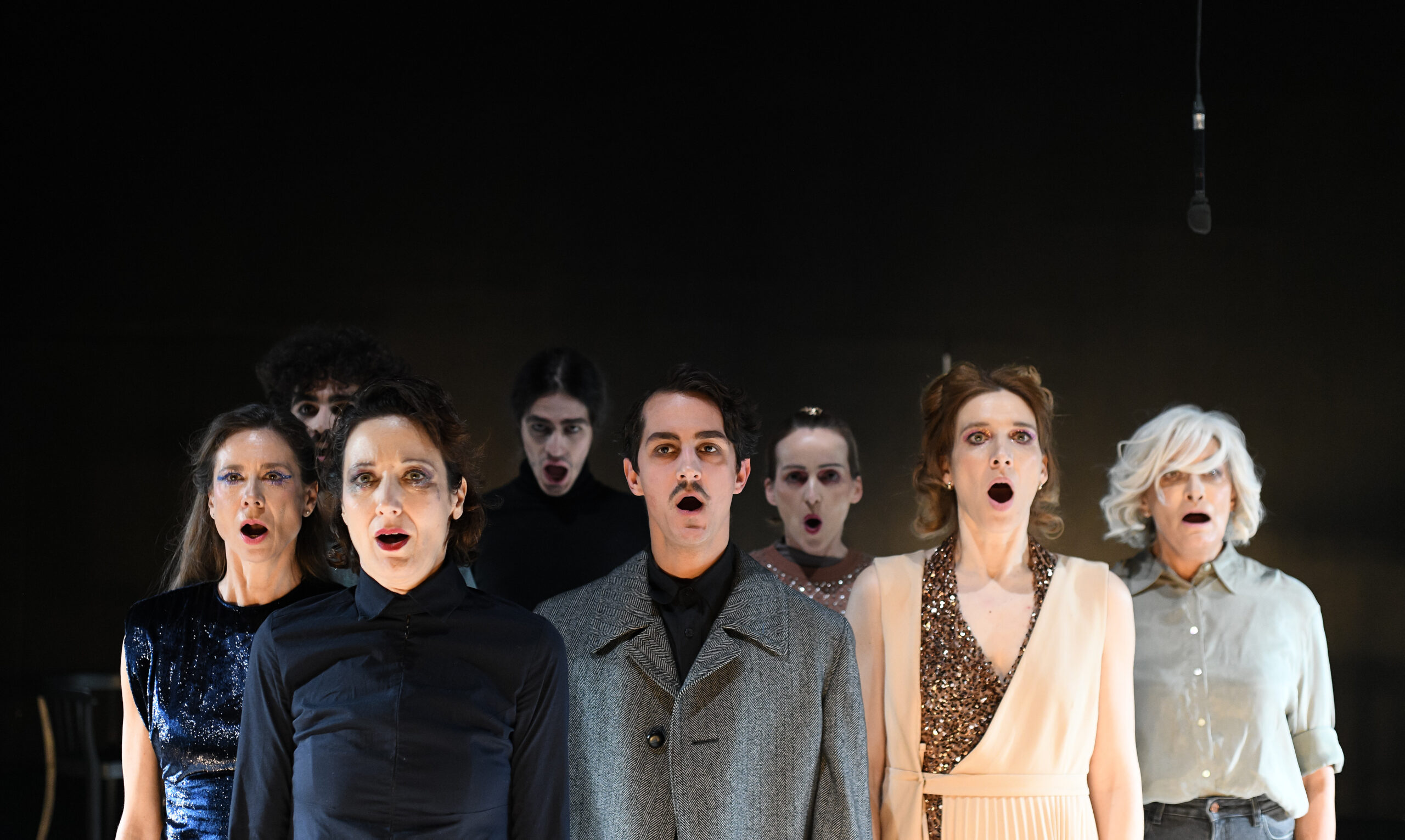
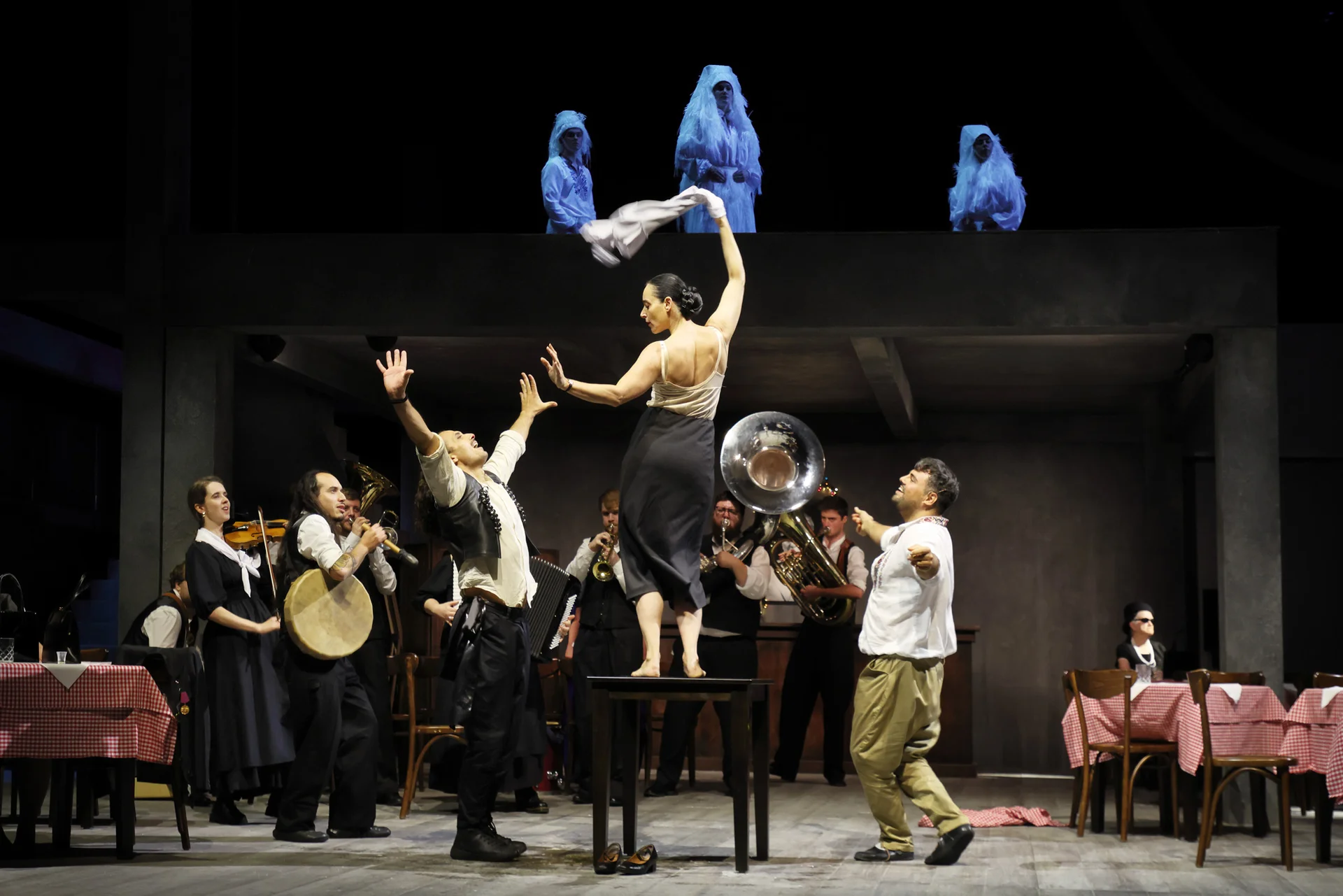
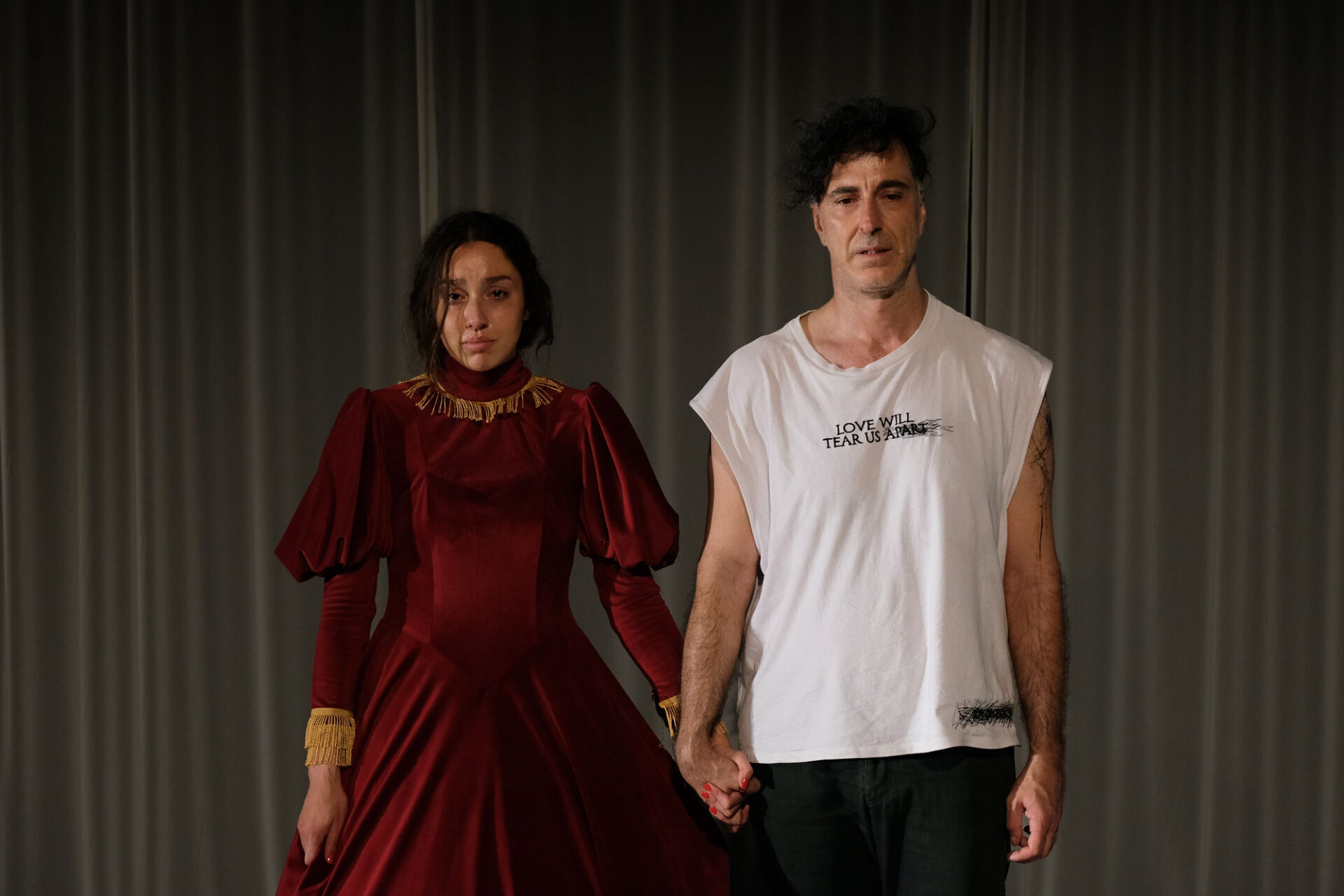
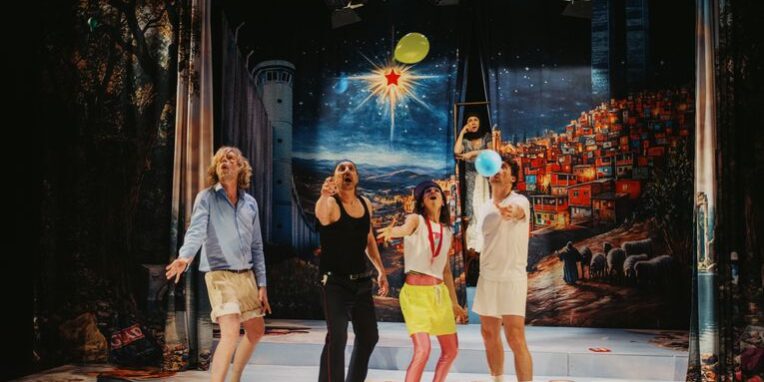
The aesthetic of Zinajić’s production is strongly camp. The set design, by Darjan Mihajlović Cerar, together with the costumes by Matic Hrovat, resembles a school nativity play. There are curtains bearing the face of Jesus and a backdrop depicting Jerusalem; all of this evokes religious kitsch while simultaneously referencing an older style of theatre that relied on painted scenery. The same applies to the costumes and props – paper wings, plastic helmets, and a cross made out of ladder. The aesthetic layer alone suggests that what we are about to witness is satire, something mocking in tone. From this visual style, it follows that church rituals and traditions, as well as the pomposity of classical theatre, will become objects of ridicule. Combined with the textual interpretation, additional layers of meaning and further motifs emerge that are likewise subjected to satire.
The play is based on scenes inspired by the Bible, especially the passion of Christ, depicted from the perspective of ordinary people – a mother raising her son or the victims of Herod’s massacre of the innocents. Biblical themes are subjected to criticism and presented as a negation of goodness. The final section tells the story of a farmer who, due to the greed of wealthy businessmen, lost his land and became a jester, guiding the audience through the successive tales and acting as the narrator from the very beginning of the performance. It is only at the end that we learn his true story and the source of his gift for storytelling and rhetoric. The whole is interwoven with songs that allude to nativity plays and musicals, which the creators ironically mock. Another layer of the performance is provided by the Catholic Church, represented by the figure of the Pope who appears from time to time to speak with Jesus. The whole thing is non-chronological, chaotic and Brechtian in nature. The creators seem to be “performing performance” – theatrically and humorously reenacting theatre itself as a form.
Moving on to the representation of the characters, each adopts a distinctive acting style and embodies a particular human type and social class. One example is the Pope, who moves around in a wheelchair, makes use of altar boys, and wears a large golden cross. His character bears little resemblance to the mercy preached in the Bible – he is portrayed instead as a wealthy, self-important man who seeks a relationship with Jesus only for the sake of personal fame, despite having no genuine need for such a conversation. The same actor also plays the role of a wealthy merchant who destroys the property of the farmer. Jesus is depicted as an entitled and spoiled teenager speaking with a Styrian accent, a choice that seems deliberate – Styria is a region associated with wine production. There is also an angel with rainbow-colored wings who introduces all of the songs and identifies as non-binary for reasons that remain unclear. The production additionally features a director character parodying the stereotype of male theatre directors and their seemingly profound yet ultimately empty statements, suggesting that they have little to communicate. There is also a simple man speaking with a Prekmurje accent. Another added figure is a political correctness coordinator in the theatre, whose role is to update the play with contemporary social issues while, unfortunately, reproducing those same problems.
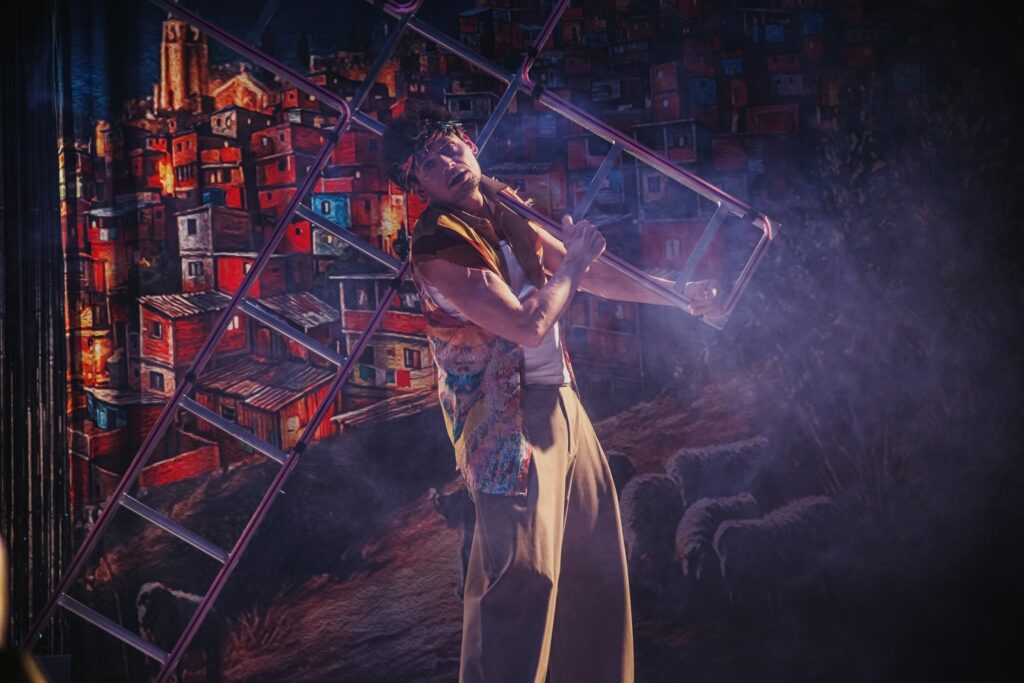
The Comic Mysteries, Mladinsko Theatre
The creators emphasise that the production was inspired by the centenary of Fo’s birth, as well as by the chaotic times we live in, in which society continues to await the coming of the saviour. They also point out that the play is intended as a reflection on the disconnect between the teachings of Jesus and the present day, in which many people – and particularly the Catholic Church – seem neither to understand these values nor to follow them, especially in the context of supporting marginalised people. Although the intention seems noble, its execution has had a different effect.
The problem seems to lie in the creators’ inability to make a clear choice about what exactly they want to criticize. The vision lacks coherence, as it appears to touch on various aspects of life in the twenty-first century without focusing on a single issue. In the case of Dario Fo, the primary target was the Catholic Church, however, in Slovenia this does not seem to be the most effective direction, since the Church is neither as popular nor as influential there as it is in strongly Catholic countries such as Italy, Austria or Poland. The creators, likely aware of this, seem to have chosen to address other anxieties of the present century. Hence the inclusion of elements drawn from contemporary political debate, such as Palestine and left-wing political correctness.
In Dario Fo’s case, however, satire and humour were intended to criticize the Church while supporting people from lower social classes. For this reason, the inclusion of a non-binary angel and a political correctness coordinator – both of whom become objects of audience laughter – seems at odds with the purpose of the original version. The performance criticizes the Church that remains unwelcoming toward queer individuals and continues to fail in giving sufficient attention to victims of sexual violence or workplace abuse stemming from unequal power relations and hierarchical structures – issues that persist in the theatre world as well. At the same time, the performance uses queer elements for comic effect and makes fun of the role of the coordinator, which is very much needed in today’s theatre. I would like to believe that the introduction of the coordinator character was intended as a preemptive gesture against accusations of political incorrectness, however, her comic portrayal only seems to provoke even greater laughter at serious issues. This becomes especially evident when contrasted with the representation of people with disabilities in the production.
Returning to Susan Sontag’s observations, this could be understood as camp, since at times the form appears more important than the message itself. Following Sontag’s idea of deliberately constructed camp and its potential for cynicism, this seems to be precisely what occurs in the performance. The creators try to conceal everything beneath a layer of humour and exaggeration, resulting in a performance that is not particularly funny and ends up mocking everything – even though some subjects perhaps should not be treated as objects of which to make fun.
Credits:
Directed by: Tijana Zinajić//Dramaturgy and adaptation: Marko Bratuš//Set design: Darjan Mihajlović Cerar//Costume design: Matic Hrovat//Music: Sebastijan Duh//Choreography: Lada Petrovski Ternovšek//Lighting design: Igor Remeta//Sound design: Marijan Sajovic
For further information, visit: Mladinsko.com

Karolina Bugajak is a theater critic from Poland, currently living in Ljubljana. She studied culture and contemporary art at the University of Lodz. The title of her master's thesis was "Theatricality and Exaggeration. Camp aesthetics as a strategy for creating new identities in the plays of Grzegorz Jaremko". Her main theatrical interests include topics such as institutional criticism, the representation of marginalized groups in plays, and most recently the theater of the former Yugoslav states.