
National Theatre “Vojdan Chernodrinski” – Prilep
What is patriotism, and how far can one go in its name? What does it mean to follow an ideal so faithfully that it eventually swallows up the very person who carries it? These questions lie at the centre of Dejan Projkovski’s new staging of Kole Čašule’s Crnila (Darkness), the latest premiere of the National Theatre “Vojdan Chernodrinski” in Prilep.
Earlier this year, the theatre was closed for safety reasons, leaving the 75-year-old institution without a permanent home in the city that also hosts North Macedonia’s most significant national theatre festival. Staged in a temporary chamber space inside the Marko Cepenkov Cultural Centre, Crnila becomes both a premiere and an act of artistic insistence, a reminder that theatre continues even in displacement.
In a region where patriotism remains a deeply sensitive and often polarising topic, and where history is constantly reopened, reread, and renegotiated, returning to Čašule’s play feels less like revisiting the past and more like confronting something still unresolved, as the moral questions it raises continue to shape our present.
Written in 1960 and set in Sofia in 1921, Crnila is one of the most penetrating examinations of the ideological fractures within the Macedonian revolutionary movement. Inspired by the real assassination of Gjorče Petrov by members of the Internal Macedonian Revolutionary Organization (VMRO), the play turns its focus not toward the political spectacle of the murder but toward its moral anatomy. Čašule was the first to write openly about “Macedonian darkness,” a term that captures the internal betrayals, fratricides, and ideological distortions that marked the revolutionary struggle. His play is not a reconstruction but an autopsy of loyalty. Petrov is killed not by an enemy but by one of his own, a young man whose loyalty has been shaped, trained, and ultimately weaponised.
Staging such material demands both precision and courage. The director approaches the text with a clarity that avoids nostalgia as much as revisionism. His work could be described as historical realism sharpened by moral critique; he does not simply illustrate the past but interrogates it. In dramaturgical collaboration with the creative team, Lidija Mitoska-Gjorgjievska contributes thoughtfully calibrated interventions that refine the structure and accentuate the work’s moral undercurrents, ensuring that the historical material resonates with contemporary clarity.
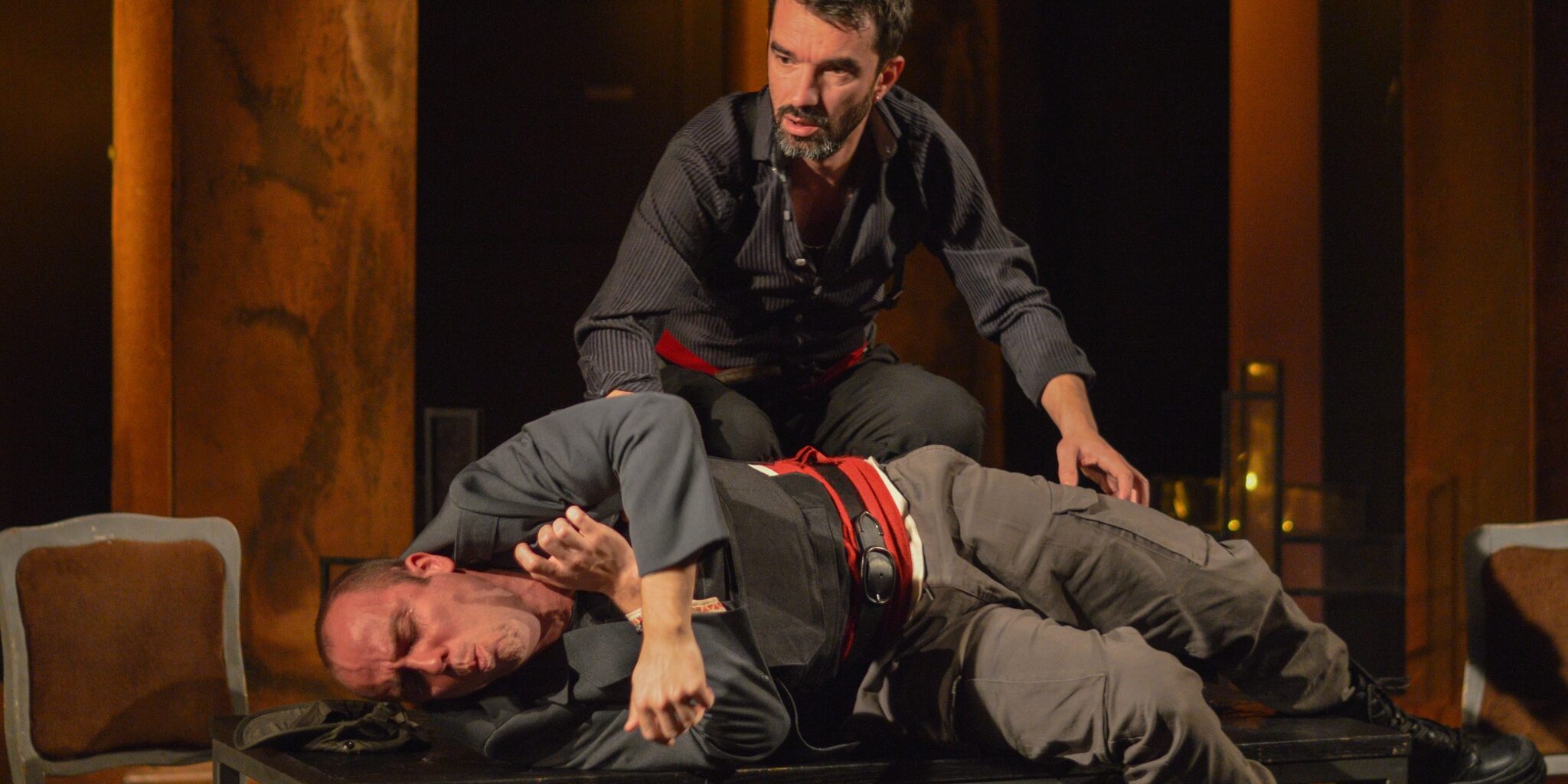
Together with scenographer Valentin Svetozarev, he constructs an apartment that feels simultaneously lived-in and symbolic. A wide table sits at the centre, around which the characters orbit. Massive pillars rise behind it, and in the distance stand crosses reminiscent of a cemetery, silent markers of all those who died for the same ideal. The colour palette of the costumes (designed by Marija Pupucevska) leans into the black and red of the Organisation, while Goran Trajkoski’s music adds a subtle atmosphere of tension and an underlying sense of inevitability. Each visual and sonic choice supports the narrative without overwhelming it.
At the core of the staging is an ensemble working with an exceptional degree of concentration and balance, something Prilep has not witnessed at this level for several years.
The plot unfolds around the preparation of Petrov’s assassination. The action is orchestrated by Lukov (Aleksandar Stepanuleski), acting on orders from the unseen Ivanov. Stepanuleski delivers a commanding performance, beginning as a dominant and ruthless figure who manipulates and threatens, yet gradually revealing layers of fear, dependency, and moral disintegration. In his scenes with Fezliev (Dimitar Gjorgjievski), a man he has known for many years, something shifts. Lukov becomes smaller, insecure, almost boyish.

Darkness. Photos: Aleksandar Vojneski
Fezliev, witty and sharp-minded, stands as the ethical counterpoint of the play, a man exhausted by ideology yet unable to free himself from it. Entangled in this web, he continues to challenge Lukov while alcohol becomes his escape and his weakness. The role is finely shaped, and Gjorgjievski captures each nuance with precision.
When Lukov realises who has been sent to execute the task, he appears again in a different light: surprised, unprepared, frightened. He begins criticising the Organisation itself, noting that the one who ordered the killing will be the first to mourn and glorify the deceased at his grave. Yet he still chooses to carry out the task. In every exchange, Stepanuleski lets new layers slip through, shaping Lukov as a man whose authority shifts in unexpected ways. From scene to scene he moves into different registers, allowing the character’s contradictions to surface.
The Young Man, portrayed by Ilija Volcheski, is someone raised from childhood to believe that the Organisation is his family, purpose, and horizon. Volcheski’s early scenes are full of freshness, naïve pride, and a fierce desire to prove himself. His transformation after realising whom he has killed is conveyed through a striking physical performance. It is not melodramatic but rooted in physical truth, and it becomes one of the production’s most affecting moments. After the realisation, he leaves and takes his life offstage in a park, leaving behind a letter meant to expose the Organisation and reveal how it works against itself. In a cruel twist of Čašule’s dramaturgy, the letter returns to Lukov’s hands.
The director amplifies this circular irony with one of the production’s strongest images: the spirit of the Young Man crossing the stage with knives in his back. The ideal he served has literally stabbed him. The scene closes with John Lennon’s Imagine — a choice that risks sentimentality, yet here becomes a devastating irony: “Nothing to kill or die for…” After an evening of ideological violence, the simplicity of the line cuts deeper than any historical manifesto.
The supporting ensemble is uniformly strong. Each actor is given a clear emotional trajectory and purpose. Nothing feels accidental; every gesture belongs to a system of forces.
All the action unfolds in the apartment of Hristov (Aleksandar Todeski) and Neda (Sara Spirkoska). Neda is in love with Ivan (Boban Aleksoski), another obedient and increasingly significant member of the Organisation. She lives under constant pressure and fear, and although Ivan becomes a source of comfort, she is ultimately the one who kills Lukov. Spirkoska brings a quiet emotional precision to the role. Milka (Katerina Chakmakoska-Klincheska) serves as a delicate counterweight, anchoring the domestic world. Todeski and Mihajlo Milenkoski (Metodi) contribute strongly to the ensemble’s rhythmic structure.
The ending shifts the staging into a museum space. Four children enter, touching objects, lifting boots, moving through what remains on stage. The simple gesture reframes the entire production and turns it back on us. History may become a museum, where we inherit information rather than understanding. Theatre, however, bridges that gap. It pushes us toward the unresolved, toward the moral fractures we still carry, and insists on asking again:
What happens when an ideal becomes more important than the human life that carries it?
In the hands of the director and an exceptional ensemble, Crnila becomes a historical excavation that speaks in the present tense, reminding us that the moral questions we inherit are not relics but living challenges that demand to be confronted, discussed, and understood.
Credits
Author: Kole Čašule// Director: Dejan Projkovski// Dramaturg: Lidija Mitoska-Gjorgjievska// Set Design: Valentin Svetozarev// Costumes: Marija Pupucevska// Music: Goran Trajkoski..
Cast: Sara Spirkoska, Boban Aleksoski, Katerina Chakmakoska – Klincheska, Aleksandar Stepanuleski, Aleksandar Todeski, Dimitar Gjorgjievski, Mihajlo Milenkoski, Ilija Volcheski
Further reading: Interview with Boban Aleksoski: “As artists, it’s our job to unite people”

Katerina Markoska is a translator, theatre critic, and emerging author from North Macedonia, living between Skopje and Sofia. She is currently completing a master’s
degree in Theatre Arts and Dramaturgy at the National Academy for Theatre and Film Arts “Kr. Sarafov” in Sofia. Her translations of contemporary drama have been
recognized by Eurodram, and her creative texts have been published in collective books in Bulgaria.