Teatar 071, Sarajevo, premiere 23th May 2026
Nothing in Alen Šimić’s Kiss of the Spider Woman asks to be believed. Instead, the performance insists that everything on stage is a reproduction of a reproduction of reality, as if sabotaging any attempt by the story to settle into illusion. By doing so, he delivers a production full of metatextual wit, formal inventiveness and self-reflexive irony, triumphantly worthy of concluding the inaugural season of Teatar 071.
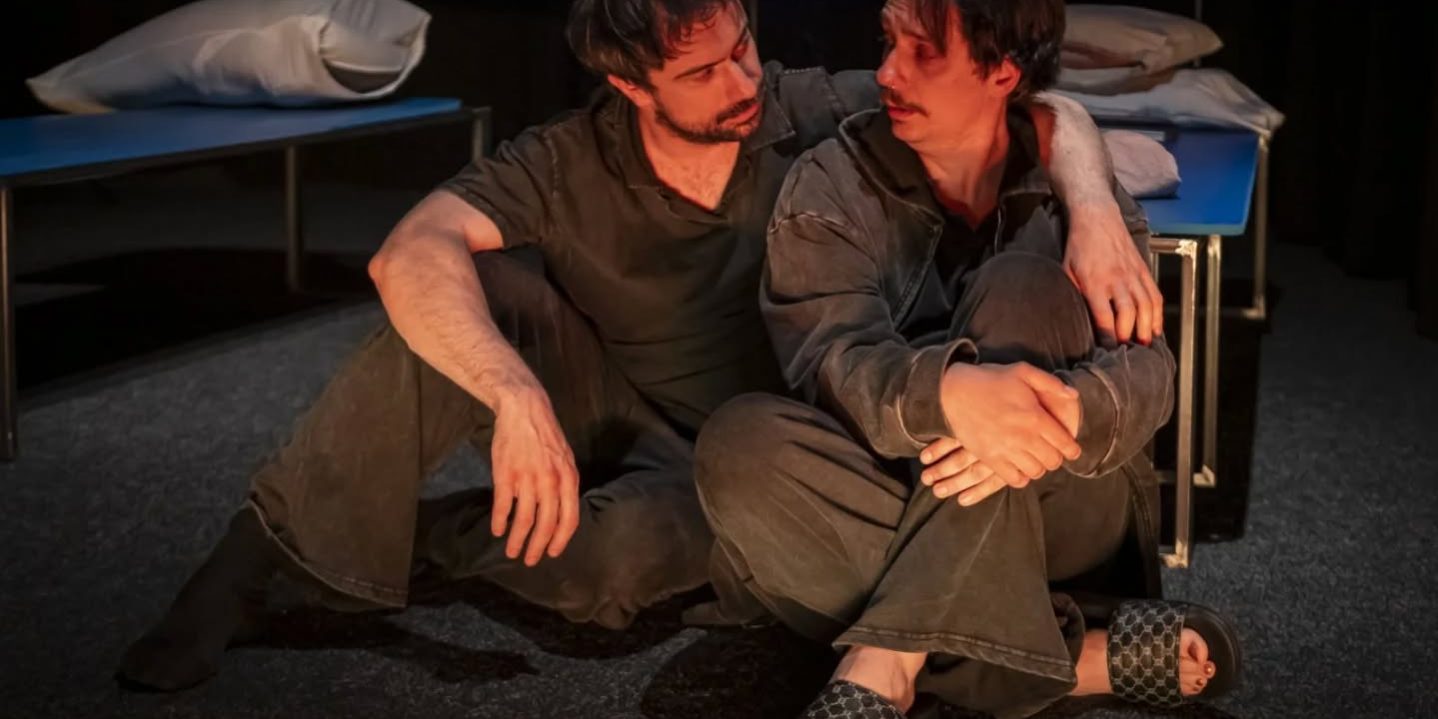
Two men share a prison cell, each incarcerated for very different reasons. Luis Molina (Dino Sarija) has been convicted of the alleged corruption of a minor, while Valentín Arregui (Edin Avdagić) is a revolutionary who, in the eyes of the state he seeks to reform, has become a public enemy. To keep tabs on Valentín, the secret police recruit Molina as an informant. Yet what initially appears to be an impossible coexistence between two opposites gradually develops into an unlikely bond. Their shared language becomes cinema: through Molina’s vivid retellings of films, the cell is transformed into a space where imagination triumphs, at least for a few fleeting moments, over captivity.
Since its publication in 1976, Manuel Puig’s bestselling novel and landmark work of queer literature Kiss of the Spider Woman has inspired numerous stage and screen adaptations. Puig himself transformed the novel into a play, while Leonard Schrader’s screenplay for the 1985 film adaptation went on to win widespread acclaim, including an Academy Award for William Hurt’s performance. Most recently, the story returned to the screen in Bill Condon’s film adaptation of the celebrated 1993 musical, starring Diego Luna, Tonatiuh and Jennifer Lopez.
Now, the story has been reimagined once again. In his adaptation for Teatar 071, Bosnian-Herzegovinian film and theatre director Alen Šimić approaches Puig’s material not as a literary classic to be preserved, but as a living text to be translated for his own theatrical purposes. The resulting piece bears his typical stylistic fingerprint, combining brisk moments of genuine emotional depth and metatextual play with an emphasis on physicality and fragmentation, alongside sudden ruptures and a darkly comic sense of irony, as seen in earlier works such as Kafkas’s The Hunger Artist (“Umjetnik u gladovanju”, 2022) at the National Theatre Sarajevo and Truth or Dare (“Istina ili Izazov”, 2023), written by Zoe Ibrahimović, at the Sarajevo War Theatre.
Working from Darko Lukić’s dramatization and translation, Šimić treats Puig’s text less as a fixed narrative than as material to be dismantled and reassembled. Much like a message passed along in a game of whispers, elements are omitted, transformed, misplaced, or newly invented along the way. The result is a two-act structure that deliberately distances itself from linear storytelling in order to recontextualize the source material. While the first act focuses on the mechanisms of narration itself, the second gradually shifts towards the story of Molina and Valentín, allowing the audience to experience both the process of storytelling and its consequences.
The first part functions as an introduction not only to the story, but also to Šimić’s theatrical poetics. Jumping, skipping, tumbling and engaging in a series of deliberately alienating choreographic interventions, the actors establish a mode of performance rooted in fragmentation and Brechtian Verfremdung—both recurring features of the director’s unique thumbprint. Rather than immediately inhabiting their characters, Dino Sarija and Edin Avdagić appear as themselves. They introduce their careers, reflect on the previous production of Kiss of the Spider Woman in which they both appeared a decade ago, and openly discuss the reasons for revisiting the material. From there, the conversation expands into a playful summary of Puig’s novel, reflections on adaptation, and a collection of familiar platitudes about the transformative power of theatre. Along the way, the actors repeatedly invoke classics of Bosnian-Herzegovinian cinema—or, as they call it, “BH Film”—such as the Oscar-winning Ničija zemlja (2001) by Danis Tanović or Gori vatra (2003) by Pjer Žalica. In doing so, they partially replace the cinematic universe of Puig’s original with a local constellation of references, situating Molina and Valentín’s story within a distinctly Bosnian-Herzegovinian cultural context.
While this self-referential framework could easily have become overly cerebral, it is exactly here that the performers appear most at ease. Freed from the demands of psychological characterisation, Sarija and Avdagić engage the audience with spontaneity, effortlessly moving between personal anecdotes, playful banter and theatrical commentary, all the while treating irony as their highest principle. Nothing is sacred, nothing too serious—no, especially not themselves. Their long-standing familiarity with both the material and each other generates a sense of ease that turns the first act into the production’s most entertaining part.
Kiss of the Spider Woman, Teatar 0771
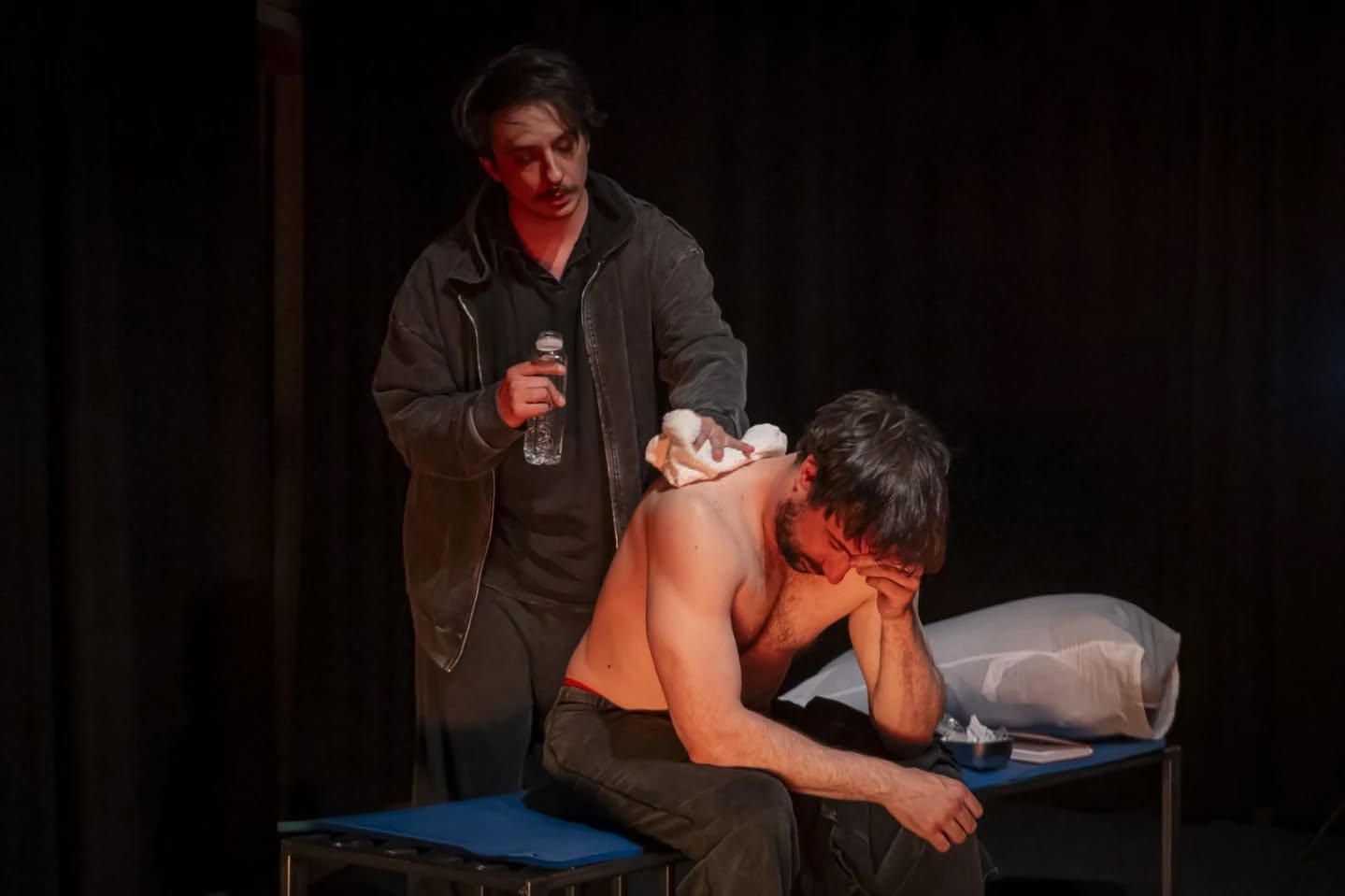
Only in the second act does the production fully surrender itself to Puig’s narrative. Šimić strips the story to its bare minimum, retaining only fragments necessary to evoke the relationship between the two prisoners. Here, Molina and Valentín finally emerge as dramatic figures, allowing the actors to exchange commentary for character work. Sarija and Avdagić approach their roles with emotional commitment, yet their performances remain marked by a certain physical lethargy. The narrowing-down of the narrative and emotional register is not a weakness of the adaptation, but one of its central conceptual choices. As a consequence, the audience is given less material through which to identify with the characters or become emotionally immersed in their fate. The figures of Molina and Valentín remain partially inaccessible, less believable as fully realised individuals than as theatrical ideas.
Throughout the evening, the production repeatedly reminds its audience that what they are witnessing is a representation rather than reality. This is theatre. This is “BH Film”. Nothing here claims authenticity. By refusing complete emotional absorption, Šimić foregrounds the act of performance itself, privileging reflection over illusion and reminding us that every story is, ultimately, a story being told.
The production adopts a similarly stylised approach to questions of gender expression and sexuality. Sarija’s Molina is not conceived as a naturalistic portrait, but as a consciously theatrical figure whose femininity is articulated through gesture, posture and vocal inflection. Sarija imbues his character’s care for his cellmate with a maternal tenderness that at times verges on possessiveness, provoking a series of increasingly petulant reactions from Valentín. Rather than grounding their relationship in psychological realism, the production presents intimacy itself as a performance—carefully constructed, negotiated and, ultimately, no less theatrical than the stories Molina recounts.
Adisa Vatreš Selimović’s stage design demonstrates the surprising flexibility of the Teatar 071 space. For Kiss of the Spider Woman, the set and costume designer transformed the venue into something resembling a black-box version of Edison’s famous Black Maria studio, one of the earliest film studios in history. The stage is reduced to a few essentials: a projection screen, two ring lights familiar from contemporary social-media culture, and a pair of small spotlights positioned in opposite corners.
The ring lights create a striking visual effect. While they lend the actors’ eyes an almost cinematic sparkle, they simultaneously drain colour from their faces, accentuating the physical and emotional deprivation of imprisonment. The projection screen—here replacing the cinematic canvas with a white curtain— serves a dual function. It evokes the world of cinema that Molina constantly recreates through his storytelling, while also suggesting another layer of confinement. In German, the idiom hinter schwedischen Gardinen (“behind Swedish curtains”) is a colloquial expression for being behind bars; similarly, the translucent screen functions as a symbolic barrier, separating the prisoners from the world beyond. The spectators no longer share the characters’ space; instead, they observe them as if through the lens of a camera—or through the bars of a cell.
After Dino Mustafić’s Sniper, written by Damir Karakaš, and the world premiere of Adnan Lugonić’s latest play The Last Piano Lesson (Posljednji čas klavira), directed by Macedonian director Nina Nikolikj, Alen Šimić’s Kiss of the Spider Woman marks the final production of the first—and notably successful—season of Teatar 071. Under the leadership of director Senad Alihodžić and his creative team, they have sought to create space for alternative theatrical practices beyond the city’s established stages. As the city’s newest theatre venue, it concludes its inaugural season with an impressive record: 3 productions adding up to 18 performances, 93% occupancy, more than 40 participating authors and collaborators, and the support of 19 partners. Judging by these results, the ambitions outlined in its founding manifesto have largely been realized, leaving audiences and observers with considerable anticipation for what the next season will bring.
Credits
Director: Alen Šimić/Dramatisation: Darko Lukić/Set & costume designer: Adisa Vatreš Selimović/Producers: Senad Alihodžić & Adna Rizvan/Technical operator: Mladen Maroje Dolić
Performed by Dino Sarija and Edin Avdagić
Further reading: review of Sniper at Teatar 071

Berina Musa is a writer, dramaturg, and critic based in Sarajevo and Freiburg. She studied German linguistics, literary studies, and art history at the University of Freiburg and is currently completing a second degree in dramaturgy at the Academy of Performing Arts in Sarajevo. Her plays and short films have been presented at the Bosnian National Theatre Zenica, MESS, the Sarajevo Film Festival, and the Mostra Internazionale del Nuovo Cinema di Pesaro.