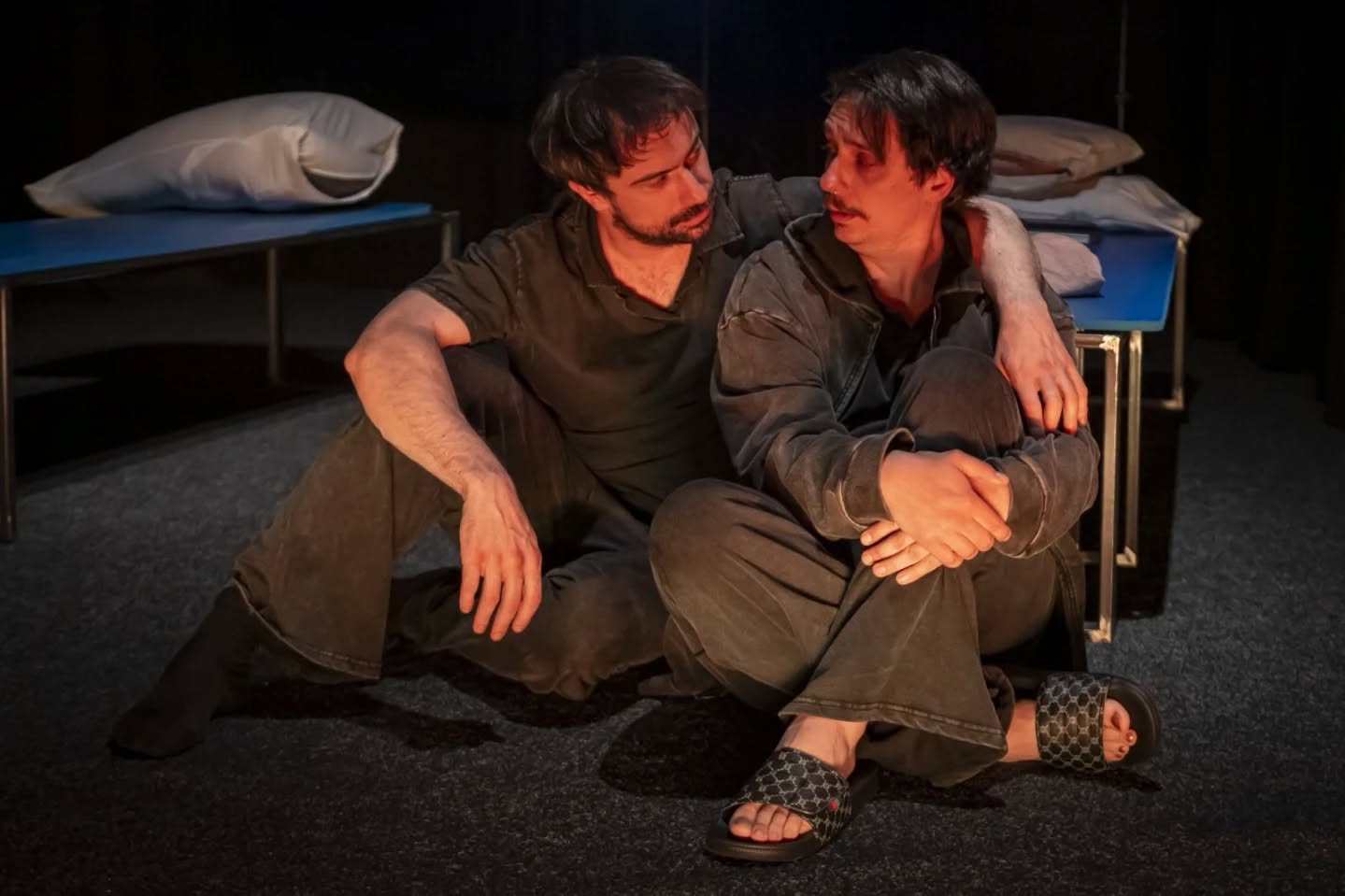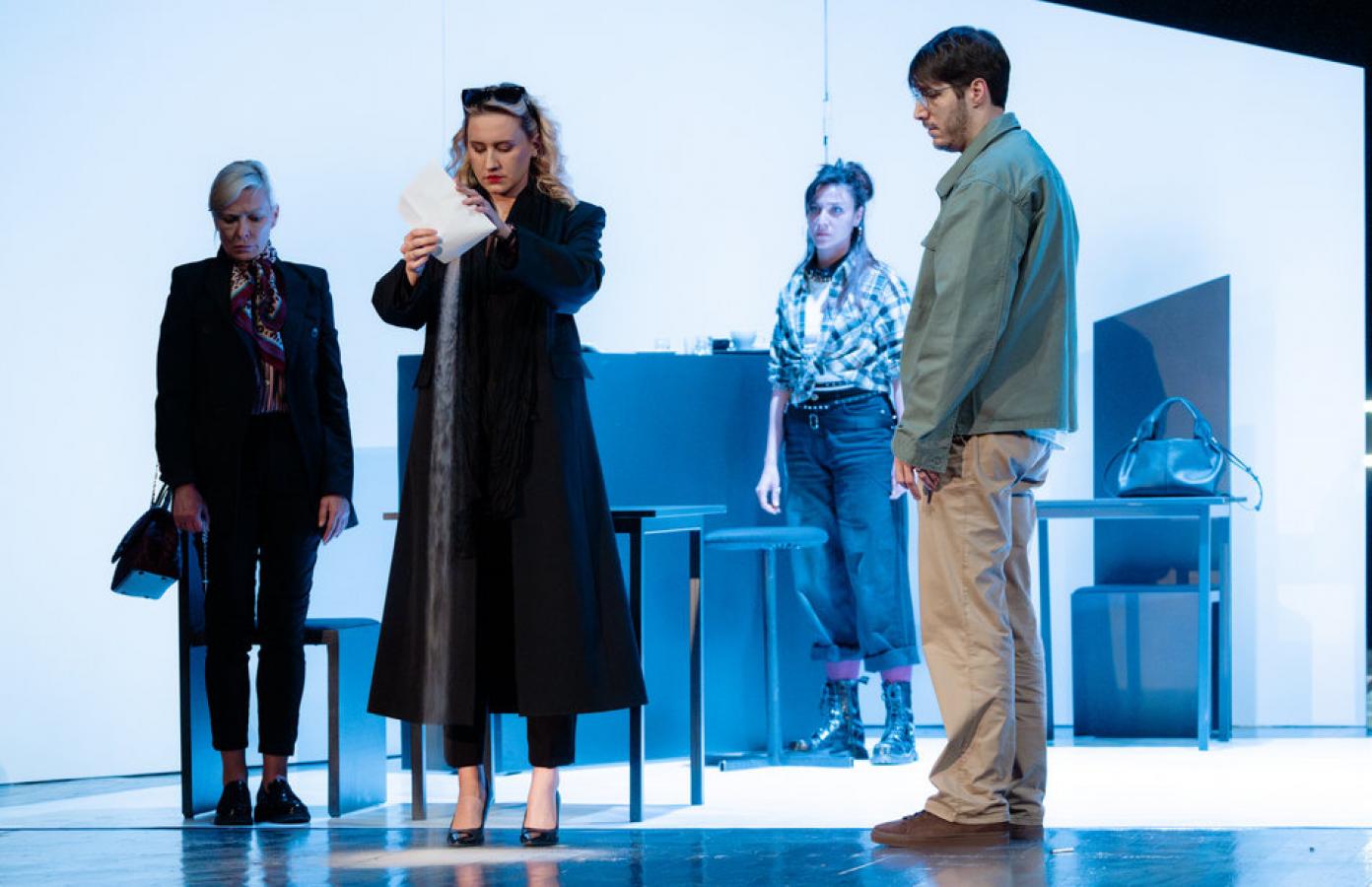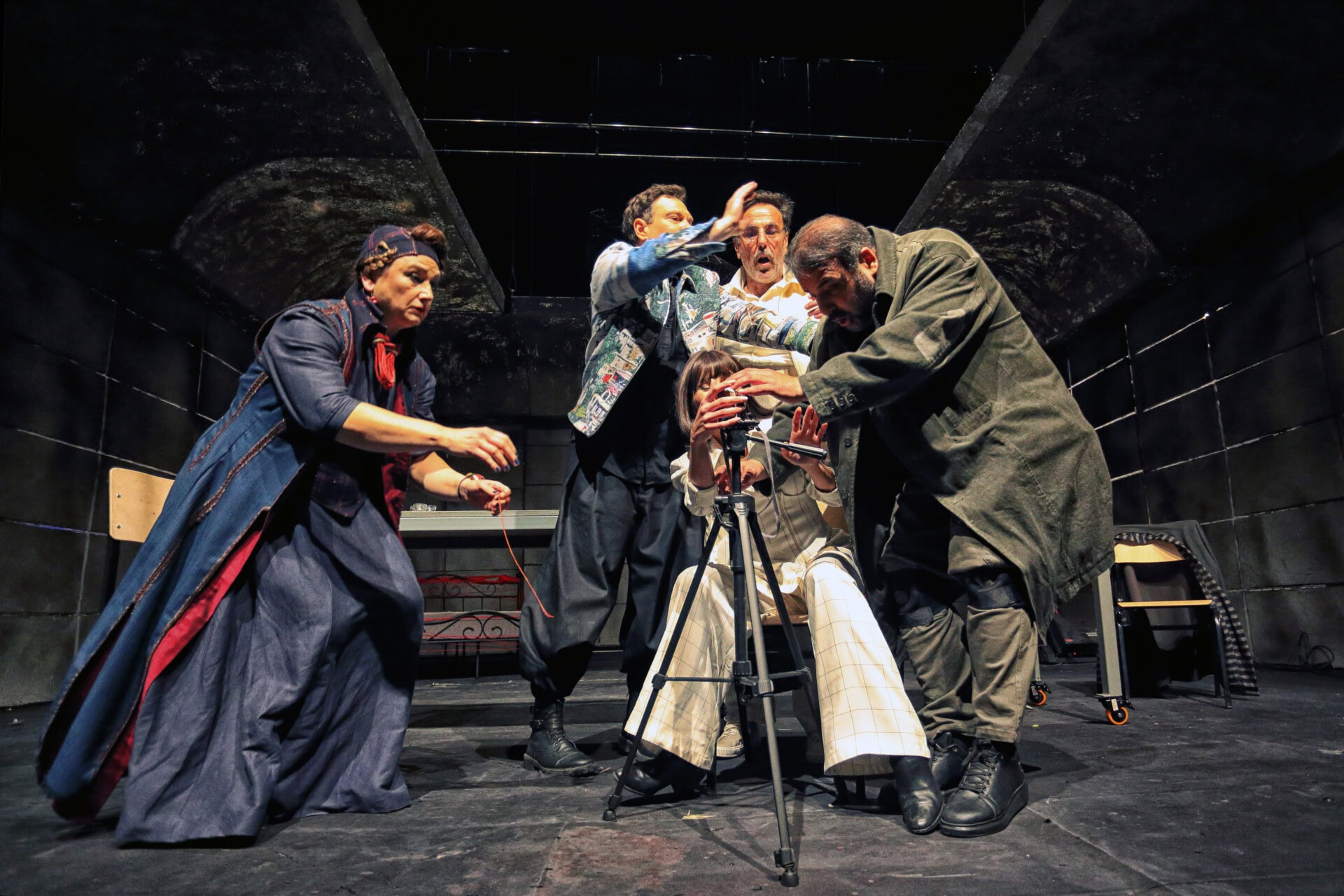
Slovenian National Theatre Drama Ljubljana, premiere 14th February 2026
The only thing I knew about Dane Zajc’s Voranc is that it was supposed to be incredibly difficult to stage. Zajc’s plays are often described as poetic dramas, which made it even harder for me to imagine what a performance that tells the story of Slovenian rural life on a farm during wartime in a poetic way could look like. At the same time this 1978 work remains one of the most frequently staged works by this author.
Zajc’s play does not follow a linear plot, and the action itself is not extensively developed. Scenes and motifs frequently appear without being resolved. Ballads and symbolic parables constitute an important part of the text. This may seem like a strange characterization, considering that the drama is regarded as a vehicle for the history of twentieth-century Slovenia, yet in some respects it resembles nineteenth-century Romantic dramas, which broke with the unity of place, action, and time and embraced a form of genre syncretism, among other things through the incorporation of poetry. The same occurs here, a large portion of the text consists of monologues/ballads about nature, work, and the mother, which disrupt the familiar model of drama.
The plot centres around a single household, a farm in Slovenia, whose inhabitants are feeling the effects of the war. The household consists of a married couple – the traditional, work-focused Voranc, who wants to find his son at all costs so that he can continue working on the farm, and Neža, his wife, who has visions and worries about her missing son. In addition to them, the drama features Jernej himself – the son who, carried by a wave of hope for a better life, joins the partisans and has no intention of becoming a farmer and living the life of his parents. Voranc sets off in search of his son with his neighbour Žagar, who is the title character’s travelling companion. Zajc also introduces two other characters who are purely symbolic and whose scenes are woven into the main plot. These are Katra and Murovčan. Katra is the embodiment of everything human and carnal, while Murovčan is a spiritual man, connected with nature. Their characters, although taken out of context, can be interpreted as a cross-section of society at that time and reactions to the ongoing war.
The impression that we are watching a romantic drama is further intensified by the adaptation by Živa Bizovičar and Nik Žnidaršič, who introduce the character of a house spirit that helps the audience understand the sense of fate hanging over Voranc’s family. The appearance of supernatural motifs are emblematic elements characteristic of nineteenth-century drama. The spirit is a magical figure originating from another world. In the staging, it wears a costume made of white doilies – handicrafts and lacework that were a common hobby of our great-grandmothers and are still often found in old houses. The spirit almost never leaves the stage, it constantly accompanies the characters in their home, sometimes observing them, sometimes interfering with their work. The character, played by Mina Švajger, resembles a figure from a horror story – it haunts, yet at the same time it is a mischievous household imp, who ultimately seems like a natural member of the household.
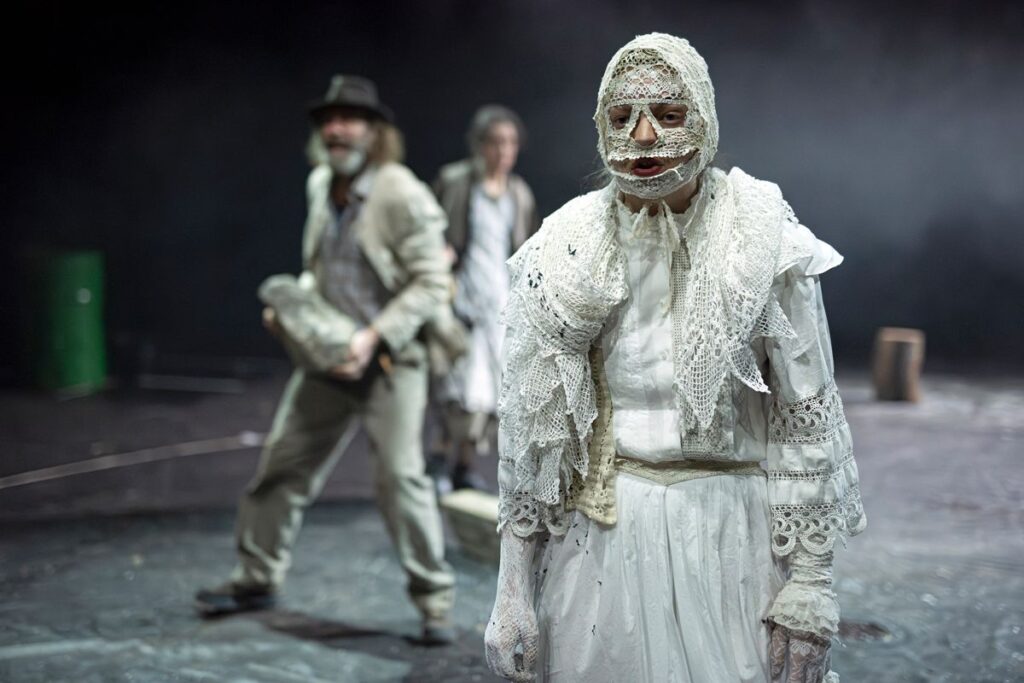
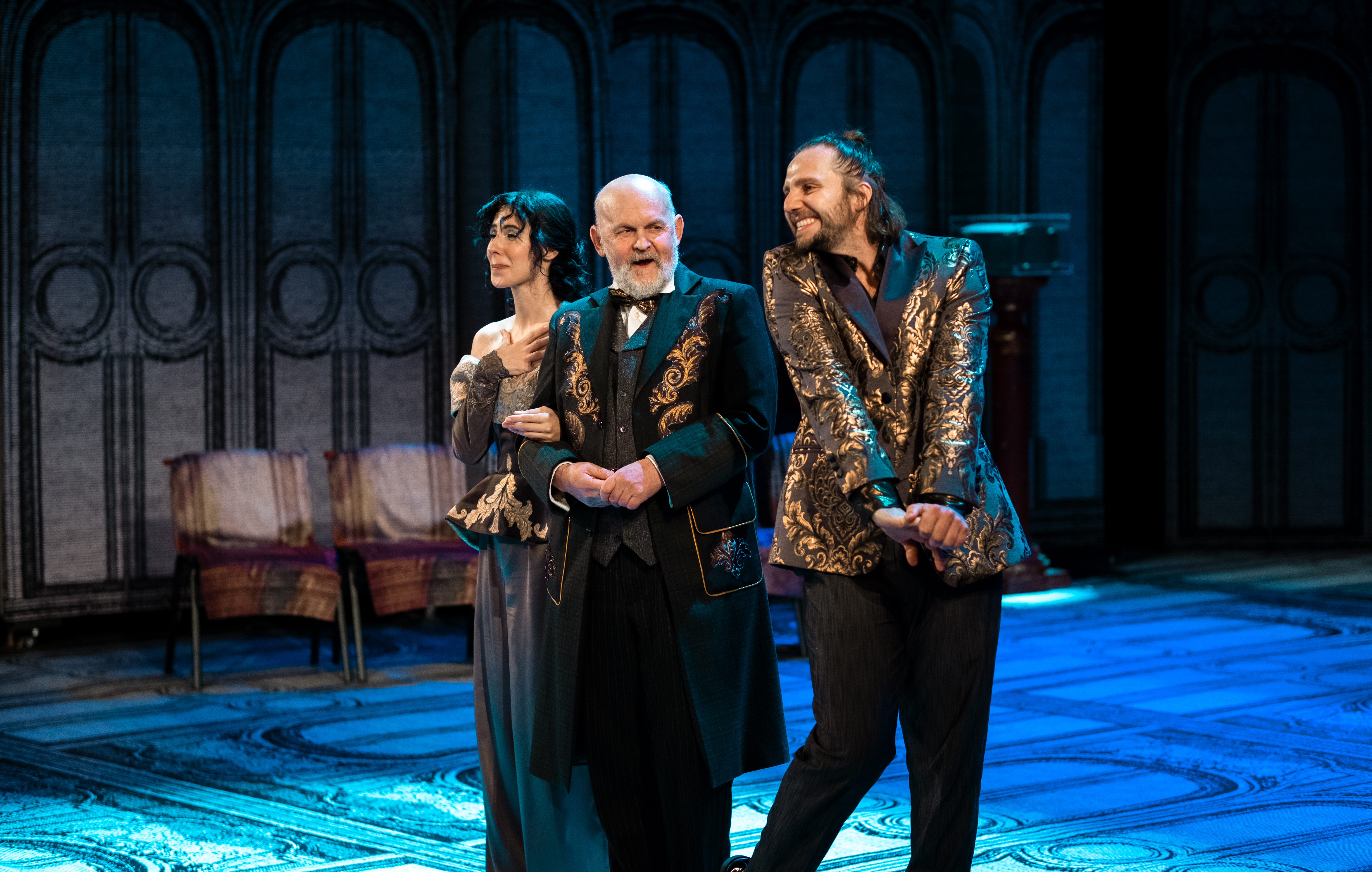
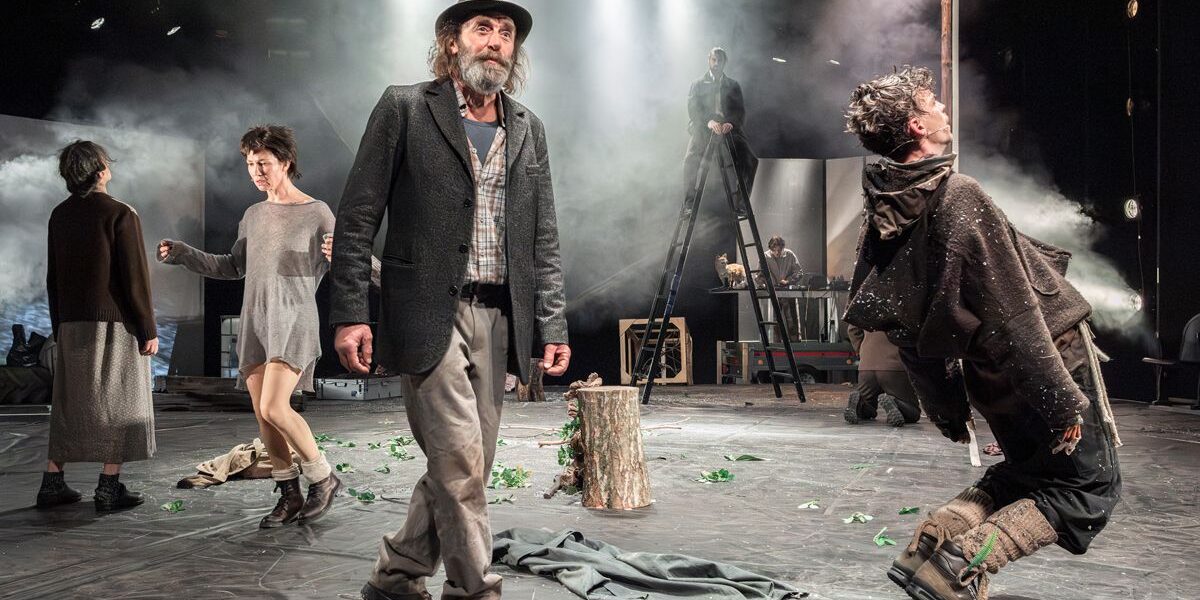
Voranc, SNG Drama Ljubljana. Photo: Peter Uhan
The set design by Dorian Šilec Petek in the first part takes us to Voranc’s farm. At the back of the stage there is a small hut that is too small for the characters, who appear almost too large for it. The cramped space it creates can also help interpret the sense of being trapped within a particular way of life. In addition, an old lantern stands at the center of the stage, seemingly providing the only light in the characters’ village. In the second part, however, changes occur. As the drama becomes increasingly abstract and new characters appear (Katra and Murivčan), the scenography also becomes more symbolic and incorporates more contemporary objects. The most important prop is a ladder, which the creators use in various ways – it serves either as a meeting point for the characters or as a kind of prison into which Jernej is placed.
Moving on to Bizovičar’s adaptation itself, the director emphasises a world that no longer exists. One gets the impression that it is not so much the plot and the conflict between father and son that interests her, but rather the home as an element of oppression of the individual and Slovenian farms. Perhaps this effect is heightened by the character of the house spirit. However, his character is also important since he sets the overall atmosphere of the performance and its aesthetic choices. Afterall the performance is a kind of dark fairy tale, a gloomy parable oscillating between elements of contemporary horror and the mystery of romantic ballads. The atmosphere is further enhanced by the live music composed by Gašper Lovrec, in which the sounds of the countryside mix with contemporary electronic sounds.
Bizovičar also does something characteristic of postdramatic work – she leads to the disintegration of the structure of the performance itself. In the second part, she introduces a crowd of characters and stage elements, creating a climactic chaos in which all the stories converge. Visually, she accomplishes this very skilfully. The entire performance is an aesthetic feast. She manages to transform a static drama – in which the word rather than action plays the more important role – into a dynamic spectacle in which each scene receives its own language and style. Bizovičar quite often uses visually pleasing elements such as the doilies/curtains that form part of the spirit’s costume and (perhaps too often) a revolving stage. The second part also leads one to wonder whether the creators intended to explain or clarify Voranc. I have the impression that this was not their goal, precisely because the creators attempt to make the chaotic and poetic narrative of the text visible through the staging itself. Over time, the poetic quality and fragmentation of the text appear on stage with doubled intensity, forcing the audience into a primarily sensory and visual reception based on the atmosphere that has been created, since the interpretative layer becomes too blurred. It is also definitely a performance that requires greater concentration and engagement from the audience due to its structure, poetic nature and symbolism.
Živa Bizovičar is clearly interested in what it is to be Slovenian. As someone from abroad, lacking the lack of broader context and familiarity with Slovenian literary works it is hard for me to say what this performance might mean for Slovenians today. Historically, this play was, in some sense, an attempt to come to terms with a disappearing world and to reckon with the experience of war. Perhaps it still serves this function. In a polarized society, presenting on stage different approaches to dealing with destruction may still be compelling. So what seems universal in this performance, at least in my reading, is the portrayal of a cross-section of characters trapped in a larger, more powerful system in which they try to find their own philosophy for navigating their lives. As theatre scholars have noted, Zajc’s play is a universal drama set in a specific place and time.
Credits:
Director: Živa Bizovičar //Dramaturg: Nik Žnidaršič//Scenography and video design: Dorian Šilec Petek//Costumes: Nina Čehovin//Composer: Gašper Lovrec//Movement direction: Anna Javoran
For further information, visit: drama.si
Further reading: Review of Boško and Admira, directed by Živa Bizovičar

Karolina Bugajak is a theater critic from Poland, currently living in Ljubljana. She studied culture and contemporary art at the University of Lodz. The title of her master's thesis was "Theatricality and Exaggeration. Camp aesthetics as a strategy for creating new identities in the plays of Grzegorz Jaremko". Her main theatrical interests include topics such as institutional criticism, the representation of marginalized groups in plays, and most recently the theater of the former Yugoslav states.