
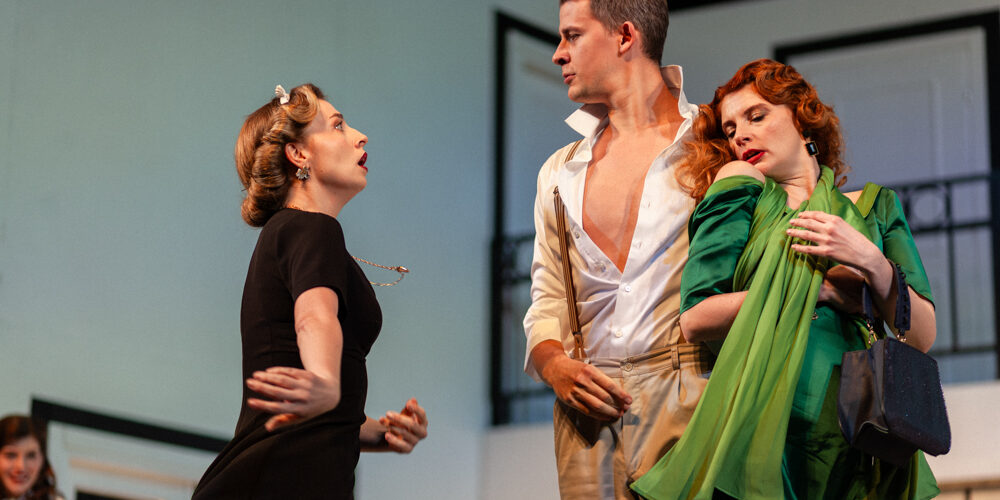
Atelje 212, Belgrade, premiere 31 January 2026
The walls of Gorčin Stojanović’s set radiate white. The valuable works of art that used to hang there, the last remnants of the Andrenji family fortune, have been sold in order to preserve, for a little while longer, a lifestyle whose material foundations have already disappeared. Facing total total collapse Countess Andrenji Erzsébet seeks to marry her son, Ivan Radisavljević, to the wealthy heiress Marija Jovanović. He, however, loves someone else – the new maid, Milica Rašković.
In Fedor Šili’s new play, set in interwar Belgrade, the tension between economy and emotions, compressed into a single day, sets in motion a conflict that develops into increasingly complex situations. The arrival of the countess’s brother, István, a Hungarian Don Juan from Belgrade, who is pursued by the Spanish ambassador because Count Andrenji dishonoured his wife, initiates a new cycle of conflict. The attraction that develops between the ambassador’s translator and the count further complicates the situation, especially once it becomes clear that she is a doctor who has accidentally hypnotised a patient into believing himself to be a diplomat. The maid’s boyfriend, a pimp and pornographer, blackmails the betrayed and distressed young woman, leading to a series of new comic situations.
Within this chaos of mistaken identities, blackmail, seduction, duels, concealment and discovery, a debauched and intoxicated wealthy heiress wanders through the action. Her age can be associated with youth only through an act of generosity. If one adds that her lost love is the delusional Spanish ambassador, the result is a tightly knotted network of intrigues and misunderstandings that promises a difficult resolution.
The play consistently and skilfully employs the formal mechanisms of vaudeville. These include verbal humour, recognisable social stereotypes, accelerated dramaturgy, the multiplication of complications, and precisely-timed climaxes. The genre allows for serious socio-economic issues to be conveyed via rhythm, movement and comic escalation.
The plot of this play – full title: Ode to Joy, or The Benefactor – functions as a prequel to Fedor Šili’s previous successful comedy at Atelje 212, Night Watch from 2018. Making his directorial debut. actor Gordan Kičić translates his talent for physical, gestural and verbal emphasis into precise stage craftsmanship, and delivers a high energy production.
His skill is most clearly visible in the remarkable cohesion of the ensemble. The cast confidently navigates the rapid scene transitions, intense tempo and the sharply defined genre characterisation. Kičić, in the leading role of the count, delivers each punchline with precision and focus, as if his teachers of dramatic arts were a metronome and a tuning fork. The confidence and ease of his performance, together with his willingness to acknowledge comic situations through private laughter and his ability to establish direct contact with the audience through looks and gestures while maintaining strict control, clearly influences the rest of the ensemble.
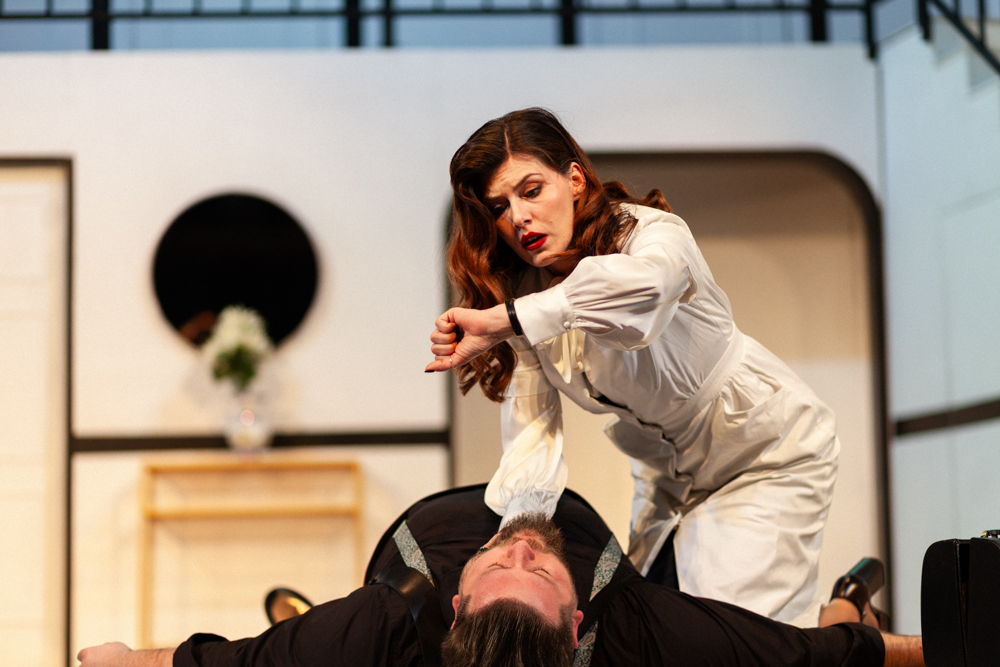
Ode to Joy. Photo: Boško Đorđević
Milica Mihajlović as the countess and Tamara Dragičević as the doctor maintain the most grounded tonal register. They create the impression of psychologically credible characters that serve as a stable reference point against which the rest of the ensemble can explore the limits of vaudevillian exaggeration. Marija Liješević, as the maid, explores shades of confusion and naivety, combined with an extended crying scene that unfolds across the full spatial depth of the stage. Ivan Mihailović, as her boyfriend, emerges as a comic performer of exceptional precision whose attention to detail invites comparison with Kičić. Within this wide expressive range, he explores how a conventional figure of a blackmailer and small-time criminal can remain charismatic without fully securing audience sympathy. Milica Trifunović, as the wealthy heiress, precisely charts the performative territory of drunkenness and sexual drive, while Stefan Bundalo operates in a similarly precise manner within the spectrum of madness, hypnosis and mistaken identity.
The character of Ivan Radisavljević, convincingly performed by Đuro Brstina, is the symbolic centre of the play. His desire to marry the maid directly collides with the family’s need for him to marry a wealthy heiress. When, at the end of this turbulent day, everyone’s sexual drives are satisfied, including his own, even at the cost of poverty, the seductive structure of the vaudeville can easily be interpreted as a triumph of love over money.
However, Ivan must be understood as the point at which individual emotion becomes inseparable from a life of luxury. His desire develops within a world where material life has been organised around surplus, comfort and the continuous availability of pleasure. In this context, romantic decisions appear as extensions of such a lifestyle, rather than purely individual emotional choices. This becomes particularly visible in the scene in which the doctor, through hypnosis, amplifies Ivan’s confidence, after which his language becomes almost entirely structured around sexual desire.
The play begins as a satire of decadent aristocracy and financial elites, yet ultimately resolves its central tension through the triumph of a passion that is itself a product of the same decadent system. Love appears as a by-product of the class order that it seems to challenge. It is not its alternative. Because of the vividly realised characters, entertaining structure and performers who take evident pleasure in performance, it becomes easy to overlook that the production does not celebrate the victory of love over class divisions. Instead, it systematically demonstrates that the nature of romantic passion is shaped by class-based possibilities of consumption and pleasure. The production reveals luxury as internally contradictory phenomenon because it destabilises itself through the continuous production of desires that it can’t fully regulate. This is what ultimately allows this vaudeville to function as both popular entertainment and a sharp critique of consumerist culture and gives the title its ironic edge.
Credits:
Director: Gordan Kičić//Scenography: Gorčin Stojanović// Costumes: Snežana Veljković// Composer: Ivan Brkljačić// Choreographer: Milan Gromilić, Nebojša Gromilić
For further information, visit: Atelje212.rs

Andrej Čanji is a theatre critic and theatrologist based in Belgrade.