Knjaževsko Srpski Teatar, Kragujevac, premiere 15 February 2026
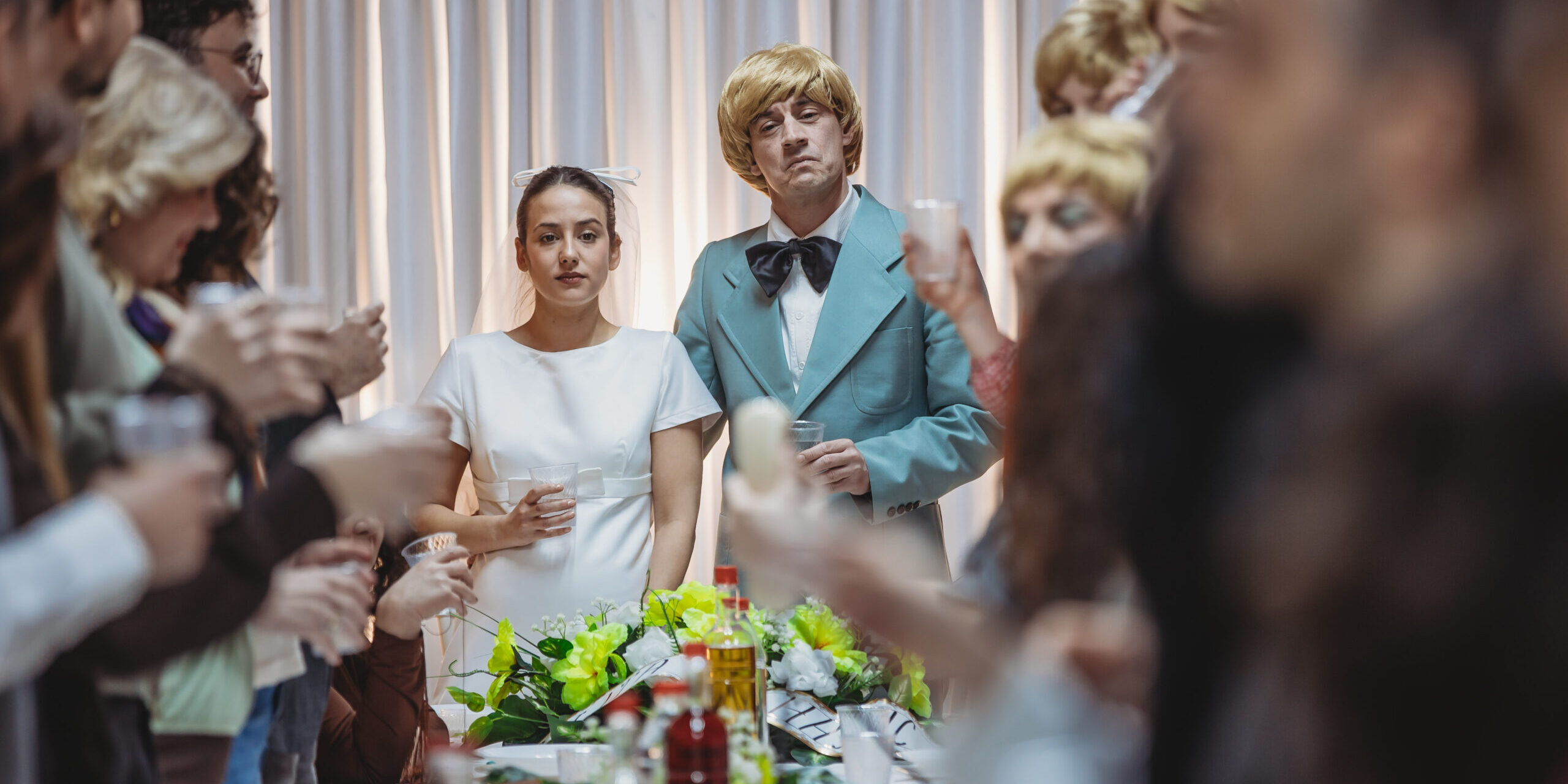
There’s a wedding taking place in Kragujevac. Two, in fact. The weddings in question are like all other weddings in many respects. Like most weddings, they are a performance for an audience, a chance to be impressed by the groom’s status, the bride’s beauty, and the family wealth (even if this is all just scenography, bought to hide the true poverty of the family). But these weddings – one of a girl named Brigitte and the other of a girl named Paula – are part of actual performance, a reworking of Elfriede Jelinek’s Women as Lovers by Dimitrije Kokanov, directed by Bojana Lazić.
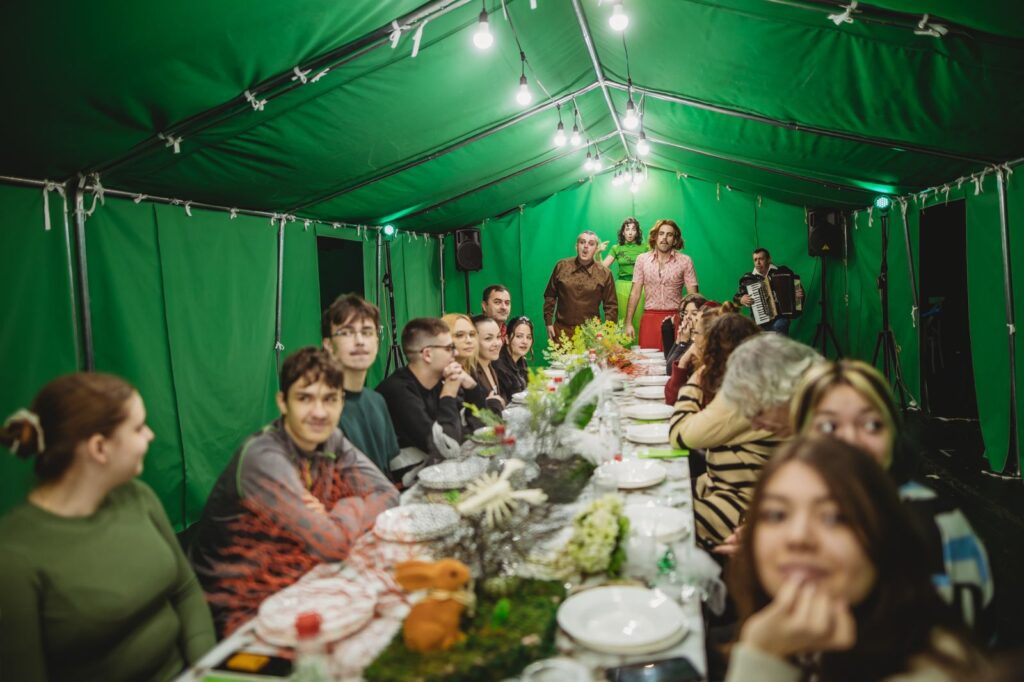
This show is composed of two strands that take place at the same time in different parts of the theatre, only merging in the last act, when the actors and the audience from Paula’s wedding join those at Brigitte’s wedding. As both weddings are happening at the same time, we only have access to one – but this just makes the performance more exciting, as we feel we are part of something bigger than us. Since I attended Brigitte’s wedding, I will focus on that in this review.
Jelinek’s novel follows the lives of two Austrian women, Brigitte and Paula, who never meet each other, but whose stories are intertwined and contrasted. Brigitte works in a factory as a textile worker and is in a relationship with Heinz, a middle-class electrician whose business is growing. Marrying him will give her a better social status, though she is full of hate towards him and his family, and she feels deeply empty. Paula, on the other hand, is a girl from a village, with much more hostile and even more patriarchal surroundings, but with bigger dreams of being a seamstress. While Brigitte is very calculated, Paula is naive and full of illusions, which are shaken by her marriage to Erich, a violent woodsman, whom she marries because of an unwanted pregnancy. The novel is written as a cold, sterile, and grotesque depiction of their empty lives and cruel fates.
Kokanov’s adaptation keeps the characters and their stories, but puts them in a new frama – their weddings – where all of their fates and their relationships can be seen in a single event. In Serbia, there are often two weddings taking place in one wedding venue, so the decision to make a show about two weddings taking place at the same time comes even more naturally. The audience at the beginning gets invitations to the wedding they’re going to attend and is divided and led to different parts of the theatre. On Brigitte’s wedding invitation, the focus is completely on Heinz and his family, while Brigitte’s name is written in smaller letters, so the relationships in this family are clear from the start. The female audience members are invited to have a drink at the wedding table, where they sit watching each other and the actors among them. The wedding is a stage, the ceremony is a show, and we are here to be impressed.
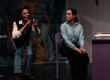
In Kokanov’s adaptation, the main character of Brigitte’s wedding is not Brigitte, nor Heinz, but Heinz’s mother. Darija Vulić plays her as hilarious and loveable but also the villain of the story – a snobbish housewife, full of pride (but ignorant about a lot of things including how to pronunce the word Turkey – she tries to pronounce it to sound German, but everybody laughs at this Pokondirena tikva moment; just like Sterija’s antiheroine, she embodies a linguistic insecurity, revealing the comic tragedy of her pretentious social climbing.). She’s a possessive mother in an Oedipal relationship with her son which is shown quite literally in the dance scene, where they dance like they’re having sex on the stage (stage movement: Damjan Kecojević).
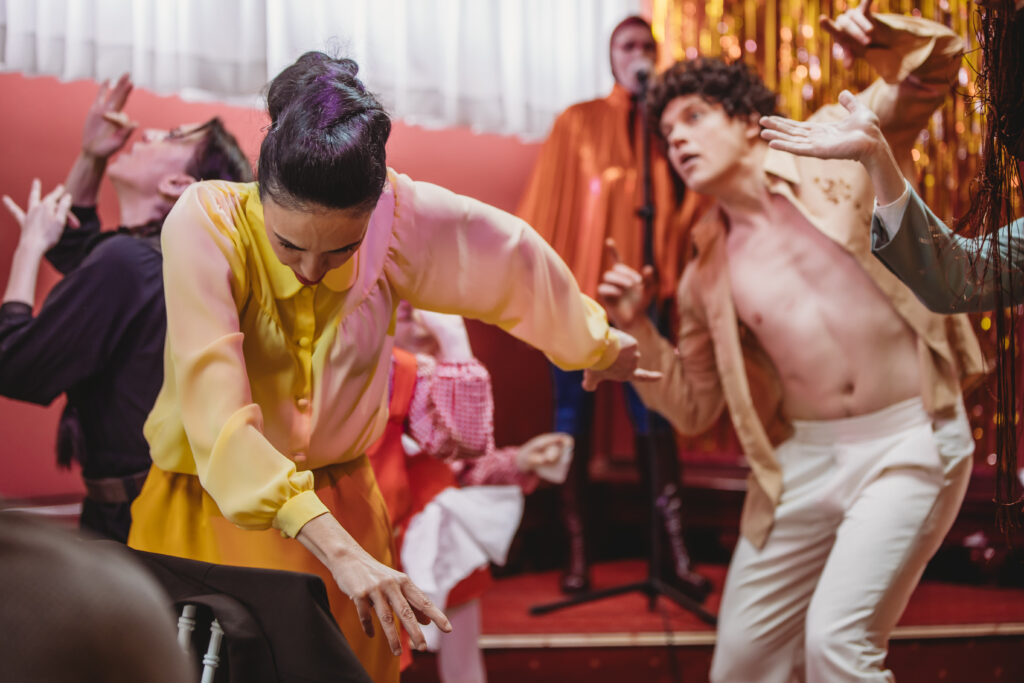
Photos: Nenad Borisavljević.
The Oedipus complex rules the world of this play, as we see other mothers also preferring young men – Brigitte’s mother, and also, Erich’s mother. This creates open conflict between Brigitte and Heinz’s mother, with Brigitte (played by Nevena Kočović) embodying pure female rage which has been repressed for a long time. Kokanov’s lines made this hatred impossible to hide; they fight each other in an agon of their hateful inner monologues.
Heinz (Čedomir Štajn) is a completely lost and phlegmatic (not so young) man, dependent on his mother, with intentions to use Brigitte’s body for sex and to also use her as an unpaid worker in his shop. He is completely obsessed with his company – SZR, to the point that he, from time to time, just out of the blue says: “SZR!”
There are also some kids, girls, who look non-binary, in their Girl Scout uniforms, but also a little like twins from a horror film. They, just like the whole Heinz family, have hilarious blond wigs.
Brigitte’s mother (Jasmina Dimitrijević) is sexually liberated single mom and the comic relief of the play, while Paula’s mother (Ana Kolanđeli)) is a silent, insecure woman, most likely the victim of violence, and Erich’s mother (Katarina Janković) sports girlish Alpine braids and displays Jocasta tendencies.
Kokanov’s textual interventions are big, hence him being listed as the co-author of the text with Jelinek. He manages not only to keep the original story but to put it in a dramatic context of condensed time and space, full of conflict, but he also monologues and dialogues that act as comical critiques of the patriarchy, in the spirit of the novel. He brings the two weddings and two stories together and gives them an alternative ending, more noble and optimistic for their female protagonists. Along with a few new characters, he also adds the mystic character of Elfriede Jelinek, which gives this show a soul and warmth that the novel lacks. Thanks to this intervention, the audience was not just laughing and critically thinking about the patriarchy, but also crying and experiencing catharsis.
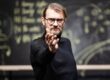
Jelinek is also the character who connects the two weddings (along with Heinz, Brigitte’s husband and electrician, who fixes the electricity at Paula’s wedding when it goes off). Jelinek is mistaken as aunt of the families, though she is actually the singer, with one name – Elfriede, like Dalida, Marina, Ceca, Mina, Adele, or Nico – the artist, eccentrically dressed, in her costume that looks like a spaceship uniform or a sci-fi costume of a character playing spermatozoa, or maybe Femme Fatale, the villain from Power Puff Girls – in a tight leather hood with a line drawn across the face (the costume for the whole show is also made by a mysterious person named Jelinek, so we can guess both Kokanov and Lazić hide behind Jelinek’s persona, one in the character in the text and one in the costume).
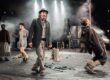
Jelinek, portrayed by Mina Stojković, in this show is a magnetizing magical being who moves between worlds – she connects the two weddings and the two brides in the last act – through her song – The Velvet Underground’s refrain of Pale Blue Eyes (which goes with her German Jelinek / Nico persona) – the two brides connect, dancing together, as the whole world, other characters – is frozen. This makes them look like figures in a wax museum; it shows how rigid they are in their lives, and how bizarre they are in their rigidity, as well as their relationships.
Photos: Nenad Borisavljević.
The two brides meet, one in white, one in green, like in the Wicked films. One bride is “perfect” but full of hatred and unhappiness – Brigitte, in a pretty short white wedding dress, and the other – Paula, bride completely dressed in green, a green vail, green underpants over green leggings, green punk shirt with something written in German – her costume alone, the wedding dress that Paula made by herself, brings so much authenticity in contrast to Brigitte’s sterile wedding under white neon lights, that this scene of two of them together, one completely inauthentic and one authentic (but, as we hear from the audience from Paula’s wedding – tragic) bride – is enough to bring one to tears. Now imagine adding the tender refrain of The Velvet Underground.
This moment is the turning point of the show, as two brides recognize each other, in one weird feminist Oresteia, and they realize that, in Kokanov’s lines, even though everyone tries to compare two of them and to show how different they are, they are THE DIFFERENCE. And thus, they say bye-bye to their families and escape together happily, as Thelma and Louise, to the main stage of the theatre, where we can watch them go into space in a rocket with Elfriede Jelinek and the girls (majestic scenography by Zorana Petrov).
And while they’re leaving Earth, they say: “We will not colonize the Universe.” They’re off to find their freedom in the unknown; the children are going away to be safe from the patriarchy. The space is the unknown, and while it may refer to a possibly tragic outcome, like in the last frame of Thelma and Louise, where the two women plunge into the Grand Canyon, but the shot stops before they fall, on the other side, space here is a reference to a queer iconography, from lesbian singer Frances Forever and her song Space Girl, to queer cosmology theories about the cosmos being inherently non-binary and fluid.
Queer, in the context of this show, doesn’t mean Brigitte and Paula are gay or even bisexual, but it refers to queer as an alternative way of living, without strict gender or other oppressive societal norms.
After watching this show I will never think about weddings or any social conventions in the same way again. I only hope one of my fellow critics reviews Paula’s wedding, so we can compare our notes!
Credits:
Author: Elfriede Jelinek/Dimitrije Kokanov//Directed by Bojana Lazić//Scenography: Zorana Petrov//Stage movement: Damjan Kecojević
For more information, visit: JoakimVujic.com
Further reading: Women as Lovers review at Mladinsko Theatre
Mina Milošević is a playwright, dramaturg, screenwriter, and theoretician based in Belgrade. She holds a BA in Dramaturgy and an MA in Theory of Drama Arts at the Faculty of Dramatic Arts in Belgrade. She worked as a dramaturg on plays in Atelje 212, Belgrade Drama Theatre, Yugoslav Drama Theatre, National Theatre in Belgrade, and Oda Theatre in Prishtina. Her play "Dr Ausländer (Made for Germany)" was presented at BITEF festival 2022. Her master's thesis on female friendship in Serbian contemporary theatre won the "Professor Boško Milin" Award.