
National Theatre of Kosovo, premiere 20 February 2026
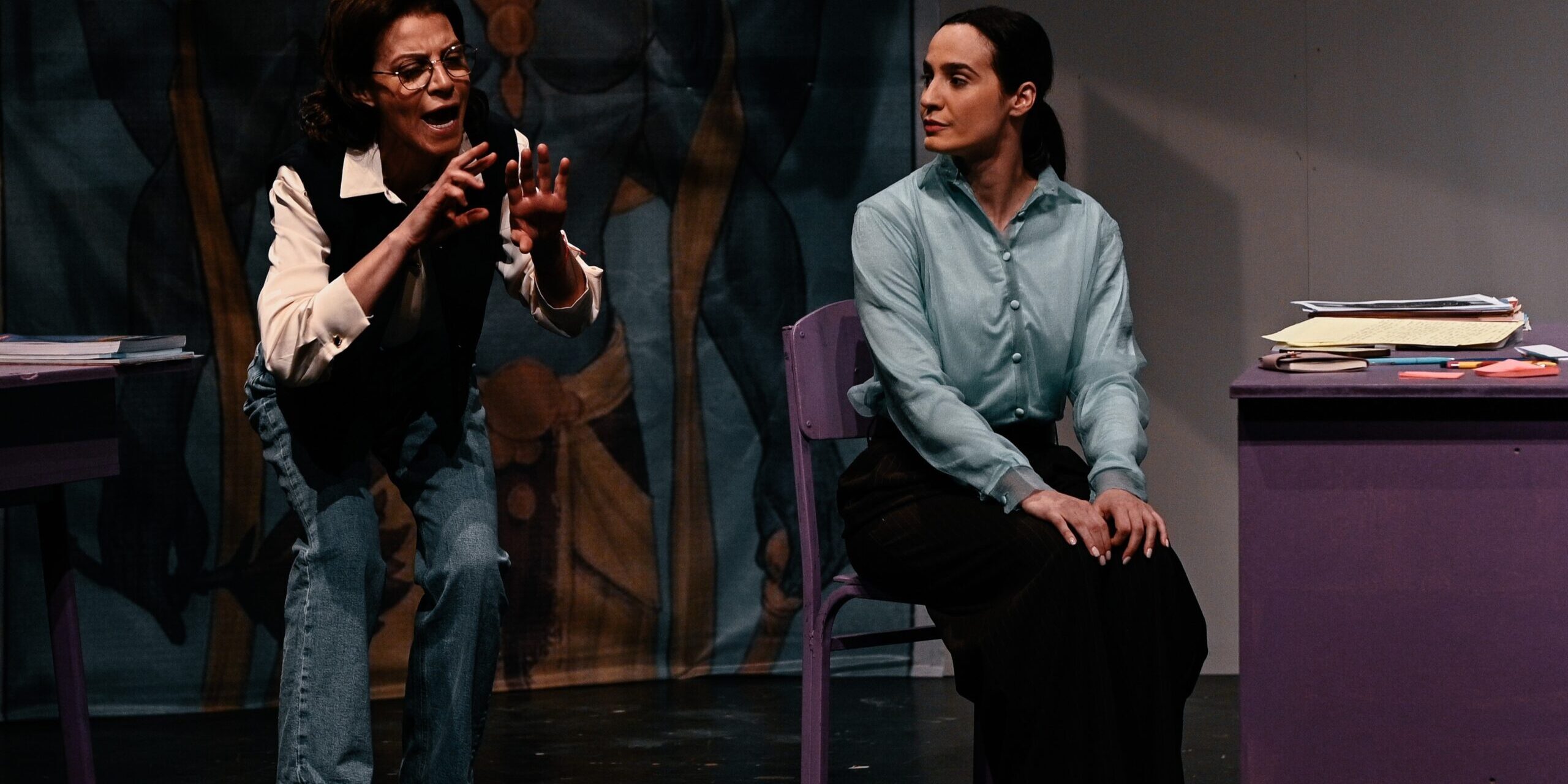
“I’m here about my son, Gidion,” a woman tells 6th grade teacher Heather Clark (May-Linda Kosumovic) at the start of US playwright Johanna Adam’s 2013 play, directed by Hana Qena. The woman insists she has a meeting scheduled and, while Heather doesn’t believe this is the case, she goes ahead with the meeting anyway.
Only gradually does she realise that Gidion is a student who just died, and the woman is his mother, Corryn Fell (Irena Aliu). The meeting was indeed scheduled, but no one thought Corryn would show up within days of losing her son. She did.
The encounter turns into a verbal rollercoaster full of unforeseen turns and dips. The conversation is slow and good-mannered at first, but it quickly escalates. A visibly shaken Heather describes how the entire school is in mourning, and how important it is for the mother to be with her family at this difficult time. Corryn comments on how unprofessional it is to assume she would not come to the meeting. “You sent my son home with a note asking me to meet you, so here I am,” she states, before adding “You have no idea how hard it is to find a babysitter on a school night.”
Their exchange intensifies, as the mother launches attacks and insults against which the teacher must defend herself. Heather tries to appear understanding of the mother’s feelings, while Corryn relentlessly asks why Gidion was suspended when he was the one being bullied. Eventually, Heather admits he was suspended because of something he wrote.
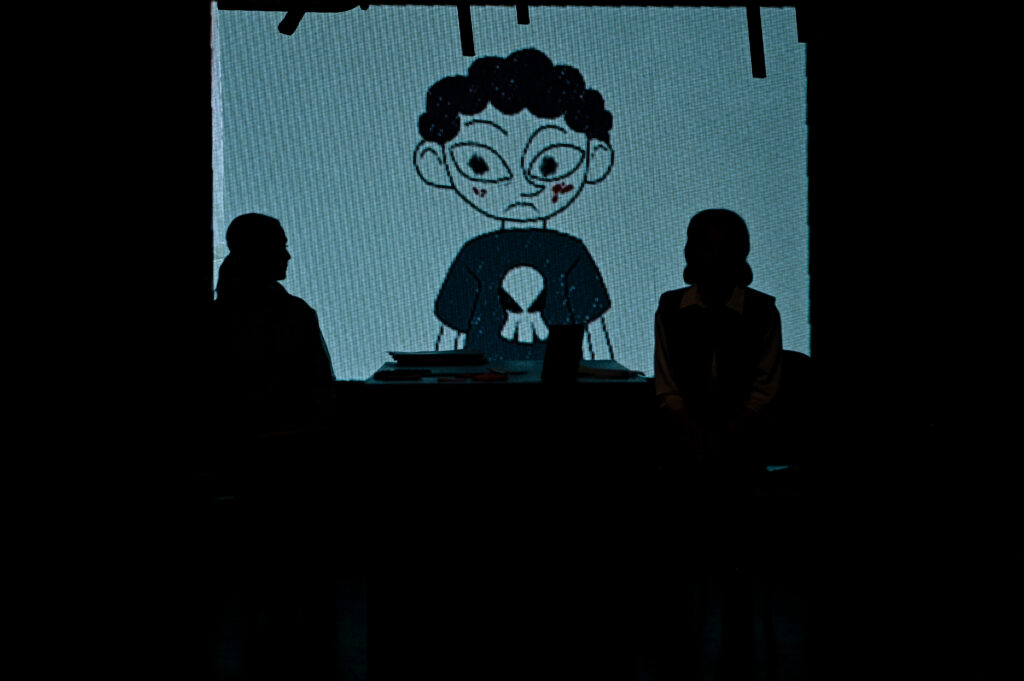
The bulk of the play consists of this back-and-forth with the mother convinced that her son was tricked and the teacher softly but firmly denying it. Ultimately, Corryn asks Heather to read what Gidion wrote. As Heather reluctantly reads it out, the stage goes dark and animations are projected on a screen which illustrate in gory detail a bloody massacre of teachers by their students. Unspeakable things are described in vivid detail. To the teacher’s horror, Corryn exclaims, “This is amazing! Marquis de Sade would be proud!”
Eventually both women break down and reconnect. Corryn sits at her son’s desk and starts inquiring about his classmates, a girl he liked, a boy he hated (it turns out Gidion actually had a crush on the boy). No, she does not want the 220 condolence cards the students want to send. In the end, it’s the teacher who’s sitting at Gidion’s desk, crying – over her sick cat. In a comic twist, it falls to the mother to comfort the sobbing teacher whose cat is going to be put down.
Irena Aliu gives Corryn the air of a well-read intellectual. As a mother freshly in mourning, she is capable of sounding cheerful even while pain slowly builds within her. She captures her aggressive edge, the way she tackles her son’s teacher without mercy, openly insulting her. There’s a tragic absurdism to her unapologetic manner.
May-Linda Kosumovic presents Heather as a caring teacher, who stands her ground despite all the fury that is being directed against her. Her movements are strained for most of the play, in a way that almost suffocating to witness. Telling a parent difficult truths about their child is a challenge of immense proportions and yet it is also an inextricable part of a teacher’s role. Kosumovic has a masterful control of her voice in this respect, her tone oftentimes more commanding than her body language.
Gidion’s Knot. Photos: Kushtrim Haxha
Both actresses carry the emotional burden of the play until the end. It’s impossible to tell who is right and who is wrong: the teacher who defends the school system or the mother who blames it. Their encounter is like a wild dance, fierce and tender in equal measure; it’s the glue that holds the play together.
Director Hana Qena maintains the tension between them. At first the two women sit across from each other, later they turn away and then face each other again. At the end they hug. At first they talk at each other, then to each other, and finally with each other. Both of them end up sitting at Gidion’s desk at different times, where each of them experiences the same stillness.
Miscommunication is the villain of the story. Both women make solid arguments and speak with conviction, but neither is listening nor prepared to concede. Still, after all the raw outbursts, the other’s reality slowly creeps in. The play is a cataclysmic conversation starter about young people’s mental health, something which ideally needs to be seriously addressed by the family and the school together. Gidion’s Knot is indeed Gordian in nature, a knot that remains untied. It’s a play that feels both poignant and relevant today when, in an age of mega-connectivity, people are more distant than ever, and so much goes unsaid or misunderstood.
Burim Arifi’s stage design is striking, with school desks and chairs hanging from the ceiling, with children’s writing assignments attached to them. The school system is big and heavy, always looming, it seems to say. Drawings of Greek and Hindu gods and goddesses adorn the walls, like indifferent witnesses to an unfolding tragedy. The animations by Flaka Kokolli, Elsa Talla, Leonita Thaqi, and Diellza Franca, which illustrate the story written by Gidion, are excruciating.
Plays like this should come with content warnings. Gidion’s Knot is deeply disturbing and ultimately alarming. It’s shocking but perhaps a shock is what it takes to invite reflection, patience, and insight.
Cast:
Author: Johnna Adams// Director: Hana Qena// Costumes: Hana Zeqa// Stage design: Burim Arifi// Soundtrack: Ger Kacerja// Animation: Flaka Kokolli, Elsa Talla, Leonita Thaqi, Diellza Franca//Adaptation: Nazmije Krasniqi//Photography: Kushtrim Haxha
Cast: Irena Aliu, May-Linda Kosumovic

Bora Shpuza is a literary translator and freelance art reviewer based in Prishtina,