Kamerni teatar 55, Sarajevo
Elfriede Jelinek’s novel Lovers addresses the lives of three women from the provinces, members of the working and middle classes who try to secure their economic futures through education and marriage. All three are victims of patriarchy, and their attempt to break into a higher social class becomes a story about winning a washing machine, about the prohibition placed on women to desire, to feel love, to feel their own bodies, and about the impossibility of overcoming transgenerational trauma.
Directed by Jovana Tomić, the production has been adapted for the stage by Asja Krsmanović and the director herself, and performed by the actors of Kamerni Teatar 55 from Sarajevo,
Hermetic and steeped in cynicism, the novel by the Austrian Nobel laureate is a powerful critique of patriarchy and its entanglement with capitalism. The author demonstrates a radical approach to language that Jelinek would continue to deepen in her later plays and novels. The novel depicts what precedes and ultimately leads to violence against women and potential femicide. Both the dramaturge and the director preserve this feminist and anti-capitalist edge in the performance text, remaining consistent not only narratively, but also linguistically, stylistically, and through humour. All characters speak on behalf of the character they are simultaneously interpreting, which creates a sense of distance and the impression that the characters have developed a dissociative disorder as a result of constant exposure to violence.
Brigitte and Paula, two working-class women, are in search of romance, love, and marriage. Brigitte (Nadine Mičić) sees love as a ticket to a carefree and financially secure life; love and orgasm are great if they happen, but they are not mandatory. Paula (Dina Mušanović), on the other hand, dreams of love under the pressures imposed by society and the media. The media are represented by a television host in a flashy jacket who offers advice and assesses a woman’s worth based on her roles as a partner and mother. This pressure women feel to be in relationships, have children, and meet societal expectations is effectively highlighted by society and television. The main difference between the two women is that Paula initially wants to train as a seamstress to support herself and find meaning in her life through her work, and Brigitte believes life happens after work. Both end up married to men who do not love them, with children who are the only reason the men stay with them. They become victims of violence and underpaid labour.
In patriarchy and capitalism, it is not only the poor who suffer. Susi, a girl from a wealthier family who has the opportunity to study, also ends up unhappily and unsatisfied, pregnant in a marriage to a university professor. Harrowing scenes of violence are interrupted by songs from Italian canzonas. Brigitte and Paula fantasise about a better life, a sunny coastline, and cocktails on the beach, so the songs function as an escape from reality. The songs serve as an effective rhythmic device, interrupting and slowing down the action at moments when the audience needs an emotional break.
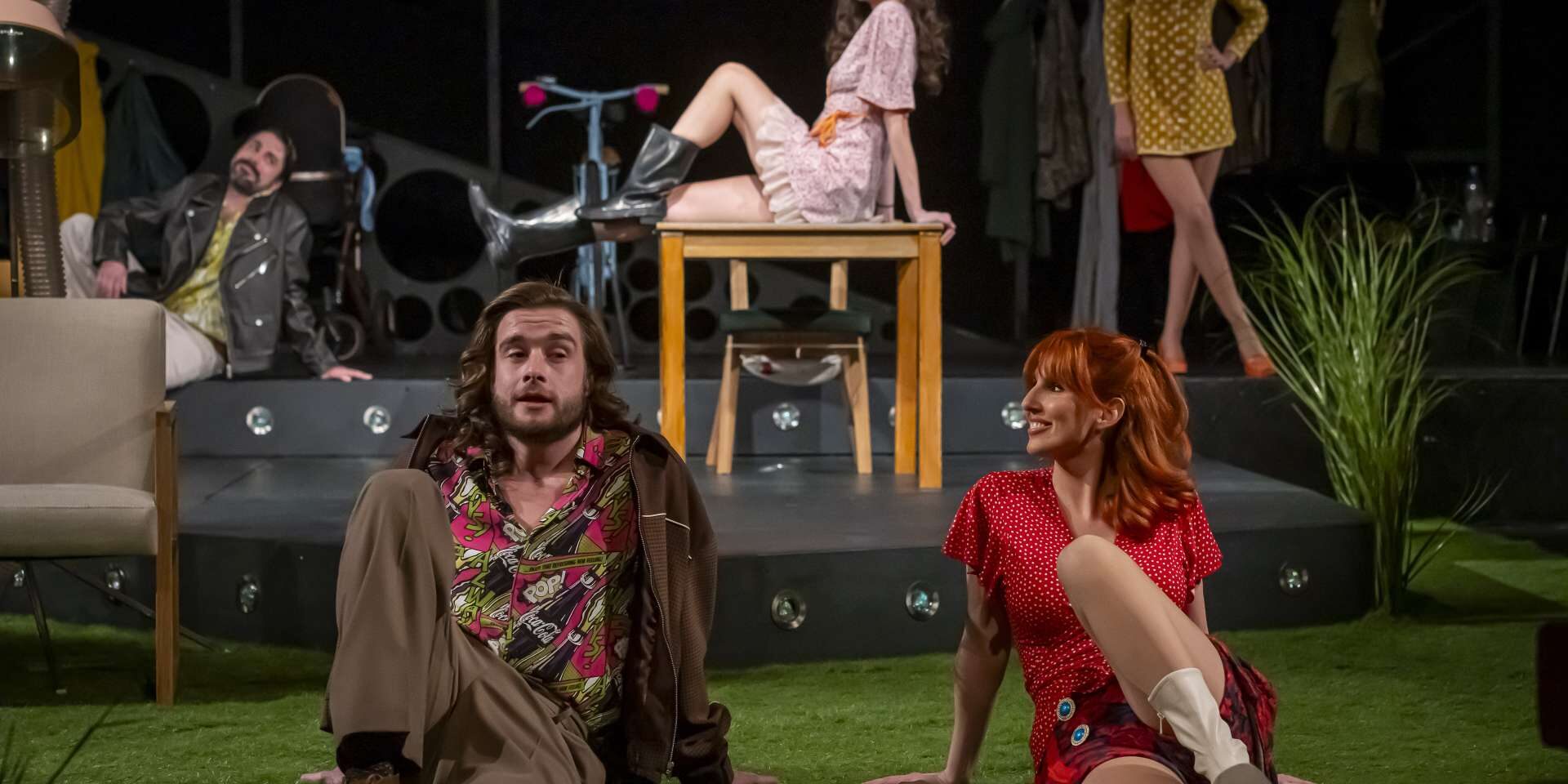
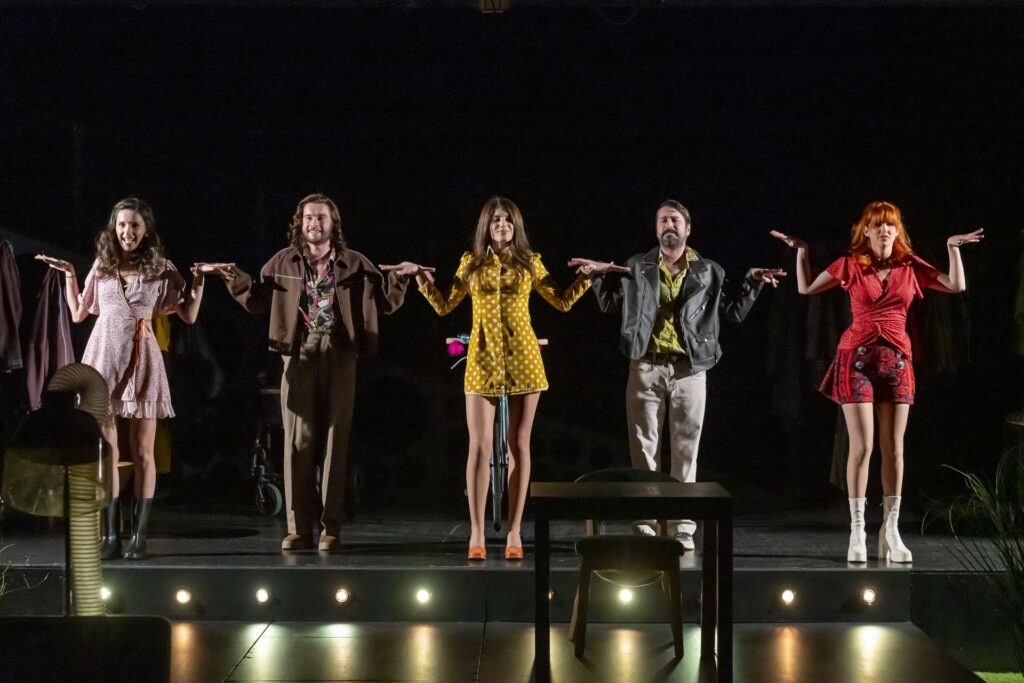
Along with the music, the set design and costumes are in contrast with the narration. They are colourful, plastic, glittering, and on the verge of camp. Although seductive, the question remains whether the set design is functional. Alongside the stage-within-the-stage that evokes television glamour and the performance of upper-class status, there is also an incline/slide that is used twice without a clear purpose.
Lovers, Kamerni 55
At times, it seemed as though there were far more actors on stage than the five who actually appeared. The skill and speed of the Kamerni Teatar actors, their mesmerising ease of transformation, were brilliant, which makes it difficult to single out individuals. Dina Mušanović, Nadine Mičić, and Anja Kraljević, in her interpretation of Susi, resemble animated dolls in their stage movement and speech. Even in their physical presence, they function as instruments of male gratification. I commend their persuasiveness and their sense of measure, which prevents the performance from slipping into banality or caricature.
The play suggests that women, particularly mothers, as guardians of patriarchy, help to sustain the patriarchal system. Paulina’s, Brigitte’s, Heinz’s, and Erich’s mothers are each violent, possessive, and controlling in their own way. Paulina’s mother forbids her daughter’s education and, against her will, attempts to force her into an abortion; Heinz’s mother shapes him into an abuser; Erich’s mother physically abuses her son. The defenders of patriarchy are also its victims, shaped by generational trauma. While they undeniably contribute to this power distribution model, the performance portrays them as solely responsible for women’s enduring suffering. Had they raised the sons better and taught the daughters to find better husbands, we would now be living better lives. Such a perspective consequently absolves men of responsibility for patriarchal attitudes and violent behaviour and further shifts the blame onto women. Paulina refuses even to look at her daughter, which is a clear sign that this girl is unlikely to have a better fate. On the other hand, the production omits to show that men also suffer under patriarchy. Heinz and Erich utilise every kind of privilege to live lives focused on their own comfort, pleasure, and the demonstration of power over those who are weaker.
Jelinek’s work on stage manages to concern us to this extent, and the creative team deserves praise for this. When the system fails to protect women’s lives and safety, and when society does not support breaking free from entrenched behavioural patterns, we must speak out against violence toward women. Only by discussing violence against women and advocating for their emancipation through education, rather than through marriage, can we can we liberate, accept ourselves and stop passing on the traumas.
Credits:
Author: Elfriede Jelinek // Director: Jovana Tomić // Dramaturgy: Asja Krsmanović // Composer: Vladimir Pejković // Set and Costume Designer: Adisa Vatreš Selimović
Cast: Dina Mušanović, Nadine Mičić, Anja Kraljević, Boris Ler, Enes Kozličić
Further reading: Interview with Jovana Tomić: “The director’s main role is to allow people to share”
Further reading: Women as Lovers review, Mladinsko Theatre
For tickets and more information, visit: kamerniteatar55

Divna Stojanov is a dramaturg and playwright. She writes mainly for children and young people.