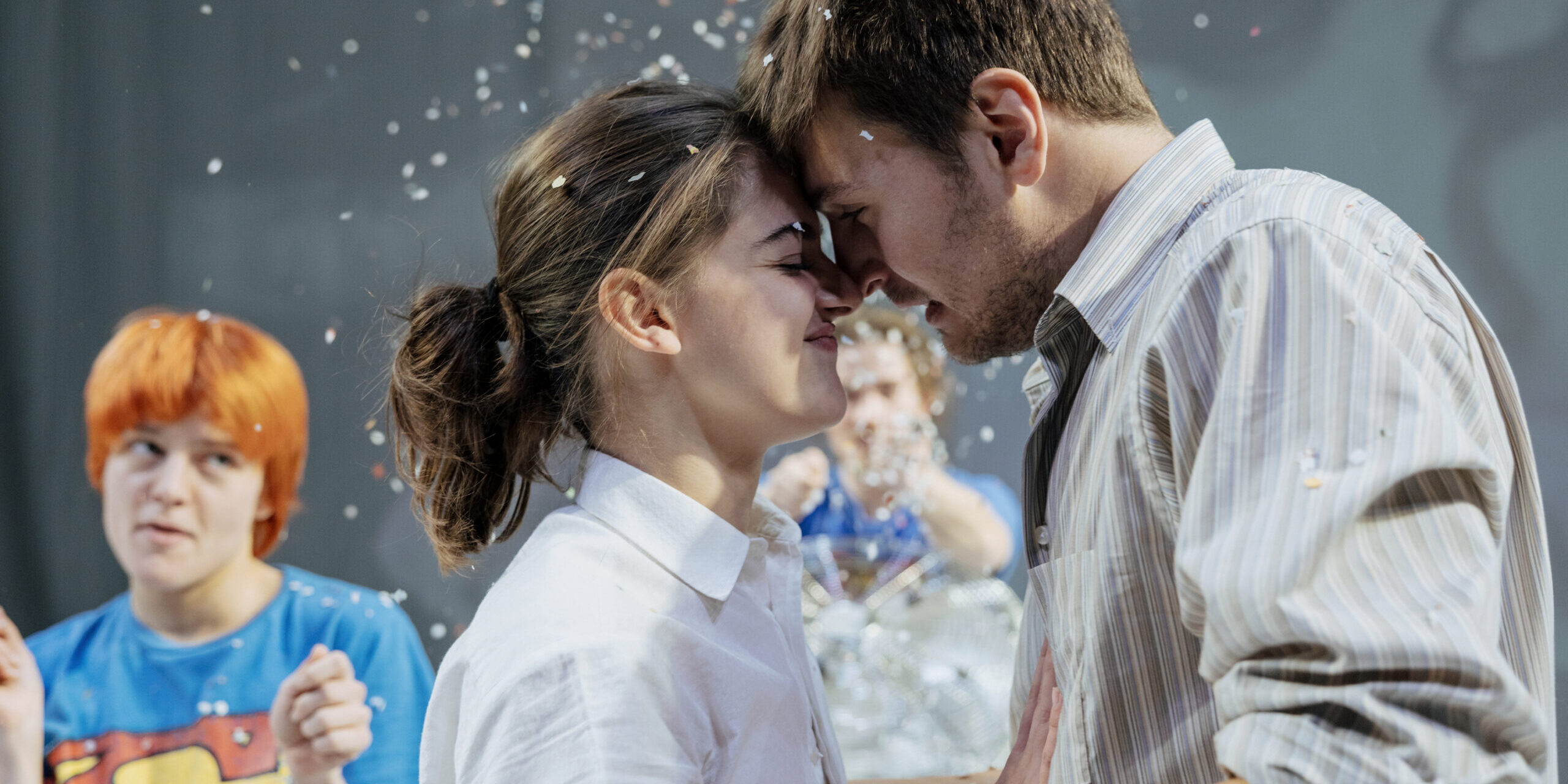
Istrian National Theatre, Pula, performance 9 January 2026
I, David tells the story of David Reimer, who was born male but raised as a girl after losing his penis during a botched circumcision as an infant. Devised by director Gabrijel Lazić (as part of his MA Theatre Directing program production at UL AGRTF) and dramaturg Nastja Uršula Virk, the show charts Reimer’s life story – from his birth, through all the struggles he faced with his gender identity, to a tragic ending.
The cast consists of four AGRFT’s acting students, each of them taking on a role of one of the Reimer family members: Eneja Štemberger and Muhamed Kulauzović play the parents, Janet and Ron Reimer, respectively, with Kaja Petrovič and Luka Kotnik as their twin children. The play is divided in three acts which are named after all the names David carried during his lifetime. .
Act I: Bruce
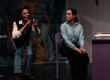
As the audience walks to their seats, Štemberger and Kulauzović are already on the stage, casually leaning on two connected baby-changing tables. The two of them start narrating the story of how Janet and Ron Reimer met and had their two sons. Both of them grew up in conservative and religious surroundings and were considered by their parents to be rebels because they wanted to live their life their way – Janet didn’t want to be a seamstress or necessarily take up any ‘female’ job – so they moved away. The Reimers’ became parents very early, Janet was just 19 and Ron 21, when they had twins Bruce and Brian. At the age of six months old, the twins were diagnosed with phimosis and were referred for an operation, during which Bruce’s penis that was burned during an unconventional method of electrocauterization for circumcision.
Štemberger reaches for a bundle of white cloth on one of the baby-changing tables and slowly unravels it, showing a tiny piece of what looks like coal. Both Štemberger and Kulauzović display silent horror over what’s left of their son’s penis – they state how, that small black piece, isn’t a ‘theatrical symbol’ for the penis, but is in fact what it really looked like and describe that the hospital room reeked of burned meat. From this moment on, there’s an eerie feeling in the air that is hard to shake off, feeling that anticipates a series of unfortunate events and tragedy, despite several warm and moving moments. The black back drop in the first act and haunting instrumental (music by Sara Renar) doesn’t help to shake that feeling.
Ron is devastated by his son’s physical defect and he falls in front of the TV that sits in the front right corner of the stage, hiding his face from the others. Janet tries to stay relatively calm and sensible while hearing Bruce’s cries that are played on an IPhone under one of the tables. She tries to imagine Bruce as an adult man in her monologue which breaks her heart because she’s afraid and aware that her son will face hardships and will never be able to have children on his own. Kulauzović now approaches her with another bundle, embodying her imagination of Bruce with his own child. Realising this will never be the case, she pulls out a hidden piece of black cloth from his shirt collar and covers his entire face with it.
Kulauzović stands like this for some time, empty handed, while Štemberger sings a lullaby to distract herself from a terrifying vision. As a whole, the play is very rich with these creative breath-taking images that poignantly communicate the characters’ inner turmoil. The characters almost never directly communicate verbally with each other, the dominant language of the play is non-verbal and based in movement. Speech is mostly used in third person to narrate David’s tale and question the gender binary opposition. This way, it’s like the ensemble wanted to minimize the spoken word in favour of mimic which is then displayed fully packed with emotion and tension.
After the devastating operation, the Reimers watched a TV talk-show that features a trans woman and the infamous sexologist John Money who talks about gender-affirming operations and care. The Reimers were astounded at how this woman didn’t show any signs of being assigned male at birth and decided to seek out Money for his help. Following his advice, the parents decide to raise Bruce as a girl and see the transition almost like a salvation, an insurance to make their child’s life less painful, even though other doctors advised them to wait until school age for a phalloplasty. Money claimed that children are able to adapt to gender and sex transition easier if the change is decided earlier. Also, the parents are strongly advised to never speak to their child about the surgery or transition under any circumstances. Štemberger brings Kotnik as Bruce to the stage for a castration that is simply shown by him lying on the two tables and Kulauzović removing his underwear under a towel. Štemberger then gives Kotnik a green collared dress to put on and tells us that Janet decided to rename her son Brenda.

I, David
Act II: Brenda
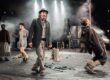
The second part starts in a very lively way with Giorni by Mina playing as the scene is totally transformed – instead of a dark black background, the curtains reveal a white screen and white linoleum floor glued to the floor which makes the stage appear sterile and hospital-like, alluding to the therapy and procedures Brenda was submitted to, despite her increasing refusal. Kotnik playfully dances and runs around the stage, wearing the green dress like a cape around his neck. On the second chorus, he throws the dress high up and runs to the back when suddenly Petrovič runs in topless and catches the dress, continuing to dance and run around. This particular scene was my favourite; the timing was perfectly executed which made the actors’ transition seem so effortless and effective.
Brenda remains playful, she climbs one of the two tables that are now placed in the back corners of the stage and does a Superman pose in slow motion before jumping off it. She will repeat that pose a couple more times later in her dreamlike scenes, one in which she imagines she had her brothers male body and the other one where she’s desperate for her family to reconnect. At first, Janet is amused by her daughter and joins in her game but quickly gets tired of her refusal to wear the dress and behave properly, as a little girl should, and not like a boy. Brenda slaps her mother across the face out of frustration which leaves both of them shocked. The slap is really the first interaction of violence and tension that will echo throughout the rest of the play.
Brenda ends up putting the dress on herself with visible guilt all over her face as her mother approaches her to film her with an Iphone up close, mimicking the thorough analysis of her bodily development and growth as a trans girl. Per usual, the usage of a camera transmission on the big screen allows the audience to see actors’ facial expressions and emotions up close, but in this medical context reminded me of a microscope, and how closely our bodies can be scrutinized.
At the back, Kulauzović sits at one of the tables with a microphone and reads in Money’s own words about his work at the institute and Brenda’s case. He specifically points out that she has a twin brother which allows a unique opportunity to follow her development in comparison to her twin. He ignores the ‘masculine’ characteristics that Brenda kept demonstrating, claiming it’s normal for her to act this way during the transitional period. Money will continue to show negligence and keep insisting on Brenda’s complete transition, this will become more clear during this part with more scenes and narration that describe the inappropriate methods Money used to teach Brenda and Brian, like telling them about dominance and submission in sexual terms following the stereotypical gender segregation where a man is considered the dominant one and a woman a submissive one.
The Reimers’ continue to face adversity beside Brenda’s forced transition, the twins are growing apart from one another and their sibling rivalry becomes more toxic and aggressive with the passing years, while their parents face marrital and mental crises. Everything escalates during the birthday scene where Brenda’s behaving appallingly, continuously stuffing her face with cake despite being sick and vomiting on the stage while her parents stare at her in silence. During this time, Brenda was experiencing puberty and taking female hormones (to which she consented to at 12) but her body, despite operations, produced male hormones. She finally snaps, smacks the cake and throws the table, grabs the microphone and lays under the white screen in the background, with the half of her body on the ‘other’ side. This is the first time we hear Petrovič’s voice and the main character in general, talking about how they hate this body and can’t continue the therapy, simultaneously apologizing to their family because they realise how difficult their transition has been for everyone.

I, David
Act III: David
After a short break, the audience comes back for the final act. The stage has been cleaned up, but there’s still some remains from the last two acts on it. One of the tables from the before is now placed on the proscenium with a tripod standing tall in front of it and next to it is a clothing rack. Previously, it carried dresses, now there’s a single brown suit, a small bottle of red pain, empty metal hangers and pliers. During the third act, we only hear David’s voice from off and his thoughts and feelings on what he went through. Petrovič’s voice on the recording is slowly shaped to sound deeper, more masculine while she models her naked body with hangers and pliers. Her body, wrapped in metal and covered in drops of red paint, presents a striking organic visual of David’s operations and transition back to desired masculine body. An Iphone on the tripod again allows the audience to closely look at the body undergoing changes, but this time it’s in control of the character who bears it. Štemberger and Kulauzović are present on the stage, busy with cleaning the stage from the mess their characters made; as it’s often said, a road to hell is often paved with good intentions, especially in case of parenting. We learn that in 1980 David finally learned the truth about himself from his father. He decided to call himself David in reference to the biblical story of David and Goliath, an underdog overcoming a seemingly much stronger opponent.
In the monologue, the protagonist touches on the feelings of guilt and shame he felt during his gender identity journey and references Judith Butler’s work on gender as a cultural construct. There’s also some references to Foucault’s bio-politics without explicitly quoting him when the monologue questions the societies/governments’ need to define human beings between the two genders it recognizes. Essentially, based on David Reimer’s real story, the play focuses on the intersex population and their inability to fit the binary gender division – not because they personally don’t fit in it, but because they were born as intersex. Having finished the ‘transition’, Petrovič puts on the brown suit over the metal hanger on her body and cuts off the excess tips from it with pliers, while in the back a slideshow of intersex bodies and real Reimer’s photos. A fraction of an interview with David is played from a documentary Every Body and I notice how Petrovič’s red hair and brown suit looks almost identical to the characters she’s playing as she slowly walk to the white screen. I feel my guts turn and hear sniffles in the auditorium when Petrovič lifts the screen where Kotnik lays and the subtitles tell us David’s brother Brian died of suicide, as did David.
This tragic ending is a real gut-punch and an emotional goodbye from the twins who’ve never found peace in the end. The significance of white screen as a border between life and death is teased during the performance, a border that Brenda spent a lot of time close to in the second part. I, David might be a ‘student’ production, but it exceeds expectations in every way. From the amazing young cast that is able to deliver every heavy emotion without almost any dialogue and pure physicality, to Lazić’s creatively rich theatre imaginarium that captures the emotions almost better than a spoken word could.
Credits:
Author and director: Gabrijel Lazić// Author and dramaturge: Nastja Uršula Virk// Scenography and costumes: Lovro Ivančić // Music: Sara Renar// Lights: Domen Lušin// Produced by: UL AGRFT, UO Orlando
Cast: Eneja Štemberger, Muhamed Kulauzović, Kaja Petrovič, Luka Kotnik

Nora Čulić Matošić (1998) is a student of Comparative Literature (MA) at the Faculty of Humanities and Social Sciences in Zagreb. She has written theatre criticism for the Croatian radio programme Theatralia and web portal Kulturpunkt.hr. Besides theatre, her interests are other forms of performing arts (particularly dance performances) and film.