National Theatre of Kosovo, premiere 27 March 2026
A world divided, imminent threats, fire in the horizon, bombastic headlines, people in comfortable living rooms laughing it off, confident in their denial of looming calamity… Sounds familiar? Max Frisch’s classic Biedermann and the Arsonists, written in 1953 for the radio and adapted for the stage in 1958, is yet another play from the past that bears a striking resemblance to the present.
A two-storey structure fills the red-lit stage of the National Theatre of Kosovo. Firefighters sing of fire, to live musical accompaniment. Biedermann (Kushtrim Qerimi), a wealthy businessman, comments on news of the arson overtaking the city. ‘Certainly, this will never happen to us, but these people must be taken care of!’, he declares. Initially taken aback by news of the arrival of an unannounced guest, he finally agrees to invite him in. Schmitz (Shkëlzen Veseli) strides in, tall and unapologetic, demanding shelter and being picky about food – apparently beggars can be choosers. Biedermann agrees to house Schmitz and later his companion, Eisenning (Arta Selimi), in the attic of his house, despite the worry that they might be arsonists. But will Mrs. Biedermann agree? She does, eventually, bored as she is by life’s comforts and intrigued by Schmitz’s rough charms.
Two parallel events transpire on the two-tier set, with dinner preparations taking place on the ground floor while cans of gasoline are stacked upstairs. The hosts are relentless in their honesty about society and notions of fair treatment, while the smell of gasoline pervades the stage. Hints of imminent arson are everywhere, and yet the Biedermanns remain stoic. They believe that everything is all right, as long as we all mind our business. No one is blinder than he who will not see. The two house guests are constantly bringing giant gasoline cans into the attic and refuse to let anyone smoke around them – that is until they decide it’s time. Their intentions are clear as day, yet still, they manage to pass themselves off, to the Biedermanns at least, as innocent interlopers who are simply grateful for their hosts’ generosity.
The play’s dialogue is elaborate and dramatic, often funny to the point of becoming ridiculous. The dinner cooked by the servant is duck, aka a platter of explosive devices. This ‘food’ is served on gasoline cans, as Biedermann attempts to be modest about his wealth but can’t resist an outrageous display of affluence. As the evening progresses, games are played, while the arsonists butter up their hosts, Eisenning dances with Mrs. Biedermann, while Schmitz ravages the servant in the background. Gradually fumes fill up the stage, fire erupts, and the Biedermanns stand together, arm in arm. For the first time in the play, their faces are serious and their standing unsure. In its fiery finality, complacency meets calamity.
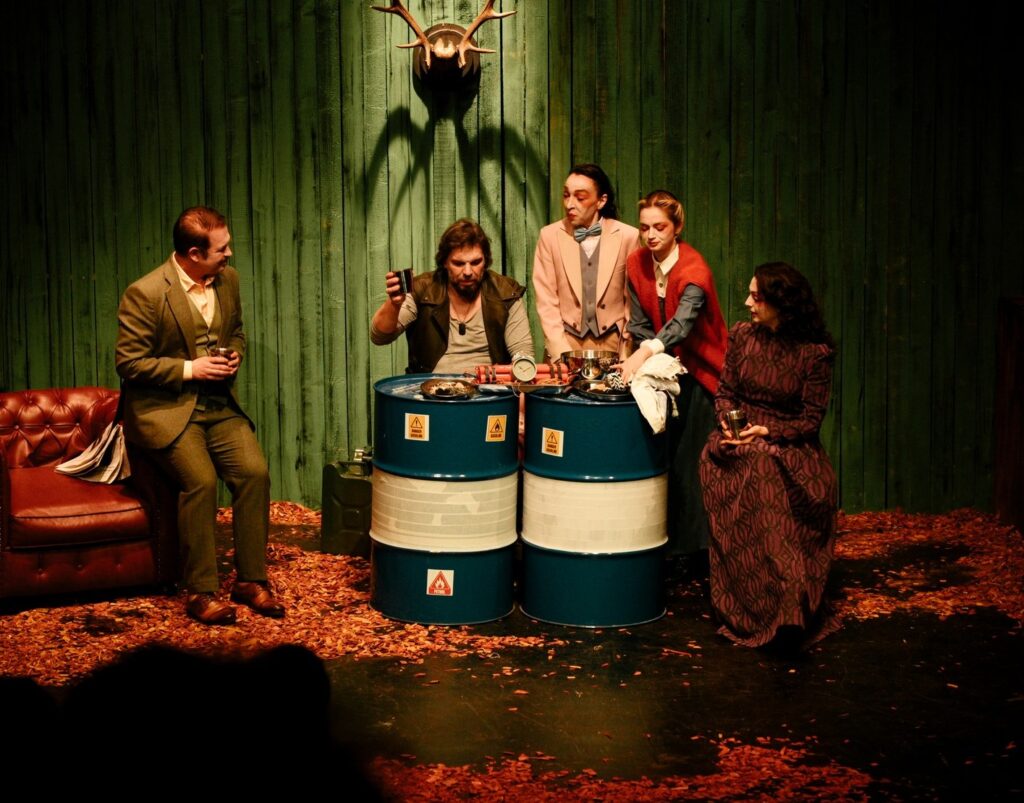
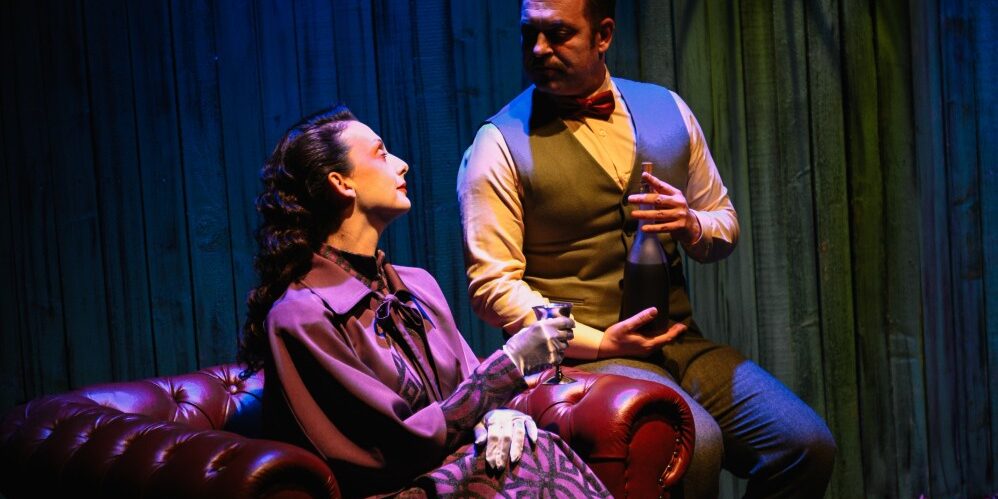
Biedermann and the Arsonists. Photo: Kushtrim Mehmeti
Kushtrim Qerimi’s Biedermann is the epitome of a fine, upstanding, law-abiding citizen. He has a big smile, uses big words, and has big opinions about the way the world should be. Proud of his hard-earned wealth, he wields his power in a seemingly benevolent way, which is clearly superficial. Semira Latifi, clad in dramatic purple, glides elegantly across the stage, sometimes panicking about her weak heart, sometimes acting all excited at the prospect of an eventful evening. Shkëlzen Veseli is particularly dazzling as Schmitz, the wrestler-turned-arsonist whose confidence is equally outrageous and admirable, with scarred fists complementing his rugged outfit. A quirky Arta Selimi plays Eisenning with a joker-like cynicism and sharp comedic skill. She embraces the physicality of her character, and makes manspreading and mansplaining a key part of his manner. The servant (Albina Krasniqi) follows all the rules but deeply resents her masters, all too aware of their phony frivolities. At one point she sits in Mr. Biedermann’s lush armchair reading his paper and cursing through her teeth.
The idiosyncratic costumes by Samka Ferri have real dramatic appeal. The cast sport pale faces and heavily blushed cheekbones, their faces lit by green light. Nicola Minssen’s set is populated by comfy armchairs, the floors filled with tinder in the salon, the attic filled with gasoline cans, while the whole house is made of wood. The music composed and curated by Memli Kelmendi is played live by musicians dressed as firemen, sat to the left of the stage on a tall red structure. Their interventions come at key moments during the play, making for a beautifully animated theatrical experience.
Director Agon Myftari weaves together movement, sound, and image, creating an artful sensory experience. The versatile cast acquit themselves well and while the production sometimes runs the risk of feeling a little smug, the staging strategies are ultimately effective, the experience enhanced by high-quality live music.
This dark comedy, written a less than a decade after the Second World War, was meant to expose the dangers of denial, in the wake of Nazi horrors. The world was recovering from turmoil then, but today it’s in turmoil. These arsonists are outcasts, one is homeless, the other an ex-convict, their sole intention is to wreak havoc the likes of which is happening on a global level now.
Liability comes through commission or omission, and indifference can have dire consequences when people see what’s happening before their eyes but delude themselves into believing it cannot touch them. The play is a reminder that nonchalance and passivity can sometimes be harmful. Action must be taken, but how and to what end? Until we figure it out, there will be fire.
Credits:
Author: Max Frisch// Director: Agon Myftari//Adaptation: Nazmije Krasniqi//Lights: Bujar Bekteshi, Arben Aliu//Stage: Nicola Minssen//Costumes: Samka Ferri//Dramaturg: Zoga Citaku
Cast:
Kushtrim Qerimi, Shkelzen Veseli, Semira Latifi, Arta Selimi, Albina Krasniqi, Ylber Bardhi, Edlir Gashi, Lum Veseli, Edona Reshitaj, Donika Rushiti, Lis Maliqi, Erdonis Gashi

Bora Shpuza is a literary translator and freelance art reviewer based in Prishtina,