
Zagreb Youth Theatre, premiere 12th December 2025
Written by Tena Štivičić, one of the more prominent Croatian playwrights abroad, Acid takes us inside a renowned dance company, its management affairs and power play relations with its employees. The title and the plot are partly inspired by the real life incident from 2013 when the artistic director of Moscow’s Bolshoi Theatre was attacked by acid by a dancer, allegedly motivated by intense conflict and casting clashes. The incident is mentioned explicitly in a play as a warning to Gabrijel, the famous choreographer and director of the dance company, who’s being publicly persecuted for his cruel behaviour, verbal and psychological abuse he conducted over his colleagues. Frano Mašković takes on this role convincingly, he emanates the coldness and narcissism with ease, although it’s a shame, as he plays a choreographer, that he doesn’t demonstrate the artistry in movement, especially since Mašković has in recent years done an awarded contemporary duet Parallel Campaigns. Alongside him, playing Gabrijel’s wife Sonja, is Nataša Dangubić, always superbly interpreting cynical intelligent women who’ve had it enough of their partner’s immature behaviour.
Directed by a Lithuanian Antanas Obcarskas, the plot is focused on what happens off-stage, the more business aspect of the artistic job. There are two screens above the stage which show individual recordings featuring interviews with play’s characters about the three decades of said dance company. Interviews are mainly focused on displaying Gabrijel’s person and work, from his own and his colleagues’ perspective. Gabrijel takes issue how, before digital era and social media which made almost everything public, the inside of a theatre where the magic of art creation was something sacred and hidden from the outside onlookers. Beside Gabrijel and Sonja, the clips also feature Adrian (Filip Nola), another manager/producer/business partner of the company, and Lucija (Ema Bates), the up-and-coming dancer in the company. We gradually learn from other characters what kind of person Gabrijel is and, it doesn’t come as a shock that this cold genius is really an ego-tripping narcissist that pushes people’s limits for the sake of art. What’s interesting with the interviews is how they speak about him with utmost respect which further shows how misconduct and abuse is normalized in arts when it comes to working with an artist you admire, or worse, worship. This is predominantly telling in the dynamics between Gabrijel and all three of their assistants, played by Adrian Pezdirc, Nikolina Prkačin and Mateo Videk. Their episodic roles perfectly captures the awkwardness and uneasiness of working with a demanding director such as Gabrijel.
Acid, ZKM. Photo: Marko Ercegović
Furthermore, they dive into the specific issues of dancers and their relationship with pain because, as Lucija states, since she started dancing, the pain became a norm for her, how as a dance performer she is most likely to retire very early on in her life. She briefly touches on the importance of using mirrors during practice, how you’re always looking at an image of yourself, superficially entertaining Lacan’s psychoanalytic idea of ‘mirror stage’. However, her character is not a victim nor does she act like one – Lucija is calculated and opportunistic, she’s conflicted between her ambition to be great and her morals. Although, she makes it seem like her morals lie on the public opinion as she openly discusses whether or not she should sign the public letter that details Gabrijel’s horrendous behaviour with him and Sonja. This lack of character’s agency and a too-soft performance from Bates (granted, she’s not a professional actor but a dancer) leaves the piece without a proper conflict, both inner and outer.
In contrast to her, as a former dancer and now a choreographer and manager, Sonja brings forth the challenges of aging as a woman in comparison to her husband. She tries to point it out to Gabrijel towards the end, but with little success as he’s all too invested in his own forced retirement. She also makes a great point of experiencing insecurity about whatever she did or does as a woman, unlike him, her dedication to his life rhythm which caused her to be childless because they stared trying too late. All this, comes out in a final dialogue and confrontation which reminded me of that brilliant argument scene from the film Anatomy of a Fall as similar scene plays here between the two spouses. A wife is calling out her husband for acting as a victim and not taking responsibility or accepting the consequences for his own actions – Dangubić naturally played it well.
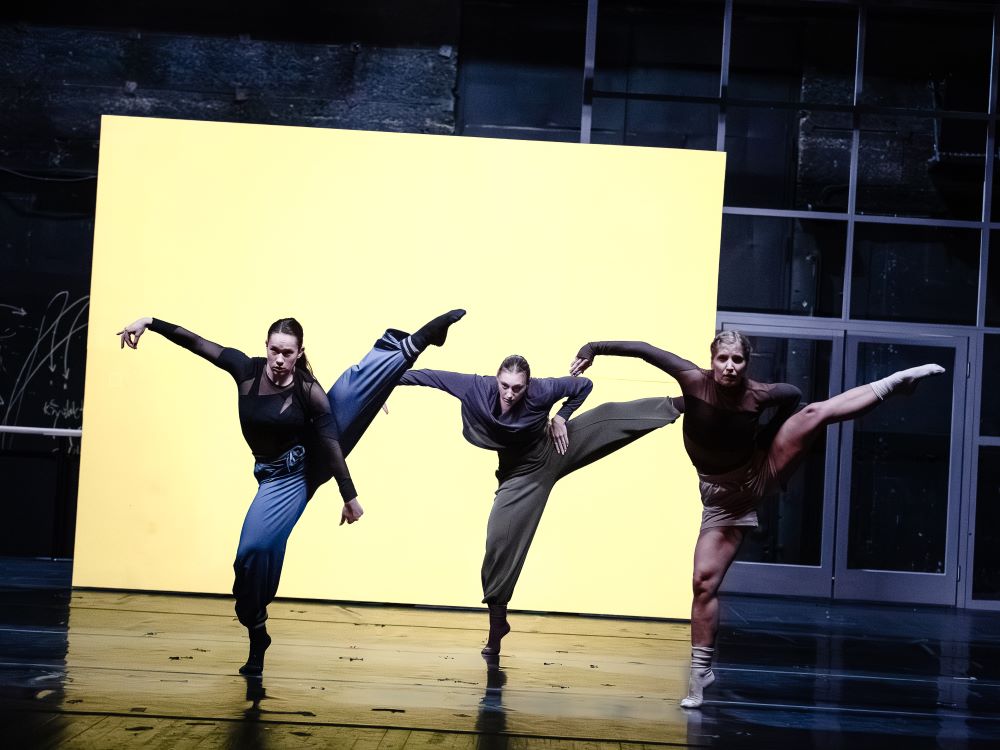
ZKM’s Istra hall is fully utilized in all its depth and width – behind the proscenium, that works as an office space where most of the dialogue happens, there rest of the scene is designed as a dance studio, a rehearsal space for the four dancers (Luna Lilek, Dorotea Domović, Gabrijela Kambić Kovačić and Bates) which appear during the performance. Besides a couple of longer sequences of actual ensemble choreography by Miloš Isailović and Igor Koruga, the dancers’ interactions are mostly reduced to background visual entertainment, or even distraction, from the acting interactions. The pieces are beautiful and skilful but bare no significant meaning for the play as the company’s aesthetic or dance style remains unclear. One of the sequence is used as a great illustration of Gabrijel’s cruel attitude towards the dancers but he mostly carries out his will through his fearful assistants.
Even though Acid touches on interesting topics, particularly in time of ‘cancel culture’ or as it’s called in the play, the ‘climate of denunciation of figures of power’, it unfortunately falls flat as a whole. The majority of the play felt like an exposition and an expose of the main villain who never shows any worry or remorse for what he’s experiencing. That also affects the revelation that it was his own wife who decided to leak the stories about his misconduct which yes, came as a pleasant surprise, but didn’t have the mind-boggling effect of a plot twist. Turns out, with Gabrijel out of the picture to minimize the scandal, it’s Sonja who takes over his position as a new directress of the dance company she managed with him. All the discourse on morality and ethics in the art space falls to nothing, as this morphs into a revenge story of a wife finally taking her rightful place from her ungrateful husband.
Credits:
Author: Tena Štivičić,//Director: Antanas Obcarskas// Dramaturg: Karla Leko// Choreography: Miloš Isailović// Scenography: Barbora Šulniūtė// Costumes: Marta Žegura
For further information visit: Zekaem.hr

Nora Čulić Matošić (1998) is a student of Comparative Literature (MA) at the Faculty of Humanities and Social Sciences in Zagreb. She has written theatre criticism for the Croatian radio programme Theatralia and web portal Kulturpunkt.hr. Besides theatre, her interests are other forms of performing arts (particularly dance performances) and film.