
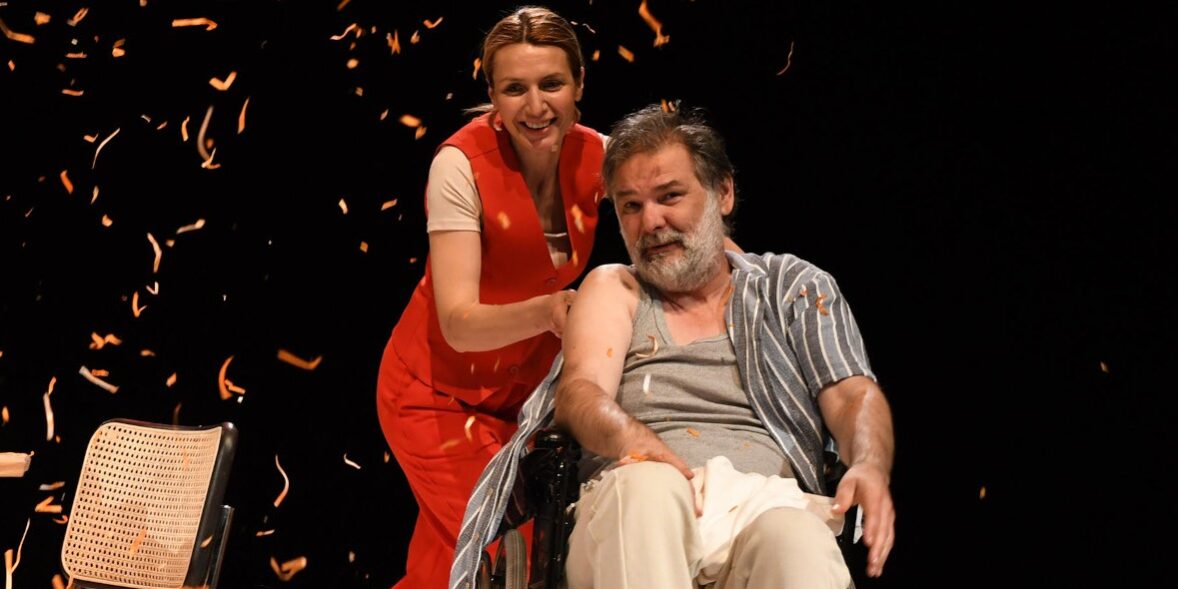
Bosnian National Theatre Zenica (BNP), premiere 23 May 2024, presented at Chamber Theatre 55, Sarajevo
In the half-darkness of the theatre, someone plays the theme from Kubrick’s The Shining on an electronic keyboard. The metallic tones hang in the air, quietly inscribing a sense of unease before the play begins. For a moment, one might expect a story of horror – an axe cutting through a wooden door and the frantic grin of Jack Torrance – yet what follows is a family drama of another kind: subtle, unsettling, and marked by an amalgam of cinematic and theatrical languages, evident in the rhythmic pacing, framing, and meticulous attention to both visual and dramaturgic composition.
Acid (orig. title: Kiselina) unfolds in a stereotypical Bosnian home around the autumn ritual of preparing winter preserves, turšija, a tradition that gathers three generations under one roof. At its centre is an ailing grandmother, cared for by her daughter and her son, who has never started a family of his own. Conflict arises when the grandson and his wife enter the household, confronting generational divides and clashing worldviews. The jars of pickles, stacked one by one, become a potent metaphor for tradition and the fragile attempt to preserve order amid emotional chaos. Through its exploration of responsibility, love, mortality, and personal choice, the play portrays a family clinging to the illusion of normalcy even as emotional distances steadily widen.
As both author and dramaturg, Asja Krsmanović ensures that the play’s structure reinforces its central theme with striking precision. Across five acts, the family ritual repeats itself, rhythmically and psychologically, creating a deliberate sense of monotony. Ultimately, each act ends with the reconciliation of the living—brought about by the death of a family member. This cycle of mourning and reconciliation reveals that it is not the grandmother’s illness that tenuously holds the family together; once she is gone, the ritual may dissolve, exposing the fragility of their bonds. In its circular structure, Acid poses a haunting question: do traditions save us, or trap us?
Nermin Hamzagić’s direction gives the production a distinctive style, cinematic in approach yet attentive to theatrical nuance. His vision merges dialogue-driven realism with painterly imagery in the intervals between acts, coloured in shades of green, blue, and lilac, creating a soft, almost imperceptible surrealism. It is the juxtaposition of these two opposing visual languages that produces the impression of a montage, as if the director were sitting in an editing studio, cutting the live performance to his desire. This interdisciplinary approach is no surprise given the creators’ backgrounds: both Krsmanović and Hamzagić have roots in film and theatre, and their shared experience in visual storytelling informs every gesture, frame, and pause in the production.
Apart from that, Hamzagić’s use of pictoriality never blocks out the emotional resonance of the text. By that, the focus remains firmly on the interpersonal dynamics of the family, capturing their struggles without reducing them to mere dysfunction and conflict. Instead, the performance portrays a desperate attempt to preserve what, perhaps, can still be saved: the family in the 21st century. To some an increasingly outdated concept of burden or constraint, to others a grounding fundament in the age of detachment.
The ensemble’s evident joy in collaboration generates a natural rhythm that serves the play’s realism, while even the intervals between acts—slow, subdued, almost surreal—allow reflective pauses before the next familial tragedy unfolds.
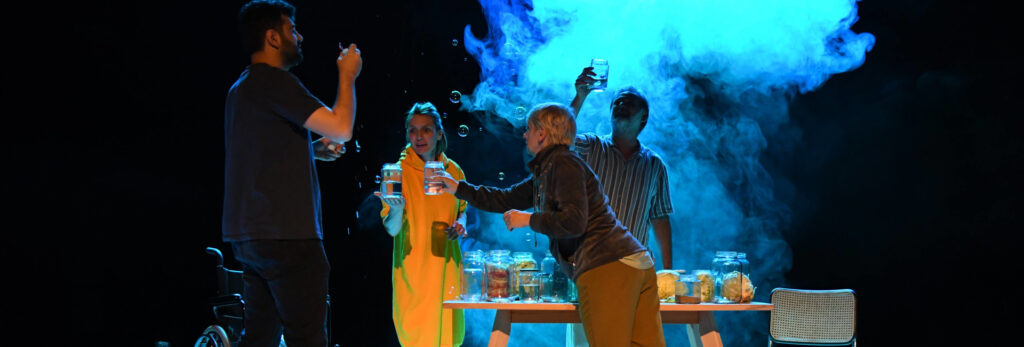
Acid, BNP Zenica
Gordana Boban navigates the fine line between the warmth of a loving mother and sister and the heavy responsibility of family care and the work as a medical sister. Mirvad Kurić, an institution in himself, wins over the audience immediately with his trademark humor and a kindness, drained in empathy and optimism. Selma Mehanović brings depth to the role of the unwanted daughter-in-law, avoiding clichés and creating astonishing tension and chemistry with Boban. Benjamin Bajramović, meanwhile, embodies restrained vulnerability, his emotions simmer beneath the surface until they suddenly erupt, punctuated by curses as a release for the weight on his heart, declaring, “It all gets easier when I swear.” At times, this restraint makes his acting appear subtly stiff, yet it remains true to the character.
The original play by Krsmanović has been met with outstanding success. Acid first premiered in April 2024, at Theater Oberhausen under the direction of Nik Eleftheriadis, performed in German from Elvira Veselinović’s translation. Just weeks later, the Bosnian premiere took place at the Bosnian National Theatre Zenica, directed by Hamzagić. So far, the Bosnian production has accrued nineteen awards, including Best Performance and the “Miodrag Žalica” prize for the best staged Bosnian dramatic text at the 23rd Festival of Bosnian Drama in Zenica, cementing the play’s critical and popular acclaim.
Hamzagić’s staging demonstrates why: Acid balances meticulous formal construction with intimate human observation, allowing moments of humor, grief, and reflection to coexist. Crowned by actorly mastery of the ensemble, the production contemplates profoundly universal themes without losing its local context, carried by the colloquial sociolect of the play’s unpretentious dialogue along with characters that appear relatable, and, eventually, draws the audience into the rhythms of a family bound by ritual, where small gestures – cutting vegetables, stacking jars of turšija – carry significant meaning, but also a blustering melancholy.
Credits
Director: Nermin Hamzagić//Author & dramaturg: Asja Krsmanović// Set design: Sabina Trnka//Costume design: Irma Saje//Music: Enes Zlatar Bure//Producers: Miroljub Mijatović and Nihad Kreševljaković//Executive producer: Denis Krdžalić//Assistant producer: Edi Lazamović//Stage manager: Abdin Čolaković
Performed by Gordana Boban, Mirvad Kurić, Selma Mehanović and Benjamin Bajramović
For more information, visit: bnp.ba

Berina Musa is a writer, dramaturg, and critic based in Sarajevo and Freiburg. She studied German linguistics, literary studies, and art history at the University of Freiburg and is currently completing a second degree in dramaturgy at the Academy of Performing Arts in Sarajevo. Her plays and short films have been presented at the Bosnian National Theatre Zenica, MESS, the Sarajevo Film Festival, and the Mostra Internazionale del Nuovo Cinema di Pesaro.