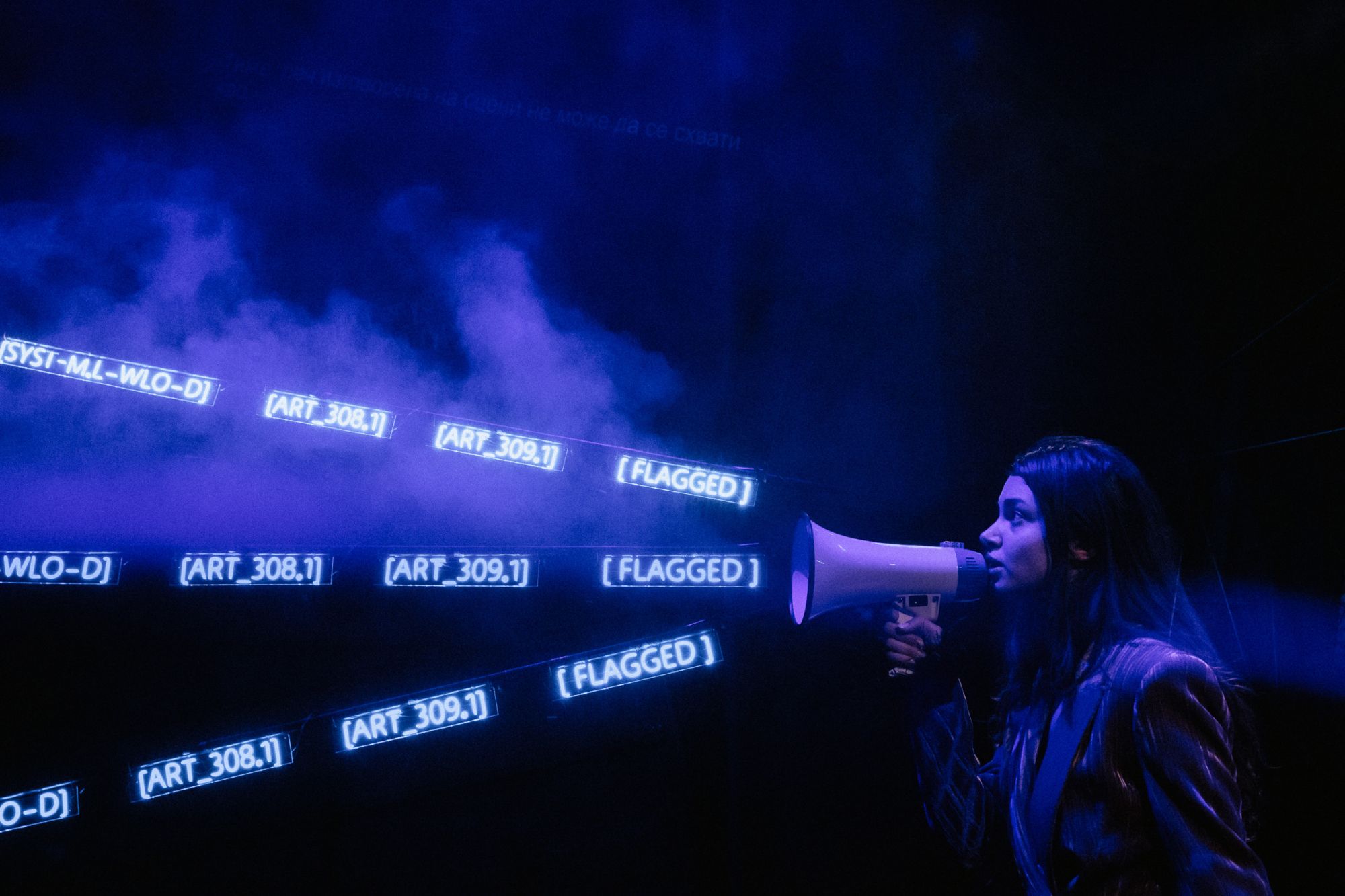

Bosnian playwright and dramaturg Armin Behrem’s play Podroom premiered at Sarajevo War Theatre (SARTR) in 2024. He talks to Berina Musa about artistic collaboration, queer visibility and his experiences of making work in Germany.
Moving between Zenica, Sarajevo, and Stuttgart, Armin Behrem belongs to a generation of theatre-makers whose artistic identity is shaped by constant negotiation between local contexts and international circulation. Trained in both music and dramaturgy, and active across institutional theatres and independent platforms, Behrem’s work reflects a practice grounded in listening – to space, structure, and collaboration. This interview traces his path from early experiences in Bosnia and Herzegovina to recent work in Germany, asking how these crossings inform not only his artistic method but also his understanding of contemporary theatre today.
Berina Musa: In what way did your upbringing in Zenica influence you as an author? Are there specific social, cultural, or theatrical experiences from that period that still resonate in your work today?
Armin Behrem: Zenica is an industrial city, it’s not a place that tries to be poetic – it’s concrete, factories, noise, routines. But it’s also full of people who are marginalized in different ways and still dream intensely. There’s very little romanticization, but a lot of desire. I think that shaped my sensitivity to people who live on the edges of systems, who imagine more than what’s available to them.
Berina Musa: You worked as a dramaturg at the Bosnian National Theatre (BNP) in Zenica. How did this institutional context influence your understanding of theatre-making, and what did working there teach you about collaboration, repertoire, and audience?
Armin Behrem: It was my first real professional dramaturgy, and in a way, that’s where I learned that compromise is often boring. Being close to institutional production showed me how easily things get softened. That experience actually pushed me in the opposite direction, toward clarity and risk. I realized early on that I’m more interested in sharp positions than in pleasing everyone. It was a good lesson to learn early.
Berina Musa: You initially studied music, then shifted to dramaturgy, only to later return and complete your first Master’s degree in music. For you personally, how are music and dramaturgy intertwined as artistic disciplines? Do you experience dramaturgical thinking as something musical in structure, rhythm, or form?
Armin Behrem: For me, dramaturgy is very musical. I think in rhythm, timing, repetition, breaks. Music trained my sense of structure in a very physical way. Not everything has to be explained, some things just need to be felt. I often approach texts like compositions rather than narratives.
Berina Musa: Could you describe your studies at the Academy of Performing Arts in Sarajevo (ASU)? What were the most important artistic or intellectual lessons the Academy has taught you – both formally and informally?
Armin Behrem: The Academy gave me friction — and that was important. Different aesthetics, strong opinions, constant debates. Formally, I learned tools; informally, I learned doubt. It pushed me to question authority, including my own ideas, and to stay curious instead of trying to be right.
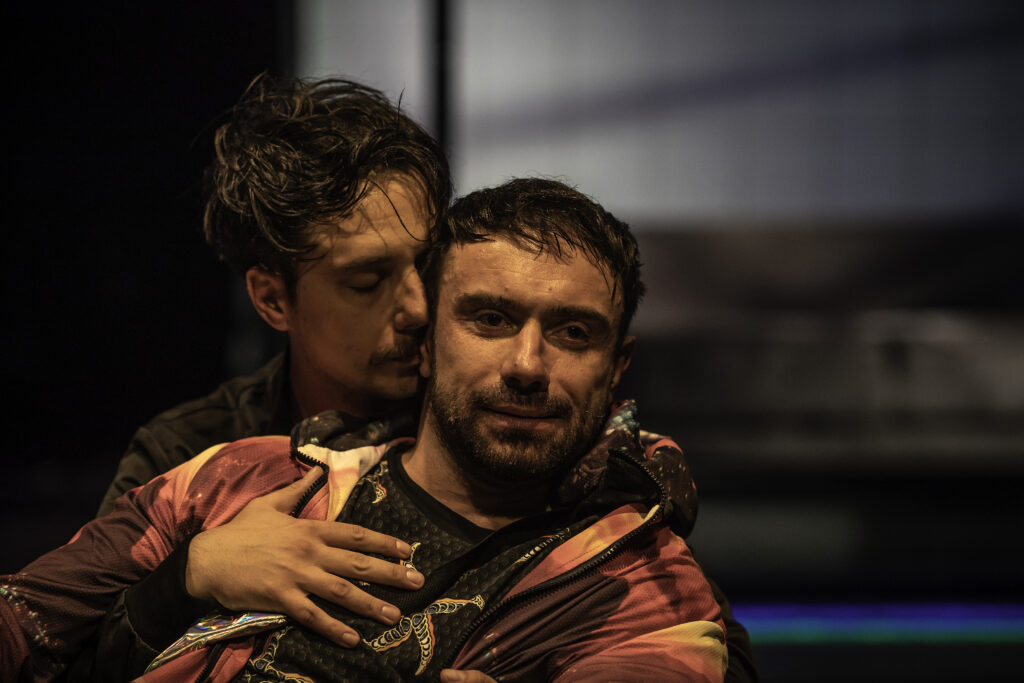
Podroom, SARTR
Berina Musa: In the 2024/25 season, your first play, Podroom, directed by Ajla Bešić, was staged at the Sarajevo War Theatre (SARTR). How would you describe the creative process there, and in what way did it impact your further work?
Armin Behrem: Podroom was a turning point. It was the first time my writing became fully public and embodied by others. Working with Ajla Bešić and the cast taught me trust — in collaboration, in risk, and in letting go of control. Since then, I’m less interested in “finished” texts and more in processes that stay open.
Berina Musa: Both Podroom and the stage adaptation of Alexander Hemon’s The World and All That It Holds, directed by Selma Spahić, feature homosexual relationships and were presented in the same 2024/25 season at SARTR. In your play, one of the characters asks, “Is this queer Bosnian theatre?” How was Podroom received locally, and how do you see it fitting into the broader landscape of theatrical and cultural production in Sarajevo?
Armin Behrem: Queer relationships on stage aren’t a trend or a provocation, they’re part of the archaeology of our society. They’ve always been here. Theatre just digs them out from layers of silence, shame, or habit. In that sense, Podroom isn’t “adding” something new to Bosnian theatre, it’s uncovering what was already present. When a character asks, “Is this queer Bosnian theatre?”, it’s really a question about who gets to narrate reality. Who gets to be visible. Theatre is where those permissions are renegotiated. I see Podroom (and The World and All That It Holds) as part of a wider movement of artists refusing inherited narratives, whether national, gendered, or historical. They fit by not fitting. By insisting on a different angle, a different body on stage. That’s the task of theatre: to compost the old structures and grow something else.
Bermina Musa: From your position between Sarajevo and the German-speaking theatre context, how do you perceive the recent development of the theatrical scene in Sarajevo, and what becomes more visible—or invisible—when viewed from outside?
Armin Behrem: I think what’s missing most is courage and new voices. There’s a tendency to play it safe, to repeat proven formats instead of really risking something unfamiliar. I strongly believe that mistakes are necessary, and even bad performances can be valuable if they come from a genuine attempt to do something new. Safe theatre is usually more forgettable than failed experiments.
Berina Musa: You continued your education at the Akademie für Darstellende Kunst Baden-Württemberg (ADK) in Ludwigsburg. How did this experience reshape your perspective on dramaturgy, especially in relation to German-speaking theatre traditions?
Armin Behrem: ADK is very experimental and strongly practice-based, and that had a big impact on me. It expanded my idea of what dramaturgy can be. I learned that not everything has to “make sense” in a traditional way in order to function. Sometimes things work on a physical, temporal, or intuitive level. That freedom and trust in practice changed how I think about structure and meaning.
Berina Musa: You recently co-wrote the play Die Luft nach oben together with the emerging director Alize Heiser. The production premiered at Theater Rampe in Stuttgart, a well-known alternative theatre space. How did this collaboration come about, and what artistic questions were central to the writing process?
Armin Behrem: Working with Alize was genuinely wonderful. We really found each other. We have a similar rhythm and way of thinking. We worked on the text for almost a year, constantly rewriting and shifting perspectives. I learned a lot about East and West Germany, their conflicts and similarities, and I couldn’t stop drawing parallels to the post–Yugoslav context. Writing about East and West from two very different personal perspectives made the process especially rich and layered. And I’m really happy it had its premiere at a theatre such as Rampe Stuttgart.
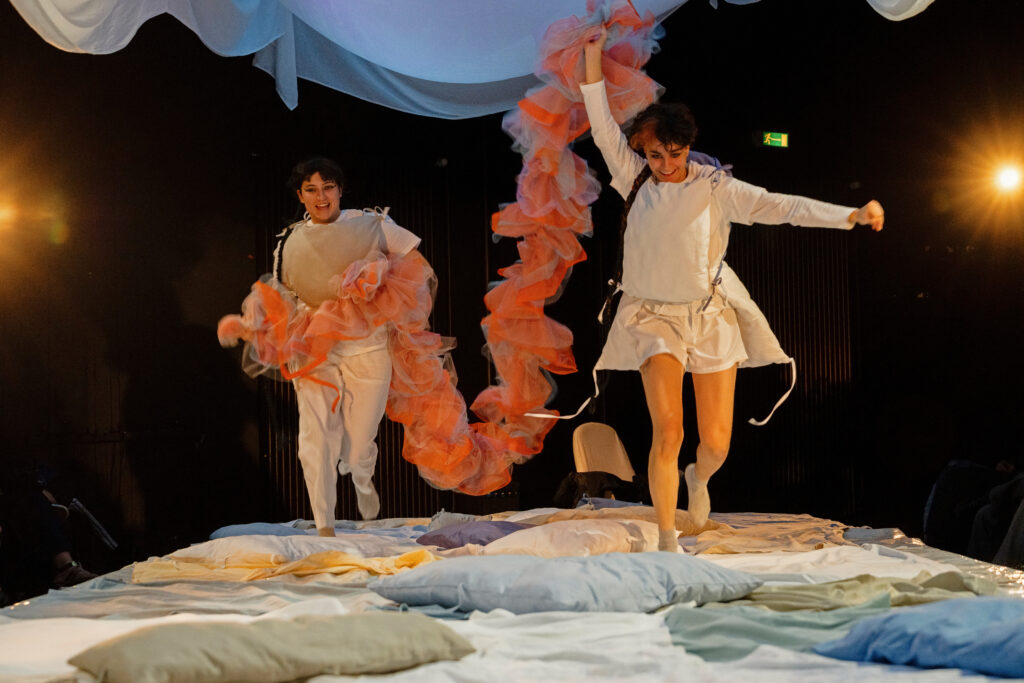
Die Luft nach oben
Berina Musa: Two years ago, you worked as a dramaturgy assistant to playwright and director Falk Richter. What was it like to be part of such a distinct theatrical universe, and what did you take away from that experience on both a professional and personal level?
Armin Behrem: Balance between political sharpness and emotional, poetic precision. Falk’s work never separates those layers, and being part of that process was very formative. It showed me that you don’t have to choose between being political and being vulnerable. The strength comes from holding both at the same time.
Berina Musa: What are your plans for the future – artistically, geographically, or institutionally? Are there themes or formats you feel compelled to explore next?
Armin Behrem: I’m preparing to move to Berlin, where I’ll be a guest student at UdK in the Scenisches Schreiben (Writing for Stage) program, the only dedicated playwriting program in Germany. I’m really excited about it.
Berina Musa: Is there anything you would like to share with future generations of theatre-makers, dramaturgs, or writers – especially those coming from smaller cultural contexts like Bosnia and Herzegovina?
Armin Behrem: Follow the impulses that matter to you, without worrying about what’s in demand.
For further information visit: Sartr.ba
Further reading: Review of Podroom at Sarajevo War Theatre

Berina Musa is a writer, dramaturg, and critic based in Sarajevo and Freiburg. She studied German linguistics, literary studies, and art history at the University of Freiburg and is currently completing a second degree in dramaturgy at the Academy of Performing Arts in Sarajevo. Her plays and short films have been presented at the Bosnian National Theatre Zenica, MESS, the Sarajevo Film Festival, and the Mostra Internazionale del Nuovo Cinema di Pesaro.