As the new year begins, SEEstage’s writers across the region discuss the shows that made a lasting impression on them in 2025.
Rather than an attempt to select the ‘best’ shows of the past 12 months, our writers have chosen their personal favourites and the shows that have had the strongest impact on them.
The World and All That It Holds (SARTR)
Chosen by Berina Musa
One of my favourite shows was, without a doubt, Selma Spahić’s stage interpretation of Aleksandar Hemon’s The World and All That It Holds at the Sarajevo War Theatre. Her conceptual directing was both clear and inviting, translating the novel’s vast emotional and historical scope into a theatrical language that felt accessible and deeply human, thanks in large part to the dramaturgical work of Nejra Babić Halvadžija and Spahić’s longtime collaborator Emina Omerović. The original music, composed by Damir Imamović, gently carried the story’s expressive weight, underscoring moments of love, memory, and longing without overpowering them. Supported by a finely tuned ensemble, the performance conveyed feelings of love, hope, loss, and resilience with striking elegance. By the end, this was not just a story well told, but an experience that left me genuinely moved and, above all, hopeful.
Read our review of The World and All That It Holds
The Blind
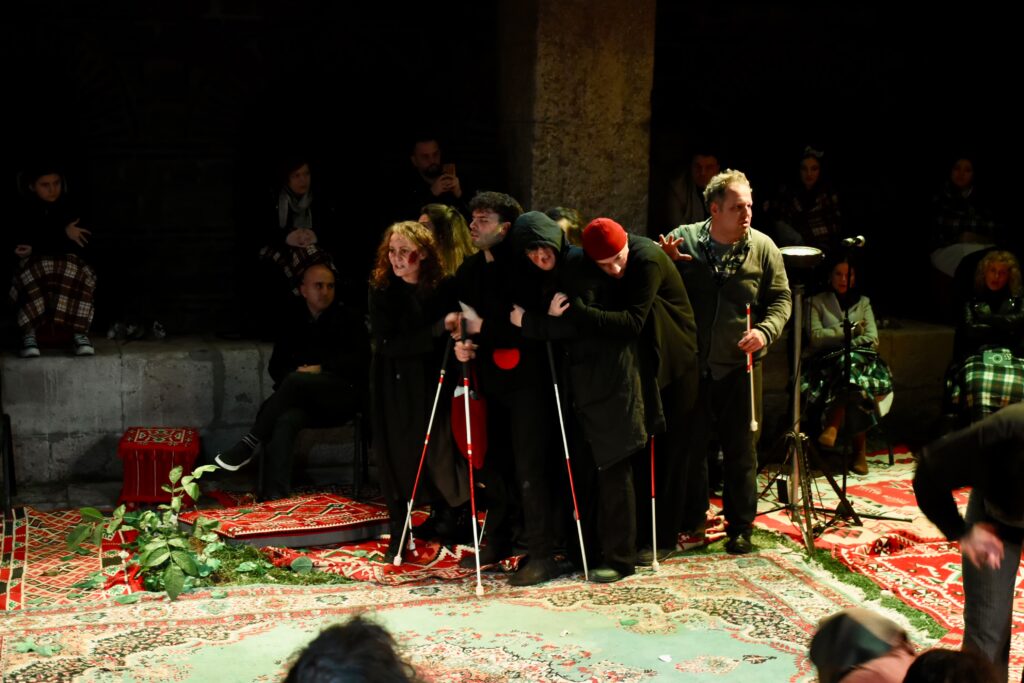
The Blind (National Turkish Theatre of North Macedonia)
Chosen by Katerina Markoska
The Blind left a deep and lasting impression on me through its courage to engage with sensitive yet urgent social questions and the emotional power it brings. The director approaches these themes with clarity and boldness, using theatre not only as a space for representation, but as a space for dialogue. At its core, the production presents authentic and diverse testimonies about the struggle with identity, both on a personal and societal level, explored through the prism of religious, ethnic, and linguistic differences that remain among the most pronounced today. What stayed with me most strongly was the production’s creativity and innovation, visible in the way texts are connected, the performance is structured, and the stage space is activated. The result is an intimate theatrical environment in which the audience is not a passive observer, but a presence within a shared experience. The play invites reflection on solidarity, care, and responsibility, reminding us that moving forward, in theatre as in life, requires attentiveness, trust, and the willingness to truly see one another.
Read our review of The Blind
Hamlet
Hamlet (Metropol Theater, Tirana)
Chosen by Belkisa Zhelegu
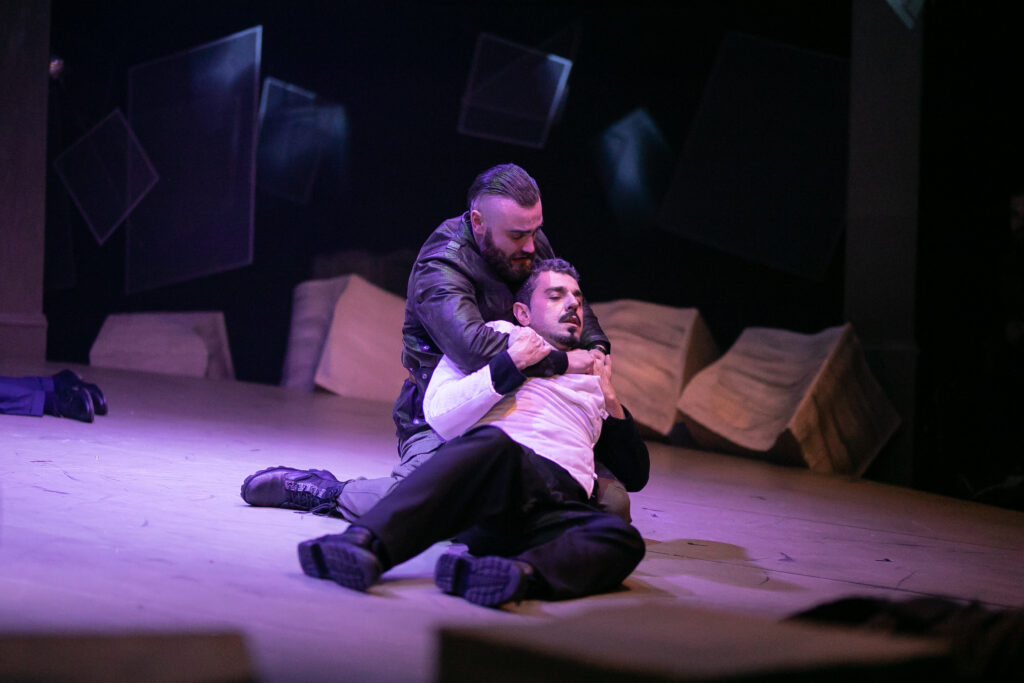
I still return to the image of the shattered glass globe hovering above the stage – a fragile world on the brink of collapse. Jonida Beqo’s Hamlet, staged at the Metropol, was the performance that stayed with me most in 2025. Through a modern retranslation and a bold visual language, the production transformed Shakespeare’s tragedy into a tense, sensorial experience suspended between nightmare and reality. Amos Zaharia’s Hamlet was restless and charismatic, painfully contemporary in his idealism and inner fracture. Choreography, lighting, and circus elements merged seamlessly with the drama, creating a stage universe where emotion, movement, and metaphor coexisted in striking harmony. This Hamlet did not merely reinterpret a classic; it invited the audience to inhabit a world where moral decay feels imminent and unavoidable. It was a performance that lingered long after the final scene – quietly unsettling and profoundly alive.
Read our review of Hamlet

Hotel Grand
Hotel Grand (Barabar Center, Prishtina)
Chosen by Bora Shpuza
Hotel Grand, created and performed by Rebeka Qena and Armend Smajli, was inspired by Dennis Kelly’s play After the End and staged at the Barabar Center in Prishtina, an alternative art space and intimate venue with only 25 seats, Qena and Smajli engulfed the small audience in the unlikely situationship of a young man and a young woman, who end up confined in the dungeons of Grand Hotel in Prishtina, as the war is about to start. He has saved her by bringing her there, and the two are indefinitely stuck between four walls covered in rust and old newspapers, with canned food, an old radio, and a bucket. With nothing but time on their hands, they reminisce about life and each-other: he was the shy boy who was secretly in love with her, and she was the popular girl who liked him as a friend. Their interactions eventually give birth to unavoidable clashes between his subconscious resentment and her involuntary amnesia. He keeps busy, fixing an old half-bike and reminding her of their early rides; she paces the narrow quarters with cautious step and measured gratitude – after all, she won’t give him hopeless hopes.
Sitting in such close proximity to the actors made the audience remember the year 1999, but mostly it made us all wonder at the (seemingly) lost art of genuine human connection, the good, the bad, and the uncomfortable. The disquietude of miscommunication that has brought on an epidemic of loneliness in the age of mega-connectivity is absurdly unprecedented. Is being stuck in a cave the only way for us to find our way back to each-other? Away from facades and protective screens, the play was pouring with raw emotion, reluctant nostalgia, restored affection, newfound awareness and implicit gratitude.

Boško and Admira
Boško and Admira (Mladinsko Theatre, Ljubljana)
Chosen by Karolina Bugajak
I have to admit that 2025 brought me quite a few theatrical delights. Many strong performances were created in Slovenia, like an ambitious project Dodekalogija. However, the show that stayed with me the longest, and provoked a wide range of reflections, was Boško and Admira. Živa Bizovicar’s performance is a production made with journalistic precision, creating stories that emerge from a single picture. The director focuses on the human dimension of war. What captivated me, was the variety of tools used to tell the facts. In a world where more and more performances are static, this kind of theatre stimulates the audience’s creativity. I don’t have the space to write about how nuanced the approach to the subject was. However, I will say that this performance is especially important in a world where wars are being fought not far from us, and we need a gentle and honest theatre that will take on the role of advocating for peace and humanity.
Read our review of Boško and Admira

The Pelicot Trial
The Pelicot Trial (ne:Bitef festival)
Chosen by Nora Čulić Matošić
Given the circumstances of the current state of affairs in Serbia and the department of culture suffering the ‘consequences’ of standing by the students’ protests and everyone else joined in the fight, I feel lucky I even had the chance to see Process Pelicot by director Milo Rau and dramaturge Servane Dècle via YouTube. In retrospect, seeing an almost five-hour-long performance from the comfort of a friend’s home proved to be a slightly better option, not because we could pause it at any moment, but so I could cry a river without holding back. This performance wrecked me emotionally, I felt like a witness of the court process. Many of the actors were very good, but Vesna Trivalić’s monologue as Gisele herself is by far the most powerful part, so much so it works as a stand-alone piece. The fact that this performance was realised shows how the logistics don’t matter that much when there is a strong will to oppose the censorship and oppression.
Read our review of The Pelicot Trial

All Good Barbies. Photos: Nata Korenskovaia.
All Good Barbies (Heartefact)
Chosen by Mina Milošević
Although 2025 ended with the triumph of Ne:BITEF’s production of The Pelicot Trial, one show that shouldn’t be forgotten is “All Good Barbies”, based on the novel of Katarina Mitrović, directed by Đorđe Nešović and with the dramatization by Isidora Milosavljević. This one’s close to my heart, maybe because, as a writer, I like a good story by contemporary playwrights and writers and I think we miss it a bit in Belgrade theatre these days, or maybe because creative ideas of Nešović’s directing showed us how to make a great show about a woman’s identity with a lot of roles and just three actresses, with interesting sound and music solutions by Marija Balubdžić. This show provided us both comedy and coming-of-age existential drama, a realistic story about the life and work destiny of a young female writer in Serbia. The story is relatable in its misery, but it leaves us with warmth, hope, and a sense of what truly matters. It’s a show you would like to come back to.
Read our review of All Good Barbies.

Natasha Tripney is a writer, editor and critic based in London and Belgrade. She is the international editor for The Stage, the newspaper of the UK theatre industry. In 2011, she co-founded Exeunt, an online theatre magazine, which she edited until 2016. She is a contributor to the Guardian, Evening Standard, the BBC, Tortoise and Kosovo 2.0